



 Research Article
Foreign Body Ingestion Due to Button Batteries in Pediatrics: A Case Series
1Pediatric Surgeon and Urologist, Norte Santandereana Society of Pediatric Surgery, https://orcid.org/0009-0009-7340-0404.
2Physician, Senior Lecturer, Department of Basic Health Sciences, University of Pamplona, Colombia https://orcid.org/0000-0002-0588-9895.
Received Date: January 28, 2026; Published Date: February 16, 2026
Abstract
Introduction: Button battery (BB) ingestion in pediatric patients constitutes a high- risk medical emergency due to the rapid onset of severe tissue damage, especially when they become lodged in the esophagus. Unlike other foreign bodies, BBs produce deep lesions in a brief time through combined mechanisms including electrolysis, caustic necrosis, direct pressure, and chemical toxicity, which can lead to potentially fatal complications.
Methodology: A descriptive case series was conducted, including five pediatric patients treated at a tertiary care institution in Cúcuta, Colombia. Plain chest and neck radiographs were analyzed, emphasizing the location, time since ingestion, and diameter of the battery, as well as the characteristic findings that allowed for its identification and clinical risk stratification.
Results: In all cases, the radiological sign of the “double halo” was identified, allowing differentiation of button batteries from other foreign bodies. Most of the batteries had a diameter ≥20 mm and were impacted in the upper esophagus. The time to onset ranged from 7 hours to 3 days, demonstrating that even in initial stages there is a significant risk of tissue necrosis. In cases of prolonged onset, a higher risk of serious complications such as esophageal perforation and tracheoesophageal or vascular fistulas was observed.
Conclusion: Button battery ingestion in children is a time-dependent emergency that requires immediate radiological diagnosis and early endoscopic removal. Early recognition of the double halo sign and battery size is essential to reduce morbidity and mortality. The importance of training healthcare personnel and implementing preventive strategies for caregivers is emphasized.
Keywords: Foreign Bodies; Injuries; Child; Emergency medical services; Radiography
Introduction
Introduction
Unlike other common foreign bodies (ECs), such as coins or food boluses, button batteries (PBs) represent a critical medical emergency due to their ability to cause serious damage extremely quickly (Casado, 2022) [1]. While most ECs pass through the gastrointestinal tract without incident, button batteries can lead to severe injury, permanent sequelae, or even death. Especially when they are impacted in the esophagus, (Jauregui, 2019) [2].
The scientific literature identifies four pathophysiological mechanisms that act in a combined and synergistic way after the impaction of a PB (Ormeño, 2022) [3]. The first of these is the generation of electric current and electrolysis; When it comes into contact with bodily fluids, the battery completes a circuit that generates a waste electrical current. This current causes the hydrolysis of tissue fluids, resulting in the accumulation of hydroxide ions at the negative pole of the battery. This phenomenon is mainly responsible for the early onset of damage.
On the other hand, we find caustic injury; The production of sodium and potassium hydroxide generates an extremely alkaline environment, raising the local pH to levels of 12 or 12 or 13. This extreme alkalinity induces liquefaction necrosis, a process that dissolves proteins and lipids from adjacent tissues, allowing the lesion to penetrate deep into mucosal layers and structures surrounding areas (Mencías, 2003) [4].
The third mechanism is direct pressure necrosis which, similar to other bulky ECs, PB exerts constant physical pressure on the esophageal or gastric mucosa. This mechanical compression causes local ischemia and decubitus necrosis, which compromises the integrity of the mucosal barrier and facilitates the penetration of the aforementioned chemical damage (Figueredo, 2021) [5].
And finally chemical filtration toxicity, where there is an inherent risk of heavy metal toxicity, particularly mercury, if the battery seal breaks or corrodes within the gastrointestinal tract. Although less common with modern lithium batteries, the release of electrolyte content it can exacerbate chemical burn, (Rasile, 2021) [6].
These mechanisms come into play when a battery is lodged in the intestine, ear, nose, or other orifice, rather than free-floating and in transit, (Zanetta, 2012 [7], Litovitz, 1992 [8], National Capital Poison Center, 2024) [9].
Methodology
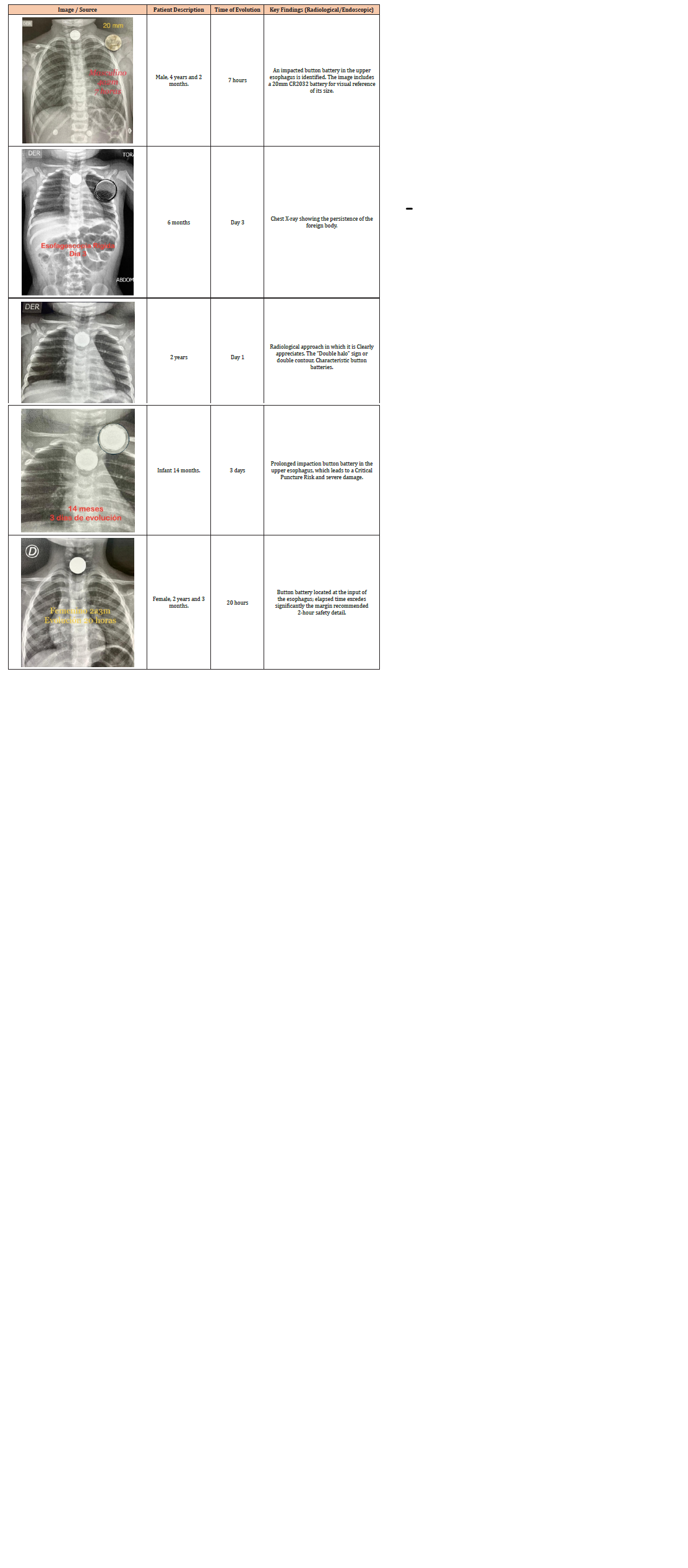
In this case series, five patients from the pediatric service of a tertiary institution in the city of Cúcuta, Colombia, are presented radiologically, with special emphasis on the recognition of PB volume. Here’s the updated table, omitting the references column and keeping the detailed analysis of the findings based on the sources and images provided:
Results
A series of critical findings are presented that coincide with the scientific literature on the medical emergency represented by the ingestion of button batteries (PB), in all images the sign of the “double halo” or “double contour” is clearly identified.
This finding is essential to differentiate a PB from a coin, since the bilaminar structure of the battery generates an additional radiopaque inner ring (Alfonso, 2021). Image number one includes a 20mm CR2032 battery for scale, highlighting the object’s dangerousness, given that batteries with a diameter ≥ 20mm are significantly more likely to be impacted in the esophagus of young children.
Most images show an impaction in the upper esophagus (proximal third). the esophagus is the site of greatest morbidity due to its physiological narrowness (Trujillo, 2008) [10]. The location in the cervical area and upper chest, observed in patients aged 14 months and up to 4 years, poses an extreme risk of compressing the trachea or eroding vascular structures such as the aortic arch.
One of the most alarming findings in this series of cases is the time elapsed since ingestion: In cases of Short Evolution (7 hours): As can be seen in the image, even after a few hours, the damage has already begun, since tissue necrosis begins only 15 minutes after contact (Galviria, 2018) [11].
Cases of Intermediate Evolution (20 hours), After 12 hours, international guidelines recommend performing a Computed tomography (CT) scan to rule out hidden vascular damage or loss of integrity of the aorta; and finally in cases of Prolonged Evolution (3 days): patients with 3 days of impact are documented. In these scenarios, the risk of serious complications such as tracheoesophageal or aortoesophageal fistulas is critical (Pérez, 2020) [12].
Although radiographs do not directly show the mucosa, the persistence of the pile on imaging suggests the presence of liquefaction necrosis. This process is driven by the hydrolysis of tissue fluids that raises the local pH to caustic levels (12-13), (Martínez, 2013) [13].
Conclusion
The ingestion of button batteries in the pediatric population is a time-dependent medical emergency with a high potential for morbidity and mortality, much higher than that of other gastrointestinal foreign bodies. The present case series confirms that tissue damage can begin in the first few minutes after impaction, even when the evolution time is short, and increases exponentially as the battery remains in the esophagus.
Radiological findings, especially early identification of the double halo sign and recognition of the diameter ≥ 20 mm, are
critical in differentiating button batteries from other foreign bodies and in stratifying clinical risk. The predominant location in the upper esophagus observed in this series is associated with a critical risk of serious complications, including deep necrosis, perforation, fistulas tracheoesophageal and potentially fatal vascular lesions, even in the absence of striking initial symptoms.
Likewise, cases with intermediate and prolonged evolution show the need to maintain a high index of suspicion of hidden lesions, which justifies the use of advanced studies such as computed tomography and close multidisciplinary follow-up. These results reinforce that watchful waiting is not safe and that immediate endoscopic removal should be considered a priority in the event of suspected or radiological confirmation of a button cell in the esophagus.
Finally, this series of cases underscores the importance of training health personnel in early radiological examination, as well as prevention and caregiver education strategies, aimed at reducing children’s exposure to these devices. The combination of timely diagnosis, early intervention and preventive measures are the most effective strategy to reduce the long-term sequelae and mortality associated with this serious clinical entity.
Acknowledgement
None.
Conflict of Interest
No Conflict of Interest.
References
- Casado Lachapel C L, Rojas Sánchez D J (2022) Clinical and epidemiological characteristics of patients with foreign bodies in the upper digestive tract treated in the Endoscopy Unit of the Dr. Hugo Mendoza Pediatric Hospital. December, 2021-May, 2022 (Doctoral dissertation, Universidad Nacional Pedro Henrique Ureña).
- Jauregui Mendoza Y J (2019) Accidental swallowing and/or aspiration of alkaline batteries in the pediatric patient.
- Ormeño Julca A, Linares Falla J P, Mas Golac C, Carranza Castillo T (2022) Esophageal impaction of button batteries in children. Experience in a hospital in northern Peru. Revista Experiencia en Medicina del Hospital Regional Lambayeque 8(1).
- Mencias E (2003) Caustic poisoning. In Annals of the Health System of Navarra (Vol. 26, pp. 191-207). Government of Navarre. Department of Health.
- Figueredo E J, Rosero G, Obando B D A (2021) Esophageal perforation and rupture. Fundamentals of General Surgery Esophagus, 360.
- Rasile M A (2021) Chapter 6 Toxicity of metals. General and Applied Toxicology, 249.
- Zanetta A, Cuestas G, Rodríguez H, Quiroga V (2012) Septal perforation in children due to button cell lodged in the nose: Case series. Arch Argent Pediatr 110(5): 430-434.
- Litovitz T, Schmitz B F (1992) Ingestion of cylindrical and button batteries: an analysis of 2382 cases. Pediatrics 89(4): 747-757.
- National Capital Poison Center, battery-induced injury mechanism, 2024.
- Trujillo M L T, Villmizar J E (2008) Foreign bodies in the aerodigestive tract in children. Seven years of experience, University Hospital Erasmo Meoz. MedUNAB, 11(3): 195-200.
- Galviria V M, Ramírez I M, Ávila F F, Halaby J V (2018) Experience in the management of battery ingestion in a pediatric hospital. Cir Pediatr 31: 121-124.
- Pérez Martínez A, Molina Caballero A, Goñi Orayen C (2020) Button batteries impacted in the esophagus: a potentially fatal surgical emergency in infancy. An Sist Sanit Navar 43(2): 255-260.
- Martínez Criado Y, Millán López A, Valladares J, de Agustín J (2013) Esophageal impaction of button batteries in childhood. How to avoid tragedy! Cir Pediatr 26: 142-145.
-

This work is licensed under a Creative Commons Attribution-NonCommercial 4.0 International License.




