


 Case Report
Drug-Induced Sleep Endoscopy Revealing Occult Laryngomalacia in Persistent Paediatric Obstructive Sleep Apnea
Department of Otolaryngology, Fundación Santa Fé de Bogotá, Bogotá D.C., Colombia
Received Date: June 08, 2026; Published Date: June 16, 2026
Abstract
Introduction: Occult laryngomalacia is an uncommon cause of persistent pediatric obstructive sleep apnea after adenotonsillectomy and may not be evident during awake airway examination.
Case report: A 4-year-old boy presented with persistent obstructive sleep apnea after adenotonsillectomy. Awake nasolaryngoscopy demonstrated no significant laryngeal abnormalities. Follow-up polysomnography confirmed persistent severe obstructive sleep apnea. Druginduced sleep endoscopy revealed severe supraglottic collapse secondary to occult laryngomalacia with arytenoid prolapse and epiglottic collapse. The patient underwent multilevel airway surgery including supraglottoplasty, partial arytenoidectomy, epiglottectomy, and epiglottopexy, resulting in marked clinical and polysomnographic improvement.
Conclusions: Occult laryngomalacia should be considered in children with persistent obstructive sleep apnea after adenotonsillectomy. Druginduced sleep endoscopy may identify dynamic airway collapse not evident during awake examination and guide targeted surgical management.
Keywords: Drug-induced sleep endoscopy; Epiglottis; Laryngeal diseases; Laryngomalacia; Obstructive sleep apnea; Polysomnography
Abbreviations: AHI- Apnea–Hypopnea Index; CSA- Central Sleep Apnea; DISE- Drug-Induced Sleep Endoscopy; OSA- Obstructive Sleep Apnea; PSG- Polysomnography; REM- Rapid Eye Movement; SaO₂- Oxygen Saturation
Introduction
Obstructive sleep apnea (OSA) is the most prevalent chronic sleep-related breathing disorder and is characterized by repeated episodes of complete (apnea) or partial (hypopnea) upper airway collapse during sleep [1]. Approximately 2-4% of the pediatric population develops OSA during childhood, most commonly secondary to adenotonsillar hypertrophy. Although adenotonsillectomy remains the first-line surgical treatment, a proportion of pediatric patients continue to experience persistent OSA following surgery, suggesting additional sites of upper airway obstruction. In these patients, laryngeal abnormalities should be considered as a potential cause of residual OSA [2].
Occult or late-onset laryngomalacia may occur in children older than 2 years without a prior history of the disease and may contribute to persistent pediatric OSA. These patients often present without inspiratory stridor or evident abnormalities during awake nasolaryngoscopy, and airway collapse may only become apparent during sleep or physical activity [2, 3]. Drug-induced sleep endoscopy (DISE) has emerged as an important diagnostic tool for identifying dynamic upper airway collapse under sleep-like conditions and may significantly alter subsequent management collapse under sleep-like conditions and may significantly alter subsequent management.
We report a child with persistent OSA after adenotonsillectomy in whom awake nasolaryngoscopy was unremarkable, while DISE revealed occult laryngomalacia with epiglottic collapse, leading to successful multilevel airway surgery.
Case Presentation
A 4-year-old male patient with a long-standing history of snoring, hyperactivity and four to seven awakenings per night. His mother also reported nasal congestion and mouth breathing. There was no history of inspiratory stridor, feeding difficulties, or dyspnea. His medical history was significant for prematurity at 32 weeks of gestation, neonatal intensive care unit admission, prolonged orotracheal intubation, and asthma.
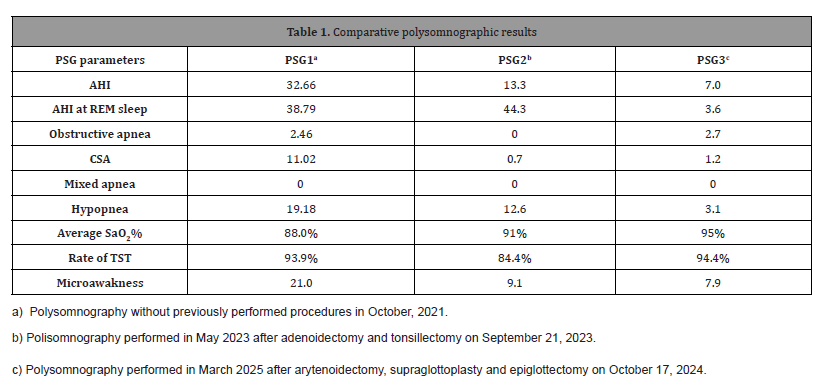
Awake nasolaryngoscopy demonstrated grade III palatine tonsil hypertrophy and adenoid hypertrophy without significant laryngeal abnormalities. Baseline polysomnography revealed severe obstructive sleep apnea, with an apnea–hypopnea index (AHI) of 32.66 events/hour and mean oxygen saturation of 81%. Adenotonsillectomy was performed with only partial symptomatic improvement.
Follow-up polysomnography one year later demonstrated persistent severe OSA, with an AHI of 13.3 events/hour, worsening during rapid eye movement sleep, and persistent snoring. Because of persistent symptoms, drug-induced sleep endoscopy (DISE) was performed and demonstrated severe supraglottic collapse secondary to occult laryngomalacia with significant arytenoid prolapse (Figure 1a) and trapdoor-type epiglottic collapse (Figure 1b).
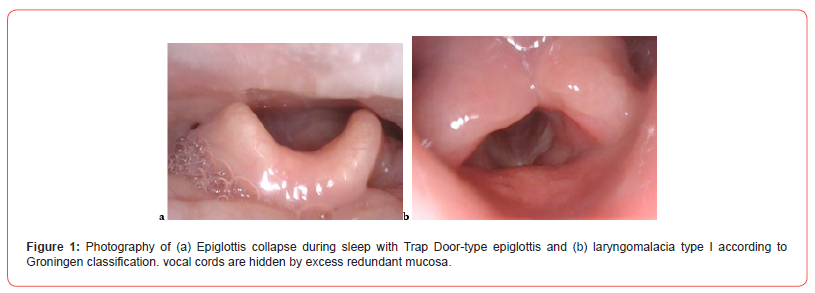
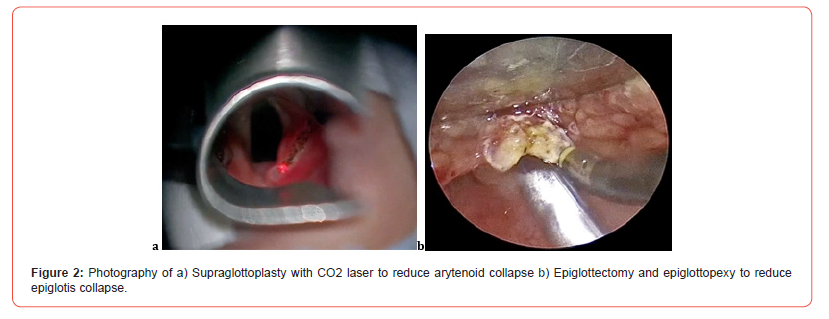
The patient subsequently underwent multilevel airway surgery. Intraoperative laryngeal microendoscopy confirmed posterior– anterior arytenoid collapse and anterior–posterior epiglottic collapse. Endoscopic partial arytenoidectomy was performed using a carbon dioxide laser for reduction of redundant arytenoid mucosa extending to the aryepiglottic folds, resulting in widening of the posterior glottic airway. Supraglottoplasty was subsequently performed with carbon dioxide laser vaporization along the posterior arytenoid mucosa (Figure 2a). Epiglottectomy and epiglottopexy were then performed using coblation, with resection of approximately 30% of the superior epiglottic edge and coblation of the vallecular mucosa to promote epiglottic stabilization (Figure 2b). The procedure was completed without complications.
Postoperative follow-up demonstrated marked clinical improvement, with reduced snoring, fewer nocturnal awakenings, and improved sleep quality. Repeat polysomnography performed four months after surgery showed substantial improvement, with reduction of the AHI from 32.66 to 7.0 events/hour and oxygen saturation improvement from 81% to 95%. (Table 1). Additional postoperative management included inhaled budesonide/ formoterol and a mandibular advancement device.
Table 1:
Discussion
Persistent obstructive sleep apnea after adenotonsillectomy remains a significant clinical challenge in pediatric patients. Although adenotonsillar hypertrophy is the most common cause of airway obstruction in children, residual OSA may occur because of additional sites of dynamic upper airway collapse [4, 5].
Occult or late-onset laryngomalacia is increasingly recognized as a cause of persistent pediatric OSA. Unlike congenital laryngomalacia, these patients frequently lack inspiratory stridor or evident abnormalities during awake examination, which may delay diagnosis [2, 3]. In the present case, awake nasolaryngoscopy failed to demonstrate significant supraglottic abnormalities, whereas drug-induced sleep endoscopy (DISE) clearly identified severe supraglottic collapse with arytenoid prolapse and trapdoor-type epiglottic collapse, significantly altering subsequent management. This discrepancy highlights the dynamic nature of upper airway obstruction during sleep and the limitations of awake airway examination in selected patients.
DISE has become an important diagnostic modality in children with persistent OSA because it allows direct visualization of upper airway obstruction under sleep-like conditions. A focused PubMed search using the terms “occult laryngomalacia”, “pediatric obstructive sleep apnea”, and “drug-induced sleep endoscopy” identified few reports describing occult supraglottic collapse diagnosed predominantly during sleep endoscopy. Early identification of these abnormalities is important because targeted surgical intervention may substantially improve both symptoms and polysomnographic outcomes.
Epiglottic collapse may contribute significantly to persistent airway obstruction and may be easily overlooked during awake examination. In this patient, multilevel airway surgery including supraglottoplasty, partial arytenoidectomy, epiglottectomy, and epiglottopexy resulted in marked clinical improvement and substantial reduction in the apnea–hypopnea index. These findings support the importance of individualized surgical management in selected patients with persistent pediatric OSA secondary to occult laryngeal obstruction.
Occult laryngomalacia and epiglottic collapse should be considered in children with persistent obstructive sleep apnea after adenotonsillectomy, particularly when awake airway examination is unremarkable. Drug-induced sleep endoscopy may identify dynamic supraglottic collapse not evident during awake evaluation and guide individualized surgical management.
Acknowledgements
The authors thank the Department of Otolaryngology at Fundación Santa Fe de Bogotá for institutional support.
Conflict of interest
The authors declare no conflicts of interest.
Financial support
This research received no specific grant from any funding agency, commercial, or not-for-profit sectors. The authors report no conflicts of interest.
Ethical standards
The authors assert that all procedures contributing to this workcomply with the ethical standards of Fundación Santa Fe de Bogotá and with the Helsinki Declaration of 1975, as revised in 2008. Written informed consent for publication was obtained from the patient’s legal guardian.
References
- Francia C, Lugo R, Moffa A (2023) Defining epiglottic collapse patterns in obstructive sleep apnea patients: Francia-Lugo classification. Healthcare 11(21): 2874.
- Cerritelli L, Migliorelli A, Larini A (2024) Laryngomalacia and obstructive sleep apnea in children: from diagnosis to treatment. Children (Basel) 11(3): 284.
- Lee CF, Hsu WC, Lee CH (2016) Treatment outcomes of supraglottoplasty for pediatric obstructive sleep apnea: a meta-analysis. Int J Pediatr Otorhinolaryngol 87: 18-27.
- Bitners AC, Arens R (2020) Evaluation and management of children with obstructive sleep apnea syndrome. Lung 198(2): 257-270.
- Koh TK, Kim J (2024 of pediatric obstructive sleep apnea) Treatment. Kosin Med J 39(2): 89-93.
-

This work is licensed under a Creative Commons Attribution-NonCommercial 4.0 International License.