


 Case Report
An Uncommon Case Report of Upper Lip Pleomorphic Adenoma
ENT department, 20 Aout Hospital, Casablanca, Morocco
Received Date: November 20, 2025; Published Date:December 09, 2025
Abstract
Although pleomorphic adenoma is commonly seen in the large salivary glands, only 8% of cases impact the small salivary glands [1]. Since intraoral pleomorphic adenomas in the upper lip are surgically removed before creating any cosmetic abnormalities, patients with these lesions seldom visit otolaryngologists [2-4]. We report an uncommon instance of large pleomorphic adenoma in the area of the upper lip.
Keywords: Pleomorphic adenoma, Upper lip, Treatment
Introduction
The most frequent salivary gland neoplasm is pleomorphic adenoma (PA), also known as benign mixed tumor. It accounts for 60%-65% of all major and small salivary gland malignancies [5]. Minor salivary glands can be found in the palate, upper and lower lips, gingiva, mouth floor, cheek, tongue, tonsillar regions, nasal cavity, paranasal sinuses, ears, jaw, pharynx, larynx, trachea, and bronchi, where they can cause inflammatory diseases as well as benign and malignant tumors [6]. Minor salivary gland tumors are most commonly found on the hard and soft palates, while they are less prevalent on the upper lip. Eighty percent of small salivary gland tumors on the lip are benign [7]. It primarily affects women in their fourth to sixth decades of life. The patients often appear with a painless, slow-growing tumor [8].
Histologically, it is distinguished by a wide range of tissues composed of epithelial cells arranged in a cord-like cell pattern, as well as areas of squamous differentiation or plasmacytoid appearance myoepithelial cells, which are responsible for the production of an abundant extracellular matrix rich in chondroid, collagenous, mucoid, and osseous stroma [9].
Case Report
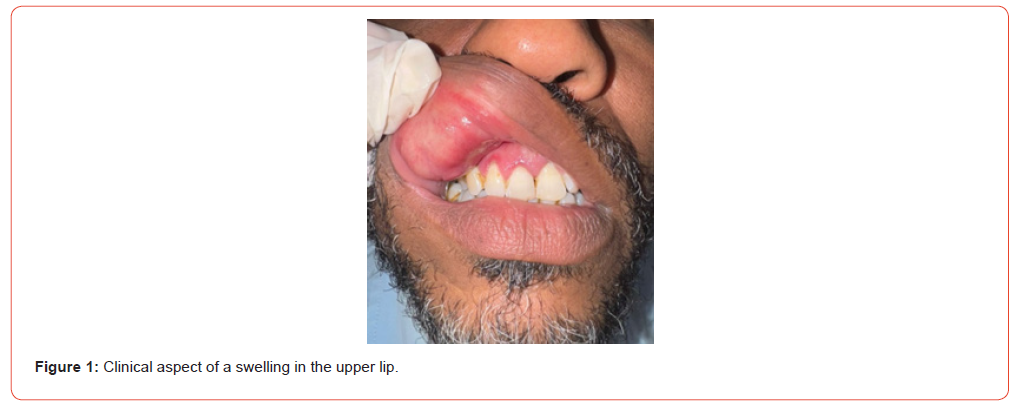
A 47-year-old man; without any medical history and no prior history of trauma; had been experiencing painless, gradually increasing swelling across his upper lip for the last four years. The patient’s overall health was maintained. Upon examination, the mass was 3.2 x 1.4 cm in diameter and was confined, sessile, and firm in consistency (Figure 1). The mucosa on top was smooth. The tumor’s surrounding skin was not fixed. Palpation revealed no blood or discomfort. Her systemic and general physical exams were normal, and there was no evidence of regional lymphadenopathy.
A lip-splitting incision was used to remove the tumor entirely (Figure 2). The lesion was easily removed during the surgical operation with a clinically normal margin because the tumor was completely encapsulated and had no muscular or subcutaneous attachments (Figure 3). Sutures were applied with good accuracy and aesthetic outcomes. (Figure 4) There were no recurrence during a later follow-up.
Grossly, a yellowish-white tissue piece of firm consistency was received, measuring weighing 6 grams and measuring 3.2x2.3x1.2cm Examination after fixation and paraffin embedding reveals an encapsulated tumor proliferation consisting of doublelayered glandular ducts whose cells show no atypia. These epithelial cells have hypercellular areas sometimes grouped together in tubes. They are immersed in an abundant chondromyxoid stroma containing spindle-shaped myoepithelial cells that also show no atypia. There was no evidence of mitosis and necrosis. A diagnosis of pleomorphic adenoma was made with these findings.




Discussion
Salivary gland tumors account for around 3% of all head and neck neoplasms. Approximately 80% are found in the parotid gland, 10% in the submandibular gland, with the remaining dispersed among the sublingual gland and the other minor salivary glands [10].
The most prevalent tumor originating from the salivary glands is pleomorphic adenoma, often known as benign mixed tumor. They make up 54% of minor gland tumors and 61% of big gland tumors, or 60% of benign tumors from all salivary gland locations [11].
The upper lip’s pleomorphic adenoma is six times more common than the lower lip’s. Benign tumors are more likely to develop on the upper lip, while malignant lesions are more common on the lower lip. The upper and lower lips’ different embryonic development has been proposed as the cause of this discrepancy [12]. 75% of upper lip tumors were found to be benign by Eveson and Cawson [13].
More women than men are impacted. The fourth and sixth decades of life are when these tumors are most frequently discovered. A slow-growing, painless, firm mass that is nontender and tends to be movable while small but attached to the surrounding tissue with advanced growth is the typical appearance [14]. If the tumor is properly removed, the prognosis is favorable.
It is still unknown what the primary etiopathogenesis of PA is. According to cytogenetic and molecular research, it has chromosomal abnormalities at 8q12 and 12q15 and is of epithelial origin [9, 15].
Conclusion
In conclusion, PA in the upper lip’s small salivary gland is quite uncommon. Despite, the differential diagnosis of any slowly developing mass in the lip area should include pleomorphic adenoma, notwithstanding its rarity. The majority of the time, this lesion is asymptomatic, the patient may not be aware of it. A comprehensive histological analysis of the tumor establishes the right diagnosis. The preferred course of therapy is local surgical excision with surrounding soft tissue, and a thorough examination of the histology material is necessary to confirm full excision and ensure that no signs of malignant transformation are present.
Acknowledgement
None.
Conflict of Interest
No conflicts of interest.
References
- Tahlan A, Nanda A, Nagarkar N, Bansal S (2004) Pleomorphic adenoma of the nasal septum: A case report. Am J Otolaryngol. 25: 118-120
- Ito FA, Ito K, Vargas PA, de Almeida OP, Lopes MA (2005) Salivary gland tumors in a Brazilian population: A retrospective study of 496 cases. Int J Oral Maxillofac Surg 34: 533-536
- Toida M, Shimokawa K, Makita H, Kato K, Kobayashi A, et al. (2005) Intraoral minor salivary gland tumors: A clinicopathological study of 82 cases. Int J Oral Maxillofac Surg34: 528-532.
- Jaber MA (2006) Intraoral minor salivary gland tumors: A review of 75 cases in a Libyan population. Int J Oral Maxillofac Surg 35: 150-154.
- Forty MJ, Wake MJ (2000) Pleomorphic salivary adenoma in an adolescent. Br Dent J 188: 545-546.
- Major and minor salivary glands. In: Rosai J editors. Ackerman's Surgical Pathology 2:9th ed. St Louis: Mosby, Elsevier; 2004. p. 873-916.
- Pires FR, Pringle GA, de Almeida OP, Chen SY (2007) Intra-oral minor salivary gland tumors: A clinicopathological study of 546 cases. Oral Oncol 43: 463-470.
- Kucuk U, Tan S (2011) Pleomorphic adenoma of the upper lip. Turk Patoloji Derg 27: 73-76.
- Lotufo MA, Junior CA, deMattos JP, Franca CM (2008) Pleomorphic adenoma of the upper lip in a child. J Oral Sci 50: 225-228.
- Shaheen OHKerr AG. Benign salivary gland tumors Scott Brown's Otolaryngology. 1997 6th ed London Butterworth Heinemann 5/20/6.
- Ellis GL, Auclair PL (1996) Benign epithelial neoplasms Atlas of Tumor pathology: Tumors of the Salivary Glands. Washington, D.C Armed Forces Institute of Pathology: 39-54.
- Shrestha A, Reddy NS, Ganguly SN (2010) Pleomorphic adenoma of the upper lip: A case report. Nepal Med Coll J l 6: 51-53.
- Eveson JW, Cawson RA (1985) Tumors of the minor (oropharyngeal) salivary glands: A demographic study of 336 cases. J Oral Pathol 14: 500-509.
- Eisele DW, Johns ME (2001) Salivary gland neoplasm. In: Bailey BJ editors. Head & Neck Surgery-Otolaryngology Philadelphia: Lippincott Williams & Wilkins 1279.
- Debnath SC, Adhyapok AK (2010) Pleomorphic adenoma (benign mixed tumour) of the minor salivary glands of the upper lip. J Maxillofac Oral Surg 9: 205-208.
-

This work is licensed under a Creative Commons Attribution-NonCommercial 4.0 International License.