




 Review Article
Prevalence of Fibropapillomatosis in Sea Turtles of New Caledonia
Received Date: August 07, 2025; Published Date: October 08, 2025
Abstract
This study investigated the presence of tumors in sea turtles of New Caledonia, which were confirmed to be fibropapilloma (FP) lesions by necropsies. The data presented here was gathered from several projects, from 2011 to 2025, using different collecting methods such as stranding reports (44%), photo-identification (40%), poaching (8%), Capture-Mark-Recapture study (4%) and traditional hunting (4%). Among the three species of sea turtles regularly seen in New Caledonian waters, Chelonia mydas represented 100% of the turtles affected by the disease. The great majority of the reports were recorded in South province (72%), the most populated area of New Caledonia. Nearly half of the affected individuals were stranded juveniles. Photo-identification allowed the detection of the disease on almost half of the affected individuals and also the monitoring of the evolution of the tumors which were seen growing in most of the cases. This method confirmed regression of FP for one turtle. FP cases appear to be slowly increasing in New Caledonia, so continued monitoring to see if this trend persists is advisable.
Keywords: Green turtles; Fibropapilloma; Photo-identification; South Pacific; Stranding
Introduction
Fibropapilloma is a tumor disease that affects all seven species of sea turtles, with a higher prevalence in green turtles (Chelonia mydas) (Whilde et al. [1]). It was first reported in green turtles from the state of Florida, southern United States in 1938 (Smith and Coates [2]). Fibropapilloma tumors are found on the skin and occasionally on the upper and lower shell of sea turtles. External tumors are histologically benign but can be fatal depending on their size and distribution (Page-Karjian [3]). When tumors are small, there is a minimum threat of life to the affected turtle. However, bigger tumors can disrupt locomotion, foraging ability, vision, and predator evasion (Herbst [4]). In the case of internal tumors, they affect vital functions and lower chances of survival of sea turtles (Whilde et al. [1]).
A herpes virus, chelonian herpes virus (ChHV5), is closely associated with the presence of tumors (Jones et al. [5]). Even though the virus has coexisted with turtles for millions of years (Whittock et al. [6]), the frequent reporting of the disease in turtles that reside in poor-quality eutrophicated waters suggests that the disease could have an environmental component (Herbst and Klein [7]). Possible routes of transmission of FP include leeches (Ozobranchus spp.), cleaner fishes and direct contact (Lu et al. [8]; Greenblatt et al. [9]; Work et al. [10]).
A growing number of scientific articles have been published over the last two decades reporting fibropapilloma cases in new geographical areas or describing current local coastal prevalence (Dupont et al. [11]). Fibropapilloma was first seen in the Atlantic (Smith and Coates [2]), but since has been documented in multiple areas in the Pacific (Greenblatt et al. [12]), Indian Ocean (Jones et al. [22]), Asia (Adnyana et al. [13]; Lucero et al. [14]; Li et al. [15]; Robben et al. [16]) and Australia (Flint et al. [17]; Ariel et al. [18]; Jones et al. [19]).
New Caledonia is a French archipelago located in the South Pacific. It is divided into three provinces (South, North and Loyalty Islands). The main island is composed of the two first provinces. The South, North and Loyalty Islands Provinces are respectively inhabited by 75, 18 and 7% of the population (ISEE 2019). The main island displays one of the largest barrier-reefs in the world, isolating a locally-wide lagoon (Coudray [20]). Salinity is generally close to ocean salinity but in protected bays it may decrease due to occasional rainfalls or increase during periods of droughts which are especially pronounced during El Niño – Southern Oscillation (ENSO) events (Ouillon et al. [21]). ENSO phenomenons can also increase the disequilibrium of oxygen’s abundance because temperatures can rise up to 30°C (Rougerie [22]). New Caledonia is geologically underlain by a metalliferous oceanic basement. About one-third of the land surface of the main island consists of massifs containing peridotite (Xun [23]). New Caledonia is currently the third largest producer of nickel in the world (USGS 2023). However, the open cast mining on the hilltops has resulted in major alterations to landscape and habitat strongly enhancing natural soil erosion and subsequent river transport of terrigenous material and associated metals toward the lagoon (Bird et al. [24]). Although all pelagic and benthic communities are affected to some extent by the increases in sediment deposition and decreases in light penetration, fringing reefs are especially sensitive to these changes (Ouillon et al. [25]).
In New Caledonian waters, three species of sea turtles are seen foraging on a regular basis: green turtles Chelonia mydas, loggerhead turtles Caretta caretta and hawksbill turtles Eretmochelys imbricata; but only the first two are known to nest there (Read et al. [26]). Reefs of New Caledonia host a large number of nesting colonies. Among them, D’Entrecasteaux, Bellona and Chesterfield Reefs shelter the largest green turtle nesting population of the South Pacific (Fretey et al. [27]). New Caledonia also presents wellknown loggerhead turtles nesting sites. The most important ones are located on the west coast of the mainland, on La Roche Percée beach, which represents the second highest density nesting site in the South Pacific (Barbier et al. [28]) when other smaller nesting sites were inventoried on dispersed coral islets along the coastline from far north to the ‘Grand Lagon Sud’ (GLS) at the meridional end of the mainland (Bourgogne et al. [29]).
Chelonia mydas and Caretta caretta are known to migrate across the Coral Sea between New Caledonia and Australia (Limpus et al. [30]) where fibropapilloma is enzootic since 2008 (Jones et al. [21]). Identification of large-scale movements was also enabled for individuals recaptured at separated nesting beaches or foraging grounds proving the migratory paths through the Coral Sea (Read et al. [31]). Green turtles are known to migrate back to their foraging site after nesting and thus can cross international waters (Cheng [32]). In New Caledonia, important foraging sites were found in the GLS area (Read et al. [33]), one of six areas of New Caledonia added to the World Heritage List in 2008 (UNESCO).
Fibropapilloma was first documented in New Caledonia in 2011 but no analyses were done to confirm presence of ChHV5, a needed requirement to confirm this disease in a new location (Work and Balazs [34]). The first confirmation of the presence of the chelonid herpesvirus was established in 2014 but was limited to one individual (Read et al. [27]). This study expands on these initial findings and documents additional cases of fibropapilloma in New Caledonia sea turtles using both histology and molecular methods as well as reports of individuals presenting fibropapilloma lesions.
Materials and Methods
Data in this study originated from multiple projects and collecting methods. All individuals which presented pathologies or abnormalities were recorded (including suspicions of fibropapilloma). Biological data (species, sex, presence of fibropapilloma) and curved carapace length (CCL) were recorded when possible. For all methods, turtles were pooled into five categories depending on their CCL used as a proxy for approximate age: post-hatchlings (>5...<-35 cm), juveniles (>35...<-65cm), subadults (>65...<-90cm), adults (>90 cm) and unknown (Limpus et al. [35]).
Fieldwork conducted between 2012 and 2014 in the GLS area, allowed the detection of affected turtles using the Capture-Mark- Recapture (CMR) method. These sampling campaigns used the turtle rodeo method (Limpus et al. [36]) to capture sea turtles (N=183) before marking them with a titanium tag and releasing them into the ocean (Read et al. [33]). Starting in January 1999, stranding of sea turtles in New Caledonia (N=406) were recorded by the Aquarium des Lagons and the different provinces (Read et al. [37]). All turtles found alive were released and tagged after receiving surgery for the removal of found tumors by qualified veterinarians. Since 2019 (and still going), the growing interest of amateurs in wildlife-research has been valuable for scientists. The “Fantastic Grandmothers” (citizen scientist group) initiated a photo-identification (PID) program in the area of Nouméa (Goiran and Shine [38]) on multiple species including sea turtles (N=1533). Photographs were added to the website inaturalist.
Turtles were assigned a subjective tumor score ranging from 0 (no visible external tumors) to 3 (heavily tumored) that indicated the severity of fibropapilloma (Work and Balazs [39]). This approach relies on a subjective index established by Balazs [40] to assess the degree of severity of external fibropapilloma lesions in sea turtles (Balazs [40]).
For a subset of turtles, tumors were collected in formalin and 90% ethanol. For histology, tumors were processed as described and examined for morphologic characteristics of fibropapillomatosis (Herbst et al. [41]). To confirm presence of ChH5, DNA was extracted from ethanol-preserved tumors using Quiagen DNAeasy kits and PCR for the POL gene done as described
Results
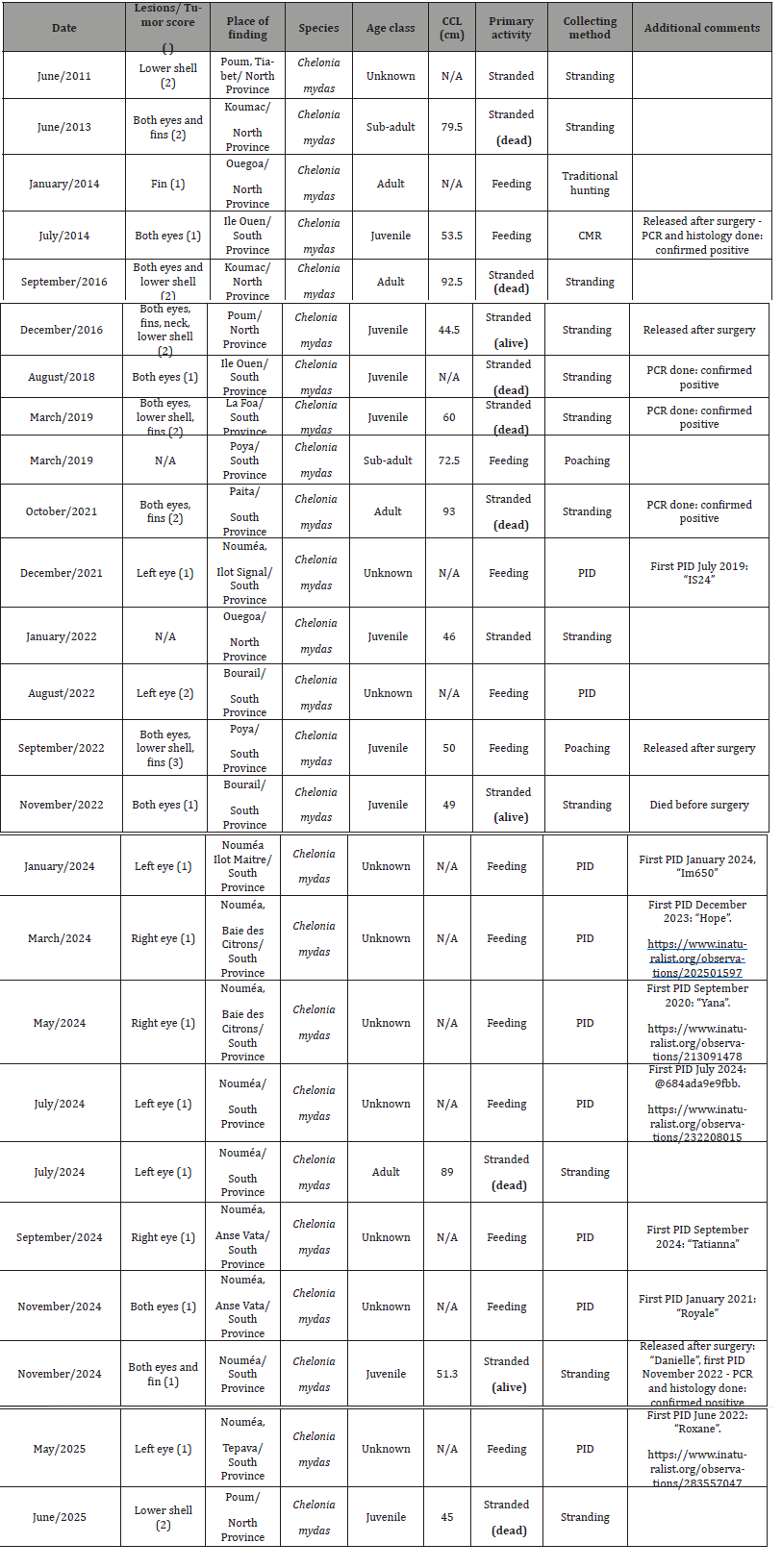
Twenty-five green turtles were reported with fibropapilloma lesions, four were captured, ten were identified by photographs and eleven stranded, from 2011 to 2025 with seven cases in North province and the remainder in South province (Figure 1). The ten turtles with FP identified by photos were from the South province, in Nouméa or Bourail (Table 1). Of turtles that could be aged, nine were juveniles, two were sub-adult, three were adults and no age class information was available for one specimen. Of twenty-three turtles assigned a tumor score, 61% were score 1, 35% score 2 and 4% score 3 (Table 1).

Table 1:Chart of turtles with fibropapilloma reported in New Caledonia.
Discussion
The first report of an individual carrying suspected lesions of fibropapilloma was recorded in 2011 on a stranded green turtle in the North province, near Tiabet (extreme North of New Caledonia) (Table 1). In 2013, a publication mentioned an individual stranded with fibropapilloma in New Caledonia, but no analysis was done at the time to confirm the virus (Work and Balazs [34]). In 2014, a specimen was found with suspected lesions in South province and a sample was sent to the National Wildlife Health Center- Honolulu field station in Hawaii. Gross and microscopic pathology results were consistent with fibropapillomatosis. Molecular analyses confirmed the presence of chelonid herpesvirus 5 DNA for herpesvirus POL gene on this individual (Read et al. [27]). Five other samples from more recent individuals (Table 1) were analyzed in 2024 and confirmed that all individuals assessed were positive for herpesvirus 5.
A higher number of individuals were reported in South province (72%) than in North province (28%), all methods combined and no individuals were reported in the Loyalty province. This may be due to the higher human population density in South province likely leading to increased chances of reporting of diseased turtles. Indeed, the CMR and photo-identification program were only located in the South province. A large number of stranded animals in South province could be explained by an increasing number of boat owners as well as an escalation of maritime traffic in the last decade who would also be more likely to report stranded turtles.
All turtles found affected by the fibropapilloma virus in this study were green turtles. This concurs with multiple studies around the world that this disease mainly affects green turtles (Smith and Coates [41]; Adnyana et al. [13]; Greenblatt et al. [12]; Li et al. [15]; Jones et al. [19,22]; Robben et al. [16]). In addition, green turtles are the most common species of sea turtle in foraging grounds of New Caledonia which could explain the results of this study (Read et al. [26]; Read and Jean [42]).
The majority of the specimens affected were in growth stages between juveniles and sub-adults. This result could be explained by the importance of these life-stages in the New Caledonian foraging grounds (Read et al. [33]) and concurs with multiple studies worldwide that show that as they enter neritic foraging areas after completing their pelagic life stage, juvenile turtles are at a higher risk of developing fibropapilloma (Ene et al. [43]; Jones et al. [5]; Page-Karjian [3]).
The number of individuals recorded with fibropapilloma lesions has appeared to increase in recent years with 56% of turtles affected since 2022 (Table 2). How significant this is remains unclear as there could be sampling biases. For instance, the CMR was only done between 2012 and 2014 and was not resumed since and the photo-identification program was initiated in 2021. A more systematic and consistent monitoring effort for stranded and inwater studies might help clarify whether FP is truly increasing or not in New Caledonia.
Data shows that the majority of the turtles with fibropapillomatosis come from stranding reports (44%) (Table 1), establishing the fact that a solid stranded network is needed in order to record and evaluate the evolution of fibropapilloma in New Caledonia. Necropsy findings confirmed that stranded individuals were in poor health condition but did not succumb directly from fibropapilloma virus. Tumors were generally located on the eyes and on the lower shell disrupting locomotion and vision thus enabling their capacity to feed (Herbst [4]; Flint et al. [17]).
40% of the data come from photo-identification from the volunteer group “Fantastic Grandmothers” which allowed monitoring of progression of tumors from sequential photos (Table 1). Among them, seven individuals were seen regularly. Six were observed with tumor growth in only a few months (Figures 2, 3 and 4). One individual “Yana” (Table 1) was seen for the first time in September 2020 and recorded with tumor growth four years later. However, tumor regression was observed in 2025 (Figure 4). This is the first case of tumor regression recorded on an individual in New Caledonia. Spontaneous lesion regression has also been observed in Brazil (Machado Guimarães et al. [44]), USA (Page-Karjian et al. [45]), Australia and Hawaii (Aguirre and Lutz [46,47]).
Tumor scoring on the individuals reported in this study are mostly at the first stage of infection (14 individuals) and only one individual was recorded with a stage 3 (Table 1). This could indicate that the lesions are recent and that the conditions for the growth of theses lesions are currently favorable in the waters of New Caledonia with a strong number of reports in the locality of Nouméa. Urbanization works are being done in the area since 2022 with a peak of activity at the end of 2023 and 2024 and could impact water turbidity. These external parameters could explain the higher number of lesions being recorded and the possible regression happening since the activity has settled in the area. Tumor scoring and precise recording of all individuals presenting fibropapilloma lesions are essential in the future in order to assess the evolution of this disease in New Caledonia.
Table 2: Chart of turtles with fibropapilloma reported in New Caledonia by year.


Conclusion
This study highlights the evolution over the last fourteen years of the fibropapilloma virus in New Caledonia. Among all twentyfive reports, only Chelonia mydas were impacted and in particular juveniles. The majority of the fibropapilloma reports were recorded from stranding or monitored by photo-identification and located in South province of New Caledonia. The first case of regression is also highlighted in this study. The disease needs to be closely monitored in the future with specific campaigns dedicated to this issue.
Declarations
Acknowledgment: Deepest thanks to the team of scientists,
local governments employees in charge of biodiversity (especially
conservation officers), members and volunteers of the Aquarium
des Lagons, park rangers, all volunteers from the stranding
network and the Fantastic Grandmothers who gave incredible work
with the photo-identification program and to Jerôme Villemain
who contributed to the development of the map. Special thanks
to all veterinarians who helped with the rehabilitation of turtles
and in memory of our dear co-worker Jean-Christophe Vivier, who
passed away before the first stages of publication. We want to thank
Thierry Work for his contribution to the writing of the paper and
for the data analyses he conducted that helped through this study.
Any use of trade, firm, or product names is for descriptive purposes
only and does not imply endorsement by the U.S. Government.
Author’s contributions:Roxane Tran performed analysis and
wrote the paper. Claire Goiran contributed to the writing and data
analyses. Jean-Jérome Cassan and Olivier Chateau contributed to
the writing and to the data collection. Frédéric Avril, Izabella Lach,
Agathe Binois and Laurent Fabre contributed to the data collection.
Tyffen Read contributed to the writing and the research idea,
collected the data and performed analysis.
Funding
No funding for this study.
Availability of data and materials
The datasets used and/or analyzed during the current study are available from the corresponding author on reasonable request.
Ethics approval and consent to participate
Not applicable.
Consent for publication
Not applicable.
Competing interests
The authors declare that they have no competing interests.
References
- United Nations Educational (2024) Scientific and Cultural Organization. UN World Water Development Report 2024: Water for Prosperity and Peace. Paris, ISBN 978-92-3-100657-9.
- Alonso G, Marín J, Salcedo D (2023) “Overview.” In Desalination in Nuclear Power Plants. Elsevier Woodhead, xiii-xvi. ISBN 978-0-12-820021-6.
- El Emam R S, Ozcan H, Bhattacharyya R, Awerbuch L (2022) Nuclear desalination: A sustainable route to water security. Desalination 542: 116082.
- OECD Nuclear Energy Agency (2012) The Role of Nuclear Energy in a Low Carbon Energy Future (NEA No. 6887). Paris. ISBN 978-92-64-99189-7.
- Khan S U, Orfi J (2023) Socio economic and environmental impact of nuclear desalination. Water 13 (12): 1637.
- International Atomic Energy Agency (2007) Economics of Nuclear Desalination: New Developments and Site Specific Studies (IAEA TECDOC 1561). Vienna. ISBN 978-92-0-105607-8.
- Hersbach H, Bell B, Berrisford P (2023) ERA5 Land hourly data assimilation description and updates. ECMWF Technical Memorandum 901.
- Sharqawy MH, Lienhard JH, Zubair S M (2010) Thermophysical properties of seawater: a review of existing correlations. Desalination and Water Treatment 16(1-3): 354-380.
- International Atomic Energy Agency. Power Reactor Information System (PRIS).
- Nisan S, Caruso G, Humphries J R, et al. (2003) Sea water desalination with nuclear and other energy sources: The EURODESAL project. Nuclear Engineering and Design 221 (1-3): 251-275.
- Intergovernmental Panel on Climate Change (2023) Harmonised Life Cycle Greenhouse Gas Emission Factors. Geneva.
- World Bank (2025) PovcalNet and Aqueduct 4.0 datasets. Washington, DC.
- Korea Atomic Energy Research Institute (2022) SMART-MED Feasibility Study Report. Daejeon. KAERI report SM-2022-F-R-001.
- Alvarez L (2023) Life cycle greenhouse gas assessment of nuclear MED desalination at Barakah, UAE. Energy Conversion & Management 277: 116684.
- International Atomic Energy Agency (2024) Desalination Economic Evaluation Program (DEEP) 6.3 User Manual. Vienna.
- Park J (2024) Public perception of micro nuclear cogeneration in water stressed communities. Journal of Environmental Policy 45: 112-128.
- Chatzis K (2022) Techno economic performance of PV battery driven RO in southern Mediterranean climates. Desalination 526: 115540.
- Sayyaadi H (2023) MILP optimisation of integrated nuclear renewable cogeneration for fresh water supply. Applied Energy 346: 121334.
-

This work is licensed under a Creative Commons Attribution-NonCommercial 4.0 International License.




