

 Research Article
Oral Health Status in Children with Diabetes Mellitus – A Systematic Review and Meta-Analysis
1 Postgraduate student, Dept. Pediatric and Preventive Dentistry Dr G.D. Pol Foundation YMT Dental College and Hospital Sector 4, Kharghar, Navi Mumbai - 410210, India
2 HOD & Professor, Dept. Pediatric and Preventive Dentistry Dr G.D. Pol Foundation YMT Dental College and Hospital Sector 4, Kharghar, Navi Mumbai - 410210, India
3 Professor, Dept. Pediatric and Preventive Dentistry Dr G.D. Pol Foundation YMT Dental College and Hospital Sector 4, Kharghar, Navi Mumbai - 410210, India
4 Senior Lecturer, Dept. Pediatric and Preventive Dentistry Dr G.D. Pol Foundation YMT Dental College and Hospital Sector 4, Kharghar, Navi Mumbai - 410210, India
Received Date:April 28, 2025; Published Date:May 06, 2025
Abstract
Background: Diabetes mellitus is characterized by multi-system involvement in children; the oral cavity is also affected. Oral health status and
complications in children with diabetes thus need to be evaluated further.
Research Question: Is there a difference in the oral health status of children with Diabetes Mellitus (DM) compared to healthy children?
Research Protocol: The MOOSE guidelines were followed.
Literature Search: Two researchers, Apurva Marsale and Amar Katre, independently searched articles using appropriate keywords like Diabetes
mellitus, oral health, etc., in search engines like PubMed, Cochrane Library, and Google Scholar etc. Studies reported in English were selected.
Data Extraction: Two authors independently extracted the data from the 21 included studies.
Quality Appraisal: The risk of bias was assessed using a modified version of the Newcastle–Ottawa Scale adapted for cross-sectional, cohort,
and case-control studies. The certainty of evidence was assessed using GRADE.
Data Analysis: Standardized Mean Differences were calculated using the Hedges g statistic, and heterogeneity was estimated using the I2
statistic. The random effect model was applied using the Stata-IC 16.0 software.
Results: 21 studies were included in the review & 19 in the meta-analysis. Pooled SMD for plaque [1.175 (0.400 to 1.950)], calculus [0.589
(0.0585 to 1.119)] and gingival status [0.698 (0.226 to 1.170)] was significantly different, however, the pooled SMD for DMFT [-0.319 (-1.052
to 0.415)], deft [-1.908(-5.432 to 1.616)], DFT [-0.267(-0.745 to 0.211)] and oral hygiene status [ 0.207(-0.0141 to 0.428)] was not significantly
different.
Conclusions: Children with Diabetes Mellitus have poor oral health when compared to healthy children.
Keywords:IDDM, oral health status, type 1 diabetes mellitus, periodontal health, caries status
Abbreviations: Type 1 DM- Type 1 diabetes mellitus; OHS-Oral hygiene status; NOS-Newcastle Ottawa Scale; DMFT-Decayed Missing Filled Teeth; SMD-Standard mean difference; GI-Gingival index; PGC-Poor glycaemic control; PI-Plaque index; DM-diabetes mellitus; DFS-Decayed Filled surface; IDDM-Insulin-dependent diabetes mellitus
Introduction
Type 1 Diabetes Mellitus (DM), also known as juvenile diabetes or insulin-dependent diabetes (IDDM), is a chronic condition in which the pancreas produces little or no insulin by itself [1]. About 422 million people worldwide have diabetes, the majority living in low- and middle-income countries. Both the number of cases and the prevalence of diabetes have been steadily increasing over the past few decades [1, 2]. The prevalence of type 1 diabetes exhibits a wide variation, i.e., low in Asia and South America, but high in European countries [1], with a peak incidence at 10-14 years of age; however, onset at an earlier age has been reported in other studies [2].
The exact cause of type 1 DM is unknown, but genetic and environmental factors trigger autoimmune damage to beta cells, resulting in insulin dependency. Common complications include retinopathy, neuropathy, nephropathy, cardiovascular issues, and delayed wound healing [3]. Periodontal disease is a complication of diabetes due to systemic vascular involvement, making children with type 1 DM more prone to developing it early [4, 5]. Also, they are prone to poor oral health with increased plaque accumulation and calculus formation, and are also at high risk for dental caries [6]. Diabetic children show a higher prevalence of oral soft tissue lesions like ulcers and cheilitis. Other common diabetes-related oral conditions include reduced salivary flow, increased microbial count, and altered saliva buffering capacity. Previous systematic reviews by Faisa, et al. (2015) and Costa, et al. (2023) lacked metaanalysis, which this study addresses [7-9]. We aimed to review and analyze the oral health status of children with DM with the following outcomes: Prevalence and severity of dental caries in children with DM, Prevalence and severity of periodontal disease in children with DM, Oral Hygiene Status in children with DM.
Materials and Methods
The present systematic review was conducted and reported according to PRISMA guidelines and the protocol was registered in the PROSPERO (Reference ID: CRD42023458049). The reporting of the review has been done by the MOOSE guidelines [10]. A systematic electronic search of the literature in the following databases was performed using search engines including MEDLINE via PubMed, Scopus, Cochrane database, Web of Science, EMBASE via OVID, and Google Scholar to identify relevant studies concerning children with DM and their oral health status. The search strategy included a combination of keywords and Boolean operators: (type1dm[All Fields] AND (“diabetes mellitus, type 1”[MeSh Terms] OR “type 1 diabetes mellitus”[All Fields]) AND (“diabetes mellitus, type 1”[MeSH Terms] OR “type 1 diabetes mellitus”[All Fields] OR (“juvenile”[All Fields] AND “diabetes”[All Fields]) OR “juvenile diabetes”[All Fields]) AND (“oral health”[MeSH Terms] OR (“oral”[All Fields] AND “health”[All Fields]) OR “oral health”[All Fields]) AND status[All Fields] AND (“oral hygiene index”[MeSH Terms] OR (“oral”[All Fields] AND “hygiene”[All Fields] AND “index”[All Fields]) OR “oral hygiene index”[All Fields]) AND periodontal[All Fields]).
The search was restricted to the literature published till April 2024. A manual search was also performed across the relevant references of the identified articles as well as in the institutional library.
Eligibility criteria
Studies assessing the oral health status of children with DM were reviewed. The study population consisted of children from diverse regions, representing the general population. Eligible studies included observational study designs such as case-control, cohort, and cross-sectional studies. To be included, studies needed to evaluate oral health status using indices such as DMFT, DFT, deft, PI, GI, OHI-S, or any validated modifications. Studies published in the English language till 1st April 2024 were included.
Study selection
Based on the inclusion and exclusion criteria mentioned above, eligible studies to be included in the qualitative analysis were selected. Two reviewers (AM and AK) independently screened the search results. The screening was performed in 3 stages: (i) title screening, (ii) abstract screening, and (iii) screening of the entire paper. Disagreements were resolved by consensus between the two reviewers. The third reviewer (SHN) was consulted in persistent conflict to resolve the discrepancies.
Data extraction and data collection process
A data extraction template was pre-determined manually by the authors (AM and SS). The extraction was carried out by Chapter 22 of the Cochrane Handbook for Systematic Reviews of Intervention [11]. The data form contained the following information: author names and year of publication, study design, number of participants, age, follow-up period, dental caries (DMFT/ DFT/dmft), plaque index, gingival index, and oral health status were assessed. We complied with the Methodological Expectations of Cochrane Intervention Reviews (MECIR) [12].
Dealing with missing data
The corresponding authors were contacted through email to address the missing data. Two follow-up emails were sent at an interval of seven days in case of non-response. Failure to obtain essential data resulted in the exclusion of the study
Risk of bias assessment
The risk of bias in the included studies was assessed by two reviewers independently (AM and AK) using the adapted Newcastle-Ottawa Scale (NOS) for observational studies [13].
Effect measures
Oral health status was analyzed as hard tissue (caries) and soft tissue (Periodontal status, plaque accumulation, oral hygiene status, and wound healing). Dental caries status (DMFT, DMFS, dmft, dmfs) was extracted/recorded as mean with SD. Gingival status (gingival index by Loe and Silness)- recorded as mean/prevalence. Plaque (plaque index by Silness and Loe) [14] - recorded as mean/ prevalence. Oral hygiene (OHIS by Greene and Vermilion) - recorded as mean/prevalence. Wound healing (Healing index by Landry et al) [15].
Data Synthesis and Analysis
Meta-analysis was performed using Windows-based ‘Stata-IC’ 16.0 (Stata Corp., USA).
Heterogeneity in the results of the studies was assessed where appropriate by inspection of a graphical display of the results and by formal tests of heterogeneity (Higgins 2011) [11]. The data heterogeneity was estimated using Cochran’s Q and I2 statistics. A value of 0-40% on the I’ indicates that heterogeneity might not be important, whereas larger values show increasing heterogeneity [12]. In cases of moderate to substantial heterogeneity, metaanalysis was done using the random effects model to compare the Pre-treatment and Post-treatment values for different measurement parameters (continuous measure). The results of the different studies included in the meta-analysis, with 95% CI, and the overall standardized mean difference (SMD) with 95% CI were depicted using a forest plot. Publication bias was assessed and depicted using a funnel plot. Wherever possible, a sensitivity analysis was done after the exclusion of studies showing publication bias.
Reporting bias assessment
Publication bias was assessed using the Funnel plot. After eliminating studies with publication bias, an additional analysis was performed wherever possible.
Certainty of evidence
Certainty assessment was determined for the outcomes using the GRADE approach [13]. Based on the study design, trials were scored as high quality, whereas observational studies were scored as low quality. The overall quality of evidence considered study design, risk of bias, impression, inconsistency, indirectness, and publication bias. The quality of evidence was determined as high (++++), moderate (+++), low (++), and very low (+). We started the assessment with high certainty, and if we identified any serious concern in any of the 5 domains, we downgraded the certainty.
Results
Study selection
After an electronic search, 10608 articles were found. After the removal of duplicates, screening of titles and abstracts, and applying eligibility criteria, 21 articles remained for review. Thus, 21 articles were analysed qualitatively (systematic review). Two articles were excluded due to insufficient and incomplete data, leaving 19 articles for quantitative synthesis (meta-analysis). Figure 1 shows the flow chart of literature search results and study selection.

Study characteristics
An overview of the characteristics of the included studies is presented in Appendix 1. Out of the 21 studies, 5 were crosssectional studies, 1 study was a cohort, and 15 were case-control studies. Ten studies were conducted in the last decade. The studies were conducted across different continents, including Europe (n=8), Asia (n=7), Africa (n=1), Australia (n=1), and North America (n=4), respectively. All were conducted in the pediatric dental departments of dental colleges/universities/ hospital settings. The sample sizes for observational studies ranged from 50 to 700 children. The age of the children across studies ranged from 5 to 18 years, the majority being in the range of 3 to 12 years.
Risk of bias assessment
The quality of included studies was evaluated based on the Newcastle Ottawa Scale and accordingly, a numeric score (NOS Score) was assigned. 14 case-control studies were awarded with 7 stars and above and deemed to be of low risk of bias (Al-Badr, et al. (2021) [15], Lydia, et al. (2011) [16], Babatzia, et al. (2020) [17], Ismail, et al. (2017) [18], Coelho, et al. (2018) [19], LALLA, et al. (2006) [20], Faisal, et al. (2020) [21], Geetha, et al. (2019) [22], Siudikiene, et al. (2008) [23], Lalla, et al. (2007) [24], Recep, et al. 2008 [2], Rafatjou, et al. (2016) [25], Ferizi, et al. (2022) [26], Siudikienė, et al. 2005 [27], Arheiam, et al. 2014 [28], Banyai, et al. 2022 [29], Rosas, et al. 2018 [30], Gunasekaran, et al. 2022 [31]). 1 case-control, 1 cross-sectional, and 1 cohort study were awarded six stars and deemed to be of moderate risk of bias (Tabatabaei, et al. (2021) [32], Rai et al, 2011 [33], Dakovic, et al. (2008) [34], Bolgül BS, et al. (2004) [35]). The risk of bias in the included studies is presented in Table 1.
Table 1:

Certainty of evidence
The certainty of evidence for the outcomes was assessed using the GRADE approach. High certainty was assigned to the data regarding plaque, gingival, and calculus status in children with DM compared to healthy children. However, the evidence for oral hygiene and caries status in children with DM versus healthy children is of low certainty. Overall certainty of evidence for oral health status in children with DM versus healthy children is moderate. Appendix 2.
Outcomes
Caries
Six studies reported mean DMFT. The pooled SMD revealed that the mean difference in DMFT between children with DM and healthy children when applying the random effect model was -0.319 (-1.052 to 0.415), (P=0.394), the difference being non-significant. The I2 value was 96.5%, indicating substantial heterogeneity. Four studies exhibited publication bias. Additional analyses after excluding these studies revealed a pooled SMD of 0.191 (-0.00480 to 0.377), the difference being statistically significant (p = 0.044). Figure 2a.
Two studies documented the mean dmft. The pooled SMD revealed that the mean difference in dmft between children with DM and other healthy children when applying the random effect model was -1.908 (-5.432 to 1.616), the difference being statistically non-significant (p = 0.288). The I2 value is 99.28%, indicating substantial heterogeneity. The funnel plot revealed that both studies exhibited publication bias. Figure 2b.
Two studies reported mean DFT. The pooled SMD revealed that the mean difference in DFT between children with DM and other healthy children when applying the random effect model was -0.267 (0.745-0.211) the difference being statistically non-significant. The I2 value is 85.74%, indicating substantial heterogeneity. The funnel plot revealed that 2 studies exhibited publication bias. Figure 2c.
Overall, there was no significant difference in the caries status between children with diabetes and healthy children. Figure 2.

Plaque
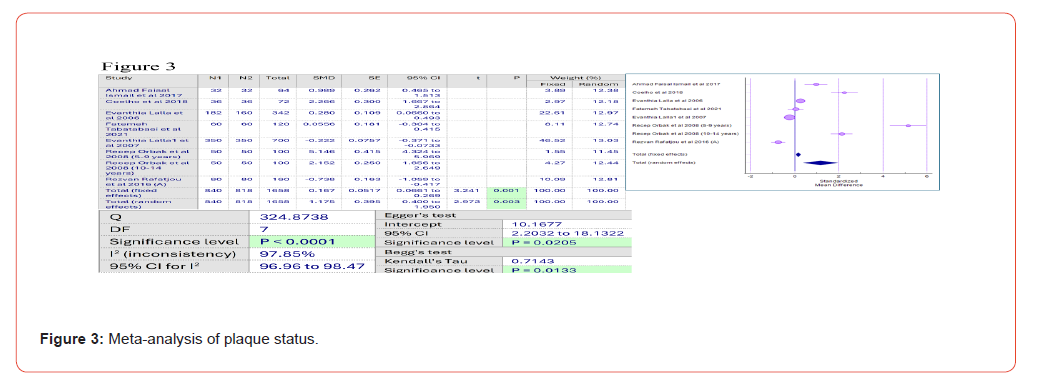
Eight studies reported mean PI. The pooled SMD revealed that the mean difference in PI between children with DM and other healthy children when applying the random effect model was 1.175 (0.400 to 1.950), the difference being statistically significant (p < 0.003). The I2 value is 97.85%, indicating substantial heterogeneity. This suggests more plaque accumulation in children with DM than in healthy children. Figure 3.
Calculus
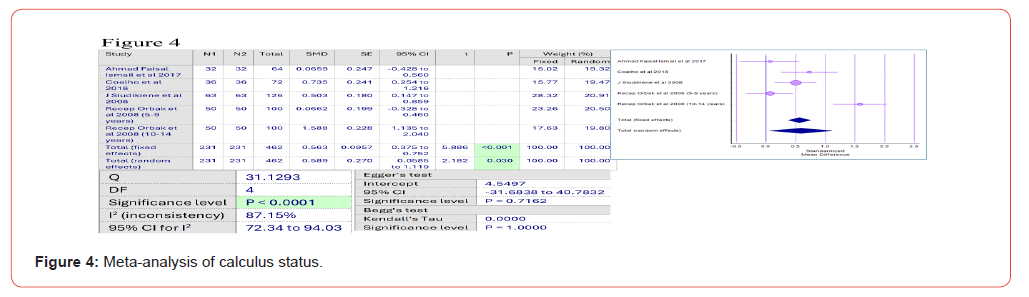
Five studies stated the mean CI. The pooled SMD revealed that the mean difference in CI between children with DM and other healthy children when applying the random effect model was 0.589 (0.0585 to 1.119), the difference was statistically significant (p = 0.030). The I2 value was 97.85%, indicating substantial heterogeneity. The funnel plot revealed that one study exhibited publication bias. Additional analyses after excluding that revealed a pooled SMD of 0.342 (0.0290 to 0.656), the difference being statistically significant (p=0.032). and I2 =54.78%. The results suggest more calculus deposition in children with DM. Figure 4.
Gingiva
Nine studies reported mean GI. The pooled SMD revealed that the mean difference in GI between children with DM and other healthy children when applying the random effect model was 0.698 (0.226 to 1.170), the difference being statistically significant(p<0.004). The I2 value was 95.22%, indicating substantial heterogeneity. The funnel plot revealed that two studies exhibited publication bias. Additional analyses after excluding that revealed a pooled SMD of the random effect model was 0.327 (-0.0181 to 0.671), the difference being statistically not significant (p< 0.063). The I2 value is 90.01%. Poor gingival health was seen in children with DM. Figure 5.
OHIS
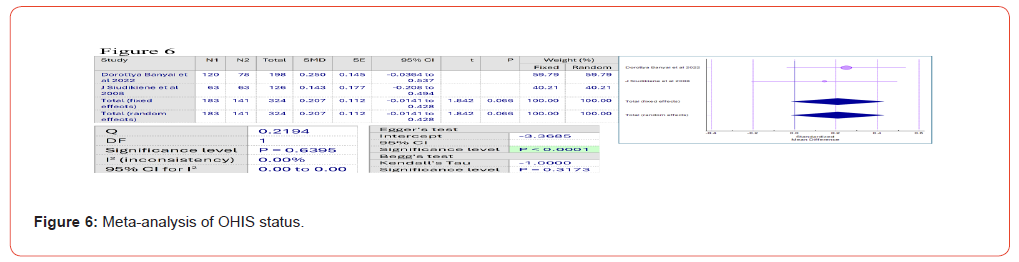
Two studies reported mean OHIS. The pooled SMD revealed that the mean difference in OHIS between children with DM and other healthy children when applying the random effect model was 0.207 (-0.0141 to 0.428). The difference was statistically not significant (p = 0.066). The I2 value was 0.00%, indicative of no heterogeneity. Oral hygiene status in children with DM was not significantly different from healthy children. Figure 6.

Discussion
A 2015 WHO report of the International Diabetes Federation has reported 111,500 children with DM in the South-East Asian Region. India is one of the 11 countries mentioned in this report [24]. Diabetes mellitus (DM) is strongly associated with compromised oral health, manifesting as dental caries, periodontal and gingival conditions, and delayed wound healing (Dahllöf, et al. 1989). These conditions have the potential to significantly affect oral healthrelated quality of life (OHRQoL) and overall quality of life (QoL). This systematic review and meta-analysis investigated the oral health status of children with DM, focusing on caries experience, periodontal health, and oral hygiene. The age range of participants varied considerably across studies, from as young as five years to 18 years. Previous Systematic reviews by Faisa, et al. (2015) and Costa, et al. (2023) have identified a higher prevalence and severity of periodontal disease in children with DM compared to non-diabetic controls. However, evidence on the caries experience in children with DM remains inconsistent. While children with DM exhibit increased plaque accumulation, no meta-analyses have been conducted to comprehensively assess these outcomes, necessitating the present analysis.
Our findings are consistent with prior studies that have reported no significant differences between caries status in children with DM compared to healthy controls; (Anastasia, et al. 2020) reported that children with poor glycemic control had a higher DMFS score. It has been proposed that children with DM with poor metabolic control carry a higher caries risk when compared to children with wellcontrolled diabetes [29, 31], these contradictory outcomes may be attributed to the different levels of glycemic control in children [20] and adolescents with DM during the inclusion period of the studies. (Geetha S, et al. 2019) observed that the mean DMFT/dmft scores were lower in diabetic individuals compared to control groups, potentially reflecting better oral health knowledge among diabetic patients. Individuals diagnosed with a disease often become more aware of their condition and the associated preventive measures. This heightened awareness can influence their behaviour and the broader dynamics of disease spread (Xin, et al. 2016) [2]. Only two studies in our review reported data on caries experience in primary dentition, limiting our ability to draw definitive conclusions on this aspect.
We found that the children with DM had more sites with visible plaque deposition than the controls [31]. Most studies agreed that children with DM had significantly higher mean plaque index and distribution than healthy children [32]. Reduced salivary flow and delayed oral clearance of plaque and debris have been identified as potential contributing factors for plaque accumulation in children with DM. (Rafatjou, et al. 2016). Understandably, children with DM exhibit poorer oral health outcomes in comparison to their healthy counterparts.
Significant differences were found between the gingival status of children with DM as compared to healthy children [32]. (Rafatjou, et al. 2016) reported GI index was found significantly higher in the diabetic group compared to healthy control subjects due to poor metabolic control, which highlights the relationship between glycaemic control and the risk of periodontal disease in DM subjects [17]. Most studies analyzed gingival status through the Loe and Silness index and P-M-A Index by Schour and Massler [14]. Our findings align with previous studies, indicating that gingival health is poor in children with DM compared to their healthy counterparts. While gingival bleeding is a common indicator of inflammation, vascular changes associated with diabetes mellitus may contribute to the increased occurrence of gingival bleeding [26]. Pathogenesis of DM in gingivitis can be attributed to factors such as small vessels involvement, changes in gingival fluid composition and elevation of inflammatory mediators, changes in collagen metabolism, decreased defence responses, the increased presence of periodontal pathogenic microorganisms and oxidative stress, and genetic predisposition to non-enzymatic glycosylation.
We observed a significantly higher rate of calculus formation in children with DM, the same has been reported previously (Orbak, et al. 2008; Sarmamy, et al. 2012; Coelho, et al. 2018). This elevated calculus formation can likely be attributed to increased salivary calcium concentration as well as heightened levels of salivary proteins and urea. These factors collectively create an environment conducive to the development of calculus.
A higher OHIS score has been observed in diabetic individuals, which is likely linked to poor metabolic and glycemic control. Consequently, inadequate oral hygiene may contribute to the onset of periodontal inflammation and subsequent tissue damage [24].
However, we did not find any significant difference when compared to healthy controls. This finding contrasts with the increased plaque and calculus scores, which may indicate disparities in the measurement tools or underlying behavioural factors. Given the limited number of studies, more research is needed to confirm these findings and explore the impact of T1DM on oral hygiene.
Clinical Implications
The findings of this review have important implications for managing oral health in children with DM. The increased prevalence of plaque, calculus, and gingival inflammation highlights the need for proactive periodontal care and regular dental check-ups. Healthcare providers should emphasize the importance of glycemic control, which is a critical factor in mitigating oral complications in DM. Furthermore, oral health education and promotion programs for children and their caregivers can play a pivotal role in improving oral health outcomes in children with DM.
Conclusion
This review and meta-analysis indicated that the overall oral health status in children with DM is poor as compared to healthy children. There is no difference in caries status or oral hygiene status of children with diabetes mellitus (DM) relative to healthy controls, the certainty of evidence being moderate. However, children with DM demonstrated significantly higher plaque accumulation, poor gingival health, and increased calculus deposition, indicating a compromised periodontal condition compared to their healthy counterparts, the certainty of the evidence being high.
Acknowledgement
None.
Conflict of Interest
No Conflict of Interest.
References
- Atkinson MA, Eisenbarth GS, Michels AW (2014) Type 1 diabetes. Lancet 4: 69-82.
- Orbak R, Simsek S, Orbak Z, Kavrut F, Colak M (2008) The influence of type-1 diabetes mellitus on dentition and oral health in children and adolescents. Yonsei Med J 30: 357-365.
- Eisenbarth GS (1986) Type I diabetes mellitus. A chronic autoimmune disease. N Engl J Med 22: 1360-1368.
- Huen KF, Low LC, Cheung PT (2009) An update on the epidemiology of childhood diabetes in Hong Kong. Hong Kong Journal of Paediatrics 715: 1234.
- Löe H (1993) Periodontal disease: the sixth complication of diabetes mellitus. Diabetes care. 16(1): 329-334.
- Novotna M, Podzimek S, Broukal Z, Lencova E, Duskova J (2015) Periodontal Diseases and Dental Caries in Children with Type 1 Diabetes Mellitus. Mediators Inflamm 2015: 379626.
- Silva MF, Barbosa KG, Pereira JV, Bento PM, Godoy GP, et al. (2015) Prevalence of oral mucosal lesions among patients with diabetes mellitus types 1 and 2. An Bras Dermatol 90: 49-53.
- Ismail AF, McGrath CP, Yiu CK (2015) Oral health of children with type 1 diabetes mellitus: A systematic review. Diabetes Res Clin Pract 108: 369-381.
- Costa R, Ríos Carrasco B, Monteiro L, López Jarana P, Carneiro F, et al. (2023) Association between Type 1 Diabetes Mellitus and Periodontal Diseases. J Clin Med 12: 1147.
- Stroup DF, Berlin JA, Morton SC (2008) Meta-analysis of observational studies in epidemiology: a proposal for reporting. Meta-analysis Of Observational Studies in Epidemiology (MOOSE) group. JAMA 283: 2008-2012.
- Higgins JP, Thomas J, Chandler J, Cumpston M, Li T, et al. (2019) Cochrane Handbook for systematic reviews of interventions version 6.0. 201920202612.
- Chandler J, Cumpston M, Li T, Page MJ, Welch VJ (2019) Cochrane handbook for systematic reviews of interventions. Hoboken: Wiley.
- Wells GA, Shea B, O’Connell D, Peterson J, Welch V, et al. The Newcastle-Ottawa. Scale (NOS) for assessing the quality of nonrandomised studies in meta-analyses. 10.1007/s10654-010-9491z.
- LOE H, SILNESS J (1963) Periodontal Disease in Pregnancy. I. Prevalence and Severity. Acta Odontol Scand 21: 533-551.
- Al-Badr AH, AlJameel AH, Halawany HS (2021) Dental caries prevalence among Type 1 diabetes mellitus (T1DM) 6- to 12-year-old children in Riyadh, Kingdom of Saudi Arabia compared to non-diabetic children. Saudi Dent J 33: 276-282.
- Arheiam A, Omar S (2014) Dental caries experience and periodontal treatment needs of 10- to 15-year old children with type 1 diabetes mellitus. Int Dent J 64: 150-154.
- Ismail AF, McGrath CP, Yiu CKY (2017) Oral health status of children with type 1 diabetes: a comparative study. J Pediatr Endocrinol Metab. 26: 1155-1159.
- Coelho ASEDC, Carneiro AS, Pereira VF, Paula AP, Macedo AP, et al. (2018) Oral Health of Portuguese Children with Type 1 Diabetes: A Multiparametric Evaluation. J Clin Pediatr Dent 42: 231-235.
- Lalla E, Cheng B, Lal S, Tucker S, Greenberg E, et al. (2006) Periodontal changes in children and adolescents with diabetes: a case-control study. Diabetes Care 29: 295-299.
- Geetha S, Pramila M, Jain K, Suresh CM (2019) Oral health status and knowledge among 10-15years old type 1 diabetes mellitus children and adolescents in Bengaluru. Indian J Dent Res 30: 80-86.
- Rafatjou R, Razavi Z, Tayebi S, Khalili M, Farhadian M (2016) Dental health status and hygiene in children and adolescents with type 1 diabetes mellitus. J Res Health Sci 16: 122.
- Umar KM (2015) Incidence trends for childhood type 1 diabetes in India. Indian J Endocrinol Metab 19: S34-35.
- Dakovic D, Pavlovic MD (2008) Periodontal disease in children and adolescents with type 1 diabetes in Serbia. J Periodontol 79: 987-992.
- AlMutairi FFJ, Pani SC, Alrobaie FM, Ingle NA (2020) Relationship between type-I diabetes mellitus and oral health status and oral health-related quality of life among children of Saudi Arabia. J Family Med Prim Care 28: 647-651.
- Ferizi L, Bimbashi V, Kelmendi J (2022) Association between metabolic control and oral health in children with type 1 diabetes mellitus. BMC Oral Health 16: 502.
- Díaz Rosas CY, Cárdenas Vargas E, Castañeda Delgado JE, Aguilera Galaviz LA, Aceves Medina MC (2018) Dental, periodontal and salivary conditions in diabetic children associated with metabolic control variables and nutritional plan adherence. Eur J Paediatr Dent 19: 119-126.
- Babatzia A, Papaioannou W, Stavropoulou A, Pandis N, Kanaka Gantenbein C, et al. (2020) Clinical and microbial oral health status in children and adolescents with type 1 diabetes mellitus. Int Dent J 70: 136-144.
- SILNESS J, LOE H (1964) Periodontal Disease in Pregnancy: Ii. Correlation Between Oral Hygiene and Periodontal Condition. Acta Odontol Scand 22: 121-135.
- Daković D, Mileusnić I, Hajduković Z, Čakić S, Hadži Mihajlović M (2015) Gingivitis and periodontitis in children and adolescents suffering from type 1 diabetes mellitus. Vojnosanit Pregl. 72: 265-273.
- Carranza FA, Newman MG (1980) Current concepts about dental plaque. Revista de la Asociacion Odontologica Argentina 1980682934, 6943603.
- Abatabaei F, Mahjoub S, Alijanpour M, Moslemnejad A, Gharekhani S, et al. (2021) Evaluation of the Relationship between Salivary Lipids, Proteins and Total Antioxidant Capacity with Gingival Health Status in Type-1 Diabetic Children. J Dent (Shiraz) 22: 82-89.
- Rai K, Hegde AM, Kamath A, Shetty S (2011) Dental caries and salivary alterations in Type I Diabetes. J Clin Pediatr Dent 181-184.
- Landry RG: Effectiveness of benzydamine HC1 in the treatment of periodontal post-surgical patients. Doctoral dissertation, Faculty of Dentistry, University.
- del Valle LM, Ocasio López C (2011) Comparing the oral health status of diabetic and non-diabetic children from Puerto Rico: a case-control pilot study. P R Health Sci J 30: 123.
- Bolgül BS, Celenk S, Ayna BE, Atakul F, Uysal E (2004) Evaluation of caries risk factors and effects of a fluoride-releasing adhesive material in children with insulin-dependent diabetes mellitus (IDDM): initial first-year results. Acta Odontol Scand 62: 289-292.
-

This work is licensed under a Creative Commons Attribution-NonCommercial 4.0 International License.