


 Review Article
Operative Dentistry: Composite Restorations—A Wonder and Blend of Engineering, Chemistry, Mechanics and Artistry
Assistant Professor, Clinical Instructor and Team Leader, Department of Restorative Clinical Sciences, University of Missouri-Kansas City, School of Dentistry, USA.
Received Date:December 30, 2025; Published Date:January 07, 2026
Abstract
Composite resin restorations are one of the most visible intersections between science and artistry in modern dentistry. What began as a
chemically simple, relatively fragile tooth-colored alternative to amalgam has matured into a sophisticated system of engineered polymers, optimized
filler particles, advanced photo initiators, and highly evolved adhesive strategies. These materials do not merely occupy space in a prepared cavity;
they are designed to harmonize with tooth structure, redistribute stress, seal dentin, and recreate the optical subtleties of natural enamel and dentin.
This article reviews the evolution, composition, and clinical application of contemporary resin composites from a multidisciplinary perspective.
The discussion emphasizes the underlying engineering and mechanical principles, including cavity design, configuration factor (C-factor)
management, polymerization dynamics, and long-term fatigue behavior under occlusal load. The chemistry of monomers, cross-linking, and filler
coupling is presented in clinically relevant terms, with a supplemental polymerization scheme provided for readers who wish to explore the reaction
pathways in greater depth. Clinical protocols for both posterior and anterior composite restorations are outlined step-by-step, integrating isolation,
adhesion, incremental layering, contouring, finishing, and polishing. Esthetic considerations, including shade selection and anatomical layering,
are examined as a form of micro medical sculpture. The article concludes with a summary of key concepts and a forward-looking discussion of
bioactive, fiber-reinforced, and digitally fabricated composites. A supplemental polymer chemistry reaction scheme is provide to support deeper
understanding of dimethacrylate polymerization for those interested in the underlying chemistry. Composite restorations are ultimately shown to
be a true blend of engineering, chemistry, mechanics, and artistry—demanding that the clinician think as both scientist and sculptor.
Introduction
Operative dentistry has undergone a profound transformation over the last several decades. Where dentists once relied almost exclusively on metallic restorations to restore decayed or fractured teeth, contemporary practice now favors adhesive, tooth-colored materials that respect and preserve sound tooth structure. Composite resins have become the workhorse of restorative dentistry in both anterior and posterior regions, providing a unique combination of esthetics, conservation, and functional durability. This shift has been driven by parallel advances in materials science and clinical technique. Improvements in monomer chemistry, filler technology, and adhesive systems have enabled composites to withstand the hostile oral environment and the repeated loading cycles of mastication. At the same time, a better understanding of caries as a disease process has encouraged more selective, minimally invasive cavity designs that depend on adhesion rather than mechanical retention alone.
The purpose of this article is to synthesize these scientific and clinical concepts into a coherent framework that supports predictable, long-lasting composite restorations. By examining composites through the lenses of engineering, chemistry, mechanics, and artistry, the clinician is encouraged to think beyond individual products or techniques and adopt a systems-based approach to restorative treatment.
Historical Evolution of Composite Restorations
The earliest generations of composite materials in the 1960s and 1970s were macrofilled resins with relatively large filler particles. While these materials represented an important step forward, they were limited by poor polish retention and significant wear in high-stress areas. Their use was largely confined to small anterior restorations where esthetics were prioritized over mechanical performance.
Subsequent development of microfilled composites dramatically improved surface smoothness and long-term gloss. However, these materials often sacrificed strength and modulus, making them less suitable for posterior occlusal surfaces. The introduction of hybrid, microhybrid, and eventually nanohybrid composites sought to combine the advantages of both approaches—balancing strength, wear resistance, and polish ability in a single universal material.
Today’s resin composites are the product of decades of iterative refinement. Modern formulations incorporate nano-scale fillers, fiber reinforcement in select systems, and sophisticated photo initiator blends. These design changes are rooted in fundamental engineering goals: controlling shrinkage, distributing stress, and aligning the material’s physical properties with those of enamel and dentin. Understanding this historical evolution helps clinicians appreciate why certain handling characteristics, indications, and limitations exist in the composites they use every day.
Material Science and Polymer Chemistry
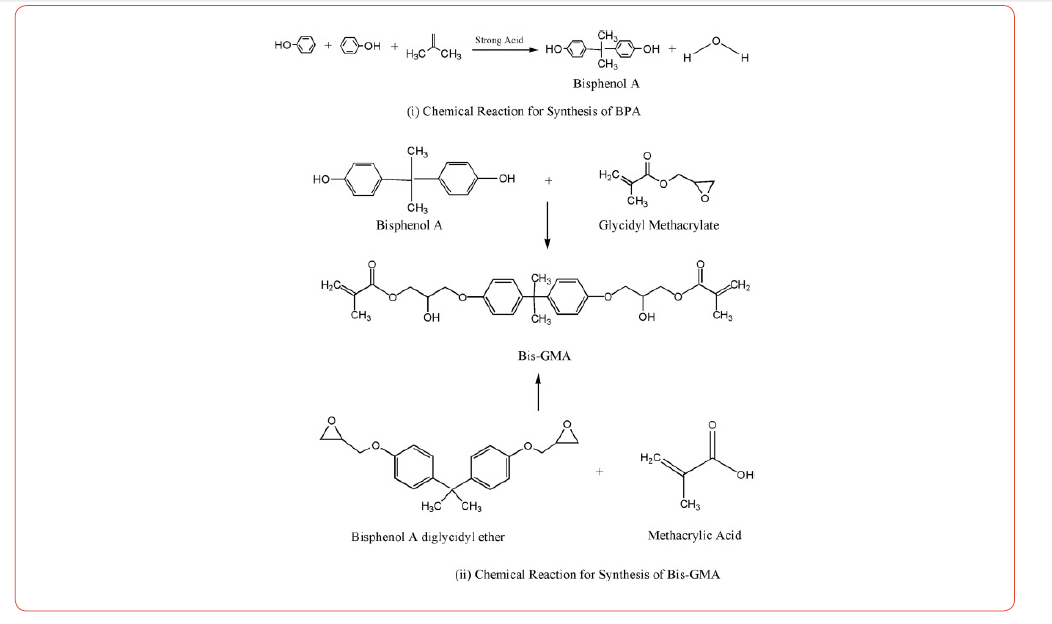
At the heart of every composite resin is a cross-linked polymer matrix, typically based on dimethacrylate monomers such as Bis- GMA, UDMA, and TEGDMA. These monomers are chosen for their ability to form a densely cross-linked network when activated by light, creating a rigid yet slightly resilient structure. High molecular weight monomers like Bis-GMA provide rigidity and reduced polymerization shrinkage, while lower viscosity monomers such as TEGDMA improve flow and facilitate higher filler loading.
The polymerization reaction is initiated by visible light in the blue spectrum, which activates photo initiators like camphorquinone. In the presence of an amine co-initiator, free radicals are generated that open the methacrylate double bonds and propagate chain growth. The reaction proceeds rapidly once initiated and continues at a slower rate after light exposure, making adequate curing time and proper light positioning critical for achieving optimal conversion.
A key engineering challenge is managing polymerization shrinkage, which is an inherent consequence of converting monomers into a denser polymer network. Shrinkage can generate internal stresses, potentially leading to marginal gap formation, postoperative sensitivity, or enamel cracks. Manufacturers address this through monomer selection, increased filler loading, and the development of so-called “low-shrinkage” or “bulk-fill” composites. Clinicians contribute by using incremental placement, soft-start curing protocols, and careful cavity design.
Filler Technology and Optical Properties
Filler particles transform a simple resin into a true composite material. Glass, silica, and ceramic-based fillers increase modulus, hardness, and wear resistance, while also modifying translucency and refractive index. The degree of filler loading, expressed by volume or weight percentage, is directly related to many key properties including radiopacity, thermal expansion, and resistance to deformation under load.
Nanofilled and nanohybrid composites incorporate particles in the tens of nanometers range, either as discrete nanoparticles or as nano-clusters. These very small particles permit a highly polishable, glossy surface that resists plaque accumulation and staining over time. At the same time, their distribution within the resin can enhance crack deflection and energy absorption, contributing to long-term fatigue resistance.
Optically, composites are engineered to mimic the complex way that natural enamel and dentin transmit, scatter, and reflect light. Different opacities and shades are formulated so that clinicians can build depth with dentin-like materials and translucency with enamel-like layers. Some systems incorporate opalescent and fluorescent effects that respond to ambient and ultraviolet light in a way similar to natural teeth, enhancing esthetic integration especially in the anterior region.
Adhesive Systems and Tooth Preparation Engineering
Adhesive systems are the critical interface between composite resin and tooth structure. Modern adhesives are expected not only to bond strongly to enamel and dentin, but also to remain stable in the moist and dynamic oral environment over many years. The engineering of these systems is rooted in micromechanical interlocking and, in some cases, chemical bonding to hydroxyapatite.
Etch-and-rinse (total-etch) systems utilize phosphoric acid to remove the smear layer and demineralize enamel and dentin, exposing a collagen network into which hydrophilic primers and adhesives can infiltrate. The resulting hybrid layer contains resin tags and micro-retentive features that anchor the composite. Selfetch and universal adhesives simplify the protocol by combining conditioning and priming in a single step, partially preserving hydroxyapatite around collagen fibrils, which may improve the durability of chemical interactions.
From a mechanical perspective, cavity design has evolved alongside adhesive dentistry. Traditional “extension for prevention” principles have been replaced by minimally invasive designs that remove only irreversibly demineralized tissue while preserving sound enamel and dentin. Rounded internal line angles reduce stress concentration, and butt-joint margins in small Class I and V preparations are common. The configuration factor (C-factor)—the ratio of bonded to unbonded surfaces—guides clinical decisions about layering and curing to mitigate shrinkage stress.
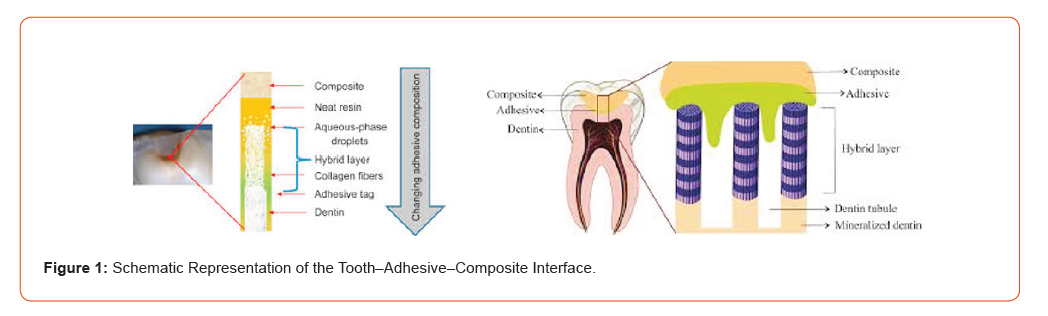
The diagram illustrates the stratified nature of a bonded composite restoration, emphasizing the relationship between enamel, dentin, the hybrid layer, adhesive resin, and the overlying composite. Understanding these interfaces is essential for optimizing bond strength and reducing marginal breakdown over time.
Cavity Configuration, C-Factor, and Stress Management
The concept of configuration factor, or C-factor, describes the ratio of bonded to unbonded surfaces in a cavity preparation. High C-factor situations, such as deep Class I occlusal preparations, create a constrained environment in which polymerization shrinkage stresses cannot be easily dissipated. As the composite attempts to contract during curing, tensile forces develop at the adhesive interface, potentially compromising marginal integrity.
Clinicians can manage C-factor by modifying both the preparation and the restorative technique. Strategies include using smaller increments, oblique layering that increases the proportion of free surfaces, and selecting materials specifically engineered for bulk placement. In deep preparations, a flowable composite liner with lower modulus may act as a stress-absorbing layer, although this must be balanced against the liner’s potentially higher shrinkage.
Engineering thinking encourages the operator to visualize the restoration as part of a composite beam system, where the tooth and restorative material share and redistribute occlusal forces. Properly bonded composite can reinforce weakened cusps, but excessive removal of tooth structure or unfavorable cusp inclines may still predispose to fracture. Each preparation should therefore be designed with the ultimate load-bearing demands clearly in mind.
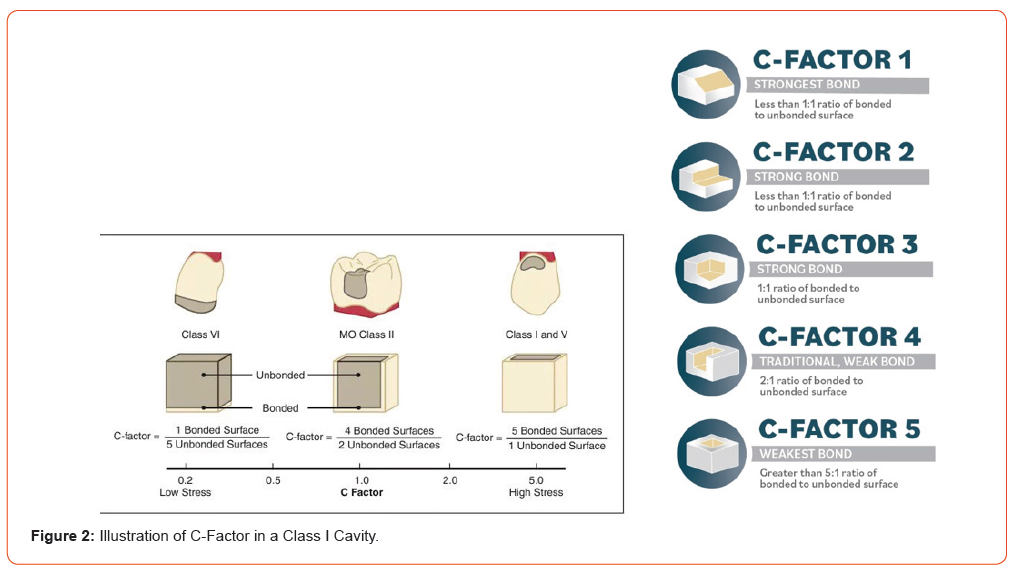
High C-factor cavities, such as the depicted Class I preparation, have many bonded walls relative to the single free surface. Incremental placement and careful curing protocols are essential to reduce the net stress transmitted to the adhesive interface.
Clinical Protocol for Posterior Composite Restorations
A methodical, step-by-step approach is fundamental to predictable posterior composite restorations. After diagnosis and treatment planning, anesthesia and isolation are achieved. Rubber dam isolation, while not universally employed, offers superior control of moisture and contamination and should be considered the standard for teaching and for demanding cases.
Caries removal is conducted conservatively, with the goal of eliminating infected dentin while preserving affected but remineralizable tissue when possible. Sharp internal line angles and unnecessary extensions are avoided. Where proximal surfaces are involved, pre-wedging and placement of a suitable matrix system help to protect the adjacent tooth and facilitate later contact formation.
The adhesive protocol follows the manufacturer’s instructions, but always with attention to general principles: thorough etching of enamel margins in total-etch systems, avoidance of over-drying dentin, active application and agitation of primers, and gentle air thinning of the adhesive before light activation. Multiple coats may be indicated for some universal adhesives on sclerotic dentin.
Composite placement is typically performed in increments of 2 mm or less, with each layer shaped to control C-factor and facilitated by appropriate hand instruments or sculpting brushes. Occlusal anatomy is gradually built into the final increments, reducing the need for extensive adjustment after curing. Care is taken to avoid incorporating voids or leaving unsupported marginal ridges.
Finishing begins with removal of gross excess and refinement of occlusal contacts using fine diamonds or carbide finishing burs. Contouring of grooves, ridges, and fossae aims to reproduce the natural occlusal scheme and support functional movements. Polishing with disks, cups, and polishing pastes yields a smooth, lustrous surface that is more resistant to staining and plaque accumulation.

Layering dentin- and enamel-shade composites allows the operator to reproduce the chroma and translucency of natural tooth structure while simultaneously controlling polymerization shrinkage stresses through smaller increments.
Anterior Composite Restorations and Esthetic Artistry
Anterior composite restorations, particularly in the esthetic zone, place unique demands on the clinician. The restored tooth must not only function properly but also disappear into the smile, indistinguishable from its neighbors. This requires a careful analysis of shade, value, translucency, surface texture, and light reflection.
Shade selection is ideally performed at the beginning of the appointment with hydrated teeth, using both shade guides and direct mock-ups where necessary. Many composite systems provide multiple opacities—opaque dentin shades, body shades, and translucent enamel shades—that can be combined to recreate the internal anatomy of the tooth, including mamelons and incisal halos.
The preparation for an anterior composite should be as conservative as possible, often limited to the defective portion of enamel or dentin. Beveled margins increase the surface area for bonding and help to feather the composite into surrounding enamel, reducing the visibility of the margin. A lingual matrix or silicone index may assist in establishing the correct palatal contour for Class IV restorations, upon which dentin and enamel layers are subsequently built.
Surface characterization is the final artistic step. Subtle vertical and horizontal texture, created with fine diamonds and polishing discs, modifies the way light reflects from the surface, influencing the perceived value and vitality of the restoration. Properly executed, the anterior composite is a small sculpture in resin, harmonizing mechanical function with esthetic expression.
Failure Modes, Repair Strategies, and Longevity
Despite significant advances, composite restorations are not immune to failure. Common modes include marginal staining, secondary caries, bulk fracture, cusp fracture, and wear of occlusal anatomy. The etiology of failure is multifactorial, involving patient factors (caries risk, occlusion, parafunction), material selection, adherence to proper technique, and the quality of the adhesive interface.
One advantage of adhesive composite restorations is their reparability. Localized defects such as chipped incisal edges or small areas of marginal breakdown can often be treated by roughening the surface, selectively etching enamel, and applying an appropriate adhesive followed by fresh composite. This approach preserves tooth structure and extends the functional life of the restoration without complete replacement.
Clinical studies generally report good survival rates for wellplaced composites, especially when proper isolation, bonding, and occlusal management are respected. Longevity is further enhanced when the restorative treatment is integrated into a comprehensive caries management strategy that addresses diet, biofilm control, fluoride exposure, and patient compliance.

Future Directions in Composite Restorative Dentistry
The future of composite restorations is being shaped by several interrelated trends. Bioactive composites seek to move beyond passive filling toward materials that can release fluoride, calcium, or phosphate ions, buffer acids, and support remineralization of adjacent tooth structure. Incorporation of antibacterial agents, either through surface characteristics or controlled release, aims to reduce the bacterial load at the restoration margin.
Fiber-reinforced composites and short-fiber materials are under investigation for use in high-stress applications and as alternative framework materials. These systems leverage the
principles of composite structural engineering, in which fibers carry tensile loads and help to arrest crack propagation. When used appropriately, they may enable more conservative alternatives to full-coverage crowns.
Digital dentistry is also influencing composite use. 3D printing and CAD/CAM fabrication of composite blocks open the possibility of indirect restorations milled or printed from highly filled, industrially polymerized materials. Chairside scanning and AI-assisted design tools may guide preparation geometry, contact relationships, and even propose optimal layering patterns for direct restorations.
Conclusion and Summary
Composite restorations exemplify the integration of engineering, chemistry, mechanics, and artistry within operative dentistry. From the molecular level of monomer design and filler coupling to the macroscopic level of occlusal morphology and smile dynamics, each restoration represents a complex, multi-scale system. Success depends not only on the inherent quality of the material but also on the clinician’s understanding of these underlying principles.
When adhesive protocols are respected, cavity designs are conservative and biomechanically sound, and finishing and polishing are meticulous, composite restorations can achieve excellent longevity and esthetic harmony. Conversely, shortcuts in isolation, bonding, or occlusal adjustment often manifest years later as marginal leakage, sensitivity, or fracture. The operator’s engineering mindset, combined with artistic sensibility, is therefore decisive.
In summary, contemporary composite dentistry demands that the clinician function as materials scientist, engineer, and sculptor. By embracing evidence-based techniques and continually refining both technical and artistic skills, practitioners can provide restorations that not only restore lost structure but also elevate the patient’s confidence and oral health. The supplemental polymer chemistry scheme that follows is offered as an additional resource for those who wish to explore the chemical foundations behind the clinical reality.
Supplemental Figure. Simplified Polymerization Scheme of a Dimethacrylate-Based Composite Resin
Acknowledgement
None.
Conflicts of Interest
No conflicts of interest.
References
- Ferracane JL. Resin composite—State of the art. J Dent Res.
- Van Meerbeek B, De Munck J, Yoshida Y, et al. Buonocore memorial lecture. Adhesion to enamel and dentin: current status and future challenges. Oper Dent.
- Opdam NJM, Loomans BAC, Roeters FJM, Bronkhorst EM. Five-year clinical performance of posterior resin composite restorations: a systematic review. J Dent.
- Sakaguchi RL, Powers JM. Craig’s Restorative Dental Materials. 14th Elsevier;
- Hilton TJ, Ferracane JL, Broome JC. Summitt’s Fundamentals of Operative Dentistry. 4th Quintessence Publishing;
- Hickel R, Manhart J. Longevity of restorations in posterior teeth and reasons for failure. J Adhes Dent.
- Ilie N, Hickel R. Resin composite restorative materials. Aust Dent J.
- Banerjee A, Watson TF, Kidd EAM. Dentine caries: take it or leave it? Dent Update.
-

This work is licensed under a Creative Commons Attribution-NonCommercial 4.0 International License.