

 Research Article
Nutritional Status of Edentulous Elderly People in The Alaotra Mangoro Region of Madagascar According to The MNA Questionnaire
1 Dental prosthetics department, at Tropical Odonto-Stomatological Institute of Madagascar (IOSTM), University of Madagascar, Madagascar
2 Public health department, at Tropical Odonto-Stomatological Institute of Madagascar (IOSTM), University of Madagascar, Madagascar
Received Date:July 23, 2025; Published Date:August 04, 2025
Abstract
Introduction: In Madagascar, few studies have been carried out into the nutritional status of the elderly, because the majority of nutritional
programmes focus on the health of children and mothers. The extent of malnutrition among the elderly is underestimated. Yet malnutrition in the
elderly has an impact on health status and increases mortality and morbidity. For the elderly, edentulism is also a problem, with reduced masticatory
efficiency leading to impaired food degradation. The aim of this study was therefore to assess the nutritional status of edentulous elderly people in
Madagascar.
Materials and Methods: 828 edentulous elderly people were tested in a cross-sectional study using the Mini Nutritional Assessment (MNA).
This tool classifies the nutritional status of elderly people into three groups: malnourished (score < 17), at risk of malnutrition (score 17 - 23) and
well nourished (score ≥ 24). The variables were evaluated using the chi-square method or ANOVA. Pearson’s correlation coefficient (r) was used to
establish correlations.
Results: The mean age was 68.1 ± 7.1 years. The mean MNA score was 21.8 ± 4.5, with a minimum of 7 and a maximum of 30. Age (r = -0.145, p
= 0.001) and former profession (r = 0.161, p = 0.000) were correlated with MNA. As for edentulous characteristics, a difference in mean MNA score
was found in relation to edentulous type, edentulous sector, number of missing teeth and masticatory coefficient.
Conclusion: Malnutrition and the risk of malnutrition were high among edentulous elderly people in Madagascar. The MNA is a useful diagnostic
tool for identifying edentulous elderly people who are malnourished or at risk of malnutrition.
Keywords:Nutrition; Elderly; Edentulism; MNA
Introduction
The ageing of the population is a global phenomenon that poses major challenges for public health. Increasing life expectancy, combined with falling birth rates, has led to a growing proportion of older people in society. This demographic transition is highlighting specific health problems, among which oral health and nutrition occupy a central place [1]. As far as oral health is concerned, edentulism, or the loss of all or part of the natural teeth, is the main problem for the elderly. Indeed, various studies have found that the number of missing teeth increases with age, so it is mainly the elderly who are most affected by this problem [2-5].
As for nutrition, it plays an important role in healthy ageing [6]. Malnutrition in the elderly has an impact on health status and increases mortality and morbidity. It can encourage the development of geriatric syndromes, and its role in the pathogenesis of other geriatric syndromes appears to be well established [7].
In later life, good nutrition, including supplementary feeding where necessary, can be used to prevent functional decline and restore health following acute or chronic illness, injury or surgery [8].
Elderly people with edentulism may experience major difficulties in consuming a varied and balanced diet. These difficulties can lead to a reduced intake of essential nutrients, adversely affecting their general state of health. Foods requiring intense chewing are often replaced by softer but sometimes less nutritious alternatives, which can lead to nutritional deficiencies and affect the quality of life of this group of people.
Early and accurate diagnosis of malnutrition is essential in order to implement nutritional therapy as soon as possible. Vellas, Garry, Guigoz and Albarède have developed and validated the Mini Nutritional Assessment (MNA) to provide a rapid assessment of the nutritional status of the elderly, in order to facilitate nutritional interventions.
The MNA is easy, quick and inexpensive to carry out and can be used to check the nutritional status of the elderly. This enables the necessary nutritional status to be ensured or restored to normality [9, 10].
In Madagascar, data on the nutritional status of the elderly is lacking, as the majority of nutritional programmes focus on the health of children and mothers. The extent of malnutrition among the elderly is underestimated. Hence the interest of the present study, which aims to assess the nutritional status of edentulous elderly people in Madagascar using the Mini Nutritional Assessment (MNA) tool.
Materials and methods
Study setting and population
This cross-sectional study was carried out in the Alaotra Mangoro region of Madagascar on 828 edentulous people aged 60 and over living at home.
All edentulous elderly people who presented chronic pathologies or those who were undergoing medical treatment contraindicating the consumption of certain foods or those who were following a special diet or those with specific dietary supplements or those who did not wish to take part in the survey were excluded.
Nutritional questionnaire
The MNA consists of 18 questions involving:
1. Anthropometric measurements (weight, height and
weight loss).
2. The global assessment (six questions relating to lifestyle,
medication and mobility),
3. The dietary questionnaire (eight questions relating to
the number of meals, food and fluid consumption and dietary
autonomy)
4. And the subjective assessment (perception of health and
nutrition).
The MNA score was calculated as the sum of the points attributed to the answers to the 18 items. A person is well nourished with a score > 24, at risk of malnutrition with a score of 17 to 23.5 and suffering from malnutrition with a score < 17 [9].
Anthropometric measurements
Anthropometric measurements included: weight, height, body mass index (BMI), arm circumference (AC) and calf circumference (CC). Body weight was measured on a digital scale to within 0.1kg, and height was measured on a measuring tape to within 0.1cm. The BMI or Body Mass Index was calculated as the weight (kg) divided by the square of the height (m2). BMI was also classified according to World Health Organisation (WHO) criteria [11]. BC was measured using a tape measure, the midpoint of the arm between the tips of the fingers: of the arm between the tips of the acromion and the olecranon.
The CM was measured with the elderly person seated, with a 90º angle in the leg, by placing the tape measure around the calf in the largest circumference [11]. All measurements were taken with three measurements for each anthropometric variable and choosing the mean as the final value. The established recommendations were followed for carrying out the anthropometric measurements [12].
Statistical analysis
Descriptive statistics such as mean, standard deviation and simple frequency were used to analyse the data. The F-test, analysis of variance (ANOVA), was used to compare means between continuous variables, and the Chi-square test for categorical variables, with a statistical significance level of p<0.05. For correlation, Pearson’s correlation coefficient was used [13]. Data were analyzed using Statistical Package for the Social Sciences (SPSS) for Windows, version 25.0.
Ethics
The Madagascar Biomedical Research Ethics Committee (CERBM) of the Madagascar Ministry of Public Health approved the study protocol. Informed consent was obtained from all participants.
Results
Table 1:Mean, standard deviation, minimum and maximum values for age, BMI, MNA, number of missing teeth and masticatory coefficient.

According to Table 1, the average age of the 828 elderly people in the sample was 68.1 ± 7.1 years, with a minimum age of 60 and a maximum age of 95. Body mass index (BMI) ranged from 13 to 34.3, with an average of 21.8 ± 3.7. The mean MNA score was 21.8 ± 4.5, with a minimum of 7 and a maximum of 30.
Concerning the number of missing teeth, on average, 16.5 teeth were missing per person, with a minimum of two missing teeth and a maximum of 32 missing teeth.
The masticatory coefficient varied from 0 to 100, with an average of 38.0 ± 0.5. 36,6.
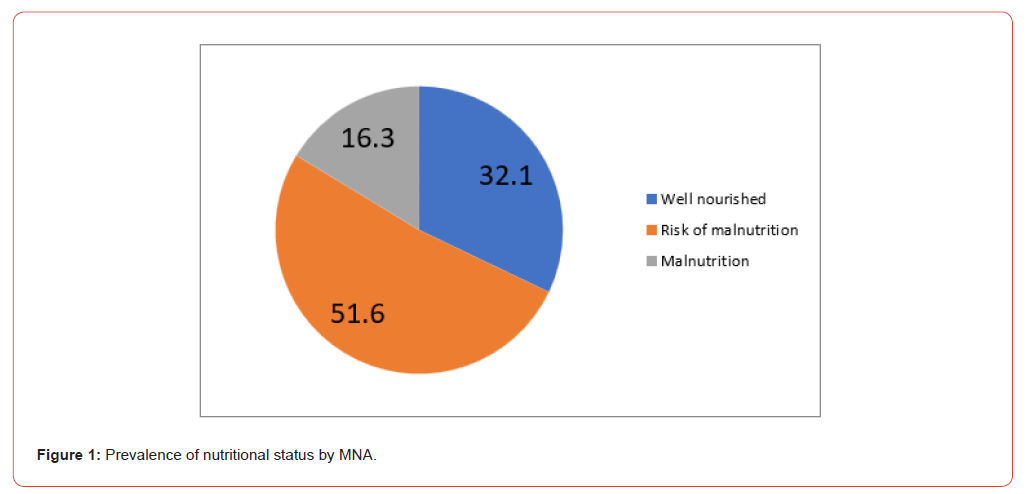
According to Figure 1, 16.3% of edentulous elderly people were malnourished, 51.6% were at risk of malnutrition and 32.1% were well nourished.
The correlation of nutritional status with the socio-demographic characteristics of the study population (Table 2) indicates that: age is negatively correlated with MNA (r = -0.145, p = 0.001). Similarly with former occupation, the correlation is highly significant (r = 0.161, p = 0.000). On the other hand, gender and place of residence were not correlated with MNA.
Table 2:
Table 1:Mean, standard deviation, minimum and maximum values for age, BMI, MNA, number of missing teeth and masticatory coefficient.

Table 3:Distribution of the study population according to mean MNA score and edentulous characteristics (type of edentulism, edentulous arch, edentulous sector, number of missing teeth and masticatory coefficient.

According to Table 3, the mean MNA varied greatly with the type of edentulism (F = 12.9 - p = 0.000), the edentulous sector (F = 7.5 - p = 0.000), the number of missing teeth (F = 11.3 - p=0.000) and the masticatory coefficient (F = 7.14 - p = 0.008). However, there was no difference in the mean MNA score according to the edentulous arch.
Discussion
Mean of continuous variables
The mean age of 68.1 years was well above Madagascar’s life expectancy of 65.3 years [14]. As for BMI, their mean value is still considered “normal” according to the WHO classification [15]. But the average BMI is slightly lower than that of older people in Poland in 2021, in a similar study [16]. On the other hand, the average MNA (21.8 ± 4.5) is in the “at risk of malnutrition” class according to the MNA score classification [9]. The study by Kostecka et al. also found a result almost similar to Poland (21.0 ± 4.4) [16].
Prevalence of nutritional status
This study found a prevalence of malnutrition in the elderly equal to 16.3%, and a risk of malnutrition equal to 51.6%. This prevalence of malnutrition is higher than that found in Brazil in 2011 according to a similar study (8.3%) but lower than that found in India in 2021 (19.5%). However, in relation to the risk of malnutrition, our result found a lower prevalence than that found in Brazil (55.6%) or India (70%) [17, 18].
According to age, it has been found that the older you are, the more malnourished you are. The study by Gülbahar et al. also found the same result. A negative correlation was found between age and MNA [19].
Correlation of MNA with socio-demographic characteristics
Gender has not been found to correlate with NAM, although the study carried out in Spain found that gender was one of the factors predicting NAM [20]. Place of residence was not correlated with NAM. On the other hand, the former occupation of the elderly did correlate with NAM; it was mainly those who had worked in the tertiary sector who had normal nutritional status, whereas it was mainly those with occupations in the primary sector who were at risk of malnutrition. This situation seems illogical, as primary sector occupations include farming, livestock breeding, hunting and other food-related occupations. In this case, we can assume that these elderly people have not been able to benefit from their profession.
Variation in MNA according to the characteristics of the edentulous tooth
The type of edentulism and the masticatory coefficient depend on the number of missing teeth. The ability to chew is what most affects the nutritional status of the elderly [21]. In this study, it was found that it was mainly the posteriorly edentulous elderly who had lower MNA scores than those who were anteriorly edentulous. Bodineau et al. suggested that it is also necessary to take into account what type of teeth are missing: posterior teeth, whose function is mastication and occlusal closure, or anterior teeth, which are used to grip food.
In relation to the masticatory coefficient, it has been found that the MNA score rises with the masticatory coefficient. Bodineau et al. found that it appears that 20 teeth need to be retained to maintain good mastication and nutrition, but this number is rare in the elderly. The number of teeth seems to decrease as age increases. In people over 65, the number of remaining teeth is between 12 and 17 and varies from country to country [22]
The number of teeth on the arch is associated with good chewing efficiency and dexterity. Conversely, being edentulous is associated with poor nutritional status. Being totally edentulous is a high-risk factor for weight loss and therefore a risk factor for malnutrition. Edentulous patients consume fewer vegetables and fibre than people with at least 25 teeth [23, 24, 21].
In the elderly, the loss of teeth leads to a change in eating habits and preferences. With a diet lacking in diversity, the consequence is a deficiency in essential nutrients and minerals [21].
Conclusion
Malnutrition and the risk of malnutrition are high among edentulous elderly people in Madagascar. The nutritional status assessed by the MNA correlated well with age, former occupation, type of edentulism, edentulous sector, number of missing teeth and masticatory coefficient. Although the anthropometric measures assessed are part of the tool, these data suggest that the MNA is a useful diagnostic tool for identifying elderly patients at risk of malnutrition and those who are already malnourished.
Acknowledgements
None.
Conflict of Interest
No conflict of interest.
References
- (2022) World Health Organization. Ageing and health.
- Hue O, Berteretche MV (2004) Complete Denture: Clinical reality and therapeutic solutions. Paris: Quintessence International p. 289.
- Dupuis V (2013) The oral health of the elderly: what issues for oral health of the elderly? 13th Public Dental Health Day France pp. 27-29.
- Peltzer K, Hewlett S, Yawson AE, Moynihan P, Preet R, et al. (2014) Prevalence of loss of all teeth (Edentulism) and associated factors in older adults in China, Ghana, India, Mexico, Russia and South Africa. Int J Environ Res Public Health 11(11): 11308-11324.
- Ratsimandresy NN, Fabien LT, Ranjarisoa LN, Ratsirarison J, Rasoamananjara JA, et al. (2023) Factors Associated with the Edentulousness of Patients Coming for cnsultation to the Dental Services in the City of Mahajanga Madagascar. On J Dent & Oral 6(5): OJDOH.MS.ID.000647.
- Zhou YF, Song XY, Pan A, Koh WP (2023) Nutrition and Healthy Ageing in Asia: A Systematic Review. Nutrients 15(14).
- Kupisz-Urbanska M, Marcinowska-Suchowierska E (2022) Malnutrition in Older Adults-Effect on Falls and Fractures: A Narrative Review. Nutrients 14(15).
- Rodriguez-Manas L, Murray R, Glencorse C, Sulo S (2022) Good nutrition across the lifespan is foundational for healthy aging and sustainable development. Frontiers in nutrition 9: 1113060.
- Guigoz Y, Vellas B, Garry PJ (1994) Mini Nutritional Assessment: a practical tool for grading the nutritional state of the elderly patients. Facts Res Gerontol (suppl 2) 15-60.
- Guigoz Y, Vellas B (1999) The Mini Nutritional Assessment (MNA) for grading de nutritional state of the elderly patients: Presentation of the MNA, History and Validation. Nestlé Nutrition Workshop Serie Clinical and Performance Programme (1): 3-12.
- World Health Organization (1995) Physical Status: The use and interpretation of anthropometry. Geneve: World Health Organization.
- Stewart DA, Marfell-Jones M, Olds T, De Ridder JH (2011) International standards for anthropometric assessment. International Society for de Advancement of Kinanthropometry, Lower Hutt, New Zealand ISAK.
- Altman DG (1991) Practical Statistics for Medical Research, Chapman & Hall, London.
- World Health Organization. Data, population Madagascar 2022. https://data.who.int/fr/countries/450.
- World Health Organisation. Obesity and overweight. March 2024.
- Kostecka M, Bojanowska M (2021) An evaluation of the nutritional status of elderly with the use of the MNA questionnaire and determination of factors contributing to malnutrition. A pilot study. Rocz Panstw Zakl Hig 72(2): 175-183.
- Pereira Machado RS, Santa Cruz Coelho MA (2011) Risk of malnutrition among brazilian institutionalized elderly: a study with the mini nutritional assessment (MNA) questionnaire. The Journal of Nutrition, Health & Aging 15(7): 532-535.
- Rajlakshmi B, Jaishree C, Banerjee S, Usha R (2018) Evaluation of Relationship between Nutritional Status and Oral Health Related Quality of Life in Complete Denture Wearers. Indian Journal of Dental Research 29(5): 562-567.
- Gülbahar E, Elif Y (2023) Evaluation of the relationship between GOHAI, MNA and the dental hygiene of using denture wearers for older patients. J Oral Rehabil 50(6): 468-475.
- Marta Cuervo M, Ansorena D, Miguel A. Gonza lez M, Garcı A, Astiasara I, Martı´nez J (2009) Impact of global and subjective mini nutritional assessment (MNA) questions on the evaluation of the nutritional status: The role of gender and age. Archives of Gerontology and Geriatrics 49(1): 69-73.
- Sheiham A, Steele JG, Marcenes W, Lowe C, Finch S, et al. (2001) The Relationship among Dental Status, Nutrient Intake, and Nutritional Status in Older People. J Dent Res 80(2): 408-413.
- Bodineau A, Boutelier C, Viala P, Laze D, Desmarest M, et al. (2007) Importance de l’hygiène buccodentaire en gériatrie. NPG Neurol - Psychiatr - Gériatrie 7(40): 7-14.
- Allen PF (2005) Association between diet, social resources and oral health related quality of life in edentulous patients. J Oral Rehabil 32(9): 623-628.
- Colvez A, Villebrun D (2003) The question of age categories and the "hinges" between different types of population, Abstract. Rev Fr Aff Soc (1): 255-66.
-

This work is licensed under a Creative Commons Attribution-NonCommercial 4.0 International License.