


 Research Article
Comparison of the Antibacterial Efficacy of Ultrasound Activated Sodium Hypochlorite and Photodynamic Therapy in Root Canals Contaminated with Enterococcus Faecalis. Faculty of Dentistry, Universidad Del Norte, July 2024
1 Students of the Dentistry Career, Faculty of Biomedical Sciences, Universidad del Norte, Paraguay
2 Professors of the Dentistry Career, Faculty of Biomedical Sciences, Universidad del Norte, Paraguay
3 Career Director, Universidad del Norte, Paraguay
Fátima Acosta, ORCID: https://orcid.org/0009-0004-8833-8360
Ximena Schneider, ORCID: https://orcid.org/0009-0007-8608-8224
Myrian Grabow, ORCID: https://orcid.org/0009-0007-4752-8020
Noemi Zárate, ORCID: https://orcid.org/0000-0002-7806-8289
Nora Rivas, ORCID: https://orcid.org/0009-0001-7522-5015/p>
Gelda Giosa, ORCID: https://orcid.org/0009-0006-5202-7063
Received Date:March 19, 2025; Published Date:April 23, 2025
Abstract
Introduction: The persistence of microorganisms in the root canal system (RCS) after endodontic treatment constitutes one of the main causes
of failure. Enterococcus faecalis frequently colonizes the root canal system in failed endodontics; hence the need to develop more effective methods
of disinfection. In photodynamic therapy (PDT) a photo-sensitizing agent is applied to the affected area and then exposed to a specific wavelength of
light in the presence of oxygen generating photochemical reactions responsible for bacterial cell death.
Objective: To compare the antibacterial efficacy of sodium hypochlorite activated with ultrasound and photodynamic therapy in root canals
contaminated with Enterococcus faecalis.
Methodology: Analytical, quantitative and experimental cross-sectional study. Thirty lower molars were divided into three groups: (1)
irrigation with sodium hypochlorite activated with ultrasound and photodynamic therapy, (2) irrigation with sodium hypochlorite activated with
ultrasound and (3) control group without treatment. After the treatments, samples were taken from each root canal and sown on sheep blood agar.
Result: The results showed that both techniques were very efficient, since the cultures of the samples were negative. Irrigation with activated
hypochlorite was highly effective due to its antibacterial chemical action and also antibacterial PDT due to its ability to penetrate inaccessible areas
of the RCS and its photodynamic action. However, combined disinfection methods should be further explored for effective endodontic treatment.
Keywords:Photodynamic therapy, Ultrasound, Enterococcus faecalis
Introduction
The main objective of endodontic treatment is “the elimination and possible eradication of the microorganisms involved, their byproducts and virulence characteristics of the infected root canal system, their cleaning and disinfection”. When there is microbial infection of the root canal system and, consequently, loss of tooth vitality, the need for endodontic treatment arises [1]. Biomechanical preparation is carried out in order to leave the root canal free of microorganisms. Different disinfection systems can be used for this purpose, and the diode laser is one of them. However, caution should be taken with its use in order to prevent possible thermal damage generated by the laser on the periodontium or the tooth itself [2].
To achieve the best result in endodontic treatment, it is essential to carry out a good management of the biomechanical preparation, using cutting-edge technological tools and with the biological approach for disinfection. In most cases, the elimination of the various microorganisms present is not achieved, but the number of microorganisms residing in the root canals should be reduced as much as possible so that they are incapable of producing some endodontic infections [3]. It is essential to clean and disinfect the root canal system (CRS) by means of a chemicalsurgical preparation (PQR) with endodontic instruments and auxiliary chemicals, usually using sodium hypochlorite (NaOCl) and disodium ethylenediamine tetracetic with 17% tergentol (17% EDTA-T). The objective of irrigating the SCR with these substances is to dissolve the pulp tissue (living or necrotic), act on the bacterial biofilm, neutralize endotoxins and eliminate the dentin mud layer. However, due to the complexity of SCR, endodontic instruments and chemicals do not reach all areas, and biofilm is not removed in isthmus, accessory canals, dentin tubules, curved canals, and branching [4].
Biofilm is a community of microorganisms from one or more species protected in an extracellular matrix of polysaccharides bonded to a solid surface. There are microorganisms that live in the Biofilm and are 1000 times more resistant to antimicrobial agents, especially Enterococcus faecalis A biofilm is defined as a microbial population attached to an organic or inorganic substrate surrounded by extracellular products which forms an intermicrobial matrix. The microorganisms, organized in biofilms, show high resistance to both antimicrobial agents and host defense mechanisms [5]. Due to this complexity of SCR, different techniques have been introduced to maximize the cleaning and disinfection of root canals. One of the most commonly used agents is sodium hypochlorite (NaOCl), known for its ability to degrade organic tissue and act as a bactericide and bacteriostatic. However, while sodium hypochlorite is effective, it does not always achieve complete elimination of all pathogens present in the duct system [6].
The persistence of microorganisms in the root canal, either after treatment or due to recolonization of the blocked canal, is one of the main causes of failure in endodontic treatments. Among these microorganisms, Enterococcus faecalis stands out for its frequent appearance in failed root canals. This bacterium, closely linked to bacterial biofilm in the apical zone, shows significant resistance both to antimicrobial agents used in endodontic treatment and to adverse conditions, such as nutrient deficiencies in clean, clogged canals. [7]. The bacterium Enterococcus faecalis is considered the microorganism commonly located in infected root canals, it is isolated in biofilm mode, which makes it more resistant to different antimicrobial treatments.
The challenge posed by Enterococcus faecalis in endodontic treatment underscores the need to develop and evaluate new disinfection methods that can be more effective. The search for irrigators that can completely eliminate bacteria from the root canal system is therefore of great clinical relevance. In this context, photodynamic therapy (PDT) emerges as a promising option to complement traditional endodontic treatments [8]. The disinfection of root canals is established through biomechanical preparation together with the use of irrigating solutions and the application of activating techniques, due to the presence of persistent microorganisms and the complexity of the root anatomy, new technologies have been implemented to improve cleaning and disinfection [9].
Recently, new systems have been proposed to improve root canal disinfection, either by replacing conventional chemomechanical procedures or by complementing their effects [9]. Among them, photodynamic therapy (PDT), defined as “the light-induced inactivation of cells, microorganisms or molecules”. PDT is based on the fact that a light is capable of exciting a nontoxic dye (photosensitizer) at its target site with minimal effects on the surrounding tissue [1, 9]. For the clinical application of photodynamic therapy, it is necessary to know the light source to be used, the type and concentration of the photosensitizer to be used and the pre-irradiation time, which is defined as the time in which the photosensitizer is in contact with the bacteria, expressed in minutes necessary for it to diffuse and then be irradiated with a light source such as the low-power laser [10].
Materials and Methods
The study design was analytical, quantitative, experimental, and cross-sectional.
Sample collection and microbiological analysis
Extracted permanent multi-root human molars were collected, immersed in a container with 2.5% sodium hypochlorite solution for 2 hours to remove impurities, the tissue remains were removed with a periodontal curette and preserved in saline solution at room temperature, until subsequent use. 30 multiradicular molars were selected, which had a total length of 16mm, standardized. And it was carried out at the Universidad del Norte (Asunción) in the preclinic room of Dentistry. Next, the teeth were placed in containers made of a sponge material in a vertical position for better handling.

They were then taken in an autoclavable box and the samples were sterilized in an autoclave at 103°C for 1 hour 33 minutes. The microbiological procedure of the research was carried out in the Microbiology Laboratory of the Universidad del Norte, all the procedures were performed using Bunsen burner, near the work area, to provide an aseptic environment. The strain used to contaminate the root canals was Enterococcus faecalis ATCC 29212 from which a 0.5Mc. Farland (MF) bacterial suspension corresponding to a bacterial concentration of 1.5 to 2 CFU/ml was prepared in a sterile tube with sterile 0.9% saline. The bacterial suspension was mixed with brain-heart broth (BHI) in a 1:1 dilution, in 2 tubes. The mixture of the bacterial suspension was inoculated in each distal root canal until it was punctured, with an insulin syringe (in all 30 teeth). The bacterial suspension was inoculated until it was seen that it exceeded the apical level. Sterile gauze was immediately passed to the apex to seal the foramina of each root with a photoactive resin and prevent bacterial seepage through the apex during inoculation.

The teeth were incubated in a culture oven at 37°C for 17 days for the formation of bacterial biofilm. After this period, the samples were randomly divided into 3 groups.
Group 1: Biomechanical preparation with AF F ONE rotary systems (Fanta dental, Shanghai), Helse HU-One ultrasoundactivated irrigation protocol was applied (20 sec 3 times), the ducts were dried with sterile absorbent cones, 0.005% methylene blue was applied with a tuberculin syringe, five minutes were waited and PDT was performed with Therapy EC with red light on 9 Jules.
Group 2: Biomechanical preparation with AF F ONE rotary systems, irrigation protocol was applied with 2.5% sodium hypochlorite activated with Helse HU-One ultrasound (20 sec 3 times).
Group 3: Control group without treatment.
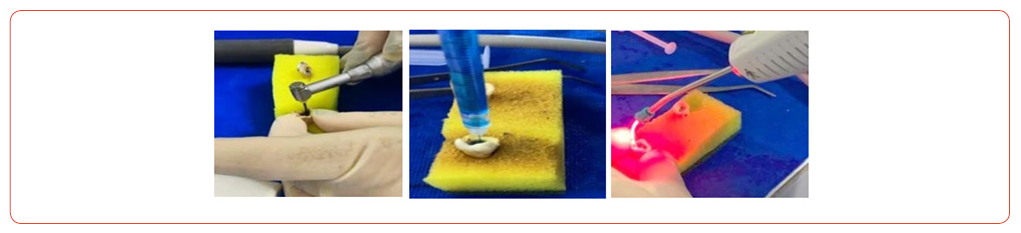
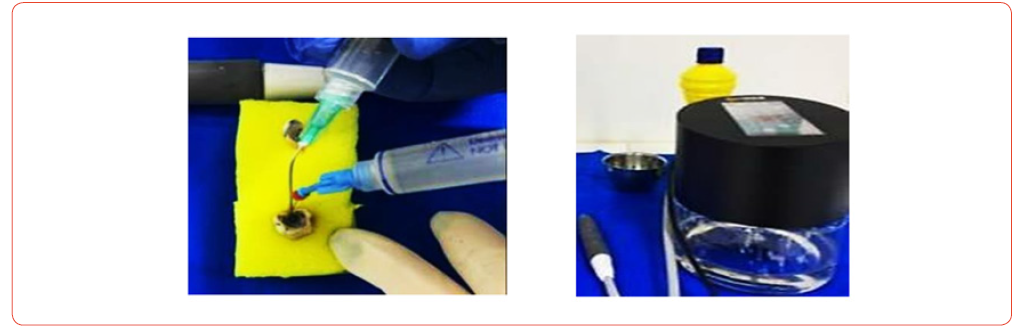
After the respective treatments, each root canal of the three groups was filled with 2ml of 0.9% saline solution, using a sterile tuberculin syringe and a NaviTip (Ultradent) type needle. A sterile absorbent paper cone was then placed in each canal and stirred circumferentially, contacting the dental walls for 30 seconds to take the respective samples. Next, the paper cones were placed in sterile cryovial tubes, which in turn were placed in an autoclavable box.

Microbiological analysis
1ml of 0.9% saline solution was added to each cryovial tube, which in turn contained a paper cone, and stirred for 60 seconds so that the sample was diluted and homogenized. Next, a representative sample of each cryovial of 10 ul was taken with an automatic pipette and sterile tips and sowed in sheep’s blood agar, performing a striation for counting with calibrated bacteriological anus and the cultured plates were taken in a culture oven at 370°C̈ for 48 hours. After the incubation period, bacterial growth was observed in each plate and then the bacterial colony count (CFU/ ml) of Enterococcus faecalis was carried out in each of the groups.
Data Processing
Data collection was carried out using the direct observation method and the colony count technique by plate was used for the quantification of colony-forming units per ml (CFU\ml), which was carried out by a specialist (microbiologist). The data obtained from the study were recorded in a file prepared for this purpose.
Ethical aspects
The samples of ex vivo teeth were obtained from the tooth bank of the Chair of Surgery of the Dentistry career of the Universidad del Norte with the authorization of the Academic Directorate.
Results
According to the objectives set, through microbiological cultures and in the count of colony-forming units per ml (CFU/ml). The count of colony-forming units per ml (CFU/ml) of Enterococcus faecalis ATCC 29212 in the LS+AM group (Red laser irradiation associated with 0.005% methylene blue photosensitizer) showed that there was no bacterial growth. On the other hand, the colonyforming unit count (CFU/ml) of E. faecalis ATCC 29212 in the NaOCl+AU group (Conirrigant Ultrasonic Activation Sodium Hypochlorite) resulted in the total elimination of E. faecalis with all negative cultures.
Table 1:

Discussion
In the present research work, the efficacy in the disinfection of the root canal system contaminated with Enterococus faecalis was compared, using instrumentation and irrigation with 2.5% sodium hypochlorite activated with ultrasound in a group of teeth and another group of teeth performing the same process plus photodynamic antibacterial therapy with diode laser. The results obtained showed that there was no statistically significant difference with both techniques.
In the work of Jane Smith, carried out in Peru -2020, entitled “In vitro antibacterial effect of Photodynamic Therapy against Enterococcus faecalis”. The statistical results showed that PDT emerges as an effective alternative for the elimination of E. faecalis, a microorganism frequently associated with cases of endodontic failure [11].
In the research “Evaluation of the efficacy of the 940 nm diode laser in the elimination of Enterococcus faecalis” by Carlos Pérez carried out in Argentina in 2023; the results showed that the disinfection methods achieved a partial elimination of E. faecalis. However, the 940 nm diode laser irrigation method was significantly more effective. Although irrigation with 5% sodium hypochlorite significantly reduced bacterial load, it did not achieve complete elimination of CFUs in all dental canals (12).
Diego Portes Vieira Leite, et al. in their topic Evaluation of microbial reduction in the root canal system after photodynamic therapy (PDT)-an in vivo study. This study included patients who needed endodontic treatment according to the inclusion criteria. They were divided into groups G1: following the chemical-surgical preparation (CSP) protocol, G2: with a protocol with tips at the entrance of the canal, and G3: with the PQC+PDT protocol with tips inside the canal. Two-way ANOVA p>0.05 was used to compare the groups. The results showed that there was a microbial reduction, but no significant differences. It was also observed that there was greater homogeneity of the data in the irradiated groups (G2 and G3). The conclusion is that TDF can be used as an adjuvant in endodontic treatment with an increase in its success rate [13].
Camila Bravo Lagos Rayén Castillo Véliz in her work entitled “Photodynamic therapy as an adjuvant of the irrigant sodium hypochlorite in conventional endodontic treatment: a critical review of the literature, in Chile, 2021; The results obtained showed that 95.8% of the groups had a greater decrease in Enterococcus faecalis when using PDT after NaOCl compared to using NaOCl alone. Of this result, 41.67% presented statistically significant differences [1]. Larrea Oyarbide Nerea Applications of diode laser in dentistry RCOE, 2004, Vol 9, Nº5, 529-534-529 compared the action of 0.9% sodium hypochlorite against sodium hypochlorite combined with a diode laser in order to achieve root canal disinfection. They used a wavelength of 809nm and powers of 1W, 3W and 4.5W for 60 seconds. They obtained a bacterial reduction of 99.86% using sodium hypochlorite and laser together at 3W power. Despite these data, his conclusion is that the diode laser cannot replace sodium hypochlorite, but it helps to obtain better results [14].
Lescano Alvarado, Jessenia Belén, in the work entitled “Effectiveness of the use of laser in root canal disinfection”, 2024; demonstrates that there are no significant differences with the use of various chemical disinfection methods and proposes to use lasers as an alternative technique or in combination [8]. Idalia Rodríguez Delgado in the research work: “Use of the ER, CR: YSGG laser as an adjuvant in the disinfection of the root canal system November 2024; investigated the antibacterial efficacy and cleaning capacity of the Er, Cr: YSGG laser in the disinfection of the root canals of fifteen teeth, they were inoculated with a biofilm of Enterococcus faecalis and divided into three groups. Group 1 (control: biofilm only), Group 2 (Ultrasound [US] + 5.25% NaOCl), and Group 3 (Er, Cr at 1.25W, 40 Hz The results were in group 2 there was a greater reduction in colony-forming units with no difference with group 3. Group 3 had greater penetration of methylene blue and cleaning of dental tubules. Both methods were effective in bacterial reduction; however, the reduction was greater with 5.25% NaOCl and ultrasound. And I conclude in this study that the Er, Cr: YSGG laser significantly removes the sweep layer [15].
In the research: Effectiveness of curcumin as a photodynamic therapy for endodontic procedures: a narrative review conducted by Alisson Salazar, et al. between the years 2018 to 2023 examining 50 articles that met the inclusion criteria demonstrated that photoactivated curcumin significantly decreases microbial cell viability and biofilm vitality, coinciding with the result obtained in the present work has enhanced the action of sodium hypochlorite with the use of a photosensitizer [16]. In the review of scientific literature on Photodynamic therapy, a new trend in endodontics for the removal of Enterococcus faecalis, carried out by José Carlos Martín, et al., they conclude that photodynamic therapy (PDT) increases the effect of disinfection and inhibition when the traditional disinfection protocol is carried out adjuvantically [17].
The findings of the present study reinforce the need for further research into combined disinfection methods that enhance the action of traditional antimicrobial agents. Future research could focus on optimizing parameters such as photosensitizer concentration, light exposure time, and irradiation power, with the aim of maximizing antibacterial efficacy without compromising the integrity of dental tissue [18, 19].
Conclusion
In this comparative study, the efficacy of ultrasoundactivated 2.5% sodium hypochlorite irrigation and antimicrobial photodynamic therapy in the disinfection of root canals contaminated with Enterococcus faecalis was evaluated. The results obtained showed that both techniques managed to significantly reduce the bacterial load. Irrigation with activated hypochlorite proved to be highly effective due to its powerful antibacterial chemical action. Antibacterial photodynamic therapy showed promising results due to its ability to penetrate inaccessible areas of the root canal system and its thermal and photodynamic action. However, the combination of both could optimize disinfection.
Recommendations
Conduct studies with larger samples to expand these results. Combine both techniques for root canal disinfection.
Acknowledgement
None.
Conflict of Interest
No Conflict of Interest.
References
- Bravo Lagos Camila, Rayén Castillo Véliz, Emma Fuenzalida (2021) Photodynamic therapy as an adjuvant to the irrigant Sodium Hypochlorite in conventional endodontic treatment: a critical review of the literature, Valparaíso-Chile.
- Matsumoto K (2000) Lasers in endodontics. Dent Clin North Am 4: 889-905.
- Rojas Galárraga, Mónica Michelle (2021) Reduction of Enterococcus faecalis in the root canal with erbium laser and diode. In vitro study. 2021 Dentist Poegdc, editor. Quito.
- José Freitas Siqueira Júnior, Isabela das Neves Rôças, Marília Fagury Marceliano Alves, Alejandro Ron Pérez, Domenico Ricucci (2018) Unprepared Surface Root Canal Areas: Causes, Clinical Implications, and Therapeutic Strategies. Braz Oral Res 32(suppl 1): e65.
- Zambrano de la Peña S, Salcedo Moncada D, Petkova Gueorguieva M, Ventocilla Huasupoma M (2016) Biofilm en Endodoncia: una revisió Odontol Sanmarquina [Internet]. 19(2): 45-49.
- University of Cartagena. Final report [Internet].
- Ballesteros LV, Méndez MC, Arévalo VA. In vitro evaluation of the antimicrobial effectiveness of photodynamic therapy and 5.25% sodium hypochlorite in roots 42 -30.
- Nava Reyna E, Cervantes López V, Sánchez Vargas Lo (2015) Presence of Enterococcus faecalis and its relationship with the clinical diagnosis of apical periodontitis [Internet]. Rev Odont Mex 19(3): 181-189.
- Lescano Alvarado J (2024) Effectiveness of the use of laser in root canal disinfection. (Degree Thesis) National University of Chimborazo. Riobamba, Ecuador. 26-Apr-2024.
- Plotino G, Grande NM, Mercade M (2019) Photodynamic therapy in endodontics. Int Endod J 52(6): 760-774.
- Sante Medina M (2023) Antimicrobial effectiveness of photodynamic therapy by applying different pre-irradiation times in root canals contaminated with Enterococcus faecalis; In vitro study. Lima-Peru.
- Pineda E, González A, Villa P (2008) In vitro comparison of root canal system disinfection with 5.25% NaOCl and Diode Laser. CES odontol 21(1): 33-38.
- https://saio.org.ar/oldsaio/new/descargas/Libro_LI_Reunion_Cientifica_An ual.pdf
- Larrea Oyarbide Nerea, Spain Tost Antonio Jesús, Berini Aytés Leonardo, Gay Escoda Cosme (2025) Applications of diode laser in dentistry. RCOE [Internet]. 9(5): 529-534.
- Idalia Rodríguez Delgado, Daniela Hernández Martínez, Isaac Kably Mizrahi, Marco Antonio Garza Navarro, Jorge Jaime Flores Treviño, et al. (2024) Use of the Er, Cr: YSGG laser as an adjuvant in the disinfection of the root canal system, November 16(11): e1339-e1345.
- Alisson Melissa Alisson, Salazar Villavicencio Alisson, Zapata Sifuentes Mauricio (2024) Effectiveness of curcumin as photodynamic therapy for endodontic procedures: a narrative review. Rev Cient Odontol 12(2): e200.
- José Carlos Martín Calderón Augusto, Luis Rodrigo Cassana Rojas, Jean Carlo Villar Zapata, Zulema Velásquez Huamán (2023) Photodynamic therapy, a new trend in endodontics for the elimination of Enterococcus faecalis.
- Meire MA, De Moor RJ (2014) Efficacy of laser-based antimicrobial strategies in endodontic treatment. J Endod 40(5): 641-647.
- Pagonis TC, Chen J, Fontana CR, Devalapally H, Ruggiero K, et al. (2010) Antimicrobial photodynamic therapy for root canal infections. J Endod 36(2): 322-328.
-

This work is licensed under a Creative Commons Attribution-NonCommercial 4.0 International License.