

 Short Communication
Artificial Intelligence-Based Multi-Model for Risk Assessment of Oral Potentially Malignant Disorders Using Confocal Imaging of Exfoliative Cytology
1 Department of Oral Medicine, Periodontology and Oral Diagnosis, Faculty of Dentistry, Ain-Shams University, Cairo, Egypt
2 Center of Excellence for Research and Technology in Stem Cells and Biomaterials (CLSBAR), Faculty of Dentistry, Ain-Shams University, Cairo, Egypt
3 Department of Oral Biology, Faculty of Dentistry, Ain-Shams University, Cairo, Egypt
4 Faculty of Computer Science, Misr International University, Cairo, Egypt
5 Department of Computer Engineering and Software Programs, Faculty of Engineering, Ain-Shams University, Cairo, Egypt
Ola Mohamed Ezzatt: ORCID
Received Date:May 27, 2025; Published Date:June 02, 2025
Abstract
Early detection of oral potentially malignant lesions (OPMLs) is crucial for improving prognosis and survival rates. Traditional diagnostic methods, including biopsies, are invasive and often delay treatment. This study introduces an innovative, non-invasive artificial intelligence (AI) system that integrates three machine learning models to evaluate patients’ clinical data, the staining patterns of toluidine blue-stained images of lesions, and confocal microscopic imaging of exfoliative cytology samples. The system was deployed using a user-friendly web interface to provide risk assessment for OPMLs. Model testing on a pilot dataset (n=50) has demonstrated the following accuracy: 91% (clinical model), 94% (microscopic image-based model), 74.32% (stained image-based model), and 98% agreement between the system output and experts’ risk assessment. This AIdriven system holds promise as a diagnostic tool for OPMLs. Further validation of this tool using larger datasets is needed.
Keywords:Oral cancer; Convolutional neural networks; Deep learning; Toluidine blue; Diagnostic model; Pilot study; Health technology assessment
Introduction
The survival rates of oral cancer are heavily dependent on early diagnosis, particularly for oral potentially malignant lesions (OPMLs). However, the conventional diagnostic techniques, such as biopsies, are not only invasive but also resource-intensive and time-consuming [1]. Recent advancements in artificial intelligence (AI) based machine learning models offer promising alternatives for non-invasive screening. The efficacy of deep learning models such as convolutional neural networks (CNNs) in analyzing oral microscopic images with high accuracy has enhanced the decisions of oral pathologists, enabling risk assessment of oral lesions [2, 3]. However, gaps remain in integrating multimodal data into unified diagnostic platforms. The primary objective of this research was to develop a robust, AI-driven system capable of analyzing multiple types of data, including patients’ clinical records, confocal microscopic imaging of exfoliative cytology samples, and patterns of toluidine blue-stained macroscopic images to provide comprehensive risk evaluations of OPMLs.
Methods
Data Sources
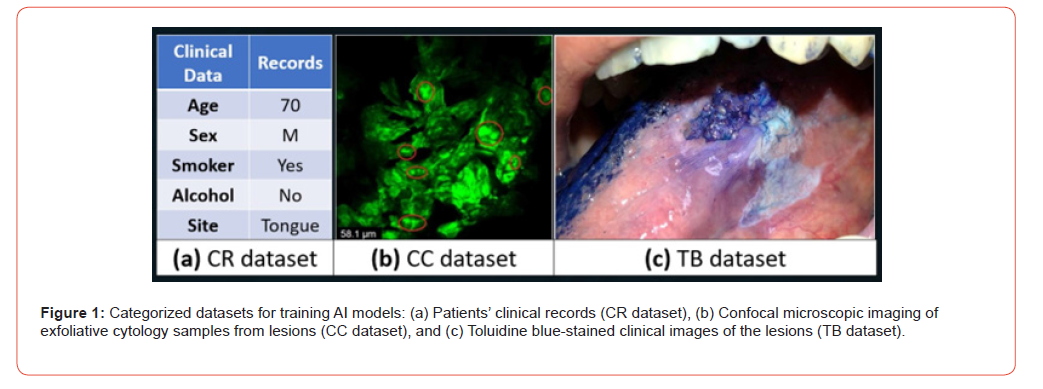
Pilot data included 50 patients recruited from the outpatient clinic of the Oral Medicine, Oral Diagnosis, and Periodontology Department, Faculty of Dentistry, Ain Shams University. Patients were diagnosed clinically as having OPMLs. Data from each patient was categorized into 3 datasets: (1) Patients’ clinical records (CR dataset), including age, sex, smoking habit, alcohol consumption, and lesions site (2) Confocal microscopic imaging of exfoliative cytology samples from lesions (CC dataset), and (3) Toluidine bluestained clinical images of the lesions (TB dataset) (Figure 1).
AI Model Development
Three models were developed and integrated into a single
web-based diagnostic tool:
1. Clinical Model: Clinical records were cleaned and
normalized, with categorical variables (e.g., tobacco use, alcohol
consumption) encoded numerically. A supervised machine
learning classifier (AdaBoost) was trained on an anonymized
CR dataset to categorize patients into mild, moderate, and
severe risk cases.
2. Microscopic Image Model: A deep learning CNN
(GoogleNet InceptionV3) was trained on the CC dataset to
count the number of cells with mitotic figures, then classify
images into mild, moderate, or severe dysplasia.
3. TB-Stain Pattern Model: A Roboflow-trained segmentation
model (SVM) that classifies the TB dataset into non-stained,
pale blue, or dark blue, indicative of mild, moderate, and severe
dysplasia, respectively.
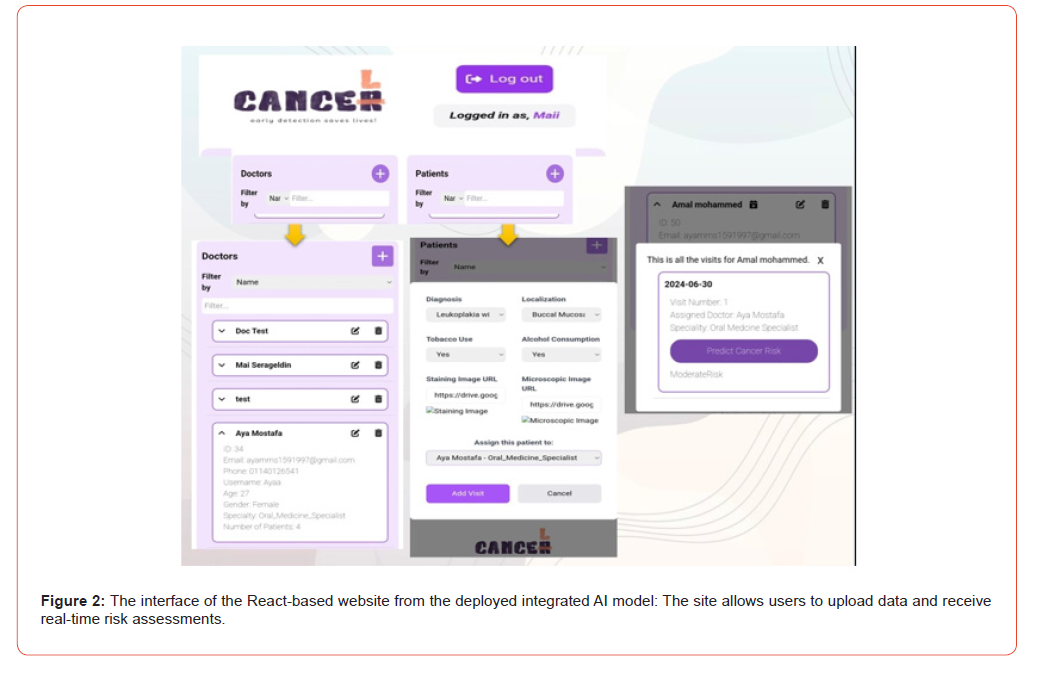
4. System Integration: The models were embedded into a
React-based website, allowing users to upload data and receive
real-time risk assessments (Figure 2). The backend, built with
.NET Core, ensured secure data handling and scalability via
Azure Cloud services.
The system was deployed and tested using a web interface by three independent oral medicine specialists.
Evaluation Metrics
Performance was assessed using accuracy, precision, recall, and F1-score. Output integration across the three models was used to generate a composite diagnostic recommendation.
Results and Discussion
• Clinical Model: AdaBoost demonstrated high performance
(91% accuracy-90% precision) in predicting risk levels from
clinical data.
• Microscopic Image Model: GoogleNet InceptionV3 showed
superior performance (94% accuracy, 92% F1-score) in
detecting cellular mitosis and classification.
• TB-Stain Pattern Model: SVM achieved 74.32% accuracy in
staining pattern classification.
• Integrated Model: The oral medicine specialists reported ease
of use and 98% agreement between the system output and
their assessment.
The developed AI-driven system addressed critical limitations of traditional diagnostics by offering a non-invasive, scalable solution for OPMLs screening. The integration of multiple data modalities enhanced diagnostic precision, while the user-friendly interface ensures feasibility in clinical settings. Notably, the microscopic imaging model’s high accuracy (94%) highlighted the potential for deep learning in pathological data.
Challenges included the need for further validation in diverse populations and a larger dataset. Future work will focus on expanding datasets, incorporating real-time imaging technologies, and conducting multicenter clinical trials to validate the system’s efficacy.
Conclusion
This pilot implementation of an AI-powered screening and risk assessment system for oral potentially malignant lesions demonstrated high accuracy and usability in a clinical simulation.
Acknowledgements
The authors would like to thank engineers Amir Mamdouh Nassif, Mai Hossam Hassan Serageldin, Malak Mohamed Metwalli, Mirna Ihab Ramzy, and Nour Hany Abdallah for their help in creating and deploying the models. This work was based on facilities in the Central Lab of Stem Cells and Biomaterial Applied Research (CLSBAR) funded by the Science, Technology and Innovation Funding Authority (STDF) under grant [CB project ID (21747)].
Conflict of Interest
The authors declare that they have no conflict of interest.
References
- González Ruiz I, Ramos García P, Ruiz Ávila I, González Moles MÁ (2023) Early Diagnosis of Oral Cancer: A Complex Polyhedral Problem with a Difficult Solution. Cancers (Basel) 15: 3270.
- Sukegawa S, Ono S, Tanaka F (2023) Effectiveness of deep learning classifiers in histopathological diagnosis of oral squamous cell carcinoma by pathologists. Scientific Reports 13: 1-9.
- Li XL, Zhou G (2024) Deep Learning in the Diagnosis and Prognosis of Oral Potentially Malignant Disorders.
-

This work is licensed under a Creative Commons Attribution-NonCommercial 4.0 International License.