


 Perspective
Vulnerable Plaque - Guided Coronary Intervention in Non–Flow-Limiting Lesions During the COVID-19 Pandemic: A Real-World Cohort Study and Paradigm Shift
Received Date:March 22, 2026; Published Date:April 01, 2026
Abstract
Background: Traditional coronary intervention strategies are guided by luminal stenosis severity. However, emerging evidence demonstrates
that most acute myocardial infarctions originate from non–flow-limiting lesions. The COVID-19 pandemic introduced a systemic proinflammatory
and prothrombotic state, further destabilizing coronary plaques.
Objectives: To evaluate the scientific rationale, clinical outcomes, and ethical justification of performing coronary interventions in lesions <50-
70% stenosis using a vulnerable plaque–guided approach during the COVID-19 pandemic.
Methods: A prospective real-world cohort of approximately 3,500 patients with coronary artery disease treated at Bethsaida Hospital (2020-
2023) was analysed. The strategy integrated plaque vulnerability assessment, selective intervention, intensive metabolic therapy, and a whole-food
plant-based diet.
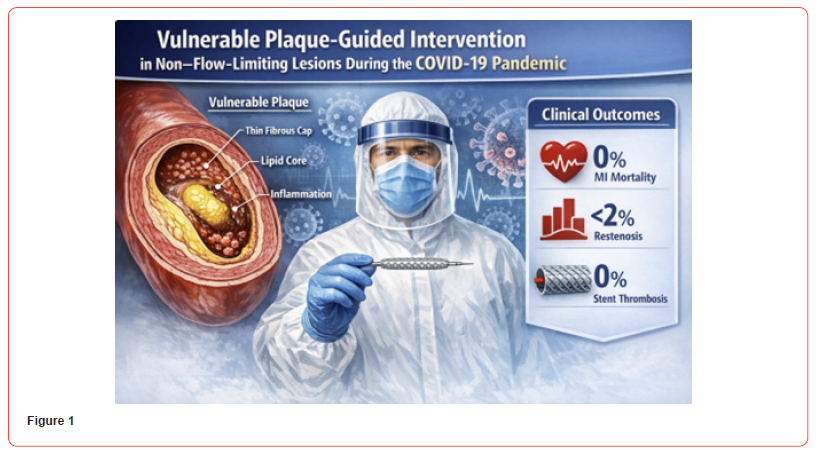
Results: The approach resulted in
• 0% acute myocardial infarction–related mortality
• <2% restenosis rate
• 0% stent thrombosis
These outcomes were achieved despite the markedly elevated cardiovascular risk associated with COVID-19.
Conclusions: Vulnerable plaque –guided intervention in non–flow-limiting lesions represents a scientifically justified, ethically sound, and clinically
effective strategy during systemic inflammatory crises such as COVID-19. This paradigm challenges traditional stenosis-based decision-making
and supports a biology-centered approach to coronary artery disease (Figure 1).
Introduction
“Medicine is a science of uncertainty and an art of probability.” —William Osler.
The COVID-19 pandemic fundamentally altered cardiovascular risk profiles [1-5], necessitating adaptive clinical strategies beyond traditional guideline frameworks. Conventional stenosis-based paradigms fail to account for plaque biology, which plays a dominant role in acute coronary events. This study provides a comprehensive scientific, clinical, and ethical justification for intervening on coronary lesions <50-70% during the pandemic, emphasizing a shift from stenosis-centric to biology-centric cardiovascular care [6-8].
Methods
Study Design
A real-world cohort analysis was conducted involving approximately 3,500 patients with coronary artery disease (CAD) treated between 2020 and 2023 [6-8].
Treatment Strategy
Patients were managed using an integrated approach:
a) Vulnerable plaque (VP) - guided intervention.
b) Selective coronary revascularization.
c) Intensive metabolic and inflammatory control.
d) Whole-food plant-based diet (WFPBD).
e) Close longitudinal monitoring.
Ethical Considerations
All patients:
• Received comprehensive explanation of risks and benefits.
• Provided written informed consent.
• Were treated under standard clinical governance.
No formal complaints were recorded to the hospital or medical disciplinary boards.
Results
Clinical Outcomes
• Myocardial infarction (MI) mortality: 0%
• Restenosis rate: <2%
• Stent thrombosis: 0%
Interpretation
These outcomes significantly outperform expected benchmarks
during the COVID-19 pandemic, where:
• MI incidence increased by 30 - 50% [9,10].
• Mortality increased 5 - 10-fold [11,12].
• COVID-associated MI mortality reached 25 - 42% [13-15].
Discussion
Limitations of the Stenosis-Based Paradigm
Evidence consistently shows:
• 75 - 86% of MI arise from lesions with 30 - 70% stenosis
[16-18].
• Non-obstructive plaques can precipitate sudden cardiac
death
The Motoyama study demonstrated [19]:
• High-risk plaque (HRP): HR 8.24
• Stenosis ≥70%: HR 1.61.
Event rates:
• HRP + stenosis <70% → 14.9% acute coronary syndrome
(ACS).
• HRP − stenosis ≥70% → 2.6% ACS
Thus, plaque biology outweighs luminal narrowing as a determinant of risk.
Imaging Evidence Supporting Plaque Vulnerability
Modern imaging (CTCA trials, SCOT-HEART trial) identifies key
predictors [20-26]:
• Low-attenuation plaque
• Positive remodelling
• Napkin-ring sign
Recent data by Vergallo et al [27]:
• Plaque burden is the strongest predictor of MI
COVID-19 as a Systemic Vascular Disease
COVID-19 induces [28-30]:
• Endothelial dysfunction
• Cytokine storm (IL-6, CCL2)
• Micro thrombosis
• Oxidative stress
• Fibrous cap thinning
This leads to rapid transformation:
• Stable plaque → VP
Clinical consequences:
• MINOCA ↑ 4× [31-33].
• Plaque rupture: 50–60% [2,34].
• Plaque erosion: 40–50% [2,34].
The Concept of “Vulnerable Patient + Vulnerable System”
Vulnerable Patient [21,35-37]
• Atherosclerosis
• Diabetes / insulin resistance
• Obesity
• Hypertension
• Hyperlipidaemia
• High inflammation
• Low nitric oxide (NO)
• Elevated trimethylamine n-oxide (TMAO)
Vulnerable System [1,38,39]
• Limited Cath lab access
• Delayed care
• Overloaded hospitals
Thus, result dramatically increased fatality risk if MI occurs.
Scientific Rationale for Intervention in <70% Lesions [40-44] Mechanical Stabilization
• Strengthening fibrous cap
• Reducing plaque stress
• Preventing rupture
Biological Modulation
• Reducing inflammation
• Improving endothelial function
• Lowering lipid burden
• Enhanced by WFPBD
Precision Medicine Approach
Combining
• Imaging risk
• Targeted intervention
• Metabolic optimization
Risk-Benefit Analysis
Procedural Risk
• Stent thrombosis: <0.5% (0% observed in our study population)
[6-8].
• Restenosis: 5–10% (2% observed in our study population)
[6-8].
Non-Intervention Risk (Pandemic)
• MI mortality ↑ 5–10×
• High risk of untreated events
Thus, non-intervention carries greater risk than intervention.
Position Relative to Clinical Guidelines
• Guidelines are designed for normal conditions
• No guidelines address:
o Pandemic-induced vascular inflammation
o Systemic thrombinflammatory states
Therefore:
• Guidelines = reference
• Clinical judgment = obligation
Global and national data indicate no significant improvement in MI outcomes during COVID-19, suggesting lack of adaptive strategies.
Ethical Framework
This approach fulfils all four principles:
a) Beneficence – Prevents MI and death
b) Non-maleficence – Lower procedural risk
c) Autonomy – Informed consent obtained
d) Justice – Reduces burden on healthcare systems
Legal and Public Health Context
Under pandemic conditions:
• Emergency response is State-led
• Clinical decisions must be evaluated based on:
a) Medical records
b) Outcomes
c) Scientific rationale
Professional organizations do not supersede clinical judgment in crisis scenarios.
Limitations
• Single-centre observational cohort
• No randomized control group
• Requires validation in multicentre studies
Conclusions
Coronary intervention in lesions <50–70% during the COVID-19
pandemic:
• Is supported by strong scientific evidence
• Aligns with modern plaque biology understanding
• Addresses pandemic-induced vascular risk
• Demonstrates superior real-world outcomes
• Meets ethical and clinical standards
This represents a paradigm shift from stenosis-based to biology- based cardiovascular care.
Clinical Perspectives
Competency in Medical Knowledge
Understanding plaque vulnerability is essential for preventing acute coronary events beyond traditional stenosis thresholds.
Translational Outlook
Future cardiovascular care should integrate:
• Advanced imaging
• Biological risk stratification
• Lifestyle and metabolic therapy
• Precision interventional strategies
Final Statement
This approach constitutes a scientifically grounded, ethically justified, and clinically effective medical decision, aimed at saving lives during a global health crisis, and should not be interpreted as deviation from accepted medical standards.
Author Contributions
D.M.; Conceptualization, writing, review, and editing.
Funding
This research received no external funding.
Institutional Review Board Statement
Not applicable.
Informed Consent Statement
Not applicable.
Data Availability Statement
Data are contained within the article.
Conflict of Interest
The authors declare no conflict of interest.
References
- Sucato V, Sausa G, Gambino G, D'Agostino A, Evola S, et al. (2024) The impact of coronavirus disease 2019 on acute coronary syndrome: Differences between epidemic waves. Am Heart J Plus 44: 100422.
- Bryniarski KL, Bartus S, Legutko J, Bryniarski L, Gasior P, et al. (2025) Pathogenesis of Acute Coronary Syndromes in Patients After COVID-19: An Optical Coherence Tomography Study. J Clin Med 14(24): 8895.
- Triantafyllis AS, Sfantou D, Karapedi E, Peteinaki K, Kotoulas SC, et al. (2025) Coronary Implications of COVID-19. Med Princ Pract 34(1): 1-12.
- Hu F, Zang M, Zheng L, Chen W, Guo J, et al. (2022) Effect of COVID-19 Pandemic on Acute Coronary Syndrome Clinical Practice Patterns: Findings from a Multicenter Clinician Survey in China. Rev Cardiovasc Med 23(11): 362.
- Kite TA, Pallikadavath S, Gale CP, Curzen N, Ladwiniec A (2022) The Direct and Indirect Effects of COVID-19 on Acute Coronary Syndromes. Cardiol Clin 40(3): 309-320.
- Mulijono D (2025) Complete Revascularization in a Time of Crisis: Why Treating Mild and Moderate CTCA-Detected Vulnerable Lesions was Lifesaving during the COVID-19 Pandemic. Online J Cardio Res & Rep 8(2): 2025.
- Mulijono D (2025) The Pandemic that Exposed the Truth: Only Vulnerability-Guided Complete Revascularization Prevents MI and Death. Med Clin Res 10(12): 01-27.
- Mulijono D (2025) Fixing the Narrowing vs Saving Lives: Vulnerable Plaque, Lifestyle Medicine, and the Future of Interventional Cardiology. Med Clin Sci 7(4): 1-8.
- Toscano O, Cosentino N, Campodonico J, Bartorelli AL, Marenzi G (2021) Acute Myocardial Infarction During the COVID-19 Pandemic: An Update on Clinical Characteristics and Outcomes. Front Cardiovasc Med 8: 648290.
- Primessnig U, Pieske BM, Sherif M (2021) Increased mortality and worse cardiac outcome of acute myocardial infarction during the early COVID-19 pandemic. ESC Heart Fail 8(1): 333-343.
- Abate SM, Mantefardo B, Nega S, Chekole YA, Basu B, et al. (2021) Global burden of acute myocardial injury associated with COVID-19: A systematic review, meta-analysis, and meta-regression. Ann Med Surg 68: 102594.
- Timpau AS, Miftode RS, Leca D, Timpau R, Miftode IL, et al. (2022) A Real Pandora's Box in Pandemic Times: A Narrative Review on the Acute Cardiac Injury Due to COVID-19. Life 12(7): 1085.
- Rus M, Ardelean AI, Andronie-Cioara FL, Filimon GC (2024) Acute Myocardial Infarction during the COVID-19 Pandemic: Long-Term Outcomes and Prognosis-A Systematic Review. Life 14(2): 202.
- Choi HK, Maity M, Qureshi M, Haider A, Kapadia S, et al. (2024) Multifaceted Impact of the Coronavirus Disease 2019 (COVID-19) Pandemic on ST-Elevation Myocardial Infarction (STEMI): A Literature Review of Incidence, Treatment Modalities, and Outcomes. Cureus 16(3): e57288.
- Ramadan MS, Bertolino L, Marrazzo T, Florio MT, Durante-Mangoni E (2021) The Monaldi Hospital Cardiovascular Infection Study Group. Cardiac complications during the active phase of COVID-19: review of the current evidence. Intern Emerg Med 16(8): 2051-2061.
- Sheng L, Li S, Li JQ, Xue JY, Sun YM, et al. (2016) Presence of Severe Stenosis in Most Culprit Lesions of Patients with ST-segment Elevation Myocardial Infarction. Chin Med J 129(17): 2074-2078.
- Toth PP (2008) Subclinical atherosclerosis: what it is, what it means and what we can do about it. Int J Clin Pract 62(8): 1246-1254.
- Doenst T, Haverich A, Serruys P, Bonow RO, Kappetein P, et al. (2019) PCI and CABG for Treating Stable Coronary Artery Disease: JACC Review Topic of the Week. J Am Coll Cardiol 73(8): 964-976.
- Motoyama S, Sarai M, Harigaya H, Anno H, Inoue K, et al. (2009) Computed tomographic angiography characteristics of atherosclerotic plaques subsequently resulting in acute coronary syndrome. J Am Coll Cardiol 54(1): 49-57.
- Blake SR, Heseltine TD, Murray S, Ruzsics B (2017) A vulnerable plaque identified on CT coronary angiography: when should we act in stable coronary artery disease?. BMJ Case Rep 2017: bcr2017219774.
- Tomaniak M, Katagiri Y, Modolo R, de Silva R, Khamis RY, et al. (2020) Vulnerable plaques and patients: state-of-the-art. Eur Heart J 41(31): 2997-3004.
- van Veelen A, van der Sangen NMR, Henriques JPS, Claessen BEPM (2022) Identification and treatment of the vulnerable coronary plaque. Rev Cardiovasc Med 23(1): 39.
- Adamson PD, Newby DE (2019) The SCOT-HEART Trial. What we observed and what we learned. J Cardiovasc Comput Tomogr 13(3): 54-58.
- Shaw LJ, Narula J (2019) SCOT-HEART is the trial that we have been waiting for!. J Cardiovasc Comput Tomogr (3): 51-53.
- McDermott M, Meah MN, Khaing P, Wang KL, Ramsay J, et al. (2024) Rationale and Design of SCOT-HEART 2 Trial: CT Angiography for the Prevention of Myocardial Infarction. JACC Cardiovasc Imaging 17(9): 1101-1112.
- Williams MC, Wereski R, Tuck C, Adamson PD, Shah ASV, et al. (2025) SCOT-HEART Investigators. Coronary CT angiography-guided management of patients with stable chest pain: 10-year outcomes from the SCOT-HEART randomised controlled trial in Scotland. Lancet 405(10475): 329-337.
- Vergallo R, Park SJ, Stone GW, Erlinge D, Porto I, et al. (2025) Vulnerable or High-Risk Plaque: A JACC: Cardiovascular Imaging Position Statement. JACC Cardiovasc Imaging 18(6): 709-740.
- Smadja DM, Mentzer SJ, Fontenay M, Laffan MA, Ackermann M, et al. (2021) COVID-19 is a systemic vascular hemopathy: insight for mechanistic and clinical aspects. Angiogenesis 24(4): 755-788.
- Saha I, Banerjee O, Sarkar Biswas S, Mukherjee S (2025) COVID-19 beyond the lungs: Unraveling its vascular impact and cardiovascular complications-mechanisms and therapeutic implications. Sci Prog 108(1): 368504251322069.
- Karakasis P, Nasoufidou A, Sagris M, Fragakis N, Tsioufis K (2024) Vascular Alterations Following COVID-19 Infection: A Comprehensive Literature Review. Life 14(5): 545.
- Alasnag M, Shah B, Botti G, Zaman S, Chieffo A. (2022) STEMIs and a Closer Look at MINOCA During the COVID-19 Pandemic. J Soc Cardiovasc Angiogr Interv 1(4): 100372.
- Eroglu SE, Ademoglu E, Bayram S, Aksel G (2021) A Rare Cause of ST-Segment Elevation Myocardial Infarction in COVID-19: MINOCA Syndrome. Medeni Med J 36(1): 63-68.
- John K, Lal A, Sharma N, ElMeligy A, Mishra AK (2022) Presentation and outcome of myocardial infarction with non-obstructive coronary arteries in coronavirus disease 2019. World J Crit Care Med 11(3): 129-138.
- Konishi T, Kawai K, Kawakami R, Ghosh SKB, Vozenilek AE, et al. (2023) Histologic Assessment of Thromboemboli Due to Plaque Rupture, Plaque Erosion, or COVID-19 Microthrombi. JACC Case Rep 14: 101826.
- Magnani G, Demola MA, Fava C, Mantovani F, Ardissino D (2010) Dalla placca vulnerabile al paziente vulnerabile [From vulnerable plaque to vulnerable patient]. G Ital Cardiol 11(12 Suppl 3): 6S-9S.
- Stone GW, Mintz GS, Virmani R (2010) Vulnerable Plaques, Vulnerable Patients, and Intravascular Imaging. J Am Coll Cardiol 72(17): 2022-2026.
- Sage AP, Antoniades C (2021) From the vulnerable plaque to the vulnerable patient: Current concepts in atherosclerosis. Br J Pharmacol 178(11): 2165-2167.
- Harky A, Chor CYT, Khare Y (2020) COVID-19 and its impact on cardiology service. Acta Biomed 91(4): ahead of print.
- Mogharab V, Ostovar M, Ruszkowski J, Hussain SZM, Shrestha R, et al. (2022) Global burden of the COVID-19 associated patient-related delay in emergency healthcare: a panel of systematic review and meta-analyses. Global Health 18(1): 58.
- Kim H, Ahn JM, Kang DY, Lee J, Choi Y, et al. (2024) Management of Coronary Vulnerable Plaque with Medical Therapy or Local Preventive Percutaneous Coronary Intervention. JACC Asia 4(6): 425-443.
- Park DW, Boden WE, De Caterina R, Gallinoro E, Ahn JM, et al. (2026) Great debate: preventive percutaneous coronary intervention added to optimal medical treatment should be the default treatment for non-flow-limiting vulnerable plaques. Eur Heart J 6: ehag103.
- Park SJ, Ahn JM, Kang DY, Yun SC, Ahn YK, et al. (2024) PREVENT Investigators. Preventive percutaneous coronary intervention versus optimal medical therapy alone for the treatment of vulnerable atherosclerotic coronary plaques (PREVENT): a multicentre, open-label, randomised controlled trial. Lancet 403(10438): 1753-1765.
- Stone GW, Maehara A, Ali ZA, Held C, Matsumura M, et al. (2020) PROSPECT ABSORB Investigators. Percutaneous Coronary Intervention for Vulnerable Coronary Atherosclerotic Plaque. J Am Coll Cardiol 76(20): 2289-2301.
- van Veelen A, Küçük IT, Fuentes FH, Kahsay Y, Garcia-Garcia HM, et al. (2023) First-in-Human Drug-Eluting Balloon Treatment of Vulnerable Lipid-Rich Plaques: Rationale and Design of the DEBuT-LRP Study. J Clin Med 12(18): 5807.
-

This work is licensed under a Creative Commons Attribution-NonCommercial 4.0 International License.