

 Short Communication
The “Three-Combined Evidence System” Of Traditional Chinese Medicine in AI Era
Received Date:March 10, 2026; Published Date:March 25, 2026
Short Communication
Traditional Chinese Medicine’s “syndrome differentiation and
treatment” is essentially individualized precision medicine based
on multidimensional features [1,2] such as tongue images and
clinical indicators [3], pulse signals [4] and multi-omics [5] in the
study of syndrome differentiation and biological basis. The National
Administration of Traditional Chinese Medicine lunched “threecombined
evidence system” [6], which refers to an integrated
evaluation framework for new Traditional Chinese Medicine (TCM)
drugs, combining:
1. Human use experience-based on long-term clinical
practice data regarding efficacy and safety;
2. Clinical trials-following modern evidence-based medicine
standards, such as Randomized Controlled Trials (RCT)
3. Basic research-encompassing the study of active
components/leads, mechanisms, pharmacokinetics and
pharmacodynamics.
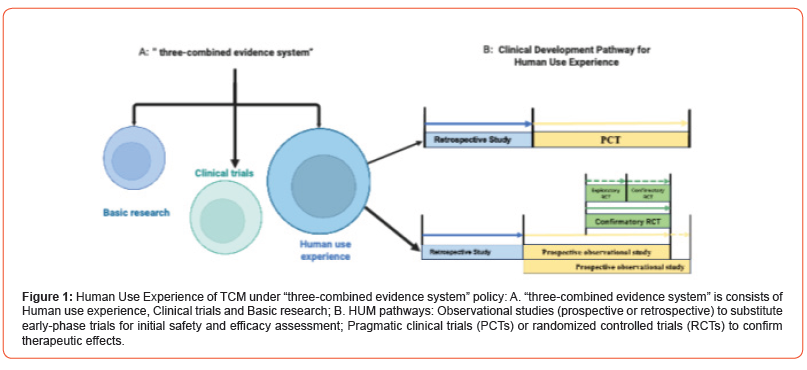
However, how to scientifically transform the massive fragmented “Human Use Experience (HUE)” into evidence-based proof that meets modern regulatory requirements, and establish the intrinsic mapping rules between “syndrome” and “precision biomarkers,” is currently a bottleneck/great opportunity in the modernization and development of Traditional Chinese Medicine. Using AI to perform cross-temporal and spatial representation alignment of millennia-old classical medical texts and clinical practice (HUE), traditional experience can be deconstructed into computable digital twin models, enabling reverse discovery and prospective simulation prediction from retrospective experience to translational medicine.
Funding
This paper is supported by Shenzhen Stable Support Project for Universities (20231127194506001) and Guangdong Province General Colleges and Universities Innovation Project (2024KTSCX055).
- Zhang P, Zhang D, Zhou W (2024) Network pharmacology: towards the artificial intelligence-based precision traditional Chinese medicine[J/OL]. Briefings in Bioinformatics, 2024, 25(1): bbad518[2026-02-20].
- Song YN, Zhang GB, Zhang YY (2013) Clinical Applications of Omics Technologies on ZHENG Differentiation Research in Traditional Chinese Medicine[J/OL]. Evidence-based Complementary and Alternative Medicine : eCAM, 2013, 2013: 989618[2026-02-20].
- Zhang J, Feng S, Xue J (2025) AI-driven multimodal fusion of tongue images and clinical indicators for identifying MAFLD patients at risk of coronary artery disease: An exploratory study[J/OL]. ILIVER 4(3): 100181[2026-02-20].
- Guo P, Jiang M, Hu S (2026) Advancing the modernization of traditional Chinese medicine through artificial intelligence and multimodal data integration[J/OL]. Chinese Medicine 21(1): 54[2026-03-06].
- Zhao M, Che Y, Gao Y (2024) Application of multi-omics in the study of traditional Chinese medicine[J/OL]. Frontiers in Pharmacology 15: [2026-02-20].
- National Medical Products Administration Announcement on Issuing the "Classification of Traditional Chinese Medicine Registration and Requirements for Application Materials" (No. 68 of 2020) _ Other Working Documents _ Shanghai Municipal Drug Administration [EB/OL]. [2026-03-03].
-

This work is licensed under a Creative Commons Attribution-NonCommercial 4.0 International License.