


 Research Article
Should Sexology Be Involved in the Discussion on Climate Change and What May Its Basis Be?
Received Date: April 01, 2026; Published Date: April 17, 2026
Introduction
Evaluating climate change from the standpoint of environmentalism as a specific and concrete structure of risks
The term “denier” appears rather frequently in the current climate change debate. This term has clearly negative and emotional connotations suggesting the closeness of merciless inquisition and seems to be originating in the darkness beyond the light of reason, including scientific reason.
I have been actively interested in various aspects environmentalism for decades alongside other field as part of my multidisciplinary focus with attempts at interdisciplinary synthesis. Therefore, I will first try to outline an entirely objective (in my opinion) structure of risks posed by the current stage of the climate change from the point of view of environmentalism:
I have been actively interested in various aspects environmentalism for decades alongside other field as part of my multidisciplinary focus with attempts at interdisciplinary synthesis. Therefore, I will first try to outline an entirely objective (in my opinion) structure of risks posed by the current stage of the climate change from the point of view of environmentalism:
b) The earth system science emerging in the 1980s surpassed the traditional environmentalist sector-based approach; it is based on ecosystem ecology and the study of complex systems. However, it is also important to note that the earth system science applies the hypothesis or the theory of Gaia, which views (somewhat teleologically) the planet of Earth as a superstructure that uses mainly negative feedback to maintain the homeostatic nature of the Earth’s ecosystem in the highly variable conditions of the cosmos.
c) The earth system science assumes that the Earth’s system changes in bursts, rather than continually; the non-linearity of development shows clearly upon crossing the turning point, at which positive feedback begins to dominate, intensifying and widening individual disruptions to the original homeostasis, instead of dampening them. Such transformation of negative feedback into positive one is not a rarity in nature; for example, it is evident at key moments of human reproduction. The dominance of positive feedback essentially leads to a change in conditions that may render the planet uninhabitable. For example, the loss of the Greenland’s ice sheet may be the frequently discussed turning point, as it would lead to reduction of the Earth’s albedo and consequently to accelerated warming of the atmosphere [1]. Collapse of the West Antarctic ice sheet may have a similarly catastrophic effect, as it may raise the global sea level by 6 meters [2].
d) The structure of the climate change risk does not stem merely from the fact that the climate change is occurring, because climate change is in fact a constant process. Even in the stable Holocene of the last approximately 12,000 years, minor ice ages or a warmer period during the Middle Ages are mentioned. As late as in the final decades of the 20th century, certain leading authors with excellent scientific achievements discussed the option that the Holocene may simply be a temporary warm spell before the next ice age as part of the ongoing Pleistocene [3]. The risk is posed by the probably realistic assumption of the abruptness of the change occurring once the turning point is reached in the overall historical situation of the Great Acceleration after World War II and the time and space compression caused by globalization processes from the 1970s. Yet, we still do not know where the turning point is and how great the rate of discontinuity will be. We know that some leverage is under our control, but we also know that not all leverage is under our control.
e) This major decision making in a highly ambiguous situation and this deep noetic and ethical ambivalence accompanied by clearly positive identification of warning phenomena at the level of the planetary ecosystem paradoxically places great responsibility on the mankind. The structure of this responsibility is extraordinary. The high level of specific uncertainty against the background of scientifically verified hypotheses of the turning point and the abrupt character of the change requires combining almost incompatible aspects. On the one hand, we need to be decisive, waste no time and utilize the greatest possible extent of opportunities. On the other hand, we need to steer clear of a dogmatic approach. We need to unite in a strategy of non-dogmatic maximalism – this applies to mitigation, as well as adaptation strategies. Therefore, this responsibility requires continuous contemplation of the topic of proportionality under the non-dogmatic maximalism, factual analysis of the character of evolution of the life on the planet of Earth, and courage to determine further perspectives of the civilization, including cosmic measures.
f) Universal acceptation of the key scientific truths is the one critical moment, which is necessary if the points mentioned above are to apply. The process of striving for non-dogmatic maximalism needs to be accompanied by continuous attempt at depoliticization of science at the planetary level. The very existence of the humanity is at stake when it comes to the climate change, and if the climate change discussion should be affected by a new version of the debate on genetics, as in the case of the competition between socialism and capitalism in the first half of the 20th century, this would represent a highly negative development. This terrifying situation, when the mankind observed medieval inquisition methods in the chase after intellectual opposition, including casualties, against the backdrop of the debate on the impact of the environment on inheritability [4], would eradicate the last hope available to the mankind – the hope in the power of science, if it were to occur in connection with climate change.
g) The author of this paper believes that it is essential that we follow the direction outlined in the two agreements mentioned below, which, in the author’s opinion, are based on non-dogmatic maximalism, while taking into account proportionality. It is safe to assume that these agreements were concluded at the highest political level as political agreements. However, they were concluded in good faith with maximum utilization of the ability to attach a political value to exceptionally disparate and often amorphous masses of scientific information. However, politics serve this very purpose and are irreplaceable in this aspect. Our world is inherently political is this regard and the deep paradox of the mankind we should be aware of lies in the fact that the wellfounded, interdisciplinary political practice as gradual expert decision making essentially protects science as a set of specialized academic sciences against their unilaterality.
Paris Climate Agreement (in the context of the UN Framework Convention on Climate Change): The long-term temperature target under the Paris Agreement from 2015 is to maintain the increase in the average global temperature significantly under 2°C compared to the values prior to the industrial revolution and, if possible, limit the increase to 1.5°C. Emissions should be reduced as quickly as possible with the aim to achieve zero emissions by the middle of the 21st century. To maintain global warming below 1.5°C, emissions need to be reduced by approximately 50% by 2030.
The European Green Deal is a strategy of the European Union introduced in 2019 with the aim to achieve climate neutrality by 2050. It is a comprehensive set of measures affecting all areas of economy. The objective is to reduce greenhouse gas emissions in the EU by 2030 by 55% compared to the status in 1990.
Objectives
The aim of the study is to determine the overall proportions of the current discussion on the contribution of sexology or reproductive medicine and health to the topic of climate change based on the performed research and its evaluation. Furthermore, the study will attempt to present rationale of the estimate and of the possible future development of such contribution. From the methodological point of view, the study aims to deepen the interdisciplinary character of the contribution of sexology or reproductive medicine or health to the topic of climate change by including topics of environmental ethics. By doing so, the study strives to point out that topics of environmental ethics form a framework of thought or a system of thought interconnections that may significantly strengthen the position of sexology or reproductive medicine or health in the current debate on climate change.
Methods
a) The study is based on previously published scientific papers:
Tomáš Hájek (2025) On Phenomenology of Neo-Malthusianism Primarily in the Aspect of Birth Control. In: Current Trends in Clinical & Medical Sciences, Iris Publishers 4(1).
Tomáš Hájek (2025) Environmentalism, Neo-Malthusianism, Anarchism, and Sexuality. In: Open Access Journal of Addiction and Psychology, Iris Publishers 8(2)
Tomáš Hájek (2025) Old Age in Humans Primarily from the Perspective of Utopic Thinking as the Foundation for Resolving Bioethical Issues Relating to Old Age. In: Current Trends in Clinical & Medical Sciences, Iris Publishers 4(3).
Tomáš Hájek 2025) Research: Utopia of Non-Technological Type and the Topic of Prostitution Open Access Journal of Addiction and Psychology, DOI: 10.3352/OAJAP.2025.08.000686, Volume 8 - Issue 3, December, 2025
'b) Literature research was commissioned and performed (Study and Scientific Library of the Plzeň Region): Climate change from the perspective of reproductive medicine, sexual behavior of the population. Timeframe: 1990 – 2026, languages: Czech, English, German.
c) As mentioned previously, the study is based on the assumption that topics of environmental ethics may be a significant basis for interdisciplinary synthesis, which will contribute to resolution of the topic of climate change or to the share of sexology and reproductive medicine and health in managing climate change. The necessary research and study utilizing to some extent the author’s long-term monitoring of the topic were performed in this context [5].
Results
a) Summary of the author’s published texts in international scientific press referring to the topic and pointing out ways of approach:
Table 1:
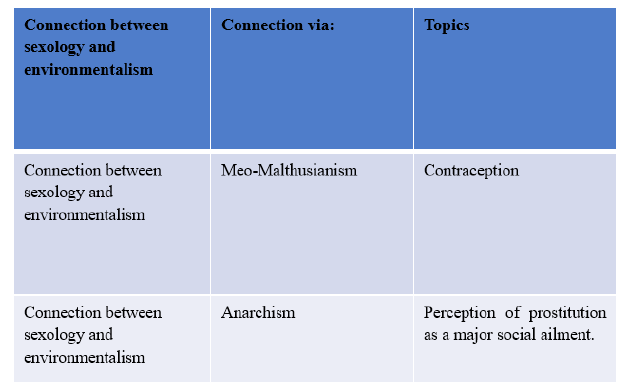
b) Summary of the analysis of literature research outcomes:
Topics of sexuality and reproductive medicine and health is currently an undisputable part of global debate on the topic of climate change with significant potential for future. On the other hand, an opposing opinion may also be quoted: “Mitigation strategies that hinge on decreasing emissions through the slowing of population growth have rightfully received relatively little attention among the different mitigation strategies for various reasons [6].” To quote the reason: “Policies and practices driven by a desire to stem population growth have led to countless human rights violations. The International Conference on Population and Development in 1994 marked an important shift away from earlier population-focused objectives to a broader sexual and reproductive health and rights agenda, grounded in individual human rights.”
The overall terrain of the debate on the relationship between population growth and climate change is complex and viewed variously in connection with the current, often surprising population trends. Opposing standpoints can be observed, for example, in the case of the so-called Northern Perspective (reduction of population growth through family planning is the general solution at least to some extent), and the Intergovernmental Panel on Climate Change (IPCC), which promotes a more comprehensive approach [7].
Research of the relationship between environmental changes and sexuality or reproductive medicine and health continues to develop and represents an extraordinarily important field of future study. It is necessary to reiterate that its dynamics are not linear. The United Nations Conference on Environment and Development held in Rio de Janeiro in 1992 can be described as a critical event. This event introduced the term “sustainable development”, which involves the triad of production – consumption – population development as its key component. The current more or less pragmatic and factual approach to the relationship discussed here can be documented by the following quote: “A wide range of direct and indirect consequences of climate change have been reported on reproductive health. This calls for the need to develop climateadaptive healthcare systems and policies to reduce the existing risks, including promoting easy access to family planning [8].”
The topic of contraception is a profiling topic in the debate as a whole: “Different stakeholders have pointed to contraception as an important intervention for climate change mitigation. Project Drawdown, for example, includes family planning alongside girls’ education among the top 10 of its climate solutions. The argument is that contraception will reduce fertility, which will lower population growth, which in turn will lead to decreased levels of greenhouse gas emission [9].”
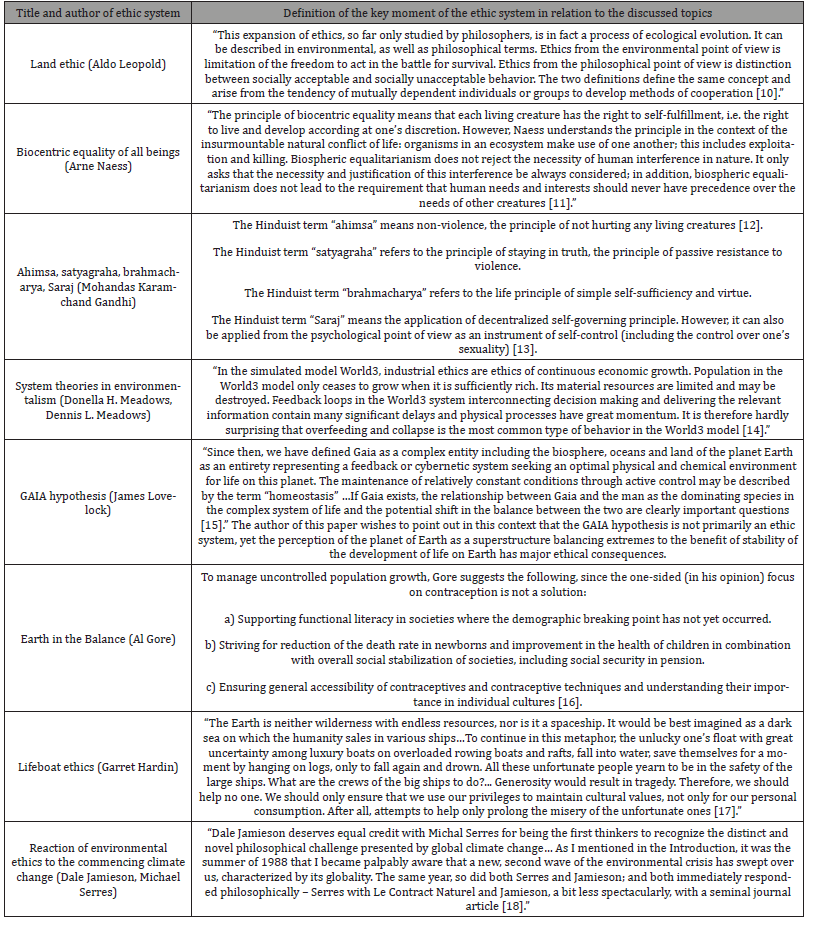
c) Selected systems of environmental ethics may frame and systematically develop the current discussion on the relationship between population, sexuality, reproduction, reproductive health and climate change. The table is structured freely, based on connections between chronology and integration of environmental ethics in wider thought frameworks: anthropocentrism versus biocentrism, liberal versus conservative. The order used in the table therefore does not imply any assessment.
Table 2:
Conclusions
a. According to the most general canon of our civilization, which developed during the Holocene, the Nature can be perceived as a constant condition from or alongside which the variable history of the Culture unfolds. This is despite the ongoing evolution of the Nature or natural conditions, which have seemingly reached their balanced stage during the Holocene with its stable climate. Therefore, the Culture develops in a certain definable framework and is therefore predictable. The exact description of the way how the silently hypostatized constancy of the Nature allowed for the definition of the variable history of the Spirit is a task for the modern thinking; the author of this study believes that this can only be achieved through interdisciplinary synthesis.
b. Climate change generally contributes to destabilization of political, economic and cultural conditions on a global scale. Its manifestations at the microlevel are so far similar to the manifestations of other “traditional” destabilizations, for example due to wars and pandemics. However, the key problem of climate change lies in the fact that it is rather difficult to predict on a long-term basis. “Climate change is not a pollutant in the conventional sense used in public health; it is projected to fundamentally alter the natural and humanmade systems on which our society relies, including air, water, agriculture, and ecosystems [19].” Therefore, the Nature can be more changeable than the Culture. The consequences of this principle may be highly significant and are undoubtedly difficult to estimate.
c. Sexology and reproductive medicine and health may face three tasks: a) to engage and ensure to the best of their ability that the Nature remains the constant for as long as possible; b) to gradually work with the assumption that this may not happen and that the upcoming change of the Nature will lead to deep transformation of the relationship between the Nature and the Culture; c) to prepare for the possibility of entirely different natural (cosmic) conditions for the existence of the civilization. Essentially, this means that sexology needs to prepare for an era of the technological Utopia in a broader sense.
d. However, the potential catastrophism of the climate change motivates us even today to deviate from the traditional, stereotypical and ideologizing understanding of the reality. Referring back to the table defining connections between sexology and environmentalism, this means for example that sexology may use Neo-Malthusianism, as well as anarchist thinking to advocate for global dissemination of modern, primarily hormonal contraception, yet at the same time raise its voice against prostitution as a major social ailment.
e. Sexology and reproductive medicine and health are fields that connect the body and the spirit or the Nature and the Culture in an almost exemplary manner. Their potential for elaborating on and developing the topics of the Nature and the Culture in changing conditions of the Nature is massive and irreplaceable. However, sexology and reproductive medicine and health should be open to interdisciplinary cooperation as an essential condition. This study highlights environmental ethics, as they may play an extraordinarily important role.
Acknowledgement
The author would like to thank the Study and Scientific Library of the Plzeň Region for their help with researching the topic.
Conflict of Interest
No conflict of interest
References
- Michal V. Marek et al. (2022) Klimatická změna – příčiny, dopady a adaptace. Praha: Nakladatelství Academia, Středisko společných činností AV ČR, v.v.i. PP. 350.
- Al Gore (2007) Nepříjemná pravda – naše planeta v ohrožení – globální oteplování a co s ním můžeme dě Traslated by Jitka Fialová. Praha: nakladatelství Argo PP. 325.
- David Malcolm Raup (1995) O zániku druhů – Je Darwinova teorie o přežívání nejkvalitnějších druhů jediným vysvětlením života na Zemi? Translated by Anton Markoš. Praha: Nakladatelství Lidové noviny PP. 187.
- Garrett Hardin (1959) Nature and Man’s Fate. New York, Toronto: Kessinger Publishing PP. 400
- Tomáš Hájek (2014) Krajina jako filozofické téma u Václava Havla (ke trojí interpretaci Havlovy krajiny domova). In: Mieczyslaw Balowski, Boguslav Bakula (eds.) Václav Havel, Człowiek-pisarz-filozof-polityk. Poznań: Instytut Filologii Slowiańskiej, Uniwersytet im. Adama Mickiewicza w Poznaniu, Wydawnictvo PRO PP. 189-198.
- WOMEN DELIVER (2021) The link between climate change and sexual and reproductive health and rights: an evidence review. New York: Women Deliver PP. 48.
- George Martine (2009) Population Dynamics and Policies in the Context of Global Climate Change. In: José Miguel Guzmán, George Martine, Gordon McGranahan, Daniel Schensul, Cicilia Tacoli (eds.) Population Dynamics and Climate Change. UNFPA; International Institute for Environment and Development PP 9-30.
- Saurabh Ram Bihari Lal Shrivastava, Sudhakar Prateek Bob hate, Abhay Bharauo Chavan (2025) Climate Change and Reproductive Health: Adopting a Comprehensive Approach to Reduce the Impact. In: Journal of Mid-life Health PP. 336-339.
- International Planned Parenthood Federation (2021) IPPF Position Paper: The climate crisis and sexual and reproductive health and rights.
- Aldo Leopold (1995) Obrázky z chatrče a rozmanité poznámky (Sand County Almanac). Translated by Anna Pilátová. Tulčík: Vydavatel´stvo Lesoochranárskeho zoskupenia VLK PP. 269.
- Rudolf Kolářský (1998) Filosofie současné ekologické In: Rudolf Kolářský, Oleg Suša. Filosofie a současná ekologická krize. Praha: Filosofický ústav AV ČR PP. 11-61.
- David M. Knipe (1997) Hinduismus – experimenty s posvátnem. Translated by Kateřina Hronová. Praha: PROSTOR, nakladatelství Aleše Lederera a Michala Štěpánka PP. 228.
- Móhandás Karamčand Gándhí (2003) Hind svarádž – Indická samosprá Translated by Jiří Zavadil. Brno: nakladatelství DOPLNĚK, společensko-ekologická edice PP. 101.
- Donella H. Meadowsová, Dennis L. Meadows, Jǿrgen Randers (1995) Překročení mezí – konfrontace globálního kolapsu s představou trvale udržitelné Translated by Pavla Polechová a Ladislav Zvolánek. Praha: Argo PP. 319.
- James Lovelock (2001) GAIA – Nový pohled na život na Zemi. Translated by Jan Edlman. Second edition. Tulčík: Abies-vydavatel´stvo Lesoochranárskeho seskupenia VLK PP. 211.
- Al Gore (2000) Země na misce vah – ekologie a lidský Translated by Jan Jařab. Praha: nakladatelství Argo PP. 374.
- Erazim Kohák (2023) Zelená svatozář - Kapitoly z ekologické etiky – přepracované vydání. Third edition, first edition in Karolinum. Praha: Univerzita Karlova, nakladatelství Karolinum PP. 233.
- Baird Callicott (2013) Thinking Like a Planet – The Land Ethic and the Earth Ethic. New York: Oxford University Press PP. 374.
- Kristie L. Ebi et al. (2009) U.S. Funding Is Insufficient to Address the Human Health Impacts of and Public Health Responses to Climate Variability and Change. In: Environmental Health Perspectives P.P 857–862.
-

This work is licensed under a Creative Commons Attribution-NonCommercial 4.0 International License.