



 Research Article
Sex Differences in Self-Medication Patterns and Stress
Received Date: November 12, 2025; Published Date: November 20, 2025
Abstract
Objective: The current study sought to find out to what degree the linkage exists between sex, stress levels, and self-medication activities.
Method: We used an anonymous survey in both English and Spanish and surveyed 615 participants, of which the average age was 36.5 years.
For gender, participants coded themselves as “male” (n = 350) and “female” (n = 243). We did not request participants to code ethnicity. We used
a demographics questionnaire, a list of substances used for self-medication along with some questions about self-medication activities, and the
Perceived Stress Scale (Cohen & Williamson, 1988).
Results: We found a significant correlation between stress and the number of different self-medication substances tried or used only for
those participants who identified as female. Further, our results indicated that reported stress, as evaluated by the Perceived Stress Scale (Cohen &
Williamson, 1988), explained a significant amount of variance in the total number of substances tried or used. These results support a link between
sex, stress, and self-medication activities.
Conclusion: The results help to contextualize the reality that individuals may be seeking out substances to handle negative situations.
Keywords:Sex; Self-medication; Stress; Negative affect; Addiction
Sex; Self-medication; Stress; Negative affect; Addiction
Self-medication, which typically occurs when a person uses medicine to treat self-diagnosed disorders without consultation or supervision by a medical practitioner, is a nearly ubiquitous feature today [1,2]. Numerous studies have suggested the percentage of adults engaging in self-medication is anywhere from 20% to 50% [1-5]. In Ecuador during the COVID-19 pandemic, Arias, et al. [6] found that about half of their Pichincha, Ecuador-based sample who took medication during the pandemic engaged in self-medicating. In a more recent Ecuador-focused study, Ortiz-Prado, et al. [7] found a significant increase of consumption of medication—both proscribed and self-administered-during the pandemic.
Khantzian, a pioneer in the field of addiction and substance use, created a theory to explain self-medication: the self-medication hypothesis (SMH) [8,9]. SMH posited addictive drugs are sought out for 1) relieving human psychological suffering and 2) providing a degree of specificity in the person’s drug-of-choice [10]. Over the past several decades, numerous researchers have used SMH to understand self-medication [8,10, 11,12]. Hall and Queener [8] examined Khantzian’s [13] theory furtherance that negative affect would be related to more substance use. These researchers did not find a relationship between substance use and negative or ambiguous affect, as specifically measured by depression, anxiety, and hostility [8]. Khantzian [13,14] previously referenced post-traumatic stress (PTSD) as potentially associated with selfmedication.
Torres-Berrio, et al. [15] outlined the interaction between stress and addiction from a neuroscience perspective. These and other researchers have shown stress as a significant risk factor for drug addiction development [16,17]. Mantsch, et al. [16] has demonstrated this linkage especially with opioid and cocainedependent individuals. Stress, both chronic and acute, appears to be strongly linked to various addictions [15]. The purpose of this study was to evaluate the role of stress with self-medication activities. We believed that the greater the stress levels, the higher the potential for an individual to engage in self-medication activities.
Methods
Participants
We used a convenience sample to recruit anonymous participants from both online sources (e.g., Reddit, Facebook) and using Amazon’s MTurk program. Overall, we had 1,624 participants start the survey. Amazon MTurk’s cross-sectional convenience sampling technique allowed us to include the following eligibility criteria: Over 18 years old and only Mechanical Task Workers with a Human Intelligence Task (HIT) approval rate of 85%. We also reviewed all the results to identify and remove outliers including those participants who did not fully complete the survey. We ended up with 615 participants. The participants had the option of completing the survey in either English or Spanish. We had 12 participants complete the survey in Spanish.
Measures
We created a simple demographic survey asking for age, gender, and sex. The average age was 36.5 years (SD = 10.7). For the open text field of gender, we received mostly those who classified themselves as “male” (n = 350) and “female” (n = 243). Others coded themselves as “non-binary”, “genderfluid”, and other variations. For sex, participants coded themselves as “man/male” (n = 344), “woman/female” (n = 261), and “intersex” (n = 4).
Perceived Stress Scale
The Perceived Stress Scale-10 (PSS-10) [18] is a self-report measure containing 10 items on a Likert-type scale with response categories ranging from 1 (Never) to 5 (Very Often). Items 4, 5, 7, and 8 are reverse coded. The whole measure is then summed. The PSS- 10 was designed to be used in community samples and assumes respondents have at least a middle school education. We found our sample’s PSS-10 reliability was .75, which was slightly lower than previously reported Cronbach’s alphas [19]. Both the English and Spanish versions of the measure were retrieved, with permission, from RST Assessments.
Self-Medication
For the main component of the study, we provided a list of 29 commonly used drugs. We obtained this list from the U.S. National Institute on Drug Abuse (https://nida.nih.gov/research-topics/ commonly-used-drugs-charts). We included an “other” category that allowed participants to write in their own responses. We asked participants to identify their age when they started selfmedicating and the reason/s for self-medicating. For the latter, we listed several choices (e.g., “distance from the healthcare facility”, “financial constraints”, etc.) as well as an “other” category.
Results
The current study examines the prevalence of self-medication and stress by participants. We began by looking at the descriptive statistics. Form the sample, 603 (out of 615) indicated that they had participated in self-medication at least once. The average number of drugs used was 3.2 (SD = 3.5). The most tried substance was alcohol followed by cannabis/marijuana and tobacco/nicotine/ vaping. When looking at sex, seven females indicated they had never tried any substance. Females reported the average number of drugs used was 3.4 (SD = 3.6). Only three males indicated they had never tried any substance. Males reported an average number of drugs used as 3.0 (SD = 3.5). See Table 1 for the results.
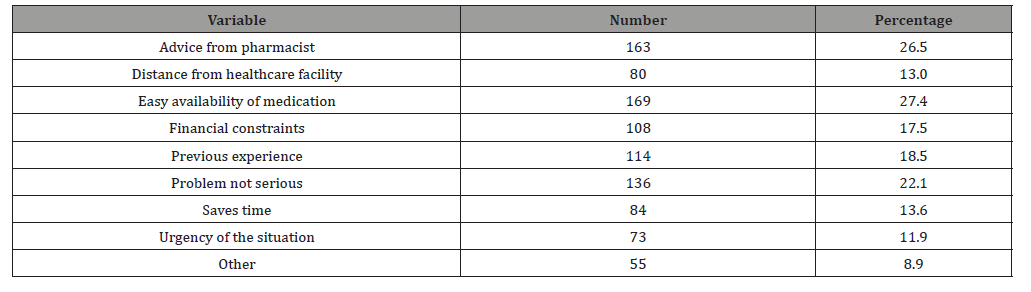
Most participants self-medicated because of the availability of substances (n = 169), advice from pharmacist (n = 163), and the problem not being serious (n = 136). We performed correlations to see if sex had an effect on any of the reason for self-medication, but we found no significant effects for sex were found for this variable. See Table 2 for the results.
Table 1:Participant’s Previous or Current Use of Self-Medication Substances By Sex.
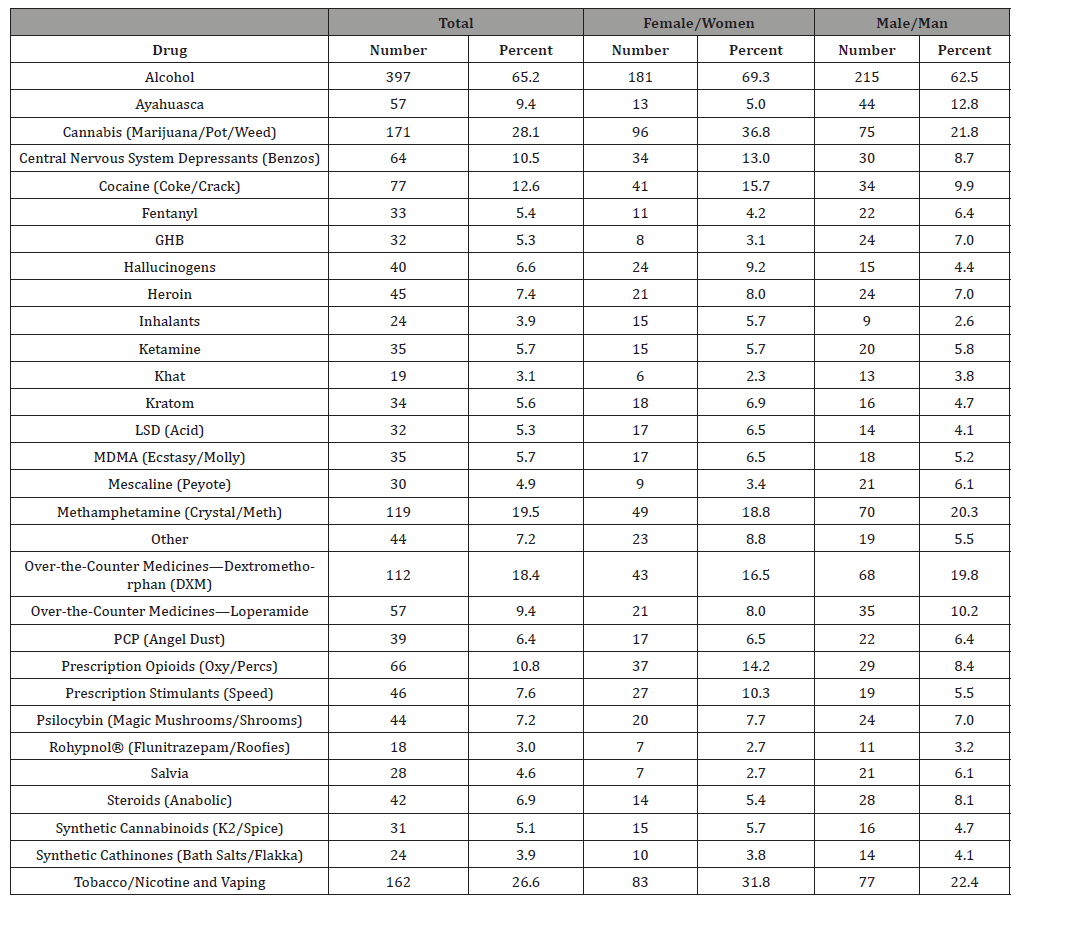
Table 2:Reasons for Self-Medicating.
The number of different substances tried or used was significantly correlated to the reported stress, r (613) = .180, p < .001. In fact, the reported stress significantly predicted the total number of substances tried or used, β = .180, t(614) = 4.54, p < .001. Reported stress also explained a significant amount of variance in the total number of substances tried or used, R2 = .03, F(1, 613) = 20.63, p < .001. We tested if sex had a moderating effect on reported stress and total substances by using a hierarchical regression analysis. The results of this regression analysis revealed a significant interaction effect between stress and sex on the total number of substances used, β = 3.341, p < .001. We found a greater effect of stress on total substances in female participants.
Interestingly, when we examined this correlation by sex, we saw the number of different substances tried or used was significantly correlated to the reported stress for females, r(261) = .219, p < .001. For males, this correlation was not significant, r(344) = .089, p = .099. The regression analyses were not significant for males. For females, reported stress significantly predicted the total number of substances tried or used, β = .219, t(260) = 3.62, p < .001, and reported stress also explained a significant amount of variance in the total number of substances tried or used, R2 = .05, F(1, 259) = 13.07, p < .001. On average, participants did not start self-medicating until after their teenage years. The mean age was 22.8 years (SD = 8.6). Based on sex, the means were similar: female = 22.1 years (SD = 9.2) and male = 23.3 years (SD = 8.2). We did not find a significant correlation between the age when first selfmedicating and reported stress, r(614) = -.069, p = .105. We also did not find a significant relationship between the age of first selfmedication and the total number of substances, r(559) = .033, p = .430.
Discussion
The current study sought to evaluate stress and selfmedication. We found a significant correlation between stress and the number of different self-medication substances tried or used. Further, our results indicated that reported stress, as evaluated by the Perceived Stress Scale [18], explained a significant amount of variance in the total number of substances tried or used These results support a link between stress and self-medication activities. They also support Khantzian’s [13] theory linking negative affect and substance use. We were unable to find a link between the age of initial self-medication and both the total number of substances or reported stress. This appears to suggest that the stress-and-selfmedication linkage may be unrelated to age.
Limitations
We had hoped to obtain a more diverse sample given the surveys were available in both Spanish and English. This largely English-speaking sample may have introduced some bias into our results. We also did not inquire into the legality of the substances at the time of initial self-medication. Many countries are moving toward decriminalization or even legalization of marijuana and other cannabis substances. Another limitation was the availability of the substances. Participants indicated that the two main reasons for self-medication were advice from a pharmacist and availability, which was interesting given roughly a fifth of participants had tried or used methamphetamine.
References
- Ocan M, Obuku EA, Bwanga F, Akena D, Richard S, et al. (2015) Household antimicrobial self-medication: A systematic review and meta-analysis of the burden, risk factors and outcomes in developing countries. BMC Public Health 15(1): 742.
- Walker LK (2024) Are You Self-Medicating with Drugs or Alcohol?. American Addiction Centers.
- Alhomoud F, Aljamea Z, Almahasnah R, Alkhalifah K, Basalelah L, et al. (2017) Self-medication and self-prescription with antibiotics in the Middle East-do they really happen? A systematic review of the prevalence, possible reasons, and outcomes. International Journal of Infectious Diseases 57: 3-12.
- Elong Ekambi GA, Okalla Ebongue C, Penda IC, Nnanga Nga E, Mpondo Mpondo E, et al. (2019) Knowledge, practices and attitudes on antibiotics use in Cameroon: Self-medication and prescription survey among children, adolescents and adults in private pharmacies. PLoS One 14(2): e0212875.
- Kazemioula G, Golestani S, Alavi SMA, Taheri F, Gheshlagh RG, et al. (2022) Prevalence of self-medication during COVID-19 pandemic: A systematic review and meta-analysis. Front Public Health 10: 1041695.
- Arias F, Izquierdo-Condoy JS, Naranjo-Lara P, Alarcón V, Bonilla P, et al. (2022) A Cross-Sectional Analysis of Self-Medication Patterns during the COVID-19 Pandemic in Ecuador. Medicina 58(11): 1678.
- Ortiz-Prado E, Izquierdo-Condoy JS, Mora C, Vasconez-Gonzalez J, Fernandez-Naranjo R (2023) Poor regulation, desperation, and misinformation, a countrywide analysis of self-medication and prescription patterns in Ecuador during the COVID-19 pandemic. Res Social Adm Pharm 19(12): 1579-1589.
- Hall DH, Queener JE (2007) Self-medication hypothesis of substance use: Testing Khantzian’s updated theory. J Psychoactive Drugs 39(2): 151-158.
- Khantzian EJ (1977) The ego, the self and opiate addiction: Theoretical and treatment considerations. NIDA Res Monogr (12): 101-117.
- Khantzian EJ (2018) Treating addiction: Beyond the pain. Rowman & Littlefield.
- Hawn SE, Cusack SE, Amstadter AB (2020) A Systematic Review of the Self‐Medication Hypothesis in the Context of Posttraumatic Stress Disorder and Comorbid Problematic Alcohol Use. Journal of Traumatic Stress 33(5) 699-708.
- Ostrowsky MK (2009) Self-medication and violent behavior. LFB Scholarly Pub.
- Khantzian EJ (1999) Treating addiction as a human process. Aronson.
- Khantzian EJ (2013) Addiction as a self‐regulation disorder and the role of self‐medication. Addiction 108(4): 668–669.
- Torres-Berrio A, Cuesta S, Lopez-Guzman S, Nava-Mesa MO (2018) Interaction Between Stress and Addiction: Contributions From Latin-American Neuroscience. Front Psychol 9: 2639.
- Mantsch JR, Baker DA, Funk D, Lê AD, Shaham Y (2016) Stress-Induced Reinstatement of Drug Seeking: 20 Years of Progress. Neuropsychopharmacology 41(1): 335-356.
- Sinha R (2008) Chronic Stress, Drug Use, and Vulnerability to Addiction. Ann N Y Acad Sci 1141: 105–130.
- Cohen S, Williamson GM (1988) Perceived stress in a probability sample of the United States. In: S Spacapan & S Oskamp (Eds.) The social psychology of heatlh: Claremont Symposium on Applied Social Psychology. (pp. 31–67). Sage.
- Taylor JM (2015) Psychometric analysis of the Ten-Item Perceived Stress Scale. Psychological Assessment 27(1): 90–101.
-

This work is licensed under a Creative Commons Attribution-NonCommercial 4.0 International License.




