


 Review Article
Research: Utopia of Non-Technological Type and the Topic of Prostitution
Received Date: November 27, 2025; Published Date: December 02, 2025
Introduction on the Context of Research
The presented topic is not addressed in isolation. It is studied as part of the author’s thought line following the topic of Malthusianism and Neo-Malthusianism, including contraception and prostitution [1-3]. Dividing Utopia into utopia of the ideal human will and technological type of utopia is the cornerstone of the approach to this topic. The author proposed this division in the paper entitled Old Age in Humans Primarily from the Perspective of Utopic Thinking as the Foundation for Resolving Bioethical Issues Relating to Old Age [4]. Utopia of the ideal human will can also be referred to as utopia of non-technological type.
This main benefit of this research is seen in outlining the structure of the issue presented for discussion.
On Structure of Research
1. Key works of utopic thinking of non-technological type will be compared as regards their attitude to prostitution. The following authors and their works are analysed (Table no. 1).
a. Plato (The Republic)
b. Thomas More (Utopia)
c. Tommaso Campanella (The City of the Sun)
d. Francis Bacon (The New Atlantis)
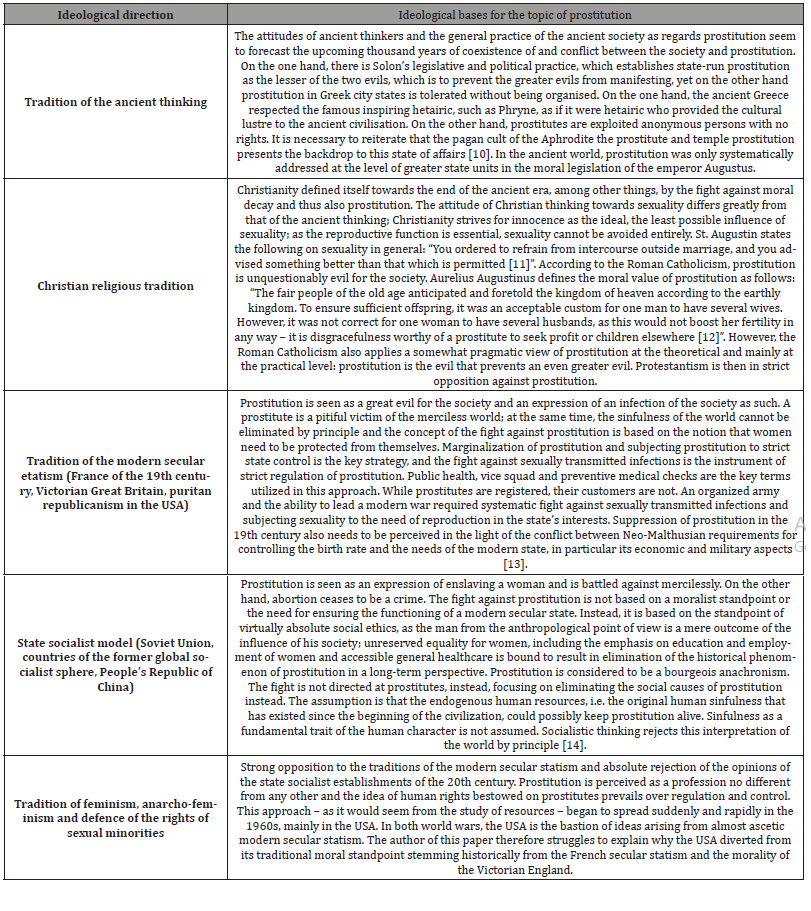
2. The general terrain of thinking about prostitution will be studied in the key aspects (Table no. 2).
a. In the ancient tradition
b. In the Christian religious tradition
c. In the tradition of modern secular etatism (France of the 19th century, Victorian Great Britain, puritan republicanism in the USA)
d. In the tradition of the state socialist model (Soviet Union, countries of the former global socialist sphere, People’s Republic of China)
e. In the tradition of anarcho-feminism and defence of the rights of sexual minorities [14].
Table 1:
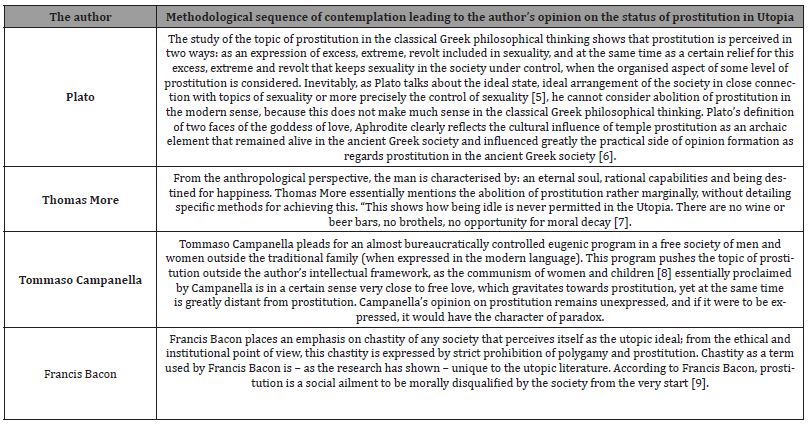
Table 2:
Final Research Summary
a) Although the issues of sexology are one of the major thought axes in non-technological types of utopias, utopias as such failed to develop their own original attitude to prostitution.
b) Plato’s attitude towards sexuality reflects the overall approach of the classical Greek philosophy to sexuality. Aphrodisia, cheeses and entreaties are some of the major terms reflecting to a great extent not only Plato’s thinking, but the entire classical Greek philosophical thinking as regards sexuality. In general, it is assumed that nature created pleasure to ensure mutual attraction between men and women and thus secure the survival of the mankind. On the other hand, sexuality has its special urgency that makes individuals cross the lines drawn by nature and tends to spark rebellion. Aphrodisia are physical acts leading to pleasure. According to Plato, Aphrodisia Chrissi, or ketosis the kai Cherie determines the correct acquisition of women and children, which should be calculated and in moderation. Encarta refers to the active form of selfcontrol used to fight against desire [15].
c) The opinion expressed in this research as regards the lacking originality of ideas on prostitution in utopias applies in particular to Thomas More, who mentions abolition of prostitution as a condition for the ideal state, while failing to provide any details or any strong emotional emphasis. It seems as if more shifted from the somewhat pragmatic approach of the Roman Catholicism to the much stricter Protestantism, yet this shift is rather subconscious in his overall cultural view.
d) The Utopia by Tommaso Campanella is characterised by dynamism of a connecting piece. While Campanella is a Roman catholic, he builds on Plato’s philosophy in issues of sexuality, for example in communism of women and children. On the other hand, he discusses communism of women and children in Christian heresies, for example in the case of Nicolaite’s. Campanella is the connecting piece between Thomas More and Francis Bacon, because his eugenic reproduction program in communism of women and children is systematically and scientifically addressed in the sense of Francis Bacon’s New Atlantis despite the fact that Campanella and Bacon are the opposing poles in the issues of sexuality.
e) Francis Bacon’s strict rejection of prostitution is somewhat surprising in the overall concept of the New Atlantis; prostitution as an undoubtedly archaic principle cannot survive long-term in a society, where science is gaining the decisive role. The powerful science is guaranteed to tame prostitution in the end. However, it seems as if Francis Bacon suspected that powerful science would not overpower prostitution and the scientific ethos would be crushed by prostitution. It seems as if he continued to perceive the archaic character of sexuality as the main obstacle to establishing a scientifically ideal society. The almighty science will always have limited impact in sexual ethics. Therefore, the prophet of the new technical civilisation remains a conservative religious individual when it comes to sexuality.
Final Additional Notes to the Completed Research: towards Utopias with Borderline Feasibility
a) The issues of sexology are one of the major thought axes in non-technological types of utopias. From sexology point of view, utopias contain certain deep polarity that seems to rip utopias into two – one could even say rival – parts. On the one hand, there is communism of women and children, which is rather close to free love, and on the other hand emphasis is placed on chastity in a strictly monogamous family.
b) When utopias step on the borderline of their feasibility, they take the polarity in issues of sexology with them. While utopias on the borderline of their feasibility naturally aim to raise a new man, it seems that this polarity is stronger than any probability of change in a man. In the end, utopias may fail due to sexology constants of a changing man.
c) Utopias undoubtedly stepped on the borderline of their feasibility in state socialist systems of the 20th century, since the Chinese model of state socialism, including its specifics, is alive and well. The ideological basis of the opinion on the genesis of prostitution and the methods of fight against prostitution as the cardinal social evil is highly original in state socialist systems. The extent and diligence of the fight against prostitution, which takes place at a continental level, is also unprecedented. The systematic fight against prostitution aimed at its social causes, but not at the victims of these social causes is one of the brightest moments of the world history of implemented ethics.
Acknowledgement
None.
Conflict of Interest
No conflict of interest.
References
- Tomáš Hájek (2022) Kontexty vlivu neomalthusiánství na aktuální otázky kontroly porodnosti. XXV. Košické sexuologické dni, Téma: Sexualita v době covidovej Hotel Doubletree by Hilton Košice: 16.9.2022.
- Tomáš Hájek (2025) On Phenomenology of Neo-Malthusianism Primarily in the Aspect of Birth Control. In: Current Trends in Clinical & Medical Sciences, Iris Publishers 4(1).
- Tomáš Hájek (2025) Environmentalism, Neo-Malthusianism, Anarchism, and Sexuality. In: Open Access Journal of Addiction and Psychology, Iris Publishers 8(2).
- Tomáš Hájek (2025) Old Age in Humans Primarily from the Perspective of Utopic Thinking as the Foundation for Resolving Bioethical Issues Relating to Old Age. In: Current Trends in Clinical & Medical Sciences, Iris Publishers 4(3).
- Platón (2014) Ú Translated by František Novotný. Fifth, amended edition. Praha: OIKOYMENH PP. 427.
- Platon (1947) Symposion – o lá Translated by František Novotný. Third edition. Praha: Jan Laichter v Praze XII PP. 93.
- Thomas More (2024) Utopie. Translated by Bohumil Ryba. Praha: Univerzita Karlova, Nakladatelství Karolinum PP. 157.
- Tomáš Campanella (1934) Sluneční stá Translated by Maxmilián Ryšánek. Praha: Jan Laichter v Praze PP. 106.
- Francis Bacon (1952) Nová Translated by Konstantin Jelínek. Praha: Nakladatelství Rovnost Praha PP. 56.
- Pierre Dufour (2003) Dějiny prostituce I.-Starý Orient, Egypt, Izrael, Ř Translator not listed. Olomouc: Fontána PP. 185.
- Svatý Augustin (2025) Vyznání. Translated by Ondřej Koupil, Marie Kyralová, Pavel Mareš. Third edition. Karmelitánské nakladatelství ve společnosti KatMedia PP. 439.
- Aurelius Augustinus (2004) Křesťanská vzdělanost- De doctrina christiana. Translated by Jana Nechutová. Praha: nakladatelství Vyšehrad spol PP. 232.
- Kate Listerová (2023) Děvky, šlapky & hampejznice – dějiny prodejného sexu. Translated by Petra Diestlerová. Praha: Nakladatelství Paseka, PP. 256.
- Lujo Bassermann (1993) Nejstarší řemeslo-kulturní dějiny prostituce. Translated by Marie Goldmannová. Praha: Mladá fronta PP. 336.
- Michel Foucault (2003) Dějiny sexuality II-užívání slastí. Translated by Karel Thein, Natálie Darnadyová, Josef Fulka. Praha: Herrmann&synové 338.
-

This work is licensed under a Creative Commons Attribution-NonCommercial 4.0 International License.