




 Mini Review Article
Impact of Drug Testing on Healthcare
Received Date: July 03, 2026; Published Date: July 16, 2026
Abstract
We perform drug testing on oral fluid and urine specimens for pain clinics and rehabilitation facilities. Our work is used to demonstrate patient medication adherence, ensure that they are not using drugs outside of those prescribed, (including illicit drug use), inform the practitioner of all the drugs they are taking, and through software note whether or not there is the possibility of drug-drug interactions potentially causing harm to the patient.
Determine true medication compliance
We note that adherence to prescribed medication is of major concern in US healthcare “In the United States, 3.8 billion prescriptions are written annually [1]. Approximately one in five new prescriptions are never filled, and among those filled, approximately 50% are taken incorrectly, particularly with regard to timing, dosage, frequency, and duration [2]. This lack of adherence to prescribed medication is of such profound concern that the us government has encouraged programs to improve adherence [3].
In order to show medication adherence, the test parameters must be appropriate. One of the stewardship responsibilities of a laboratory is to decide on appropriate ranges of values for patients. We observed that the diagnostic test cutoffs for pain management drugs were inappropriate. Many of these had been set using immunoassays available from commercial suppliers as moderate complexity tests or set by SAMHSA guidelines. We developed drug tests using LC-MS/MS instrumentation which achieved lower accurate cutoffs. We observed that these lower cutoffs showed improved compliance [4]. We showed that a lognormal distribution of patient urine test results fitted with a trendline is appropriate for estimating the required cutoff levels needed to assess medication adherence [5]. The study showed a wide variation in the falsenegative rate, ranging from 1.5% to 94.3% across a range of prescribed and illicit drugs. Thus, appropriate cutoffs reduced the false negative rate in the patients.
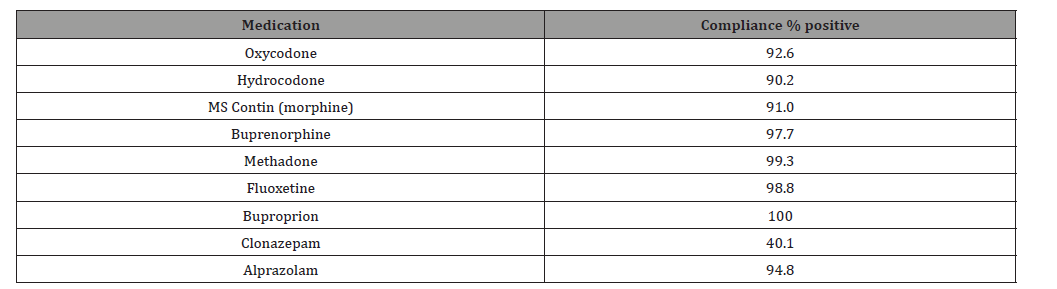
However we can demonstrate a high level of compliance with our drug testing. In this case we test for both the parent drug and its metabolite to confirm the drug was actually taken.
Table 1: Medication adherence determined by urine drug tests.
Complete the drug profile of the patient
We observe that very often the medication list that accompany the drug test request does not list all the drugs the patient is taking. Urine drug test data for one study on antidepressants showed this was a deficiency in properly assessing patients by the patient’s caregiver [6].
Alert the patient’s caregiver to potential drug-drug interactions
In addition to showing compliance the laboratory does provide software interpretation of the test results in the situation of drugdrug interactions. Although these interactions are presumed to be noted by the providing pharmacists, we have observed that these are often missed [7].
Tracking illicit drug use over time
This allows monitoring patterns of drug abuse. One example our work showing heroin being replaced by fentanyl [8].
Tracking polysubstance abuse over time Monitor the impact of designer drugs on our substance abuse population
This allows us to determine if these designer drugs are strongly impacting the substance abuse population [9].
Detect Deception
One of the major concerns in drug testing is attempts at deception, most often the individual is attempting to hide drug use or to show compliance. The SAMHSA drug testing program has a variety of measures to prevent deception. As part of our stewardship we have developed measures to detect deception thus ensuring the validity of our results [10,11].
Our stewardship is impacted by the insurance payment landscape. The use of better methods of detecting drugs is limited by Medicare and insurance company payment. These organizations will not pay for the current state of the art drug testing to identify designer drugs [11].
References
- Osterberg L, Blaschke T (2005) Adherence to medication. N Engl J Med 353: 487-497.
- Neiman AB, Ruppar T, Ho M, Garber L, Weidle PJ, et al. (2017) CDC Grand Rounds: Improving Medication Adherence for Chronic Disease Management-Innovations and Opportunities. Morbidity and Mortality Weekly Report (MMWR) 66(45).
- Krock K. Pesce A, Ritz D, Thomas R, Cua A, et al. (2017) Lower Cutoff for LC-MS/MS Urine Drug Testing Indicates Better Patient Compliance. Pain Physician 20: E1107-1113.
- Pesce A, West C, West R, Crews B, Mikel C, et al. (2010) Reference intervals: A novel approach to detect drug abuse in a pain patient population Opioid Management 6: 341-350.
- Bordson SJ, Atayee RS, Ma JD, Best BM (2014) Tricyclic Antidepressants: Is Your Patient Taking Them? Observations on Adherence and Unreported Use Using Prescriber-Reported Medication Lists and Urine Drug Testing. Pain Med 15(3): 355–363.
- Nickley J, Kain J, Krock K, Thomas R, Pesce A (2019) Severe Drug-Drug Interactions: Reported and Missed. J Clin Toxicol 9: 406.
- Pesce A, Bevins N, Tran K, Thomas R, Jensen K (2023) Changing Landscape of Fentanyl/Heroin Use and Distribution. Ann Clin Lab Sci 53: 140-142.
- Agnes Cua, Kevin Krock, Richard Thomas and Amadeo J Pesce (2023) Observations on Fentanyl Designer Drugs; Open Access Journal of Addiction and Psychology: Volume 7(3).
- Cua A, Krock K, Thomas R, Pesce (2023) Observations of Deception in Urine Drug Testing. Ann Clin Lab Sci 53(4): 671-672.
- Pesce AJ, Geary E, Corbin J, Tran K, Bollman K (2024) Deception in Urine Drug Tests and It’s Identification Open Access Journal of Addiction and Psychology 7(5).
- Pesce AJ, Krock K (2023) Designer drugs. Lab Med 54(6): 553-554.
-

This work is licensed under a Creative Commons Attribution-NonCommercial 4.0 International License.




