




 Commentary
Immunoassay Testing of Benzodiazepines in Urine Fails to Protect Patients
Received Date: January 27, 2024; Published Date: March 01, 2024
Abstract
Objective: Current immunoassays are yielding misleading benzodiazepine test results. Many current immunoassays use a 200ng/mL cutoff to
define a positive test result.
Experimental: Using an LC-MS/MS method we observed that the median observed value for the benzodiazepine metabolites 7-aminoclonazepam
and alphahydroxyalprazolam were below this concentration. The fraction of patients positive for both an opiate and a benzodiazepine were greater
than twenty percent.
Conclusion: The current immunoassays fail to detect concomitant drug use potential hazardous drug use in patients on pain medications.
Keywords: Benzodiazepines, Opiates, Immunoassays, LC-MS/MS
Introduction
Benzodiazepines are one of the most commonly prescribed class of drugs in the world for the treatment of insomnia and anxiety [1]; they are also used as anticonvulsants [1], When used as prescribed, benzodiazepines are relatively safe, but have abuse potential and enhance CNS and respiratory depression when used concomitantly with opioids [2]. Therefore, compliance monitoring using urine drug testing for these drugs is employed. There are problems with the immunoassays used for this type of testing. There are two reasons for this 1. the assay cutoff of 200ng/mL is set too high and 2. the assays do not cross react well with the excreted benzo-glucuronide metabolized drug. Several benzodiazepines are excreted as the glucuronide metabolite [3,4]. The current cutoff for a positive benzodiazepine assay is commonly set at 200ng/ mL. However there has been a large change in the amount of drug prescribed. Early benzodiazepines were prescribed in dosages of 10 or more milligrams while some of the more recently approved drugs are given in dosages of 1mg or less (Table 1).
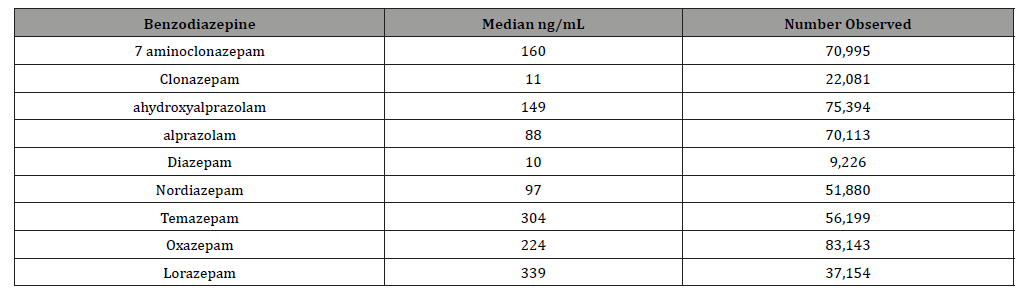
The poor cross reactivity with some of the benzodiazepine glucuronide metabolites is well known. To avoid this problem assay package inserts only list the cross reactivities with the parent drug and not the glucuronide metabolite. For example, the Thermo Scientific assay does not list the cross reactivity of any glucuronide [7]. In contrast the Roche Cobas assay lists the cross reactivity of the Temazepam glucuronide at 0.7% and lorazepam glucuronide at 1% [8]. In addition to the poor cross reactivity. The excretion of these drugs is often below the 200ng/mL cutoff for a positive test result. We list our median observed concentration for several benzodiazepines obtained from our pain management and rehabilitation facility clients performed by our LC-MS/MS method in the following table [9,10] (Table 2).
Table 1:Benzodiazepine equivalence Table [5,6].

Table 2:Median benzodiazepine concentration values (after hydrolysis) in urine from LC-MS/MS data.
Results
The data shows that the median concentration of the excreted 7-aminoclonazepam and alphahydroxyalprazolam are below the 200ng cutoff implying that these observations would be deemed negative by immunoassay.
This poor reactivity has been known for about 13+ years.
However, these immunoassays are popular because they have FDA approval and are classified as moderate complexity and can be use in physician offices. There are some studies showing improved detection by hydrolyzing the urine with glucuronidase improves assay sensitivity [11]. However, this modification makes the assay a lab developed test requiring a more complex and costly validation.
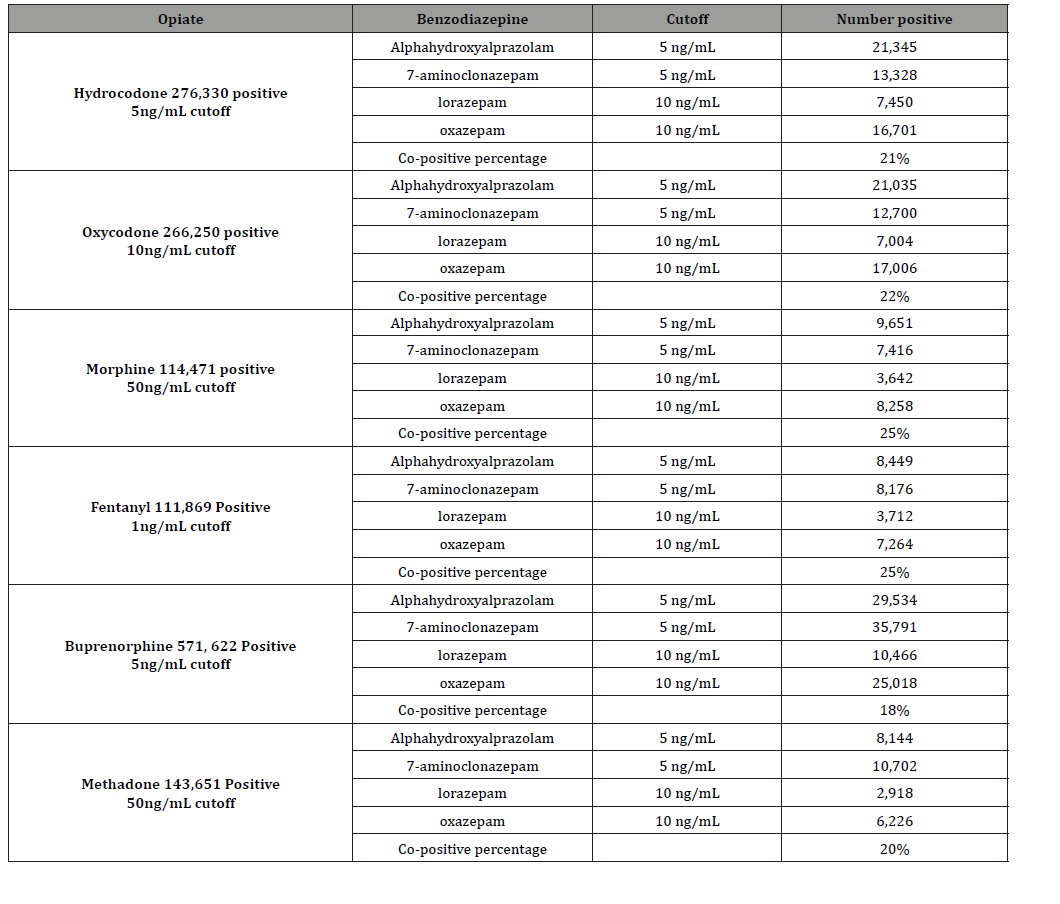
Even though the CDC has recommended not prescribing an opiate and a benzodiazepine together, we have observed a significant fraction of patients on opioids also positive for a benzodiazepine. We examined the co positive findings for hydrocodone, oxycodone, and morphine with the following benzodiazepine drugs or their metabolites. The time frame was Jan 1, 2020 to Jan 24, 2024. More than twenty percent of patients on man opiate also were positive for a benzodiazepine. We also observed that 25% of benzodiazepine use in individuals using fentanyl. Further patients on medication assisted substance abuse therapy were also observed to use benzodiazepines. This data reinforces the need to appropriately monitor patients on opioid therapy. Current immunoassay tests are not appropriate.
Conclusion
We and others have shown the poor sensitivity of these immuneassays and have used definitive testing to overcome these poorquality results. Newer immunoassays using glucuronidase and lower cutoffs are required to effectively monitor benzodiazepines (Table 3).
Table 3:Observed Frequency of benzodiazepine and opiates in urine specimens.
Acknowledgement
All the authors are employees of Precision Diagnostics LLC.
Conflict of Interest
There are no conflicts of interest.
References
- (2024) Benzodiazepines. Drug Enforcement Administration Diversion Control Division Drug & Chemical Evaluation Section.
- (2022) FDA warns about serious risks and death when combining opioid pain or cough medicines with benzodiazepines; requires its strongest warning. U.S. Food and Drug Administration.
- Oshiro C (2009) Benzodiazepine pathway, pharmacodynamics. PharmGKB.
- Oshiro C (2009) Benzodiazepine pathway, pharmacokinetics. PharmGKB.
- Ashton CH (2002) Benzodiazepines: How they work and how to withdraw.
- Ashton CH (2007) Benzodiazepine Equivalence Table. Northern Regional Health Authority Drug Newsletter. benzo.org.uk.
- Thermo Scientific DRI Benzodiazepine assay.
- Benzodiazepines Plus (BENZ Cobas) assay.
- Pesce A, Sundyhanata R, Ritz D, Thomas R, Ackerman G, et al. (2021) Effects of a Pandemic and Isolation on Alcohol and Psychoactive Medication Use in a Population of Rehabilitation and Pain Patients Ann Clin Lab Sci 51(5): 694-697.
- Krock K, Pesce A, Ritz D, Thomas R, Cua A, et al. (2017) Lower Cutoff for LC-MS/MS Urine Drug Testing Indicates Better Patient Compliance. Pain Physician 20(7): E1107-E1113.
- Kamisha L, Johnson-Davis (2018) Opiate & Benzodiazepine Confirmations: To Hydrolyze or Not to Hydrolyze is the Question J Appl Lab Med 2(4): 564-572.
-

This work is licensed under a Creative Commons Attribution-NonCommercial 4.0 International License.




