




 Mini Review Article
Drug Metabolite Presence in Oral Fluid Differs from Urine
Received Date: April 27, 2024; Published Date: June 13, 2024
Abstract
Metbolite to parent drug concentrations in urine and oral fluid were observed for the following drug pairs morphine/hydromorphone, buprenorphine/norbuprenorphine, oxycodone/oxymorphone, fentanyl/norfentanyl, methadone/EDDP, and carisoprodol/meprobamate. A higher metabolite/parent drug ratio was noted in urine compared to oral fluid. Our hypothesis is that the passive diffusion of the metabolites into oral cavity is hindered by the glucuronide metabolites.
Keywords: Urine, Oral fluid, Drug tests, Parent drug, Metabolite
Background
Use of the oral fluid matrix to monitor drug use was championed by Cone and Huestis [1,2]. It is now recognized as a valid test matrix by SAMHSA [3]. However, there are differences [4-12]. One of the most striking differences is the low oral fluid concentrations of some metabolites compared to the parent drug observed in urine. That is the ratio of metabolite to parent drug is much lower in oral fluid. We decided to examine the difference between the metabolic pattern as observed by parent drug and metabolite concentrations in the two matrices as well as how often they were present in the same specimen. We use the term co-presense to describe the observation of both parent drug and metabolite in the same specimen.
Experimental Design
The data from the 2million specimens collected between Jan 2, 2020 and July 25, 2023 were used in the analysis [13]. The patient population was from pain physician practices and rehabilitation facilities [13]. The method of analysis was that of Krock et al [14]. The data analysis was that of Pesce et al [15]. For ease of comparison, we used the median concentration in ng/mL as the comparative metric.
Results
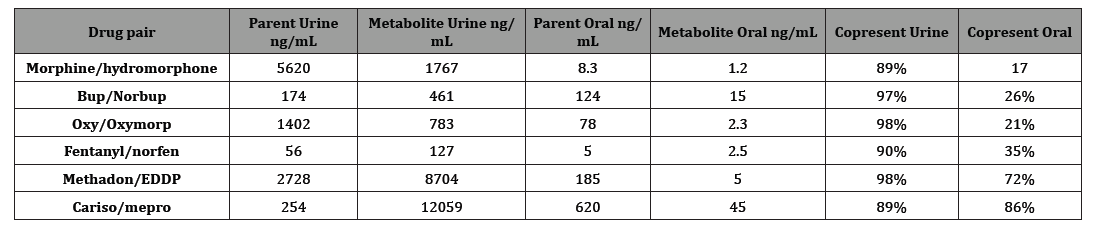
The observations on the six pairs of parent drug and their major metabolite are presented in Table 1. It shows that the two matrices are different. In all cases the concentration differences between urine and oral fluid are similar in that the metabolite is present in much smaller amounts compared to urine. In several examples, such as buprenorphine/norbuprenorphine and methadone/ EDDP the metabolite/parent drug ratio is greatly different from that observed in urine. The data shows that the metabolite is not passing into the oral fluid.
Table 1:Median concentration of excreted buprenorphine and norbuprenorphine in urine and oral fluid.
Discussion
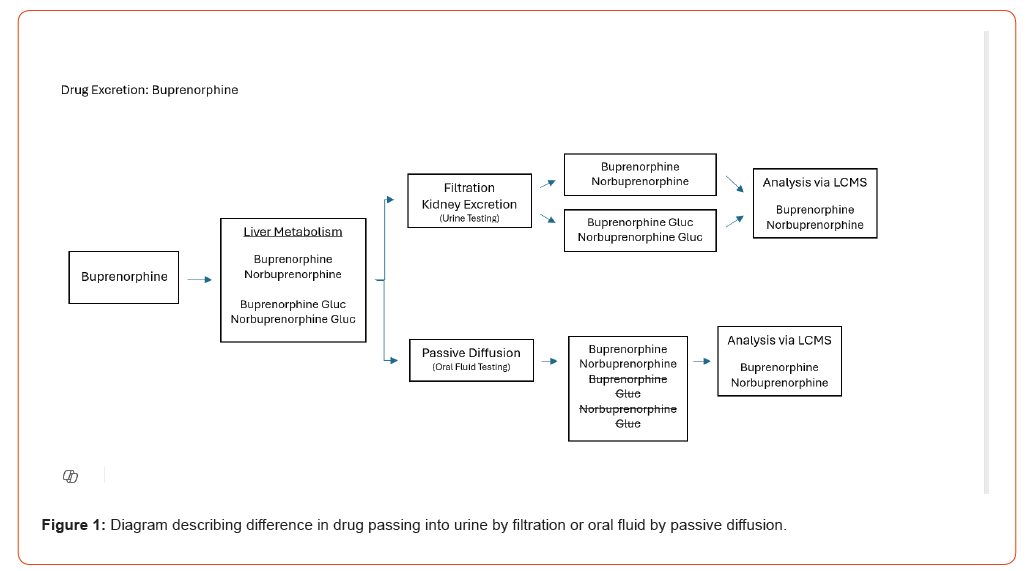
There is clearly a difference between the two matrices as the metabolite is present in much lower quantities compared to urine. This same difference is also observed for THC where the parent drug is observed in oral fluid, but the glucuronidated excreted metabolite THCA is not observed [16,17]. Our explanation is that the metabolism of these drugs results in a glucuronidated metabolite which does not pass into the oral fluid. Figure 1 is an illustration using buprenorphine metabolism of our explanation of the difference between urine and oral fluid observed drug concentrations. Drugs such as buprenorphine are processed by both Phase I and Phase II mechanisms. Phase I results in the formation of norbuprenorphine and phase 2 results in the formation of both buprenorphine and norbuprenorphine glucuronide. As shown in the diagram, all the Phase I and Phase II, metabolites are filtered by the kidney and pass into urine. They are monitored as total buprenorphine and norbuprenorphine. However, buprenorphine and its metabolites must pass through the oral cavity membranes before entering the oral fluid. In this case the glucuronidated forms cannot easily diffuse through because they are charged molecules. This difference in excretion mechanisms is responsible for the low metabolite to parent drug ratio.
Acknowledgement
All the authors are employees of Precision Diagnostics LLC.
Conflict of Interest
There are no conflicts of interest.
References
- Cone EJ, Park S, Presley L, Lehrer M, Seiter W, et al. (2002) Oral Fluid Testing for Drugs of Abuse: Positive Prevalence Rates by Intercept Immunoassay Screening and GC-MS-MS Confirmation and Suggested Cutoff Concentrations. J Anal Toxicol 26(8): 541-546.
- Cone EJ, Huestis MA (2007) Interpretation of Oral Fluid Tests for Drugs of Abuse. Ann N Y Acad Sci 1098: 51-103.
- (2019) Department of Health and Human Services 57582 Federal Register 84(207): 1-47.
- Drummer OH (2006) Drug testing in oral fluid. Clin Biochem Rev 27(3): 147-159.
- Heltsley R, Depriest A, Black DL, Robert T, Marshall L, et al. (2011) Oral fluid drug testing of chronic pain patients. I. Positive prevalence rate of licit and illicit drugs. J Anal Toxicol 35(8): 529-540.
- Petrides AK, Melanson SEF, Kantartjis M, Le RD, Demetriou CA, et al. (2018) Monitoring opioid and benzodiazepine use and abuse: Is oral fluid or urine the preferred specimen type? Clin Chim Acta 481: 75-82.
- Bosker WM, Huestis MA (2009) Oral fluid testing for drugs of abuse. Clin Chem 55(11): 1910-1931.
- Vindenes V, Yttredal B, Oiestad EL, Waal H, Bernard JP, et al. (2011) Oral fluid is a viable alternative for monitoring drug abuse: Detection of drugs in oral fluid by liquid chromatography-Tandem mass spectrometry and comparison to the results from urine samples from patients treated with methadone or buprenorphine. J of Anal Toxicol 35(1): 32-39.
- Verstraete AG (2004) Detection Times of Drugs of Abuse in Blood, Urine, and Oral Fluid. Ther Drug Monit 26(2): 200-205.
- Wille SMR, Raes E, Lillsunde P, Gunnar T, Laloup M, et al. (2009) Relationship between oral fluid and blood concentrations of drugs of abuse in drivers suspected of driving under the influence of drugs. Ther Drug Monit 31(4): 511-519.
- West RE, Guevara MG, Mikel C, Gamez R (2017) Detection of Hydrocodone and Morphine as Metabolites in Oral Fluid by LC-MS/MS in Patients Prescribed Codeine. Ther Drug Monit 39(1): 88-90.
- Smiley S, Pesce A, Krock K, Thomas R, Cua A, et al. (2019) A Comparison of Urine and Oral Fluid Drug Testing. J Clin Toxicol 9(2): 414.
- Pesce A, Sundyhanata R, Ritz D, Richard R, Ackerman G, et al. (2021) Effects of a Pandemic and Isolation on Alcohol and Psychoactive Medication Use in a Population of Rehabilitation and Pain Patients: Ann Clin Lab Sci 51(5): 694-697.
- Krock K, Pesce A, Ritz D, Thomas R, Cua A, et al. (2017) Lower Cutoff for LC-MS/MS Urine Drug Testing Indicates Better Patient Compliance. Pain Physician 20(7): E1107-E1113.
- Pesce AJ, Chandler N, Ackerman G (2021) Information Technology Structure for Urine Drug Testing Reports. 21st Century Pathol 1(1): 103.
- Huestis MA (2007) Human cannabinoid pharmacokinetics. Chem Biodivers 4(8): 1770-1804.
- Desrosiers NA, Huestis MA (2019) Oral Fluid Drug Testing: Analytical Approaches, Issues and Interpretation of Results. J Anal Toxicol 43(6): 415-443.
-

This work is licensed under a Creative Commons Attribution-NonCommercial 4.0 International License.




