




 Mini Review Article
Deception in Urine Drug Tests and It’s Identification
Received Date: January 29, 2024; Published Date: March 01, 2024
Abstract
Urine drug testing is commonly used in preemployment testing, to show drug rehabilitation in cases of substance abuse or to show medication compliance. Some individuals use methods such as dilution, adulteration, and substitution to evade detection of illicit drug use or to show prescription compliance. Validity testing is used as one way to detect these attempts at deception. However substituted urines present a challenge to detect deception.
Keywords: Deception; Urine drug testing; Dilution; Adulterants; Substitution; Validity tests
Background
There are several reasons that urine drug testing is performed. Employees that fall under Federal Guidelines are required to be tested for drugs to continue employment and many employers follow these guidelines [1]. Patients that are being treated for pain with chronic opioid therapy need to be tested to meet medication compliance and therapeutic guidelines [2], and those patients in substance rehabilitation programs are tested for compliance. In some of these cases such as preemployment testing, there is an incentive to ensure that the drug test will be negative. In others there is a need to demonstrate medication compliance. In the case of employment or to show no drug use before chronic opioid therapy, individuals are expected to be negative for drug use. Some of these test subjects apply various methods to obtain a negative test result [3]. The most common are dilution, adulteration, and substitution. The Federal government is aware of these attempts and has implemented validity test requirement to ensure that the test specimen is appropriate. Drug testing for these Federally defined workers use the SAMSHA definitions for a valid specimen [1]. These include legal handling of specimens, chain of custody, temperature check at time of collection and validity testing. Employer testing programs often follow SAMHSA guidelines. Attempts to deceive have resulted in tests to determine if specimen is valid i.e., validity testing. Employers and patients’ providers have accepted the need to ensure their patients have provided a valid specimen. In all cases, the major concept is to ensure that the specimen is physiologic. In those cases where employment is being considered, a negative drug test is expected. However, when patients are being tested for medication compliance, many of these methods of deception cannot be used as the prescription drug would not be found. For example, in testing for compliance, the drug test should not be negative, in these cases deception may be attempted by dipping or shaving the prescription drug into the urine, or substitution with another person’s urine or use of a clean urine purchased on the internet.
One of the most common methods of deception is to dilute the specimen. Dilution of the urine makes the illicit drug more difficult to detect by lowering its concentration. In virtually all drug tests there is a concentration of drug below which the test device cannot detect. Creatinine and specific gravity are important tests to identify this type of deception. SAMHSA Medical Review Officer Guidelines states. “Dilute is defined as creatinine greater than 5.0 mg/dL but less than 20.0 mg/dL and the specific gravity is equal to or greater than 1.002 but less than 1.003.” One indirect method of detecting dilution is examining the temperature of the specimen. It should be between 90 °F to 100 °F (32 °C to 38 °C) within 4 minutes of collection. In this case adding tap water would result in a lower than accepted temperature.
Another common deception tactic is to add adulterant to the urine. Commonly these interfere with the immunoassay type of screening tests. Some of these adulterants alter the pH of the urine. This deception can be identified by monitoring urine pH. Deception is identified if the pH is less than 4.0 or equal to or greater than 11.0. This pH test does not detect many adulterants. One class of these adulterants are oxidants which can give false negative results in the immunoassay screen or modify the drug in solution to an undetected form. Thes adulterants which effect testing. Include Nitrite present equal to or greater than 500 mcg/ mL. Chromium (VI) present equal to greater than 50 mcg/mL. A halogen (e.g., bleach [chlorine], iodine, fluorine) is present equal to or greater than 200 mcg/mL nitrite-equivalent cutoff. Detection of the adulterant Glutaraldehyde requires a specialized test. Pyridine (pyridinium chlorochromate) detection is based on general oxidant colorimetric result [equal to or greater than 200 mcg/mL nitriteequivalent cutoff or equal to or greater than 50 mcg/mL chromium (VI)-equivalent cutoff] or equal to or greater than 50 mcg/mL. Surfactant detection requires a separate test and is detected if it is present equal to or greater than 100 mcg.
An excellent review of methods used to obtain a negative drug test has been published by Dasgupta [3], this paper describes methods of making dilute urine and commercially available adulterants and their detection. Many drugs testing laboratories test for validity by monitoring pH, creatinine, oxidant, and specific gravity. Dilution is detected by observation of both low creatinine concentrations and low specific gravity. Note if dilution is found, these specimens are not eligible for analysis under SAMHSA guidelines. We observed 3.7% of our specimens were observed as dilute or substituted by this measurement [4]. In our study of 1,057,477 urine specimens, creatinine 2 or less was observed 897 times, creatinine of 2.01 to 10.0mg/dL was present 6,099 times and 32,260 specimens were observed to have 10.1 to 19.9mg/dL of creatinine. In this study dilute or substituted specimens were 39,256 or 3.7% of the total indicating the possible extent of potential deception.
Detection of the oxidant adulterants is often achieved using a colorimetric test where a dye changes colour when oxidized [5]. In one study performed by us (unpublished) and using a tetramethylbenzidine (TMB) method, we observed that about 3.7% of the 63,000 specimens sent for analysis were positive for oxidant above the manufacturer’s suggested 200ug/mL cutoff. A frequency distribution curve of oxidant values indicated that a cutoff value of greater than 1000ug/mL was more appropriate to indicate this type of possible adulteration as those values in the 200 to 1000 range were often collection artefacts. Another observation that may flag the urine oxidant is the absorbance of the EMIT type of immunoassay. In these cases, the absorbency of the assay NADH may be below the test blank because these agents oxidize the NADH component of the assay reducing its absorbance at 340nanometers.
Substitution of urine with another one is a common deception practice. Substitution is difficult if the specimen collection is observed, and the temperature of the collected urine is monitored. However, if collection is not observed and temperature monitoring not used, there are a number of urine products that can be purchased over the internet that can be used to yield a negative drug test result [6,7].
As stated above, these practices are often used when a negative result is required. However, in the case of compliance monitoring, the patient is expected to have a test result positive for the prescribed drug. One form of deception used to show compliance is to add the parent drug to the urine specimen (spiking). This type of deception is effective if the provider relies only on immunoassay testing. These types of assays will be positive for the parent drug and usually only give a positive or negative response. Detection of spiking can be done by examining the specimen for the presence of the parent drug metabolite. Most commonly this analysis is performed using definitive analysis by an LC-MS/MS method. We have published on this form of deception [8,9], but the detection of this type of deception requires a method usually LC-MS/MS which quantitatively measures both the parent drug and its metabolite in the same specimen [8,9]. In this type of deception, the ratio of metabolite to parent drug is low and/or high concentrations of parent drug are often observed.
Substitution with another person’s urine or with a commercial urine product, however many of these substituted urines can be readily identified [7]. This type of substitution can also be detected if two urines with exactly same validity and drug concentrations are observed. However, this is often difficult to determine. In one of our cases, we found three urines with same validity results. We obtained urines from three different patients being treated at the same facility (Table 1). In this case note that the validity tests were almost identical, the out-of-range specific gravity measurement was identical, the same drugs amphetamine and ethyl sulfate (ETS) were present in the same concentration. Such matching measurements are difficult to detect. Sometimes substituted urine from an associate may contain an illicit or non-prescribed drug.
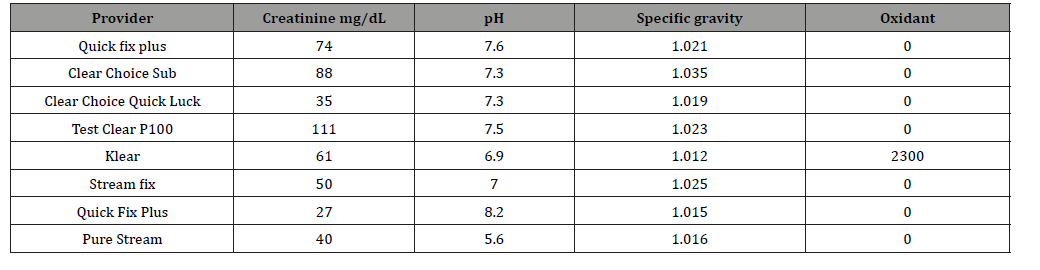
We performed validity and Lc-MS/MS testing on eight urines purchased on the internet (Table 2). Only two failed to be identified as possible substituted urines. One was because of the presence of an oxidant, the other because the specific gravity was much greater than the matching creatinine concentration.
Table 1:Validity testing of urines from three different patients showing identical validity tests.

Table 2:Validity Testing of Substituted Urines purchased on the internet.
One of the most common interpretive issues is whether or not the drug observed in the urine is from reuse or from slow metabolism. For the purpose of deception, the patient may claim they have not reused their abused drug. In these cases, reference to the detection window may be helpful to estimate a negative observation. Because of the way drugs are metabolized and removed from the body, the concentration of the observed drug is expected to decrease over time. The best interpretation is to use the creatinine corrected concentration for monitoring urine output.
Conclusion
In summary, common methods of deception are dilution, adulteration, substitution, and spiking. Current detection methods can document some, but not all these methods of deception.
Acknowledgement
All the authors are employees of Precision Diagnostics LLC.
Conflict of Interest
There are no conflicts of interest.
References
- (2020) Medical Review Officer Guidance Manual for Federal Workplace Drug Testing Programs. Department of Health and Human Services. Substance Abuse and Mental Health Services Administration Center for Substance Abuse Prevention Division of Workplace Programs.
- (2017) Guidelines for the Chronic Use of Opioid Analgesics. Adopted as policy by the Federation of State Medical Boards. Federation of State Medical Boards.
- Amitava Dasgupta (2015) How People Try to Beat Drug Testing Issues with Urinary Adulterants and their Detection. Association for Diagnostics & Laboratory Medicine.
- Katie Bollman, Keith Tran, Richard Thomas and Amadeo J Pesce (2023) Observations of Drugs Present in Substituted or Dilute Urine Specimens Using Creatinine Concentrations. Open Access J Addict & Psychol 6(5): 2023.
- Thermo oxidant test DRI® General Oxidant-Detect® Specimen Validity Test. Fremont, CA, USA.
- (2024) How to Pass a Drug Test. 100% Effective Solutions and Remedies.
- Kim VJ, Okano CK, Osborne CR, Frank DM, Meana CT, et al. (2019) Can synthetic urine replace authentic urine to “beat” workplace drug testing? Drug Test Anal 11(2): 331-335.
- Agnes Cua, Kevin Krock, Richard Thomas, and Amadeo Pesce. Estimates of Drug Metabolism Using Drug Excretion Concentrations. Ann Clin Lab Sci 53(3): 460-468.
- Agnes Cua, Kevin Krock, Richard Thomas, Amadeo Pesce (2023) Letter to Editor: Observations of Deception in Urine Drug Testing. Ann Clin Lab Sci 53(4): 671-672.
-

This work is licensed under a Creative Commons Attribution-NonCommercial 4.0 International License.




