



 Mini Review
Research Into African Art
Received Date:July 10, 2026; Published Date:July 21, 2026
Introduction
European exploration of Africa began in the late 18th century and intensified during the 19th century. Since that time, many cultural objects from Africa have found their way into Western museums. The aim was also to study the people and their civilizations through these objects. The study of the art itself was not a priority. Ethnology sought to categorize the objects held in museums as cultural artifacts items used in social or religious contexts. The term “African art” was alien to art theorists and ethnologists alike. From a Western perspective, the objects were viewed as exotic not as art, but as religious or cult objects. Peter Junge observes that the scientific exploration of Africa in the 19th century took on an increasingly strong dimension of power politics as the century progressed [1]. This applied above all to major colonial powers such as France, England, and Belgium. The primary goal was to explore and exploit this foreign continent for their own interests.
Unfortunately, rich expeditions to Africa were not only undertaken by researchers and ethnologists but also by people of low character who exploited the African tribes and “brought” various objects back to Europe. These objects then found their way into European museums in the cabinet of curiosities or the art chamber. The objects were presented to visitors as “cultural artifacts” a motley collection: objects from daily life, ethnography, physical anthropology, weapons, musical instruments, clothing, jewellery, tools, furniture, and of course, ritual objects. From a Western perspective, the primitive peoples of Africa were considered uncivilized; they had as the African explorer Georg Schweinfurth called it an “innate artistic drive.”[2] There was a strict separation between Western art and African objects.
Later, traditional objects such as masks and statues found their way into ethnographic museums. The zoological and botanical objects were exhibited in natural history museums [3]. African art has come a long way until the 1960s, there was no proper research on it. African artists and their art were not appreciated or recognized in the West. If the artist wasn’t called a “folk artist,” then he was called a “primitive artist.
There were also different (often derogatory) terms for the art itself – if it wasn’t perceived as magical, curious, or fetishistic, it was considered “grotesque.” The academic word “art” was not used in connection with African art. In the 15th and 16th centuries, the Kingdom of Benin, with its bronze cast figures, demonstrated that Africa also possessed art. Unfortunately, these objects were not attributed to their origin but were labelled as Indian or Turkish art. In my opinion, the West had no interest in researching African art, but rather prematurely offered a superficial and inaccurate interpretation of Africa and its art; for an objective assessment, one would have had to engage seriously with the continent and its culture.
The study of ethnological art was hampered by the fact that the West lacked knowledge of the social, religious, and economic conditions of the tribes, which is why it was impossible to view this art *as* art. Here is another example: In the course of trading and exploratory voyages to Africa, many African art objects found their way to Europe. The Sapi (a tribe in present-day Sierra Leone) produced beautiful salt cellars carved from ivory (oliphants) (Figure 1), which were brought to Europe by the Portuguese. They were popular precisely because, at first glance, they were not recognizable as African art featuring no “uncanny” motifs or masks as ornamentation, and no depictions of fetishes. To boost sales, the country-of-origin Africa was not mentioned; instead, it was claimed that they came from Asia (!) [4].
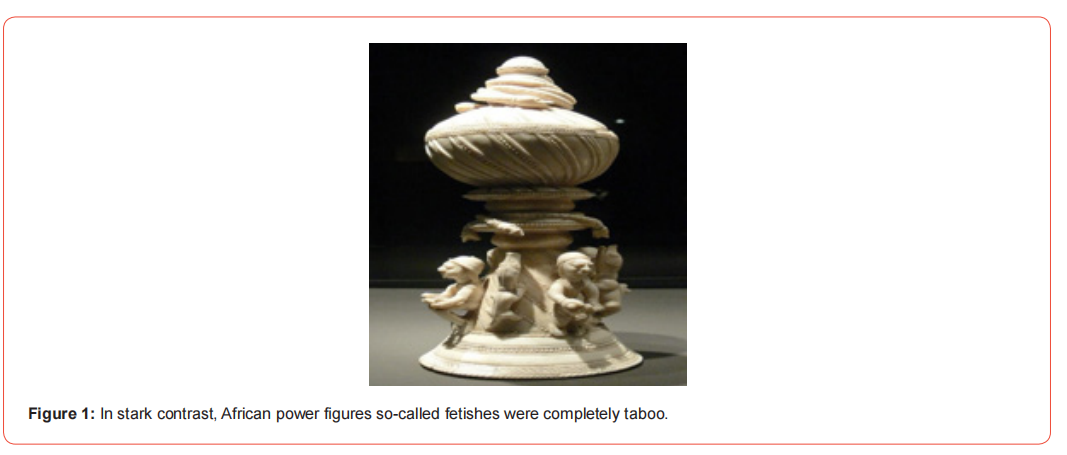
To the Western mind, these “self-made gods” stood in sharp opposition to the revealed deity of Christianity; they were also perceived as uncanny because they defied Western explanation. To European observers, these figures appeared mystical and potent, radiating an immense, primal energy. For these reasons, they were often burned. Such fetishes naturally, there was no desire to sell them. And for this reason, the aforementioned salt cellars were not classified as African art. Although the literature on African art and the number of art exhibitions have grown significantly in both scope and quality, many questions remain unanswered. There is little concrete research regarding the art of Africa and its artists, yet there are many misinterpretations, misunderstandings, and Western-concocted theories concerning African art history.
-

This work is licensed under a Creative Commons Attribution-NonCommercial 4.0 International License.




