




 Research article
The Effects of Total Mass Flow Rate and Gas Composition in Reactive Radio-Frequency Sputtering of Ultrathin Films
Received Date:October 14, 2024 Published Date: November 14, 2024
Abstract
The effects of total mass flow rate and gas composition in low-pressure plasma discharges, typical of radio-frequency (rf) sputtering, were investigated in the context of deposition experiments with nitrogen-containing amorphous carbon ultrathin films. An analysis of low-pressure rf discharges is presented to illuminate the dependence of effective ionization rate on the absorbed power, target and substrate bias voltages, and working pressure and provide insight into the effects of total mass flow rate and gas composition on key plasma parameters. The effect of the gas composition on the ion-current density of bombarding plasma ions is shown to be more significant than that of the total mass flow rate. The correlation of the effective ionization rate, ion-current density, and total mass flow rate established by the experiments and analysis of this study explains the variations in growth rate and microstructure of thin and ultrathin films deposited by low-pressure rf discharges.
Keywords: Deposition parameters; Low-pressure plasma discharges; Radio-frequency sputtering; Thin and ultrathin films
Highlights
• Effects of total mass flow rate and gas composition on key plasma parameters
• Effective ionization rate versus ion-current density and total mass flow rate
• Effective ionization rate versus absorbed power, bias voltage, and working pressure
• Stronger effect of gas composition on ion-current density than total mass flow rate
• Insight into growth rate and microstructure variations of radio-frequency sputtered carbon thin and ultrathin films
Introduction
Radio-frequency (rf) sputtering is one of the most widely used thin-film deposition methods. This method uses low-energy neutral atoms or clusters of atoms as film-forming precursors, and its low input energy, process temperature, and working pressure make it an efficient method for depositing thin films. Characteristically, Ar+ ion bombardment during film growth tailors the film microstructure and properties without altering its chemical environment. The film composition can also be modified by a reactive plasma, such as nitrogen plasma. Thus, the film microstructure, composition, and properties can be tweaked by accordingly adjusting the deposition parameters controlling the low-pressure plasma discharges in rf sputtering, such as forward rf power, ion current density, target voltage, working pressure, plasma ion density, and substrate bias voltage [1-5]. Particularly, the effect of substrate biasing on the microstructure and mechanical properties of sputtered films has been extensively studied because it directly influences the ion bombardment energy, which, in turn, affects the intensity of collision cascades between the impinging Ar+ ions of the plasma and the atoms at the growing film surface. The resulting atomic interactions at the film surface promote film densification, intermixing of the film atoms with the surface atoms of the substrate [6], growth of diamond nanocrystallites [7], and formation of a layered film structure [8]. The bias voltage for maximum sp3 hybridization in rf sputtered amorphous carbon (a-C) films has been reported to be in the range of –100 to –200 V [9]. Higher voltages intensify the ion bombardment, subsequently instigating film damage, thermal spikes that may induce transformation from sp3 to sp2 carbon atom hybridization, and film resputtering.
The foregoing studies and several others indicate that reactive plasma discharges offer a wide spectrum of possible surface modifications. In the context of supply-rate/pumping-rate-limited competing factors in chemical vapor deposition and plasma etching processes, the total mass flow rate and reactive gas composition are important process parameters [10]. However, the effects of the former parameters on the low-pressure plasma discharges encountered during rf sputtering has not been thoroughly studied. For a fixed working pressure, the total mass flow rate of the sputtering gas may affect the growth rate, microstructure, and properties of the deposited film. Indeed, it has been shown that the total mass flow rate of Ar/N2 sputtering gas affects the growth rate, microstructure, and nanomechanical properties of nitrogen-containing amorphous carbon (a-CNx) films deposited by reactive rf sputtering, but not the chemical composition, although the effect is secondary compared to that of the gas composition [11]. These trends can be attributed to changes in plasma parameters influencing the mechanical and chemical environment of the deposited film. Therefore, knowledge of the effect of the total mass flow rate of sputtering gas (either noble or reactive) on key plasma discharge parameters of rf sputtering is of profound importance in deposition of thin films with desirable properties.
In consideration of the plasma discharges encountered under capacitive rf sputtering conditions, the characteristics of low-pressure rf discharges were examined in this study in the context of analytical and experimental results demonstrating the effects of total mass flow rate and sputtering gas composition on important plasma parameters (i.e., effective ionization rate and ion-current density) affecting the growth rate and mechanical properties of a-CNx films. The results presented below provide explanation for the differences in growth rate, microstructure, and properties of thin and ultrathin films deposited by reactive rf sputtering.
Experimental Method
Deposition of a-CNx thin films was accomplished with a capacitive rf sputtering system (Perkin-Elmer Randex-2400) in the presence of Ar/N2 gas (0–50 vol% N2) under working conditions of total mass flow rate f ≈ 6–50 sccm, forward rf power Pf = 750 W, self-biased substrate voltage VS = –200 V (applied by a substrate tuning technique [12]), and working pressure p ≈ 3 mTorr. The self-biased target voltage VT, reflected rf power, and chamber pressure measured before plasma ignition p1 and under steady-state sputtering conditions p2 were correlated to the total mass flow rate and composition of the Ar/N2 gas mixture.
Analysis
A low working pressure (e.g., p = 3–10 mTorr) in rf sputtering yields low deposition rates and enhances energetic ion bombardment, which is conducive to film densification and resputtering of weakly bonded atoms. Important plasma parameters are the electron and ion temperature Te and Ti, respectively, plasma density n0, ion kinetic energy Ei, and ion-current density Ji [3,13,14]. The product Ei Ji determines the power density on both the target and substrate surfaces during film deposition. Low-pressure discharges are weakly ionized, e.g., for a pure Ar plasma, p = 3 mTorr, and plasma-absorbed rf power Pab = 100–1000 W, n0 ≈ (2–8) x 1010 cm–3 and neutral gas density ng ≈ 1014 cm–3 [3]. For p = 3 mTorr, the neutral-neutral mean free path for Ar and N2 is ~1.4 and ~1.2 cm, respectively [15]. For the intermediate gas flow range [3,16] examined in this study, plasma transport is predominantly diffusive and the generated low-pressure discharges yield an approximately uniform cylindrical plasma of radius r and length l, confined between collisionless electric sheathes and exhibiting negligible energy losses in the radial direction.
For low-pressure (e.g., 3 mTorr) rf discharges, the electron Debye length λDe ≈ 743(Te ne )1 2 , where Te is given in eV and the electron density ne is given in cm–3, is much smaller than the ion-neutral mean free path λi [3]. For example, for Te = 3.5 eV and ne = 1010 cm–3, λDe ≈ 0.014 cm ≈ 71. λi Hence, the ion velocity at the plasma-sheath edge us is equal to the ion sound (Bohm) velocity uB =(Te/Mi )1/2, where Mi is the ion mass [13]. Consequently, for collisionless sheathes, the ion-current density per unit area ns uB on the target and substrate surfaces can be presumed to be equal, i.e., Ji = ens uB, where ns is the ion density at the plasma-sheath edges and is given by ns ≈ 0.86n0 (3+l/2 λi)–1/2 [14]. Therefore, an overall discharge power balance for approximately cylindrical plasma gives [3]
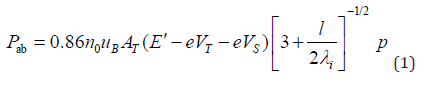
where AT is the target surface area and E′ ≈ 114 eV for 3 mTorr Ar discharges [3]. For a given p and fixed target-substrate geometry, Pab, and VS, Eq. (1) indicates that a lower n0 intensifies VT, which explains the changes in VT due to gas composition variations in reactive rf sputtering of a-CNx films [11].
The foregoing particle balance for steady-state rf plasma discharges yields that ion losses to the target and substrate surfaces are balanced by ions generated in the bulk of the plasma at an effective ionization rate. Thus,

where iz K'is the effective ionization rate (expressed in s–1) and ng = PNA /RT, where NA is the Avogadro number, R is the gas constant, and T is the neutral gas temperature, which is close to the ambient. Eq. (2) indicates that K'iz indirectly depends on n0, which might be a function of the total mass flow rate. For the diffusive discharges considered here, a higher gas flow rate may lead to more charged particle losses in the chamber space and walls. While the energy loss due to the foregoing particle losses can be neglected due to the high VT and VS K'iz may differ from the real ionization rate in the plasma bulk at a given pressure.
Using Eqs. (1) and (2), the effective ionization rate can be expressed as
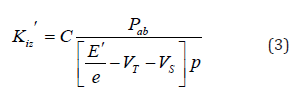
where C = 2RT/elAT NA is a constant in this study. Thus, K'iz can be used to indirectly interpret the effects of the total mass flow rate and sputtering gas composition on controlling plasma parameters by substituting in Eq. (3) the magnitudes of key process parameters measured under various sputtering conditions.
Results and Discussion
In the present experiments, p, Pf, and VT were measured at steady-state plasma conditions. While the steady-state chamber pressure p2 remained almost constant after the ignition of the pure Ar plasma (i.e., p1 ≈ p2), Figure 1 shows an appreciable change in chamber pressure during the Ar/N2 discharges, especially for a relatively low total mass flow rate Qm. As adsorption of reactive nitrogen atoms occurred readily on the fresh surfaces of the chamber, p2 decreased after plasma ignition, even though Qm and the pumping speed were kept constant. Moreover, Figure 1 shows less change in chamber pressure due to plasma ignition with increasing Qm. This is because the introduction of nitrogen gas at higher flow rates decreased the relative amount of consumed nitrogen, subsequently causing the effect of nitrogen-adsorbing sites to become secondary
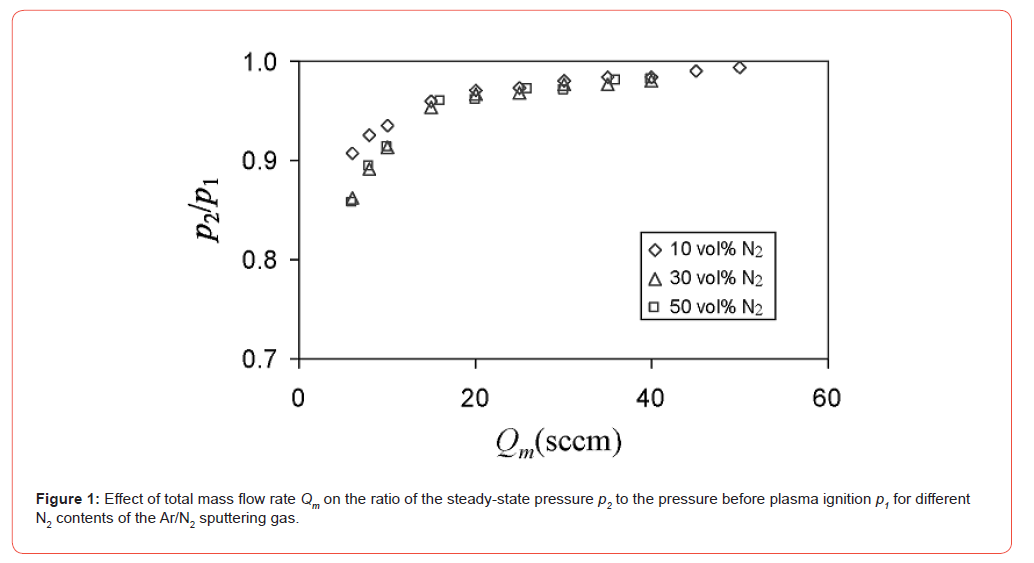
Figure 2 shows the self-biased target voltage VT versus total mass flow rate Qm and gas composition. The trend for VT to increase with the N2 content and Qm is in good agreement with previous findings [11]. In view of Eq. (1) and the tendencies shown in Figure 2, it can be inferred that the increase of the N2 content and Qm reduced the plasma density n0. It is noted that Ar/N2 discharges are considerably more complex than pure Ar discharges, and for molecular gases the collisional energy loss can be 2 to 10 times higher than that for a noble gas at a given electron temperature [17]. Nevertheless, the approximation of the Ar/N2 plasma by a pure Ar plasma does not change the trends observed in the present experiments.
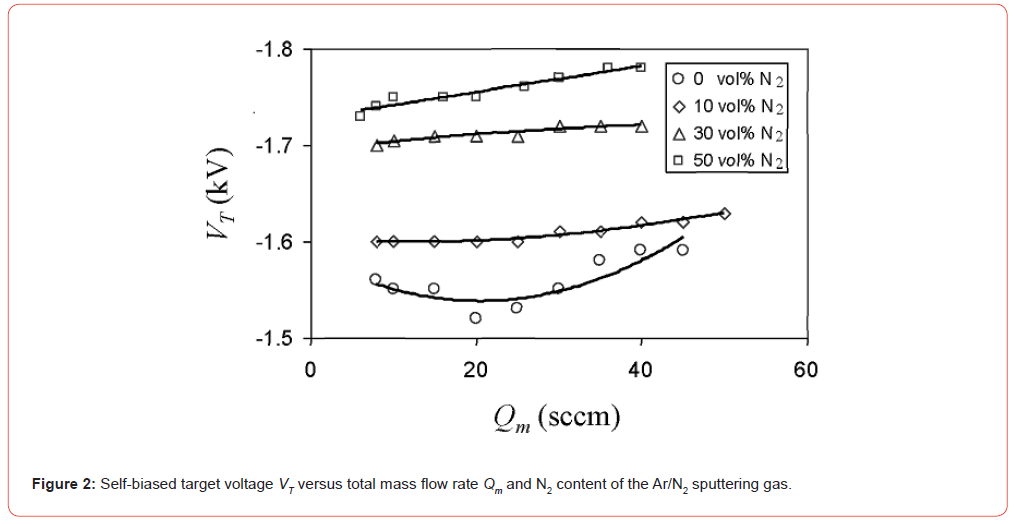
Figure 3 shows the effective ionization rate K'iz versus the total mass flow rate Qm and gas composition. For all gas compositions, K'iz decreased with the increase of Qm, especially for higher N2 contents. In view of the trends shown in Figure 3, it may be interpreted that although for pure Ar plasma the effect of the total mass flow rate was marginal, for an Ar/N2 plasma with a relatively high nitrogen content the effect was significant. This indicates that, for a constant chamber pressure (i.e., ~3 mTorr), an increase in Qm resulted in more ion or electron losses through diffusive discharges due to the corresponding higher pumping speed. Consequently, for a given sputtering gas composition, a higher total mass flow rate yielded a lower plasma density in the discharges, even though the density change (indicated by the change in ion-current density) was not very profound, as seen by the decrease of Ji primarily with increasing N2 content and secondarily with increasing Qm (Figure 4). Since VT was fixed at –200 V during sputtering, the power density on the substrate surface exhibited the same trend as Ji. For Ei ≈ 200 eV, Ji plays an important role in the film growth process, affecting the microstructure and nanomechanical properties of the deposited films [18].
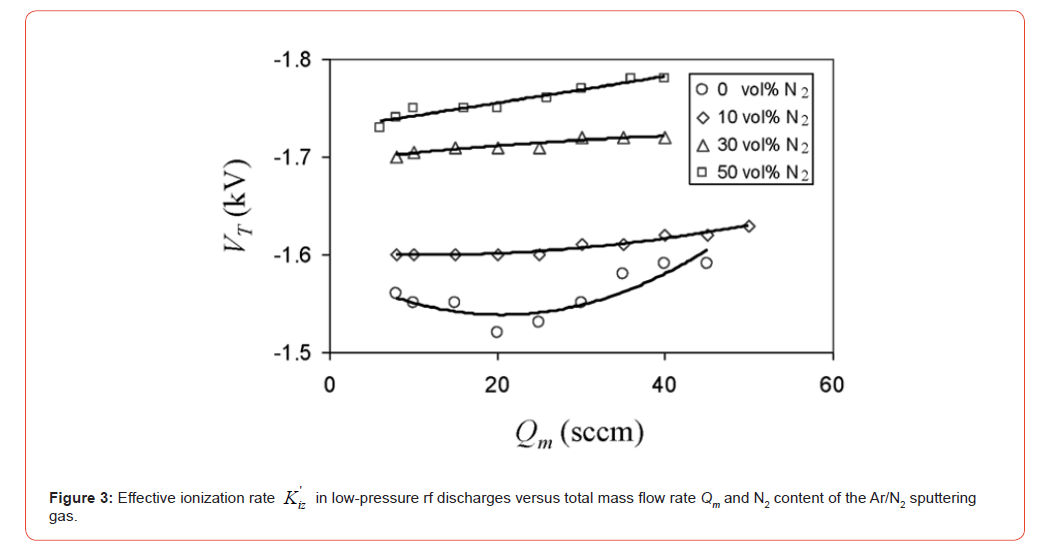
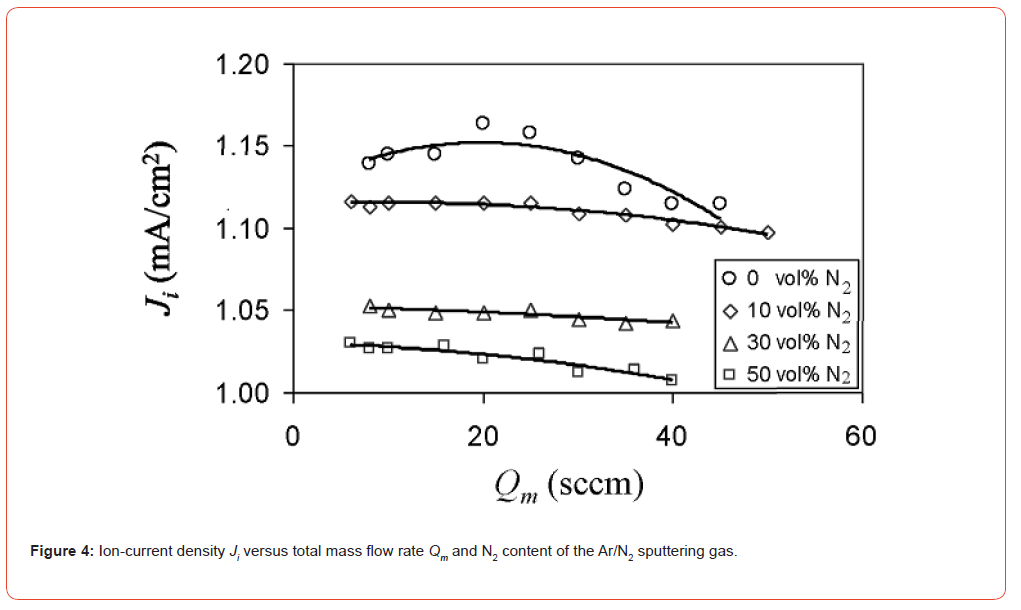
The foregoing trends of the ion-current density and power density on the substrate surface are in good agreement with those reported for the growth and nanomechanical properties of a-CNx films deposited under similar rf sputtering conditions [11]. Furthermore, the analytical and experimental results of this study reveal that a possible reason for the discrepancies in microstructure and properties of reactively rf sputtered thin and ultrathin films may be the effects of the total mass flow rate and sputtering gas composition on the effective ionization rate and ion-current density.
Conclusion
The composition of sputtering gas was shown to exhibit a significant effect on the ion-current density (or power density on the growing film surface) and, consequently, on the growth and properties of thin films deposited by reactive rf sputtering. However, the effect of the total mass flow rate on the plasma conditions and, in turn, the film characteristics was shown to be relatively less significant. The effective rate of plasma ionization decreased with the increase of the total mass flow rate, and this trend became more pronounced with the incorporation of a reactive gas (i.e., nitrogen) in the sputtering gas. The results of this study elucidate the effect of total mass flow rate and sputtering gas composition on important process parameters in low-pressure plasma discharges encountered during reactive rf sputtering and provide explanation for the variations in the growth rate and physical properties of reactively rf sputtered a-CNx films reported in the literature. Moreover, from a fundamental thin-film synthesis perspective, the present study sheds light into the interdependence of the effective ionization rate, ion-current density, and total mass flow rate, which is critical to understanding variations in the growth rate and structure characteristics of thin and ultrathin films deposited by low-pressure rf discharges.
Acknowledgment
This work was funded by the National Science Foundation under Grant No.CMS-9734907.
Conflict of Interest
None.
References
- Coburn JW, Kay E (1972) Positive‐Ion Bombardment of Substrates in RF Diode Glow Discharge Sputtering. Journal of Applied Physics 43: 4965-4971.
- Keller JH, Pennebaker WB (1979) Electrical Properties of RF Sputtering Systems. IBM Journal of Research and Development 23: 3-15.
- Lu W, Komvopoulos K (1999) Dependence of Growth and Nanomechanical Properties of Ultrathin Amorphous Carbon Films on Radio Frequency Sputtering Conditions. Journal of Applied Physics 86: 2268-2277.
- Lazar G (2001) Influence of the Substrate-Electrode Applied Bias Voltage on the Properties of Sputtered a-C:H Thin Films. Journal of Physics: Condensed Matter 13: 3011-3021.
- Wan D, Komvopoulos K (2006) Effect of Low-Pressure Plasma Discharge Conditions on the Thickness and Roughness of Ultrathin Films of Amorphous Carbon. Journal of Applied Physics 100: 063307.
- Wan D, Komvopoulos K (2006) Probabilistic Analysis of Tetrahedral Carbon Hybridization in Amorphous Carbon Films. Applied Physics Letters 88: 221908.
- Wan D, Komvopoulos K (2008) Formation of Diamondlike Nanocrystallites in Amorphous Carbon Films Synthesized by Radio-Frequency Sputtering. Journal of Materials Research 23: 700-703.
- Xie J, Komvopoulos K (2016) Friction, Nanostructure, and Residual Stress of Single-Layer and Multi-Layer Amorphous Carbon Films Deposited by Radio-Frequency Sputtering. Journal of Materials Research 31: 1857-1864.
- Xie J, Komvopoulos K (2015) Hybridization and Tribomechanical Properties of Ultrathin Amorphous Carbon Films Synthesized by Radio-Frequency Low-Pressure Plasma Discharges. Surface and Coatings Technology 262: 15-20.
- Chapman B (1980) Glow Discharge Processes: Sputtering and Plasma Etching. Wiley, New York, NY.
- Lu W, Komvopoulos K (1999) Microstructure and Nanomechanical Properties of Nitrogenated Amorphous Carbon Thin Films Synthesized by Reactive Radio Frequency Sputtering. Journal of Applied Physics 85: 2642-2651.
- Logan JS (1970) Control of RF Sputtered Film Properties Through Substrate Tuning. IBM Journal of Research and Development 14: 172-175.
- Lieberman MA, Lichtenberg AJ (1994) Principles of Plasma Discharges and Materials Processing. Wiley, New York, NY.
- Lieberman MA, Selwyn GS, Tuszewski M (1996) Plasma Generation for Materials Processing. MRS Bulletin 21: 32-37.
- Konuma M (1992) Film Deposition by Plasma Techniques. Springer, Berlin, Germany.
- Ohring M (1992) The Materials Science of Thin Films. Academic Press, Boston, MA.
- Lee C, Lieberman MA (1995) Global Model of Ar, O2, Cl2, and Ar/O2 High-Density Plasma Discharges. Journal of Vacuum Science and Technology A 13: 368-380.
- Fancey KS, Porter CA, Matthews A (1995) Relative Importance of Bombardment Energy and Intensity in Ion Plating. Journal of Vacuum Science and Technology A 13: 428-435.
-

This work is licensed under a Creative Commons Attribution-NonCommercial 4.0 International License.




