




 Research article
Study on Dislocation-Dopants Interaction in KCl: Zn2+ Single Crystals by Strain-Rate Cycling Tests Combined with Ultrasonic Oscillation
Received Date:December 15, 2025 Published Date: January 07, 2026
Abstract
Combination method of strain-rate cycling tests with the ultrasonic oscillation was conducted for KCl:Zn2+ (0.1 mol.% in melt) crystals at the temperature of 102 to 299 K and for KCl crystal at 128 K. Relative curve between Δτ and λ has stair-like shape at a given strain for the impure KCl crystal. That is to say, Δτ values ( τp1 ) at first bending point are observed on the curve. As for the nominal pure KCl crystal, τp1 does not appear on the Δτ vs. λ curve at the low temperature. Therefore, τp1 depends on the dopant ions (i.e., Zn2+ ) in the KCl crystal. The τp1 tends to be gradually depressed with increasing temperature in similar as the variation of yield stress with it. The critical temperature (Tc), at which τ p1becomes zero, is near 217 K. Above the Tc, it is considered that the dopant Zn2+ ions no longer act as obstacles for dislocation motion in the impure crystal during plastic deformation.
Keywords: Mobile dislocation; Yield stress; Effective stress; Strain-rate cycling test; Ultrasonic oscillation
Introduction
Study on dislocation-point defects interaction has been carried out on the basis of Δτ versus λ below room temperature so far (e.g., [1,2]). Δτ is the stress change due to the application or removal of ultrasonic oscillation. λ is the strain-rate sensitivity of flow stress and is given by the following Equation (1)
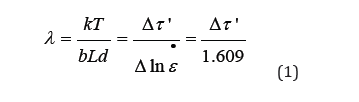
where b is the magnitude of Burgers vector, L is the average length of dislocation segments, d is the activation distance, and kT has its usual meaning. That is to say, the λ value is inversely proportional to the L [3] and was derived here from the stress charge (Δτ ') due to the strainrate cycling between ε̇1 (2.2×10⁻⁵ s-1) and ε̇2 (1.1×10⁻⁴ s-1) in the middle of ultrasonic oscillation with constant stress amplitude. The Δτ versus λ curve, which is obtained from the values of Δτ versus λ at the same strain, reflects the effect of ultrasonic oscillation on the free flight motion of dislocation on the slip plane containing forest dislocations and point defects such as dopant ions during the plastic deformation of ionic crystal (e.g., [1]). The information on the dislocation motion has been given by the original combination method of strain-rate cycling tests with the ultrasonic oscillation for the many kinds of materials, for example, the sodium halide crystals doped with monovalent cations (NaBr:Li+ [4-6] and NaCl:Li+ [6]) or irradiated by X-ray at room temperature [7]. Motion of dislocation on the slip plane contained obstacles such as Zn2+-cation vacancy dipoles, which cause rapid hardening, is further investigated here by the original method, following on from the previous paper [8].
Experimental Procedure
Nominal pure KCl and KCl single crystals doped with Zn2+ (0.1 mol.% in melt) were cleaved to the size 5×5×15 mm3 and were subjected to the following heat treatments. Annealing at 973 K for 24 h, these crystals were gradually cooled to room temperature to remove as much internal strain as possible. Furthermore, the impure crystals only were quenched after keeping at 673 K for 30 min for the purpose of dispersing the Zn2+-cationic vacancy dipoles into them immediately before the original combination tests described in the introduction section.
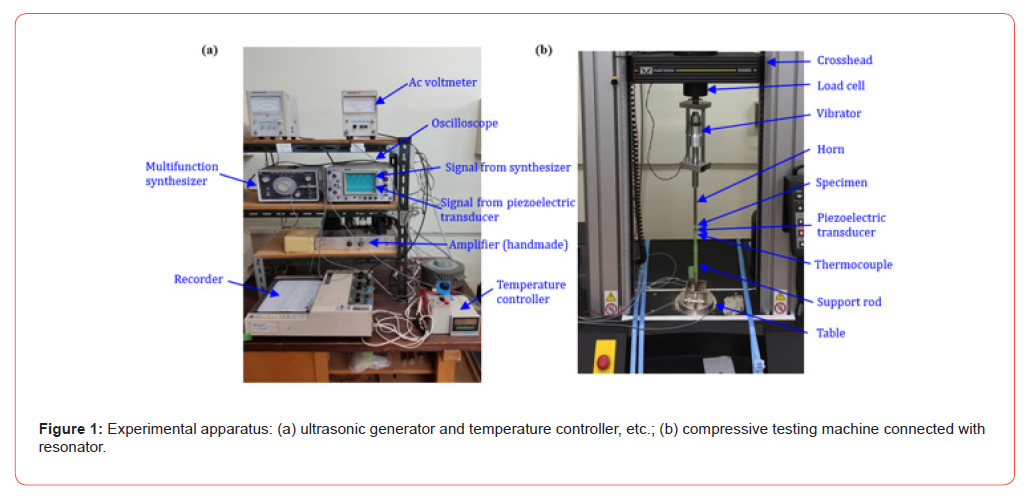
Figure 1(a) and (b) show the photographs of experimental apparatus. Strain-rate cycling tests between the strain rates of 2.2×10⁻⁵ and 1.1×10⁻⁴ s-1 were conducted in association with ultrasonic oscillation (20 kHz), using this test machine (Instron 5565) connected with resonator and keeping the stress amplitude constant during plastic compression at 102 to 299 K. This experimental method was detailed in the paper [1].
Results and Discussion
In Figure 2, the Δτ versusλ is shown for KCl:Zn2+ crystals at various temperatures and has stair-like shape. Two bending points of τp1 (at low stress decrement Δτ ) and τp2 (at high Δτ ) are observed on the variation of λ with Δτ at 134, 180, and 188 K in the figure. And further, these two stress values seem to be smaller at higher temperature, although the second bending point (i.e., τp2 ) does not appear on the relationship line at 117 and 124 K since the ultrasonic oscillation with larger stress amplitude could not be applied to the crystals during the tests.
With regard to the nominal pure KCl single crystal at the low temperature of 128 K, the Δτ versus λ curves are shown in Figure 3. Blue, red, and gray solid lines represent the relationships at the strains of 10, 11, and 12 %. In low Δτ , the plateau place does not appear and λ all slopes downwards with rising Δτ . No the first bending points (i.e., τp1 ) appear on the relationship lines for the KCl crystal and second bending ones (i.e., τp2 ) only can be seen in the figure. Similar phenomenon as Figure 3 is also seen at other low temperatures. Therefore, the τp1 , observed for the impure KCl crystals in Figure 2, is considered to represent the effective stress due to the dopant ions Zn2+ in the crystal. And also, the relationship line between Δτ and λ rises upwards as strain increases, although there is some scatter in the plot data as shown in Figure 3. This is caused by the strain-rate sensitivity due to the dislocation cuttings, because the dislocation cuttings increase in the process of plastic deformation [9]. This leads to the increase in λ with strain.
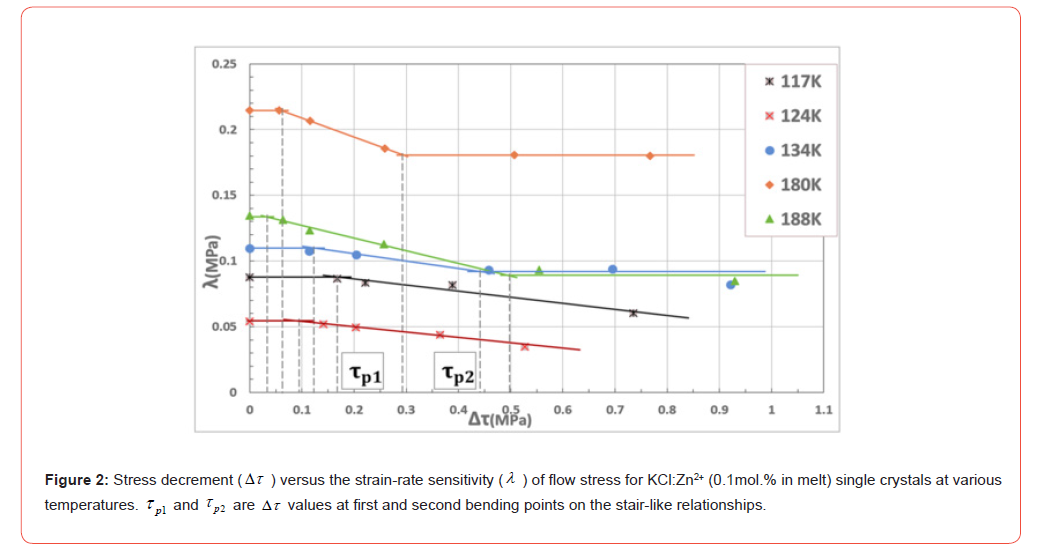
Figure 4 shows the variation of τp1 with temperature for KCl:Zn2+ crystals. τp1 value tends to decrease with increasing temperature and becomes zero above around 217 K. Dislocations overcome the obstacles (i.e., Zn2+-cation vacancy dipoles) on the slip plane with the help of thermal activation. At higher temperature, it will be easier to overcome the obstacles by mobile dislocations.
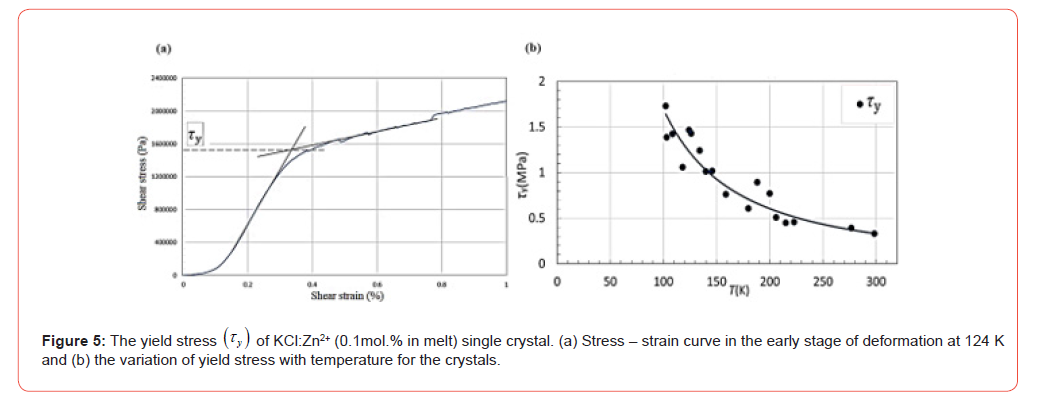
Figure 5 (a) shows the compressive stress versus strain curve in the early deformation region for the KCl: Zn2+ crystal at 124 K. Yield stress y τ has been given by the stress at the intersection of the tangent to the plastic deformation region and the straight line extrapolated from the elastic deformation one in the stress-strain curve [10], as denoted in the figure. Here, the value of τy is about 1.5 MPa for the crystal at 124 K. Temperature dependence of τy is shown for the crystals below room temperature in Figure 5 (b). Solid curve in the figure was determined as to be fitted to the data plots using the least-squares method. τy decreases with increasing temperature and seems to approach constant stress above 200 K.
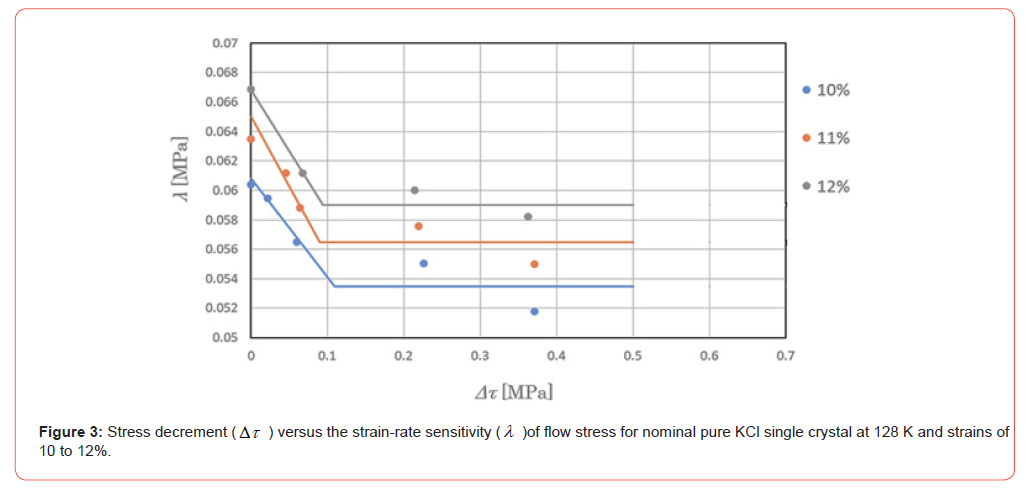
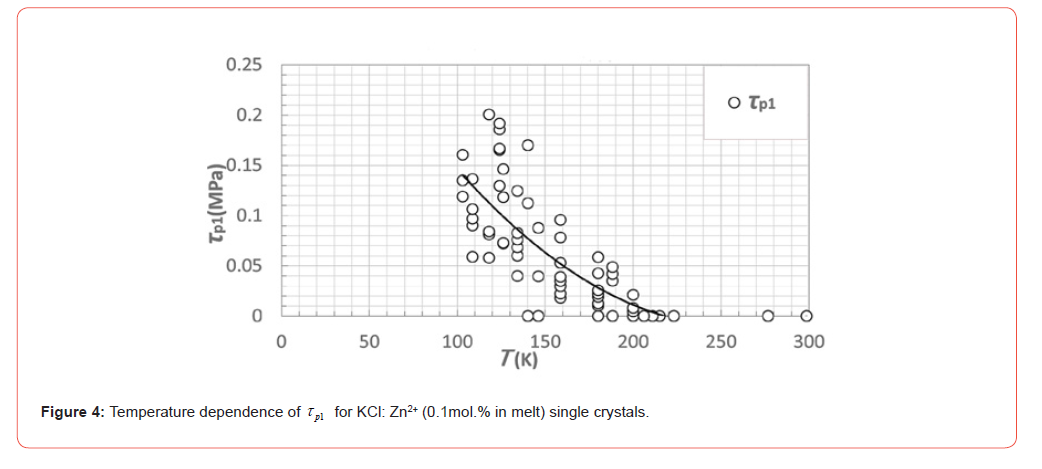
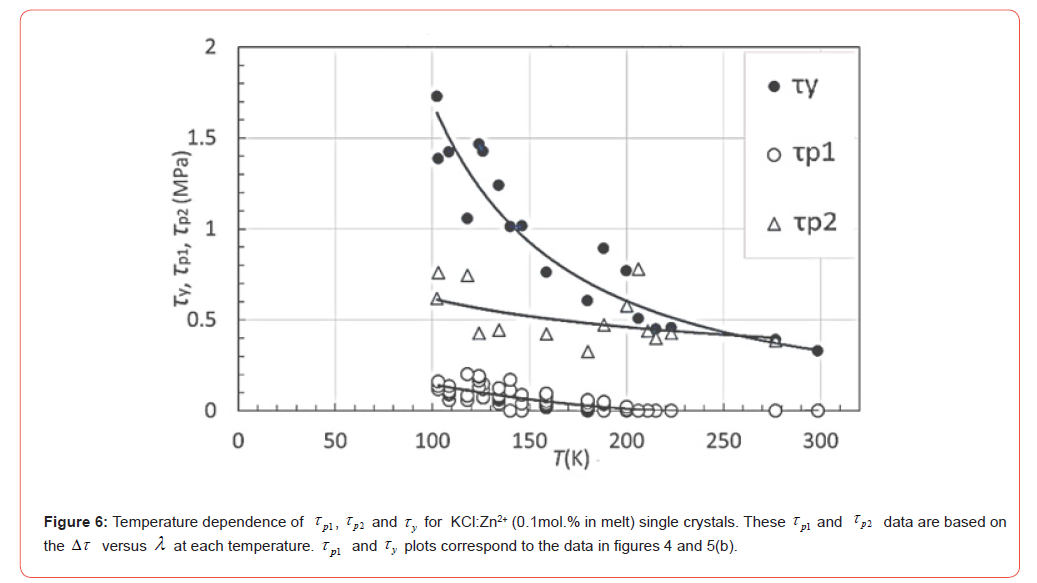
Figure 6 is concerned with the dependence of τp1 , τp2, and τy on temperature for the KCl:Zn2+ crystals. The open circles and triangles represent τp1 and τp2 , respectively, and the solid circles the yield stress τy The curves for three kinds of stress are to guide the reader’s eye by the least-squares method. As mentioned in the previous paper [8], it has been reported that Zn2+-cationic vacancy dipoles do not act as the obstacles for mobile dislocation by the application of the stress more than τp2 , where strong obstacles such as the forest dislocations behave as obstacles. τp1 and τp2 become gradually large with decreasing temperature as the variation of τy within the temperature. The difference between τp1 and τp2 might not be seen and is almost constant at a given temperature in the figure. This may suggest the almost unchanged distribution of the separation between the obstacles (dopant ions Zn2+) on the mobile dislocation independently of temperature.
The critical temperature Tc at which the intersection with the abscissa of τp1 versus temperature curve in Figure 4 and τp1 becomes zero is 217 K, as mentioned above. There, Zn2+-cationic vacancy dipoles no longer act as impedimenta to movement dislocation in the KCl:Zn2+ crystal. That is to say, the dislocations move forward, overcoming the dopants only with the help of thermal activation above the temperature of Tc (i.e., 217 K) during the compressive deformation of the crystal. Above near the Tc, τy also seems to approach a constant value due to internal stress, as can be seen in Figure 6.
Conclusion
The information on motion of dislocations on the slip plane contained obstacles such as Zn2+-cationic vacancy dipoles was obtained by the original method of strain-rate cycling tests combined with the ultrasonic oscillation for KCl:Zn2+ single crystals.
The first bending points τp1 are observed at low stress decrement Δτ on the stair-like Δτ versus λ relationships for KCl:Zn2+ crystals at 117 to 188 K, however τp1 does not appear for the nominal pure KCl crystal at the low temperature. This means that the stress τp1 is due to the dopant ions Zn2+ in the crystal. τp1 value gradually decreases with increasing temperature as the variation of yield stress and becomes zero at 217 K. Above the critical temperature of 217 K, Zn2+-cationic vacancy dipoles no longer behave as obstacles for mobile dislocations and dislocations break-away from them only with the help of thermal activation during the plastic compression of the KCl:Zn2+ single crystal.
Acknowledgement
None.
Conflict of Interest
No conflict of interest.
References
- Kohzuki Y (2018) Study on dislocation-dopant ions interaction in ionic crystals by the strain-rate cycling test during the Blaha effect. Crystals 8(1): 31-54.
- Ohgaku T, Migiuma S, Nagahira D (2011) Interaction between dislocation and defects induced by X-irradiation in alkali halide crystals. Radiation Measurements 46(12): 1385-1388.
- Conrad H (1964) Thermally activated deformation of metals. Journal of Metals 16: 582-588.
- Kohzuki Y (2021) Interaction of mobile dislocation with additives in ionic crystals. Modern Concepts in Material Science 4(4): 1-3.
- Kohzuki Y (2022) Study on thermal activation barrier for dislocation motion by strain-rate cycling tests combined with ultrasonic oscillations. Modern Concepts in Material Science 5(1).
- Kohzuki Y (2024) Dislocation-monovalent cations interaction in sodium halide crystals during plastic deformation. Modern Concepts in Material Science 5(4).
- Kohzuki Y (2023) Study on X-ray-induced defects as barriers for dislocation motion by strain-rate cycling tests combined with ultrasonic oscillation. Modern Concepts in Material Science 5(2).
- Kohzuki Y (2025) Study on dislocation-divalent cations interaction in potassium chloride crystals by strain-rate cycling tests combined with ultrasonic oscillation. Modern Concepts in Material Science 7(1).
- Ohgaku T, Takeuchi N (1989) Relation between plastic deformation and the Blaha effect for alkali halide crystals. Physica Status Solidi A 111(1): 165-172.
- Sprackling MT (1976) The plastic deformation of simple ionic crystals. Alper AM, Margrave JL, Nowick AS, eds., Academic Press, London, New York, San Francisco pp. 179-189.
-

This work is licensed under a Creative Commons Attribution-NonCommercial 4.0 International License.




