




 Research article
Silver Dopant Enhances the Nafion IPMC Bending and Bending Controllability
Received Date:April 08, 2025 Published Date: April 17, 2025
Abstract
Ionic Polymer-Metal Composite (IPMC) is a soft actuator that operates in bending mode and is classified as a type of electroactive polymer (EAP). Previous studies have suggested that the deformation of IPMC is induced by the movement of hydrated mobile ions under an external voltage. It is also well known that doping, the process of introducing mobile ions into the IPMC, further enhances its bending deformation. However, our observations indicate that even in a dehydrated state, IPMC exhibits bending and controllability comparable to those of its hydrated one. This finding necessitates a reassessment of the conventional understanding of the deformation mechanism of IPMC and the effects of doping. In this study, we demonstrate that merely introducing ions through doping does not necessarily lead to an increase in deformation or controllability of IPMC. However, we have identified that certain dopants can enhance the bending characteristics of IPMC. Specifically, in Nafion-based IPMC, silver ions were found to be effective. Furthermore, our findings suggest that silver ions contribute to the improvement of bending properties by inducing structural changes at the atomic/molecular level in IPMC.
Keywords: IPMC; Bending; Doping; Redox reaction
Introduction
One of the soft actuators, Ionic Polymer-Metal Composite (commonly abbreviated as IPMC), is a highly attractive bending-mode actuator. Sometimes it is called an artificial muscle [1-5]. Its bending is significant even under a quite small external electric stimulation, which a common battery can generate.
Nafion is an ion-exchange membrane, and many researchers have investigated the characteristics of Nafion-based IPMC. Its structure is quite simple, consisting of Nafion surfaces that are merely coated with metal, usually platinum [1-15], which is formed by electroless plating. When hydrated, Nafion-based IPMC exhibits significantly large bending even under a quite low applied voltage. It is believed that IPMC bending is governed by the shift of hydrated mobile ions under an externally applied electric field [1,4,5,10,11,14]. This ion shift causes the swelling ratio gradient in the direction of IPMC thickness, resulting in the bending. Importing an excess quantity of mobile ions is a known method for enhancing IPMC bending, called “doping” [10,15]. Intuitively, the increased number of mobile ions leads to the formation of a greater quantity of hydrated mobile ions. Consequently, these hydrated mobile ions under the applied voltage shift their positions within the IPMC body, resulting in enhanced bending. However, the hydrated IPMC bending is accompanied by the backward bending relaxation, namely, the IPMC bending becomes electrically uncontrollable [5,16,17]. It is unfavorable property of IPMC and it needs to get around such a problem. The backward bending relaxation must be inevitably accompanied by the backward flow of hydrate mobiles ions. Therefore, it is natural to think that what will happen when the IPMC does not contain much water molecules.
The effectiveness of IPMC bending does not depend solely on the shift of mobile ions quantity under external electric field. Notably, even highly dehydrated IPMC can exhibit significant bending under an applied voltage. An IPMC consisting of Selemion CMV (an ion-exchange membrane manufactured by Asahi Glass Co., Ltd. (Tokyo)) coated with silver exhibits significantly large bending with the application of only a few volts [18-20]. Intriguingly, it also exhibits substantial bending even in a highly dehydrated state. Here, “highly dehydrated” does not mean “completely dehydrate” but means that the IPMC contains a minute quantity of water by absorbing the moisture from the atmosphere. Nevertheless, a relatively large bending is still induced. Hence, it is reasonable to consider that IPMC bending is governed by a more complex mechanism than previously believed. Tamagawa et.al. have explained that the effective bending of highly dehydrated Selemion CMV-based IPMC is due to atomic structural changes in the silver layers on the IPMC surfaces [19]. These changes are caused by a redox reaction in the silver layer, induced by the applied voltage. Dehydration treatment to the IPMC is effective method for reducing the bending relaxation, but the degree of its bending is not large enough compared with the hydrated IPMC bending. Therefore, we came to think that we should reinvestigate the bending of IPMC and need to find the effective way of fabricating the highly-deformable and well-bending- controllable IPMC.
Materials
Hydrated IPMC
Following the underlined hydrated IPMC specimens were fabricated.
Ag-Naf-w: A Nafion sheet was purchased from Ion Power, Inc. (Germany), and was swollen with deionized water. A hydrated nondoped Ag-coated IPMC was fabricated by placing a silver foil (thickness = 0.1 μm ∼ 0.2 μm), which was purchased from Imai Kinpaku Co., Ltd. (Ishikawa, Japan), on the surface of this Nafion sheet. This IPMC is denoted as Ag-Naf-w.
Ag-p-Naf-w: A small piece of Nafion sheet underwent the silver mirror reaction [18,21]. The resulting IPMC surface was coated with silver. Silver mirror reaction was carried out by the following procedure: The silver-plating solutions, Solution-A and Solution-B, were prepared. Solution-A consists of silver nitrate (1.2 g), 17 N ammonium hydroxide (2.0 g), and deionized water (60 g). Solution- B consists of D-(+)-glucose (0.8g), sodium hydroxide (1.6 g) and deionized water (60 g). All the chemicals were purchased from FUJI FILM Wako Pure Chemical Corporation (Osaka, Japan). A Nafion sheet was placed in 15 g of Solution-A followed by the pouring of 15 g Solution-B. This process was repeated at least totally four times to do the better plating on Nafion surface. The Ag-coated Nafion was then cut into strips (20 mm in length and 2 mm in width). These strips (Ag-plated Nafion strips) are IPMCs and will hereafter be referred to as Ag-p-Naf-w. Ag-p-Naf-w was heavily doped with the chemicals used in the silver mirror reaction and remained in a hydrated state.
Au-Naf-A, Au-Naf-B: A small piece of Nafion sheet was immersed in Solution-A for a few hours to dope it with the solution. The Nafion sheet was then removed from Solution-A, and its surface was wiped. A gold foil (thickness = 0.1 μm ∼ 0.2 μm), which was purchased from Imai Kinpaku Co., Ltd. (Ishikawa, Japan), was subsequently placed on its surface. This Au-coated Nafion was then cut into strips (20 mm in length and 2 mm in width). These strips form IPMCs and will hereafter be referred to as Au-Naf-A. Another Nafion IPMC, doped with Solution-B, was fabricated using the same procedure as for Au-Naf-A, with Solution-B replacing Solution-A. The resulting IPMC is referred to as Au-Naf-B.
Au-Naf-Li, Au-Naf-K, Au-Naf-Na, Au-Naf-Ca, Au-Naf-g: We prepared aqueous solutions of 1M LiCl, 1M KCl, 1M NaCl, 1M CaCl2 and 1M glucose for the doping treatment of Nafion. A small piece of Nafion sheet was immersed in a 1M LiCl aqueous solution for a few hours to dope it with Li+ and Cl−. The Nafion sheet was then removed from the 1M LiCl solution. Its surface was wiped, but it was not completely dried. A gold foil was subsequently placed on its surface. The Au-coated Nafion was then cut into strips (20 mm in length and 2 mm in width). These strips are IPMCs and will hereafter be referred to as Au-Naf-Li. Other types of IPMCs doped with 1M KCl, 1M NaCl, 1M CaCl2 and 1M glucose were prepared in the same manner, and the resulting IPMCs are denoted as Au-Naf-K, Au-Naf- Na, Au-Naf-Ca and Au-Naf-g, respectively.
Au-Naf-w: For comparison, we prepared a non-doped IPMC by placing a gold foil on the surface of a Nafion sheet swollen with merely deionized water, and this IPMC is denoted as Ag-Naf-w. The notations of all kinds of IPMCs introduced in the section Hydrated IPMC are summarized in Table 1.
Table 1:Notations of the “HYDRATED” IPMCs

Dehydrated IPMC
The following underlined dehydrated IPMC specimens were fabricated. Note: In this study, “dehydrated” does not mean the IPMC is completely devoid of water as explain in the section Introduction. If the IPMC were entirely dehydrated, it would not respond to external electric stimulation. Instead, the dehydrated IPMC remains slightly hydrated due to moisture absorption from the environment during the process of their fabrication. So, “dehydrated IPMC” does not mean “completely dehydrated IPMC”, but rather refers to a “highly dehydrated IPMC”.
Ag-dNaf-w: A Nafion sheet was swollen with deionized water. Subsequently it was left under the air till it dried well. A dehydrated non-doped Ag-coated IPMC was fabricated by placing a silver foil on the surface of this Nafion sheet. This IPMC is denoted as Ag-dNaf-w.
Ag-p-dNaf-w: First, Ag-p-Naf-w was fabricated. Then it was left under the air till it dried well. The resulting IPMC is the dehydrated Ag-p-Naf-w, and it is denoted as Ag-p-dNaf-w.
Au-dNaf-A, Au-dNaf-B: A small piece of Nafion sheet was immersed in Solution-A for a few hours to dope it with the solution. The Nafion sheet was then removed from Solution-A and left in the air overnight until it dried well. Then a gold foil was placed on its surface. This Au-coated Nafion was then cut into strips (20 mm in length and 2 mm in width). These strips form IPMCs and will hereafter be referred to as Au-dNaf-A. Another dehydrated Nafion IPMC, doped with Solution-B, was fabricated using the same procedure as for Au-dNaf-A, with Solution-B replacing Solution-A. The resulting IPMC is referred to as Au-dNaf-B.
Au-dNaf-Li, Au-dNaf-K, Au-dNaf-Na, Au-dNaf-Ca, Au-dNaf-g: Dehydrated IPMCs doped with 1M LiCl were fabricated using the following procedure: A small piece of Nafion sheet was immersed in a 1M LiCl aqueous solution for a few hours to dope it with Li+ and Cl−. It was then removed from the solution and left in the air overnight until it dried well. A gold foil was subsequently placed on its surface. The Au-coated Nafion was then cut into strips (20 mm in length and 2 mm in width). These strips are IPMCs and will hereafter be referred to as Au-dNaf-Li. Other dehydrated IPMCs doped with KCl, NaCl, CaCl2 and glucose were prepared in the same manner. These are denoted as Au-dNaf-K, Au-dNaf-Na, Au-dNaf-Ca and Au-dNaf-g, respectively.
Au-dNaf-w: For comparison, we prepared a non-doped IPMC using the same procedure as for the Au-dNaf-Li, replacing the 1M LiCl solution with H2 O. The resulting IPMC is denoted as Au-dNaf-w.
The notations of all kinds of IPMCs introduced in the section Dehydrarated IPMC are summarized in Table 2. IPMCs shown in Tables 1 and 2 are categorized in Figure 1.
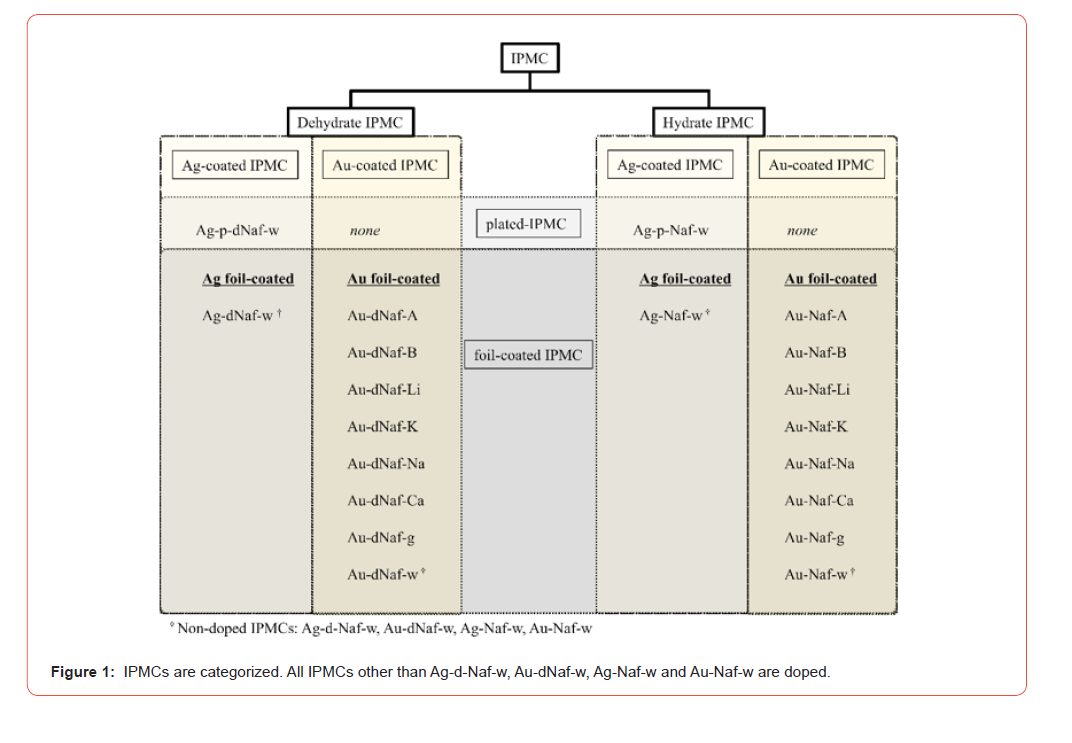
Table 2:

Measurements
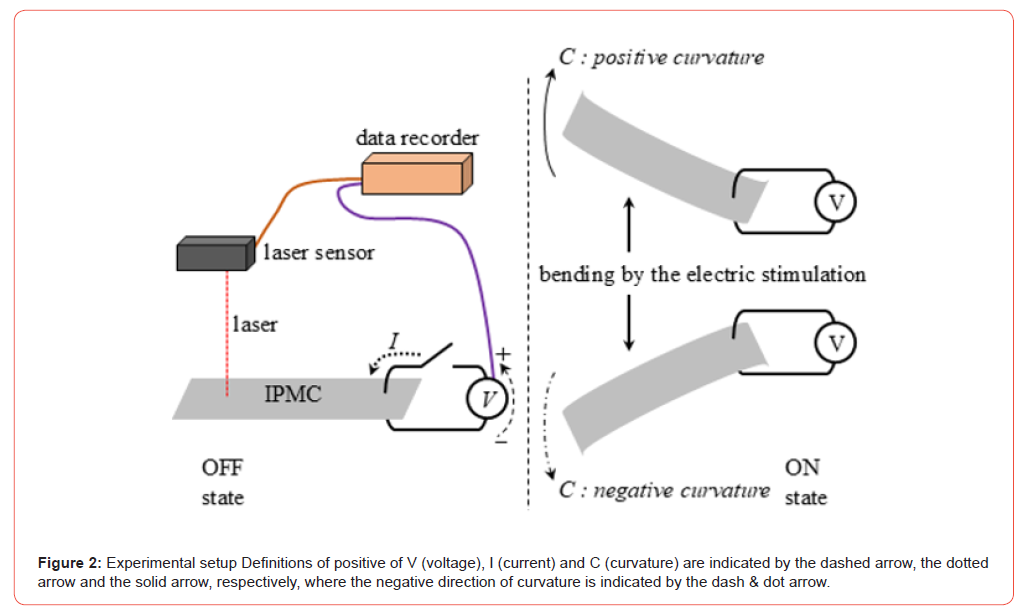
The fabricated IPMCs underwent the bending tests. Figure 2 is the illustration of experimental setup. A strip of IPMC was clamped between a pair of electrodes horizontally. Then the voltage was imposed on it. The IPMC exhibited the bending, and the bending was quantitatively measured by the laser displacement sensor as a function of time. Definitions of positive of V (voltage), I (current) and C (curvature) are indicated by the dashed arrow, the dotted arrow and the solid arrow, respectively, where the negative direction of curvature is indicated by the dash & dot arrow.
Results and Discussion
Bending of Dehydrated IPMC
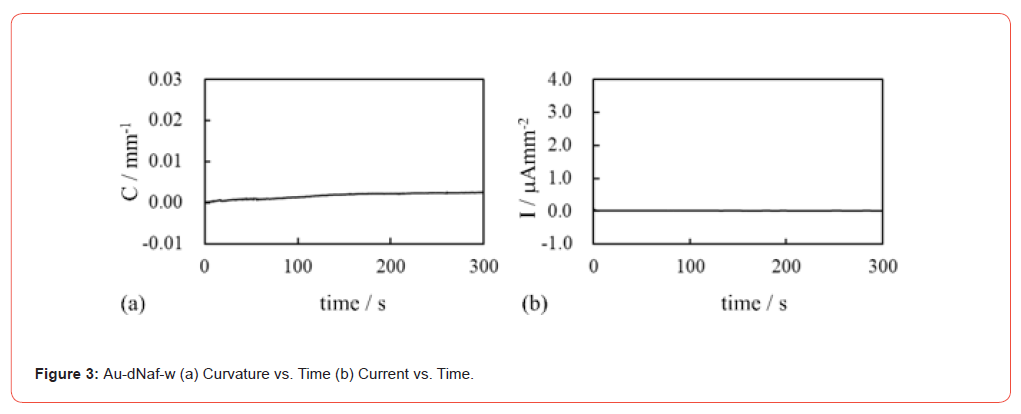
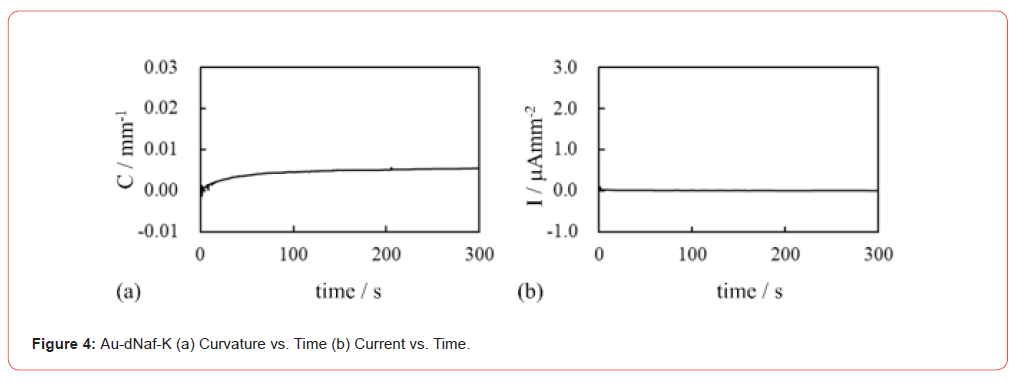
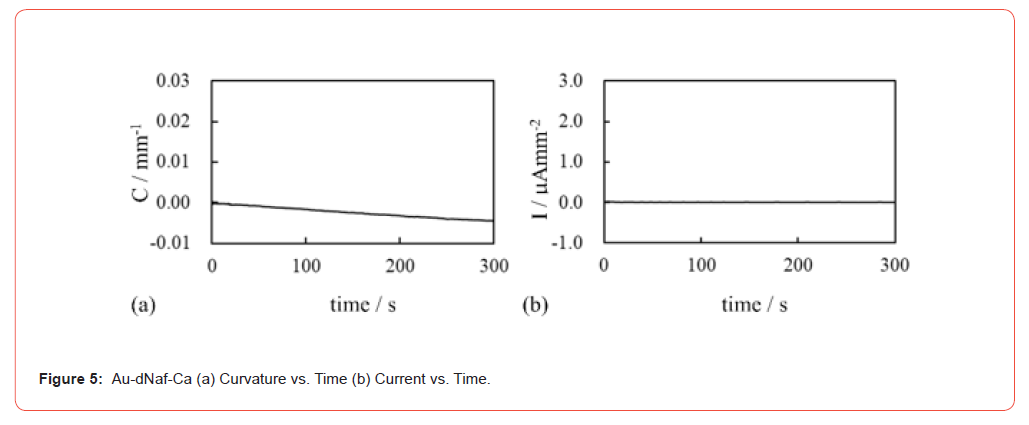
Dehydrated IPMCs fabricated in the section Hydrarated IPMC underwent the constant voltage, 2 V. All the dehydrated Au-coated IPMC did not exhibit the explicit bending. As a typical example, the curvature vs. time of Au-dNaf-w is shown in Figure 3(a). The induced curvature change is extremely low. The current for Figure 3(a) is shown in Figure 3(b). It is quite low current. As other example, the curvature vs. time and the current vs. time of Au-dNaf-K is shown in Figure 4. This IPMC is heavily doped with KCl (K+ and Cl−), but the induced curvature change and current are quite small. The characteristics of Au-dNaf-Na and Au-dNaf-Li are basically the same as those of Au-dNaf-K. The curvature vs. time and the current vs. time of Au-dNaf-Ca is shown in Figure 5. This IPMC is heavily doped with CaCl2 (Ca2+ and Cl−). What is different from Au-dNaf-K is the valency of cations contained in the IPMCs. The valency of K+ is +1, while the valency of Ca2+ is +2. However, the induced curvature change and current of Au-dNaf-Ca are quite small, or its bending curvature is even slightly negative.
All other Au-coated dehydrated IPMCs characteristics are basically same, no current and no bending. Induction of quite small bending due to the small current is quite understandable, as long as the shift of mobile ions is the cause of the IPMC bending [1,4,5,10,11,14].
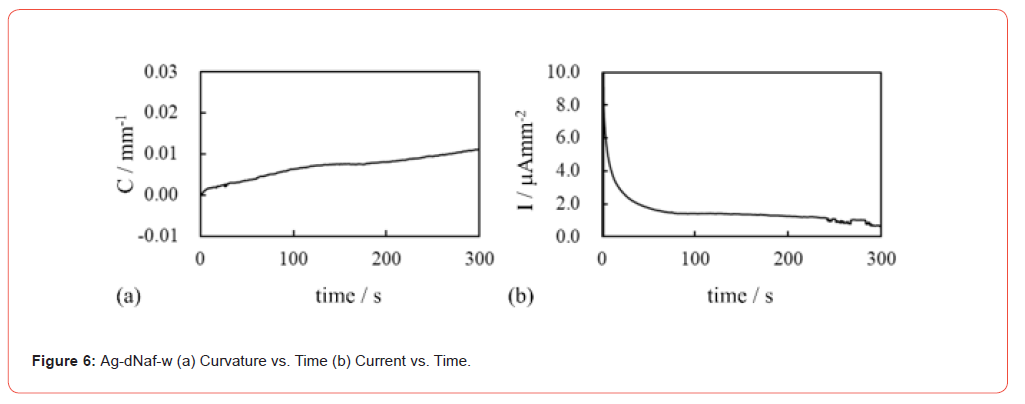
Next, the Ag-coated IPMC’s characteristics are shown below. Figure 6 shows the curvature vs. time and the current vs. time of Ag-dNaf-w. Although this IPMC is in the highly dehydrated state, relatively high current was induced compared with the dehydrated Au-coated IPMCs, and along with such a relatively high current the relatively large bending was induced. Some of our previous experimental works suggest that the magnitude of the current (or charge) induced within the IPMC body is related to the degree of bending [18-20], and the IPMC study by other researchers are also conducted on the premise explicitly or implicitly that the current by ion flow is primarily cause of IPMC bending [5,17,22]. Jian et al. introduced various models of IPMC bending. Some of them do not necessarily address the molecular- or atomic- level bending mechanism elucidation of IPMC in response to the electric stimulation, but some other touch upon the relationship between the mobile ion movement under the electric field applied to the IPMC and the degree of IPMC bending [23]. Hence, the relatively large bending characteristic along with the high current of Ag-dNaf-w also align with the conventional bending mechanism, which posits that the shift of hydrated ions causes the IPMC to bend [1,4,5,10,11,14]. However, why do the dehydrated and non-doped Ag-dNaf-w exhibit high current? Its current is significantly higher compared to other dehydrated Au-coated IPMCs (see Figures 3(b), 4(b), and 5(b)). As explained at the beginning of section Hydrarated IPMC, the dehydrated IPMC is not in a completely dehydrated state but remains slightly hydrated (or highly dehydrated) due to moisture absorption from the environment. Therefore, the silver foil on the Ag-dNaf-w might serve as a supporting electrolyte. In fact, we have previously observed redox reactions on the silver surface layers of IPMCs though they were not Nafion-based ones [18-20], where the characteristics of Ag-p-dNaf-w is to be discussed later. Since a relatively high voltage of up to 2 V was applied to the Ag-dNaf-w, the silver foil on its surfaces likely functioned as a supporting electrolyte. This induced a high current as shown in Figure 6(b). But still the relatively large bending shown in Figure 6(a) may not be understandable, since it is natural to believe that Ag-dNaf-w did not contain large enough quantity of water to cause the relatively large bending. We speculate that it must be the atomic- or molecular-level structural change within the IPMC body is involved. In fact, as we mentioned a moment ago, we have repeatedly observed that the IPMC fabricated by coating the Selemion CMV surface exhibited large bending under an external voltage even in the highly dehydrated state, and the silver layer redox reaction was inevitably induced in the process of bending where Selemion CMV is an cation exchange membrane manufactured by Asahi Glass Co. Ltd (Tokyo) [18-20]. Silver redox reaction is of course the phenomenon of atomic structural change from Ag to Ag2O and from Ag2 O to Ag. Such atomic-level structural change could influence the molecular structure of Nafion, leading to the bending. Such a phenomenon might occur in the Ag-dNaf-w body, and it led to the relatively large bending.
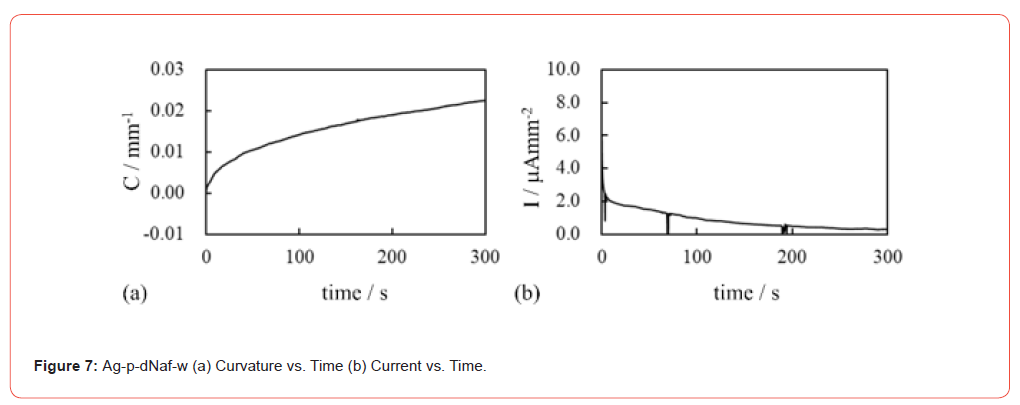
Similar characteristics to those of Ag-dNaf-w were observed in Ag-p-dNaf-w. Figure 7 shows the curvature versus time and the current versus time for Ag-p-dNaf-w. The bending curvature was significantly greater than that of Ag-dNaf-w, although its current was slightly lower than that of Ag-dNaf-w. Since a color change was observed in the surface silver layer of Ag-p-dNaf-w (from the white of Ag to the black of Ag2O), the redox reaction of the silver layer was undoubtedly induced. We speculate that several ions were introduced into the Ag-p-dNaf-w body during the silver-plating treatment and remained there even after the plating was completed. These ions likely played a role in inducing molecular or atomic-level structural changes in Ag-p-dNaf-w under the applied voltage. The ions introduced into the Ag-p-dNaf-w body must serve as dopants which cause the significant bending. Therefore, doping likely played a significant role in bending induction. Furthermore, we speculate that the dopants were not merely hydrated mobile ions which move by the external electric field but may have significantly contributed to atomic-level structural changes in the IPMC body. This is supported by the observation that even the dehydrated Ag-p-dNaf-w exhibited a greater bending curvature under a relatively lower current than Ag-dNaf-w.
However, it does not mean any ions can work as the effective dopant of Nafion IPMC bending. K+, Na+, Li+, Ca2+ and glucose did not work when the IPMC was in dehydrated state. On the other hand, Ag+ appears to serve as an effective dopant of causing the bending.
Bending of hydrated IPMC
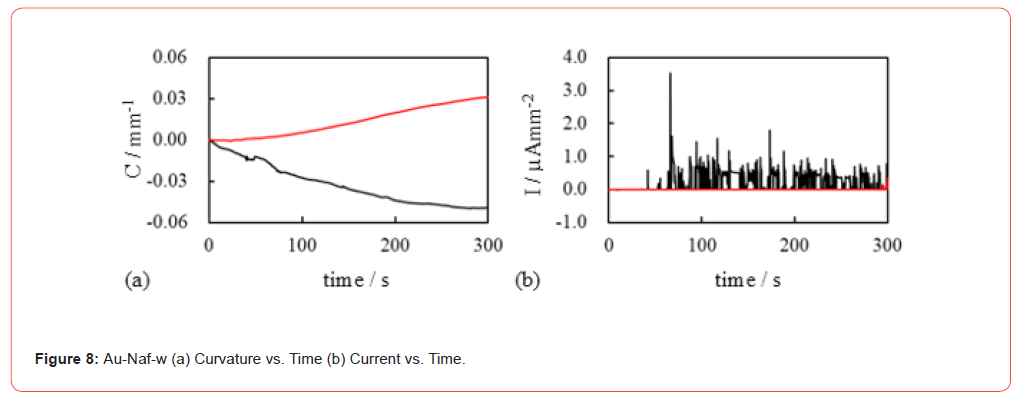
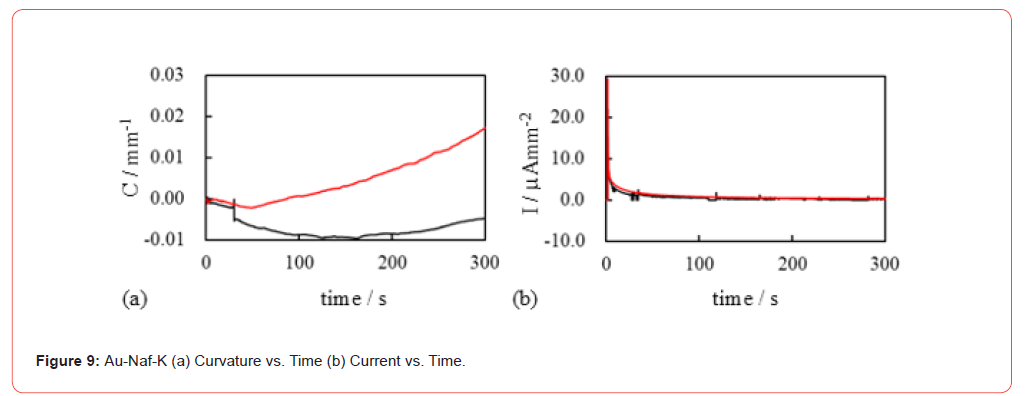
The current induced in the hydrated IPMC must be greater than that in the dehydrated one, as ionization is significantly enhanced in the hydrated state. Consequently, the bending of the hydrated IPMC should exceed that of the dehydrated one, which aligns with intuitive expectations. However, a side effect arises in highly hydrated IPMCs: disordered current induction and uncontrollable bending that does not correspond to the applied current. This irregular bending behavior is evident in Au-Naf-w and Au-Naf-K, as shown in Fig. 8 and Figure 9, respectively. These diagrams illustrate two distinct bending and current profiles as such examples exhibiting the irregular and inconsistent bending behavior. Although a constant voltage of 2V was applied to Au-Naf-w, the two different current profiles were obtained as indicated by the black and red lines in Figure 8(b). Similarly, the corresponding bending profiles also differ as represented by the black and red lines in Figure 8(a). The same analysis was carried out about Au-Naf-K. It exhibited unpredictable bending behavior. For example, Figure 9(a) shows a typical example of the unpredictable bending of Au-Naf-K. These two distinct bending profiles were obtained under the same constant applied voltage of 2V. Nevertheless, the corresponding currents were identical, as shown in Figure 9(b). These diagrams suggest that the bending of Au-Naf-K is essentially uncontrollable by external electric stimulation. The characteristics of Au-Naf-Na and Au-Naf-Li are fundamentally similar to those of Au-Naf-K.
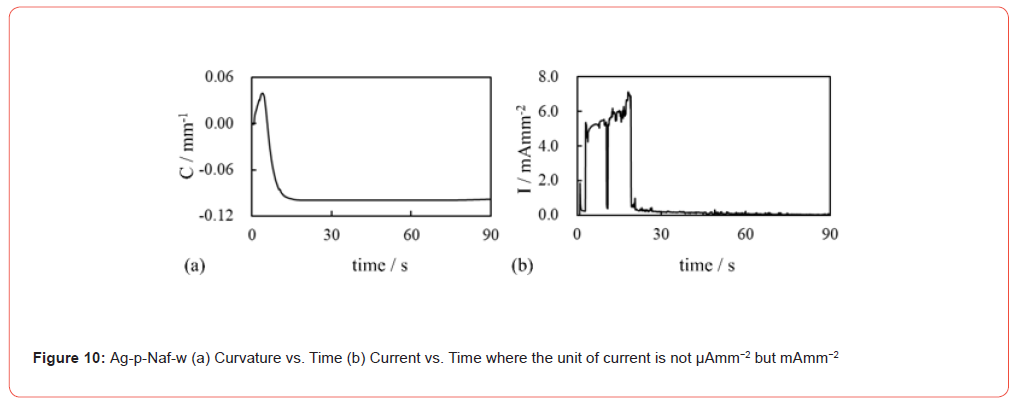
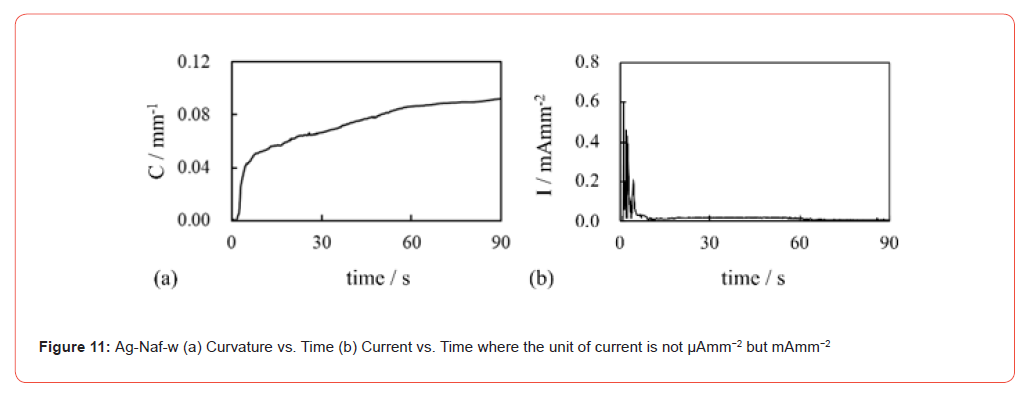
The bending of Ag-p-Naf-w is remarkably fast as seen in Figure 10. Upon applying the voltage, it exhibited a rapid and positive maximal curvature in about 5 seconds. However, despite the applied voltage remaining constant at 2V throughout the measurement, the bending curvature soon shifted to the negative direction. Consequently, its bending became uncontrollable under external electrical stimulation. Interestingly, Ag-Naf-w did not display such unpredictable bending behavior, as shown in Figure 11, while it is also Ag-coated IPMC like Ag-p-Naf-w. The difference between Agp- Naf-w and Ag-Naf-w is that the former was fabricated using electroless plating, while the latter was made by simply placing a silver foil on the Nafion surface. Furthermore, the bending curvature of Ag-Naf-w was notably large, even though it was not doped. Like Au-Naf-w, Ag-Naf-w contained only water, making such significant bending unexpected. A plausible explanation is the occurrence of a redox reaction on the silver foil surface of Ag-Naf-w, likely facilitated by the water within its structure. This is the same cause as the bending observed in Ad-dNaf-w. However, the degree of bending in Ag-Naf-w (Figure 11(a)) is significantly greater than that in Ag-dNaf-w (Figure 6(a)). Therefore, the silver foil on the surface of Ag-Naf-w undergoes a much more effective redox reaction, aided by the water, compared to Ag-dNaf-w, which is in a highly dehydrated state.
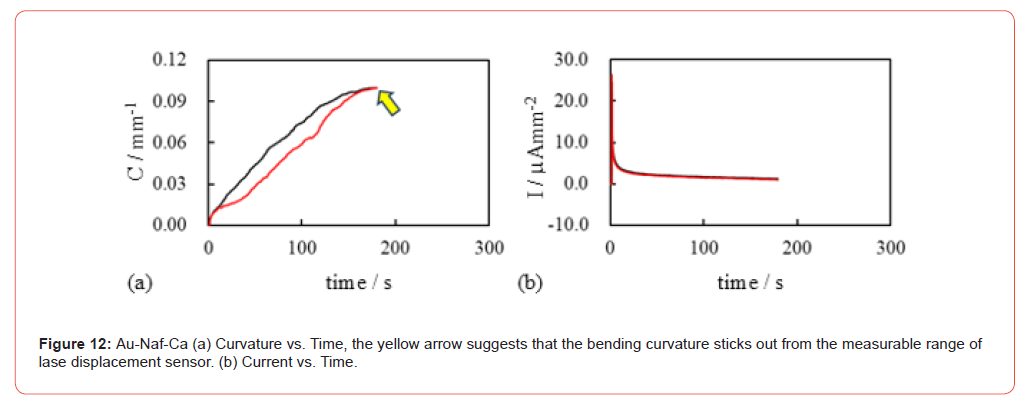
Please refer to Figure 12. Unlike Au-Naf-w and Au-Naf-K (as well as Au-Naf-Na and Au-Naf-Li), the current and bending curvature of Au-Naf-Ca are highly reproducible, and its bending curvature is significantly large. These are favorable characteristics for IPMCs. A notable difference between Au-Naf-Ca and Au-Naf-K (Au-Naf-Na, Au-Naf-Li) is the valency of their cations. Ca2+ has a valency of +2, whereas K+ has a valency of +1. This seemingly minor difference may lead to the improved bending performance of Au-Naf-Ca. Its bending characteristics are remarkably favorable, and its current characteristics are perfectly reproducible.
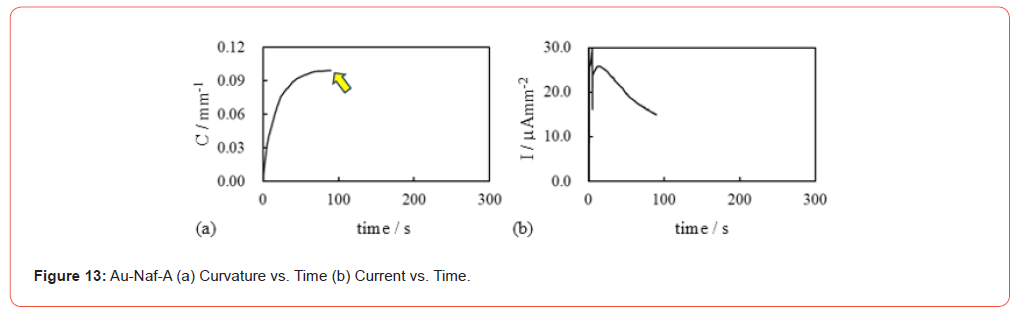
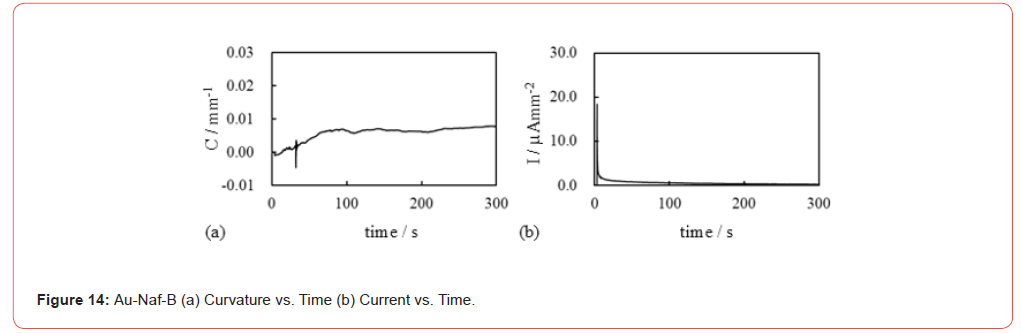
Au-Naf-A exhibits even better characteristics than Au-Naf-Ca. Its bending is remarkably fast, and the maximal bending curvature is comparable to that of Au-Naf-Ca. Au-Naf-A contains Solution-A, which is used for Ag-plating. In contrast, Au-Naf-B contains Solution- B, another solution used for Ag-plating. However, as shown in Figure 14, its current was significantly lower, and, as expected, its bending curvature was quite small. It is speculated that Solution-A implies silver ions, and they must exhibit the redox reaction under the voltage application. Therefore, Au-Naf-A exhibits better bending characteristics. On the other hand Au-Naf-B contains another part of silver electroless plating solution. It does not contain any silver ion. Hence, Au-Naf-B bending characteristics are not well comparable to those of Ag-Naf-A. Along with considering the effective bending characteristics of Ag-Naf-w shown in Figure 11 and Ag-p-Naf-w in Figure 10, silver ions appear to have some effect on enhancing the IPMC bending, fast and/or large bending.
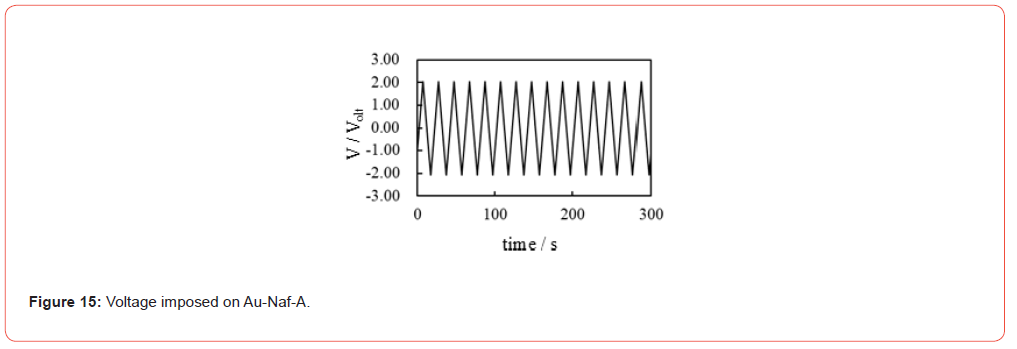
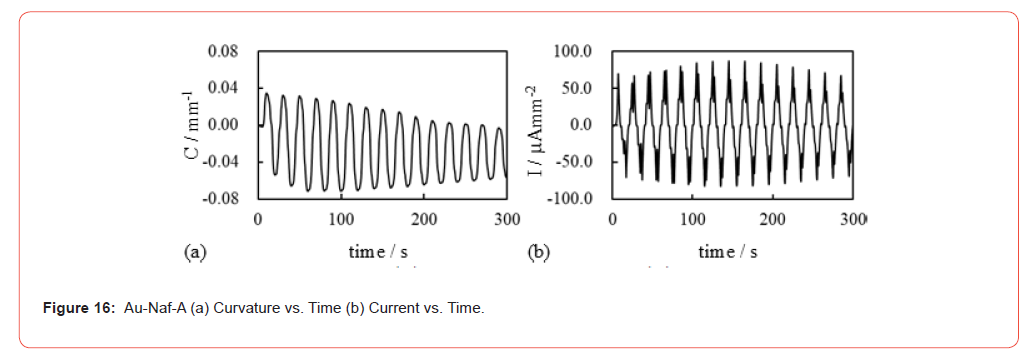
Now, we came to think that it is worth investigating the bending characteristics of Au-Naf-A further since the characteristics of Au-Naf-A is the most promising among the IPMCs so far described about. We investigated the bending controllability of Au-Naf-A under the a 0.05Hz oscillatory voltage shown in Figure 15. Unexpectedly, the induced current was highly regulated, as seen in Figure 16(b). The bending curvature also follows the current behavior quite well, as shown in Figure 16(a).
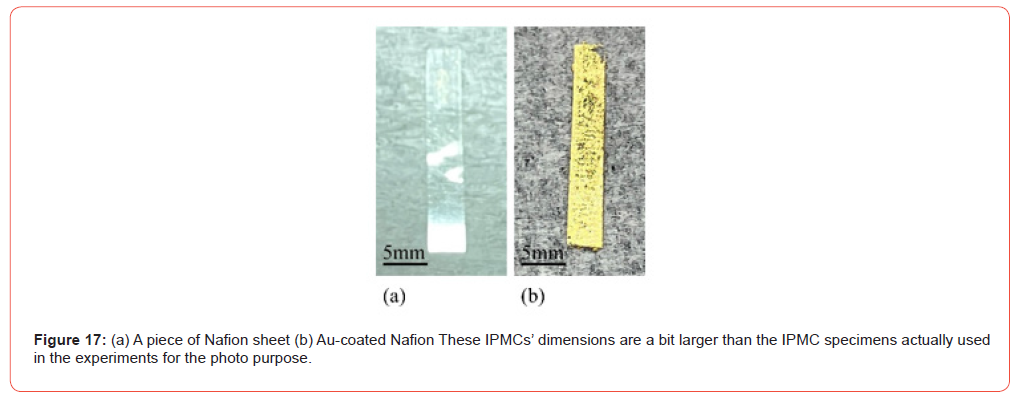
We think that the silver redox reaction occurs within the body of Au-Naf-A. In contrast, the silver redox reaction cannot occur in Au- Naf-B. We investigated this point. Figure 17(a) shows the Nafion, which had undergone no surface treatment, and its surface color is transparent. Figure 17(b) shows Au-coated Nafion. All of Au-coated Nafion described in this work look the same as Figure 17(b).
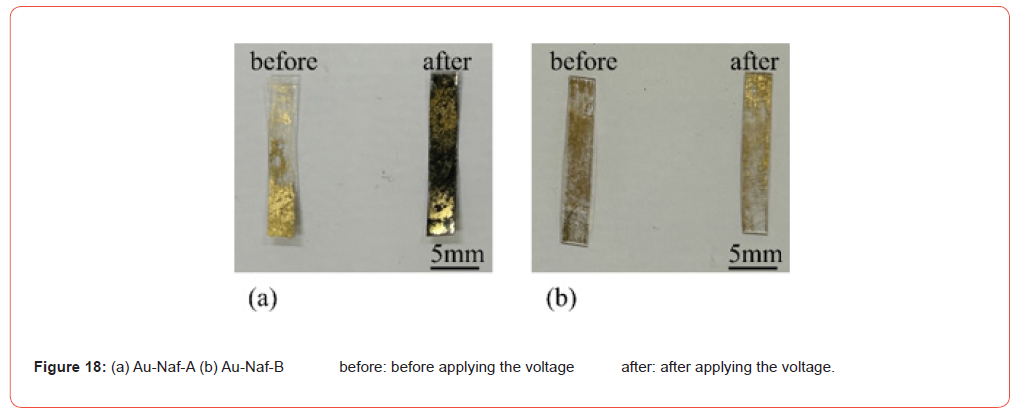
Figure 18 shows photographs of Au-Naf-A and Au-Naf-B after some Au foils were scraped off. Before applying a 2V voltage, both Au-Naf-A and Au-Naf-B, without the Au foil coating, were transparent. However, after the voltage was applied, the color of Au-Naf-A turned black after scraping off part of the Au foil, while the color of Au-Naf-B remained transparent. This suggests that Ag2 O was formed within the Au-Naf-A structure after the voltage was applied. It is further speculated that the redox reaction of silver in Au-Naf-A is responsible for the enhanced and well-controlled bending characteristics.
Role of silver dopant
Usually, the bending of hydrated IPMC is not well controllable by external electrical stimulation. Therefore, some of the authors of this paper even investigated the controllability of IPMC bending in an extremely low-humidity environment and found that bending controllability improved [24]. Thus, the less water the IPMC contained, the more its bending controllability improved. However, at the same time, we found that the degree of bending significantly diminished. Since then, we have been searching for a method to improve both bending controllability and the degree of bending. Au-Naf-A is a hydrated IPMC. However, its current is well-ordered, and its bending behavior responds well to external electrical stimulation. Moreover, the bending is fast in response to the electric stimulation, and the degree of bending is sufficiently large. It is strongly speculated that this is due to the occurrence of a redox reaction of silver.
Conclusion
Doping treatment of IPMC has been known as an effective method for inducing large IPMC bending. However, the mere introduction of ions into the IPMC body does not necessarily work. Even if bending enhancement is achieved through doping, bending controllability deteriorates. Through our investigation, we found that silver ions act as effective dopants for improving the bending characteristics of Nafion-based IPMC. It is speculated that the redox reaction of silver ions changes the atomic- or molecular- level structural change of IPMC so that it enhances the Nafion-based IPMC bending characteristics.
According to previous studies on IPMCs by other researchers, chemically and electrically stable metals, such as Pt, are commonly used for the surface layer. This likely stems from the strong belief among researchers that stable material properties are advantageous for IPMCs. However, such an approach may not be the most efficient for achieving practical IPMC actuators. Instead, utilizing the change in material properties caused by silver’s redox reaction may be more effective even for the hydrated IPMC. In fact, our findings described in this paper support this approach.
Author Contributions
Conceptualization, H.T., I.K.; Methodology, H.T., I.K.; Analysis, H.T., I.K.; Original draft preparation, H.T., I.K.; Review and editing, H.T., I.K, W.L., M.S.; Funding acquisition, W.L. and M.S.
Akowlegment
Kawamura Electric Inc. (Japan)
Conflict of Interest
The authors declare no conflicts of interest.
References
- M Shahinpoor, Y Bar-Cohen, T Xue, J O Simpson, J Smith, et al. (1998) Some Experimental Results on Ionic Polymer-Metal Composites (IPMC) As Biomimetic Sensors and Actuators, Proceedings of SPIE Conference on Smart Material Technologies, San Diego, California 3324: 218-223.
- M Hung, W Sheng (2009) Robust Adaptive Control with Leakage Modification for a Nonlinear Model of Ionic Polymer Metal Composites (IPMC), Proceedings of the 2008 IEEE International Conference on Robotics and Biomimetics, Bangkok, Thailand 1783-1788.
- Mohsen Annabestani, Nadia Naghavi (2014) Nonlinear identification of IPMC actuators based on ANFIS–NARX paradigm, Sensors and Actuators A: Physical 209: 140-148.
- J H Park, S W Lee, D S Song, J Y Jho (2015) Highly Enhanced Force Generation of lonic Polymer Metal Composite Actuators via Thickness Manipulation, AC5 Appl. Mater. Interfaces 7(30): 16659-16667.
- Muyu Hao, Yanjie Wang, Zicai Zhu, Qingsong He, Denglin Zhu, et al. (2019) A Compact Review of IPMC as Soft Actuator and Sensor: Current Trends, Challenges, and Potential Solutions from Our Recent Work, Frontiers in Robotics and AI 6: 129.
- K Oguro, Y Kawami, H Takenaka (1992) Bending of anion-Conducting Polymer Film-Electrode Composite by an Electric Stimulus at Low Voltage, J Micromach Soc 5(1): 27-30.
- K Salehpoor, M Shahinpoor, M Mojarrad (1997) Linear and Platform Type Robotic Actuators Made from Ion-Exchange Membrane-Metal Composites, Proceedings of SPIE Conference on Smart Material Technologies, San Diego, California 3040: 192-197.
- Y Bar-Cohen, T Xue, M Shahinpoor, J O Simpson, J Smith (1998) Low-mass muscle actuators using electroactive polymers (EAP), Proceedings of SPIE Conference on Smart Material Technologies, San Diego, California 3324: 218-223.
- S Guo, T Fukuda, N Kato, K Oguro (1998) Development of Underwater Microrobot Using ICPF Actuator, Proceedings of the 1998 IEEE International Conference on Robotics and Automation, Leuven, Belgium 3324: 1829-1834.
- Mikio Uchida, Minoru Taya (2001) Solid electrolyte polymer actuator using electrode reaction, Polymer 42: 9281-9285.
- Masaki Yamakita, Norihiro Kamamichi, Yasuaki Kaneda, Kinji Asaka, Zhi-Wei Luo (2004) IPMC LINEAR ACTUATOR WITH RE・DOPING CAPABILITY AND ITS APPLICATION TO BIPED WALKING ROBOT, IFAC Mechatronic Systems 37(14): 353-358.
- K Yun, W J Kim (2005) System identification and microposition control of ionic polymer metal composite for three-finger gripper manipulation, Proceedings of the Institution of Mechanical Engineers, Part I: Journal of Systems and Control Engineering 220(7): 539-551.
- G Nishida, M Sugiura, M Yamakita, B Maschke, R Ikeura (2012) Multi-Input Multi-Output Integrated Ionic Polymer-Metal Composite for Energy Controls, Micromachines 3: 126-136.
- M Wang, M Yu, M Lu, Q He, K Ji, et al. (2018) Effects of Cu2+ Counter Ions on the Actuation Performance of Flexible Ionic Polymer Metal Composite Actuators, J. Bionic. Eng., San Diego, California 15: 1047-1056.
- Z Zhai, A Tian, X Zhang, H Du, Y Wang (2024) Performance prediction of IPMC modified with SiO2-SGO based on backpropagation neural network, Nanotechnol Precis Eng 7: 043007.
- M Shahinpoor, KJ Kim (2004) Ionic polymer-metal composites: III. Modeling and simulation as biomimetic sensors, actuators, transducers, and artificial muscles, Smart Mater. Struct 13(6): 1362-1338.
- M Porfiri, A Leronni, L Bardella (2017) An alternative explanation of back-relaxation in ionic polymer metal composites, Extreme Mechanics Letters 13: 78-83.
- T Tamagawa, F Nogata, S Popovic (2005) Roles of Ag redox reaction and water absorption inducing the Selemion bending, J. Memb. Sci., 251, 145-150.
- T Tamagawa, F Nogata (2006) Atomic structural change of silver-plating layers on the surfaces of Selemion, resulting in its excellent bending controllability, Sens. Actuators B: Chem 114: 781-787.
- H Tamagawa, K Okada, T Mulembo, M Sasaki, K Naito, et al. (2019) Simultaneous Enhancement of Bending and Blocking Force of an Ionic Polymer-Metal Composite (IPMC) by the Active Use of Its Material Characteristics Change, Actuators 8(29).
- T TAMAGAWA, F NOGATA, T WATANABE, A ABE, K YAGASAKI, et al. (2003) Influence of metal plating treatment on the electric response of Nafion, J. MATER. SCI 38: 1039-1044.
- W A Lughmani, J Y Jho, J Y Lee, R Kyehan (2010) Influence of metal plating treatment on the electric response of Nafion, International Journal of Precision Engineering and Manufacturing 10(5): 131-139.
- J Jiang, C Lin, S Xu, Y Yu, L Yao, et al. (2024) Application-Oriented Modeling of Soft Actuator Ionic Polymer-Metal Composites: A Review, Adv. Intell. Syst 6: 2300568.
- M Sasaki, W Lin, H Tamagawa, S Ito, K Kikuchi (2013) Self-Sensing Control of Nafion-Based Ionic Polymer-Metal Composite (IPMC) Actuator in the Extremely Low Humidity Environment, Actuator 2: 74-85.
-

This work is licensed under a Creative Commons Attribution-NonCommercial 4.0 International License.




