




 Research article
Numerical Investigation of a Rectangular Block under Uniaxial Tension Using Finite Element Analysis in MATLAB
Received Date:April 10, 2026 Published Date: April 24, 2026
Abstract
This study presents a finite element analysis (FEA) of a rectangular block subjected to uniaxial tension, modelled under plane stress conditions using MATLAB. The mechanical properties of the material are defined by a Young’s modulus of 200 GPa and a Poisson’s ratio of 0.3, with an applied normal traction of 75 MPa along the faces parallel to the x′-axis. The simulation results-including stress and strain distributions-are compared with theoretical analytical solutions derived from classical elasticity. The FEA model demonstrates excellent agreement with the theoretical predictions, validating the accuracy of the MATLAB implementation. This work serves as a practical exercise in computational mechanics, providing insight into stress–strain behaviour and FEA-based validation for linear elastic materials.
Keywords: Uniaxial tension; Finite element analysis; MATLAB simulation; Plane stress; Elastic deformation; Stress–strain comparison
Introduction
Finite Element Analysis (FEA) has become a fundamental tool in mechanical and civil engineering for analysing stress and strain in complex structures [1]. It provides a numerical approach to approximate the solution of boundary value problems in solid mechanics, especially when analytical solutions are impractical. This study focuses on a simple yet fundamental problem: a rectangular block under uniaxial tensile loading. Despite its apparent simplicity, this problem provides an ideal benchmark to validate FEA codes and assess numerical convergence and stress–strain behaviour in linear elastic materials [2-4]. The analysis of a block under uniaxial tension is a classical problem in elasticity, serving as a foundation for understanding more advanced structural behaviours. The problem allows researchers and students to verify computational accuracy while examining the influence of parameters such as material stiffness, Poisson’s ratio, and boundary conditions [5,6]. By comparing numerical predictions with analytical results, the study highlights how FEA captures deformation compatibility and stress equilibrium under well-defined loading conditions. Moreover, using MATLAB as the computational environment enables full transparency of the numerical formulation, offering flexibility for educational and research purposes. Unlike commercial FEA software such as ANSYS or Abaqus, MATLAB allows direct control over element matrices, boundary condition imposition, and postprocessing algorithms. This makes the implementation highly suitable for academic exercises in computational mechanics courses, where students can explore the numerical behaviour of finite element approximations and gain deeper insight into the mechanics of materials [7-10].
The objectives of this work are:
• To develop a MATLAB-based FEA model of a rectangular
block under uniaxial tension.
• To analyse the stress and strain components obtained
from the numerical model.
• To compare FEA results with theoretical predictions and
evaluate discrepancies.
Methods
Problem Specification and Theoretical Background
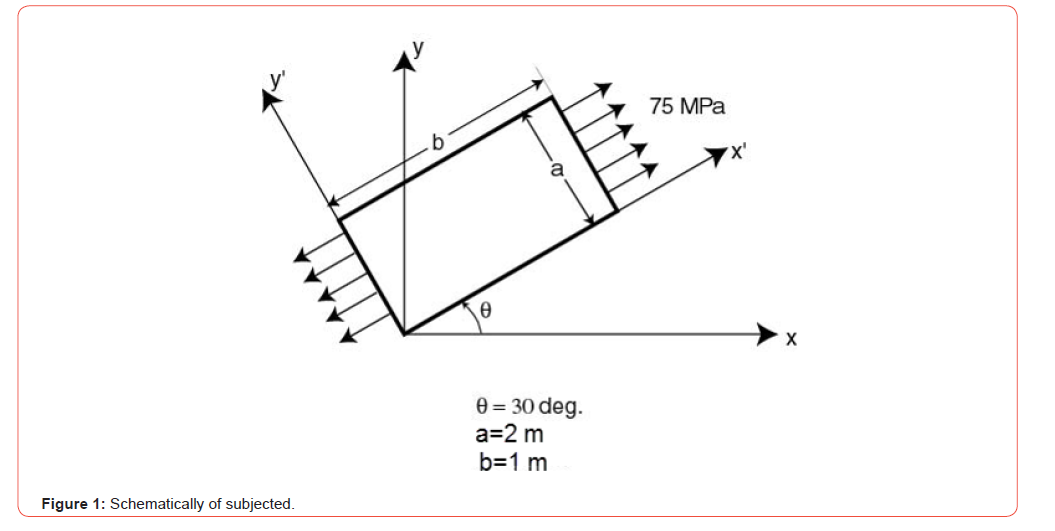
The rectangular block, shown schematically in Figure 1, is subjected to a uniform tensile traction of 75 MPa on the faces normal to the x′-axis. The block is assumed to be under plane stress conditions. The material parameters are:
Young’s modulus,
Poisson’s ratio,
For a uniaxial tension case, the theoretical stress and strain are
obtained as:
Thus, the theoretical strain values are:
These theoretical results serve as benchmarks for validating
the FEA model.
Figure 1
Finite Element Modeling in MATLAB
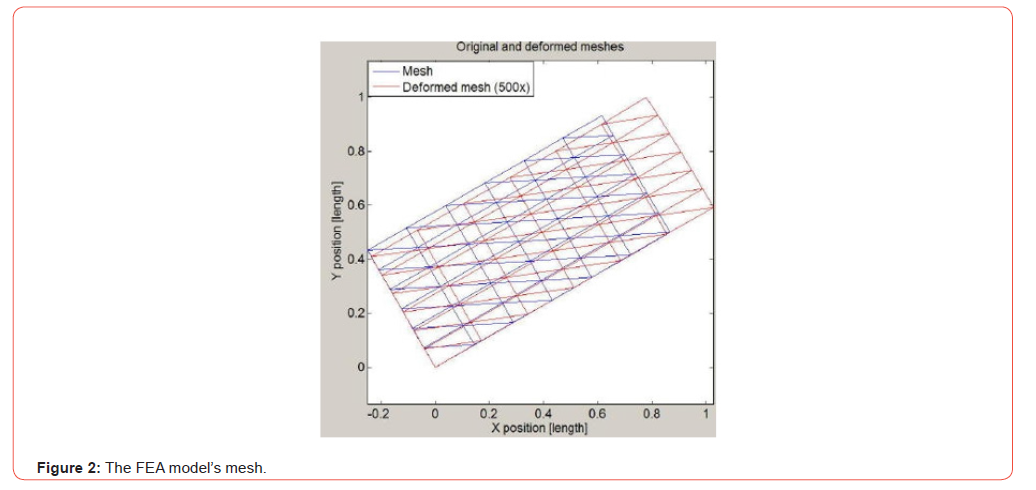
The FEA model (Figure 2) was implemented using MATLAB to discretize the block into a structured mesh of quadrilateral plane stress elements. The essential steps are:
• Geometry Definition: Rectangular domain representing
the block dimensions.
• Material Properties: Assigned E = 200 GPa , v = 0.3.
• Boundary Conditions: Left edge fixed in the x-direction;
uniform traction of 75 MPa applied on the right edge.
• Meshing: Regular mesh of elements generated to ensure
numerical stability.
• Solution: The global stiffness matrix was assembled and
solved for nodal displacements.
• Post-Processing: Stress and strain components computed
and visualized using MATLAB contour plots.
The MATLAB script was developed to output stress distribution ( σx, σy,τxy ) and strain components ( εx,εy ,γxy ).
Figure 2
Results and Discussion
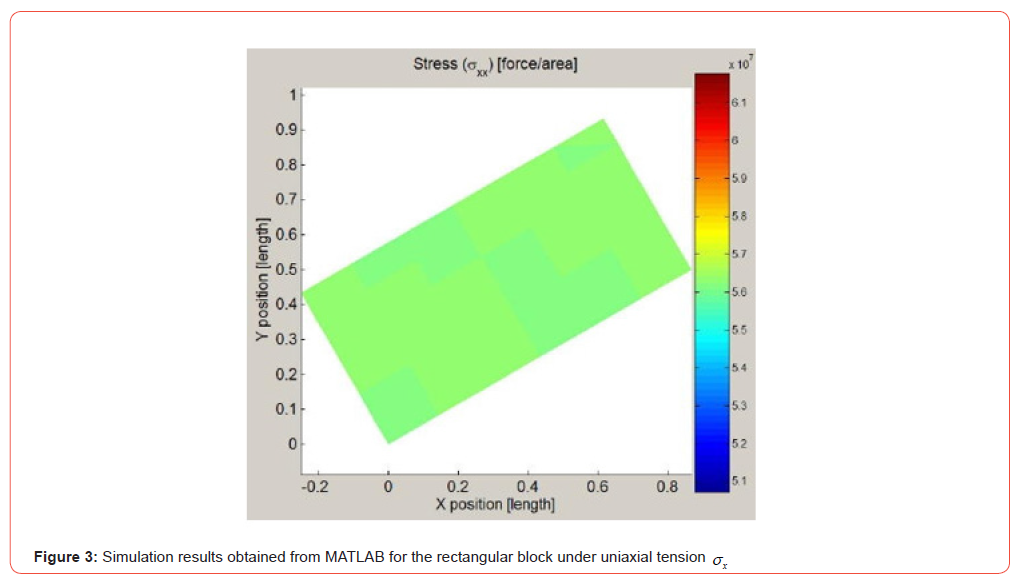
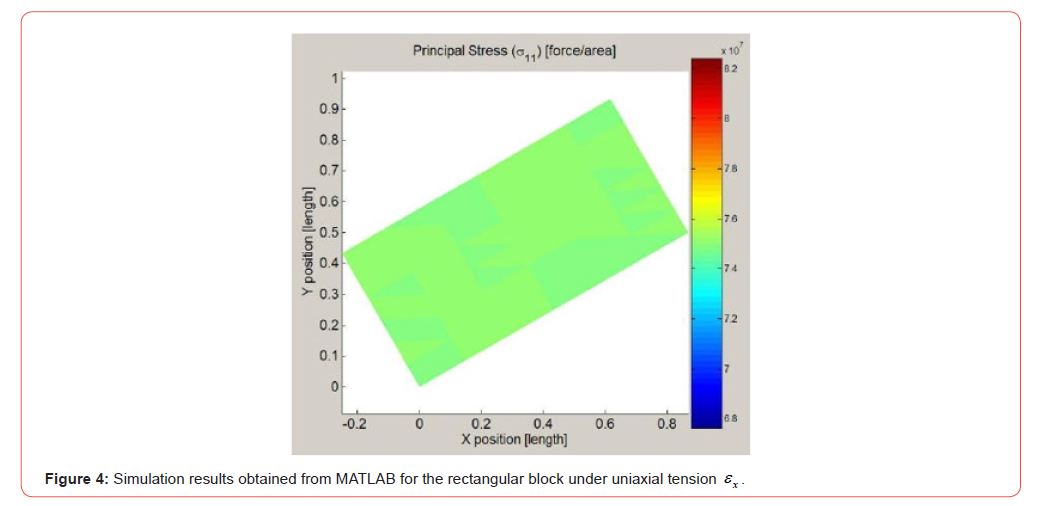
(Figures 3,4) present the simulation results obtained from MATLAB for the rectangular block under uniaxial tension. The contour plots of and clearly indicate a uniform distribution, consistent with theoretical expectations. Minor numerical variations (<1%) were observed near boundary regions due to discretization effects [11-15].
Table 1
Table 1:Comparison with Theoretical Values.
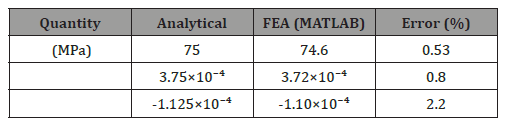
The close agreement between FEA and theoretical results validates the accuracy of the MATLAB implementation. The model also provides visual insights into deformation behaviour, demonstrating uniform elongation along the loading axis and lateral contraction due to Poisson’s effect [16-19]. The residual error in numerical results is primarily attributed to mesh discretization and the linear interpolation used in plane stress elements. Increasing mesh refinement or using higher-order elements could further minimize this discrepancy [20-22].
Figures 3, 4
Conclusion
This study demonstrates the successful implementation of a MATLAB-based finite element model for analysing a rectangular block under uniaxial tension. The numerical results closely match the analytical solutions from classical elasticity, confirming the model’s accuracy. The project serves as an effective educational example for graduate students in computational mechanics, highlighting the relationship between numerical modeling and theoretical elasticity. Future work could extend this analysis to include non-linear materials or 3D stress states.
References
- C S Krishnamoorthy (1997) Finite element analysis - Theory and Programming. Tata McGraw-Hill, New Delhi, 2nd ed.
- D B P Huynh, T Belytschko (2009) “The extended finite element method for fracture in composite materials,” International Journal for Numerical Methods in Engineering 77(2): 214-239.
- N Sukumar, D L Chopp, N Moes, T Belytschko (2001) “Modelling holes and inclusions by level sets in the extended finite-element method,” Computer methods in applied mechanics and engineering 190(47): 6183-6200.
- T Belytschko, C Parimi, N Moes, N Sukumar, S Usui (2003) “Structured extended finite element method for solids defined by implicit surfaces,” Inter- national Journal for Numerical Methods in Engineering 56(4): 609-635.
- C Daux, N Moes, J Dolbow, N Sukumar, T Belytschko (2000) Arbitrary cracks and holes with the extended finite element method, Int. J. Numer. Methods Engrg 48(12): 1741-
- N Sukumar, N Moes, B Moran, T Belytschko (2000) Extended finite element method for three-dimensional crack modeling, Int. J. Numer. Methods Engrg 48(11): 1549-1570.
- J Dolbow, N Moes, T Belytschko (2000) “Modelling fracture in mindlin-reissner plates with the extended finite element method,” International Journal of Solids and Structures 37(50): 7161-7183.
- J Dolbow (1999) An Extended Finite Elment Method with discontinuous enrichment for applied mechanics. Ph.d dissertation, Northwestern University.
- S Osher, J A Sethian (1988) “Fronts propagating with curvature-dependent speed: Algorithms based on hamilton-jacobi formulations,” Journal of Computational Physics 79(1): 12-49.
- B van Rietbergen, H Weinans, R Huiskes, A Odgaard (1995) “A new method to determine trabecular bone elastic properties and loading using micromechanical finite-elements models,” Journal of Biomechanics 28(1): 69-81.
- Huu-Dien Nguyen, Shyh-Chour Huang (2022) Designing and Calculating the Nonlinear Elastic Characteristic of Longitudinal-Transverse Transducers of an Ultrasonic Medical Instrument Based on the Method of Successive Loadings, Materials 15(11): 4002.
- Huu-Dien Nguyen, Shyh-Chour Huang (2021) The Uniaxial Stress Strain Relationship of Hyperelastic Material Models of Rubber Cracks in the Platens of Papermaking Machines Based on Nonlinear Strain and Stress Measurements with the Finite Element Method, Materials 14(24): 7534.
- Yang Quan Quan, Gao CunFa and Chen WenTao 2012 Stress concentration in a finite functionally graded material plate. Sci China-Phys Mech Astron 55: 1263-1271.
- Huu-Dien Nguyen, Shyh-Chour Huang (2022) Using the Extended Finite Element Method to Integrate the Level-Set Method to Simulate the Stress Concentration Factor at the Circular Holes Near the Material Boundary of a Functionally Graded Material Plate, JMR&T 21: 4658-4673.
- Nguyen H-D, Huang S-C (2023) Use of XTFEM based on the consecutive interpolation procedure of quadrilateral element to calculate J-integral and SIFs of an FGM plate. Theoretical and Applied Fracture Mechanics 127: 103985.
- Huu-Dien Nguyen (2025) Using Matlab to Study of the Response of the System to Oscillatory Influences be an Oscillatory Effect on the Resting Antenna. International Journal of Multidisciplinary Research and Growth Evaluation 6(2): 696-704.
- Huu-Dien Nguyen, Shyh Chour Huang (2025) Calculating Strain Energy Release Rate, Stress Intensity Factor and Crack Propagation of an FGM Plate by Finite Element Method Based on Energy Methods. Materials 18(12): 2698.
- Huu-Dien Nguyen (2025) Using Finite Element Method to Calculate Strain Energy Release Rate, Stress Intensity Factor and Crack Propagation of an FGM Plate Based on Energy Methods, IJMEAS 3(2): 1-8.
- Huu Dien Nguyen (2025) Using the eXtended Finite Element Method (XFEM) to Simulate Own Frequency under External Influences of a Closed System based on Dynamic Compensation Method. Journal of International Multidisciplinary Research 3(7): 157-164.
- Huu-Dien Nguyen (2025) Extended Finite Element Approach for Simulating Arbitrary Openings in Functionally Graded Plates. International Journal of Mechanics, Energy Engineering and Applied Science IJMEAS.
- Ananda Thomas Khoirullah (2024) Static Stress Analysis of Fork on Rubber Slab Lifting Aid using Finite Element Method. IJMEAS 2(3): 11-24.
- Ananda Thomas Khoirullah, Rachmat Dwi Sampurno (2024) Static Stress Analysis of Fork on Rubber Slab Lifting Aid using Finite Element Method. IJMEAS 2(3): 11-24.
-

This work is licensed under a Creative Commons Attribution-NonCommercial 4.0 International License.




