



 Research article
Nanomaterials: An Examination of Effects on Bacterial Systems
Received Date:April 24, 2026 Published Date: May 26, 2026
Abstract
Nanotechnology has pushed boundaries and enabled revolutionary progress in many avenues including water treatment, textile engineering, medical implants, drug delivery, materials science engineering, food storage, and packaging. The tremendous potential offered by these nano-sized particles over their micro and macro counterparts has resulted in a surge in nanoparticle production to meet the demand of multiple sectors. While the production and use of nanoparticles are on a steady increase, their effects on living systems including simple bacterial systems remain elusive. In this study, we explore how nanoparticles can enter the environment and present the effects of the most commonly produced nanoparticles on bacterial growth and survival. While titanium oxide, copper oxide, silver and zinc oxide exhibited inhibitory effects on bacteria others like silicon oxide, aluminum oxide and cerium oxide nanoparticles did not. The results of this study will aid in the understanding of nanotoxicology and in the promotion of using the benefits of nanoparticles. The findings can be leveraged strategically to ensure the responsible and sustainable use of nanomaterials.
Keywords: Nanoparticles; Engineered nanomaterials; Nanotoxicity; Nanoparticles effect on living systems; Bacterial survival; Emerging contaminants; Pathways; Fate of nanoparticles
Background and Motivation
Nanotechnology has allowed for unimaginable progress in various avenues including water treatment, textile engineering, construction, medical implants, drug delivery, materials science engineering, food storage, and packaging [1-6]. The tremendous potential offered by nano-sized particles over their micro and macro counterparts has resulted in a surge in nanoparticle production to meet the demand of multiple sectors. The Woodrow Wilson institute reports over 1500 commercial products available for purchase that contain nanoparticles [7-10] while the nanodatabase reports over 5000 products that contain nanoparticles. Owing to their unique properties and remarkable potential, the production of nanoparticles will only keep increasing to meet the demand for a suite of medical, industrial, commercial, and other applications. These engineered nanoparticles will inevitably find a way into the environment [2, 5, 11-14].
Once in the environment, the fate, transport, and interactions of engineered nanoparticles will take a different course which was originally not intended. The probable pathways through which nanoparticles may enter the environment, their fate, and the environmental impact of these engineered nanoparticles remain ambiguous [6, 11]. In this study, we provide a simplistic pathway analysis to examine the various entry points for nanoparticles into the environment and thereby demonstrate possible exposure to humans over the life cycle of these nanomaterials. Also importantly, engineered nanoparticles in the environment will result in imminent exposure to living organisms. The effect of nanoparticles on living systems including the simplest systems is poorly understood [15- 20]. It is critical to examine the effect of nanoparticles on bacteria as these organisms are crucial to multiple environmental processes [21,11,22]. Several studies have been conducted to evaluate the effect of various nanoparticles on bacteria. The studies have used various experimental methods, different conditions, and employed diverse bacteria [18,23-28]. Most studies performed have focused on studying the effect of one or two types of nanomaterials on bacteria. The results of these studies do not allow for direct comparison with each other due to varying experimental conditions and there is a lack of consensus around the findings. For example, there are conflicting results on the effect of cerium oxide nanoparticles on bacteria where some conclude that cerium oxide nanoparticles are toxic to bacteria while other studies claim no effect on bacteria and still other studies conclude that they offer protection to bacteria [29- 31,16,32-34]. Similarly, some studies have shown that aluminum oxide nanoparticles exhibit minimum toxicity while others have shown that the presence of aluminum oxide nanoparticles can result in genetic modifications and DNA fragmentation [35-40]. These findings highlight the impact of experimental conditions (pH, medium composition, and bacterium) and characteristics of nanomaterials on the overall bacterial response to the presence of nanomaterials. In this study, we identify the most commonly employed metal oxide nanoparticles through a literature review and examine their effect on BOD utilization by E.coli that served as the model bacterium. We also present a method to compare the effect of different nanoparticles on bacteria simultaneously.
To enable the sustainable and responsible use of nanotechnology, its effects on bacterial systems and other forms of life need to be understood. The study will aid in the choice of nanoparticles for various applications, in the design of environmentally safe nanoparticles, and in the prevention and management of unintentional exposure to toxic nanoparticles.
To provide the necessary foundation for the current research, the following sections discuss preliminary research developments.
Nanoparticle Identification
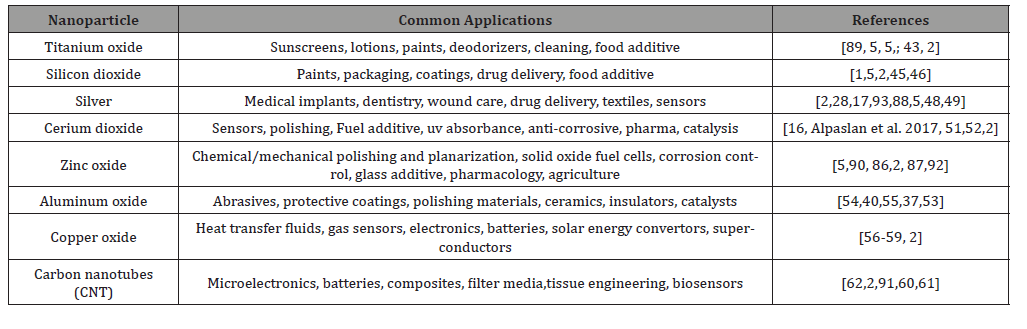
Nanoparticles are gaining application in diverse fields resulting in the production of a variety of nanoparticles. Although there is limited research on nanoparticle production volumes, a literature review allowed us to recognize the most widely used and manufactured nanoparticles [13,5,11,2,21,17,14]. Table 1 reproduces a modified summary table of the most widely manufactured nanoparticles from [41]. Titanium oxide nanoparticles are among the most widely produced for various applications due to their photocatalytic, optical, refractive, and conductive properties [42,5,43,2,44]. Silicon dioxide nanoparticles are used widely in packaging, paints, coatings and as an additive in concrete as their presence enhances mechanical and anticorrosion properties. Silicon oxide nanoparticles are also widely used as a food additive due to their non-toxic and biocompatible nature to humans [45,5,1,46,2,47]. Silver, silver salts, and ions have been used extensively for their antimicrobial and antiinflammatory properties. Thereby, their nanoparticle counterpart has been successfully used in medical implants, drug delivery systems, catheters antimicrobial coatings, and even sports attire [48,5,49,2,42]. Cerium oxide nanoparticles have multiple industrial uses and are being explored for application in biomedicine. Their applications include being used in catalytic converters for automobiles, as abrasives, as a fuel additive, and in fuel cells. The thermal, catalytic, electrical, and photochemical properties of zinc oxide nanoparticles have resulted in its increased production and use recently. Like titanium oxide nanoparticles these are widely used in cosmetics, toothpastes, and paints [50,51,52,2]. Aluminum oxide nanoparticles are used widely in electronics, heat transfer fluids, ceramics, abrasives, and polishing materials due to their extraordinary hardness and thermal stability [53,54,40,55]. Copper oxide nanoparticles are widely used in electronics, heat transfer fluids, gas sensors and lubricant additives [56-59,2]. Carbonbased nanotubes are widely used for their high tensile strength and flexibility by incorporation as composite additives. They are additionally employed in batteries, energy storage, ceramics, biomedicine, and filtration devices [60,62,2].
Table 1:Commonly used nanoparticles and their predominant applications.
Nanoparticle Entry Into the Environment
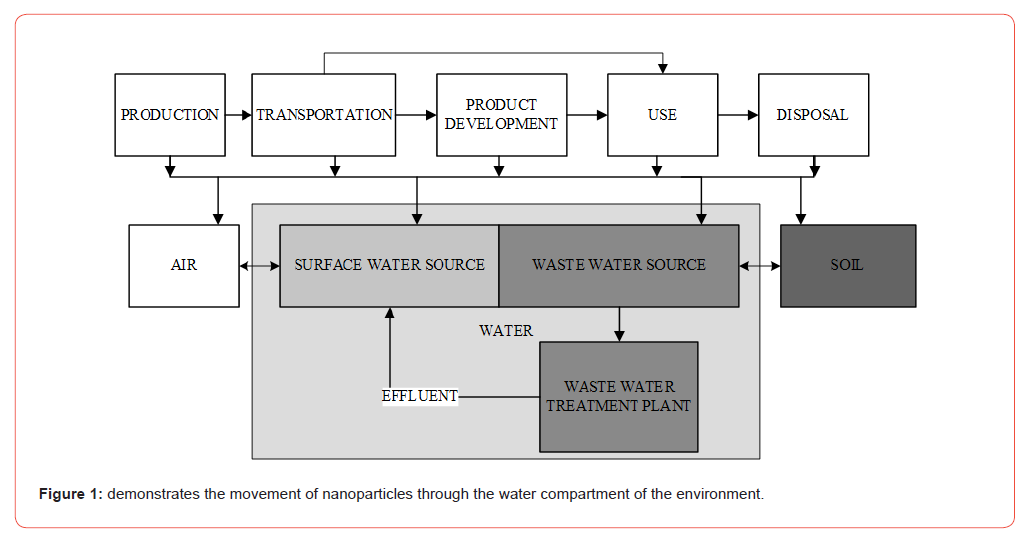
While much research has focused on understanding the benefits and the possibilities of employing nanoparticles for applications, research on understanding nanoparticle pathways is ongoing [63,41,64,65; 66,67]. With the surge in nanoparticle production volumes to meet the demand of the multiple avenues, the entry of nano-engineered materials into the environment is inevitable. The release of nanoparticles into the environment can proceed in any of the multiple phases during the nanoparticle’s life cycle as demonstrated in Figure 1. [13,16,17,68]). Nanoparticles may be released during the production phase primarily through sprays, dust, spills, and waste streams [69,66,70]. After manufacture, these nanoparticles are packaged and transported to either their point of direct use or to facilities in which they may be incorporated into commercial, medical, industrial, and additional products. During packaging, spills, dust, and waste streams may again be generated that release the nanomaterials into the environment [11]. Provided packaging is well done and that the packages incur no damage during handling, transportation, and storage, little to no further release of nanomaterials may occur at this stage. Nanomaterials if used directly or indirectly after incorporating into products can again be released into the environment during the use stage by consumers [11,71,70]. For example, disposal can either occur as a phase overlapping with the use phase like nanoparticles in toothpaste and shampoo that are disposed immediately after use; or can occur after short intervals of time like after the application of cosmetics, disposal of paint, and discarding of abrasive containers. In other cases, disposal occurs after a prolonged period. This may be when the product containing nanoparticles such as electronics, or a concrete pillar strengthened with nanoparticles reaches the end of its lifetime.
Once in the environment, nanoparticles can move from one compartment to the other [13,14,12,2,71,20]. For example, nanoparticles in water may be applied on the soil during irrigation and nanoparticles from landfills can leach out as part of the leachate and enter the groundwater system.
Figure 1 provides insight into how nanoparticles may move within the ‘water’ compartment of the environment. The figure also demonstrates the possible exchange of nanoparticles between the compartments. Nanomaterials that enter into the drain from the use of products like cosmetics, shampoos, toothpaste, and textiles that may shed the particles during laundry enter into the wastewater collection system of the city. They enter the wastewater treatment facility and will eventually end up in either the effluent that is released into a surface water source or in the sludge released from the wastewater facility. The sludge may be used as a land additive or fertilizer or be placed in a landfill with or without incineration. On the other hand, the nanomaterials may also be released into a surface water body.
Nanomaterials that are released intentionally or unintentionally on land due to land applications and being placed in landfills can enter the water system through pathways via surface or groundwater. Similarly, airborne nanoparticles may land on water for example due to wind and precipitation. At the same time, waterborne nanoparticles may enter the ‘air’ compartment during sprays generated by recreational activities like water sports. It is to be noted that nanoparticles may undergo transformation processes including degeneration and phase transfers like uptake by plants when in the environment [13,72-74].
Exposure
When nanoparticles deviate from the pathway that they were originally designed for by either unintentional release during any of the life cycle phases or intentional disposal, exposure to living systems is inevitable. Exposure to living systems can occur in manifold ways-inhalation, ingestion, dermal uptake, and in much rarer circumstances through intravenous entry [75,44,76,77]. In the case of occupational exposure to humans during production, packaging, or product development, exposure can primarily occur via inhalation and dermal contact [16,14]. In case of exposure to microorganisms in the environment, exposure occurs via direct contact and ingestion. Exposure of humans to nanoparticles that may be present in surface water can happen during recreational activities via ingestion and dermal contact. All other living organisms like algae, aquatic plants, fish, animals, and birds that ingest the surface water containing nanoparticles, can experience exposure. With the increased production of nano-engineered materials, concentrations of nanoparticles that may be present in the environment will gradually but steadily increase unless we develop better management systems.
Research Objectives and Contributions
As discussed above, while the benefits of nanoparticles are unquestionable the effect of these particles on living systems like bacteria is still not completely understood. More studies have been performed on the effect of nanoparticles on cell lines than entire living systems. To determine the effect of nanoparticles on microorganisms and facilitate the comparison of the effects, the most widely used nanoparticles were identified and the effect of their presence on E.coli was studied.
Materials and Methods
A novel method of studying the effect of contaminants of concern using the biochemical oxygen demand was adopted. This method allows us to run simultaneous experiments to compare bacterial growth at control conditions and experimental conditions of interest using a reactor system. Biochemical oxygen demand (BOD) experiments were used to determine the growth of bacteria in the presence of various nanoparticles. Biochemical oxygen demand is defined as the amount of oxygen required by bacteria while stabilizing decomposable organic matter under aerobic conditions. The BOD test is widely used to determine the pollution strength of domestic and industrial wastewaters in terms of the oxygen that they will require if discharged into natural watercourses in which aerobic conditions exist. Here, we use it to comparatively study the BOD exerted by bacteria in the absence and presence of nanoparticles.
Bacterial cultivation
E.coli K-12 (ATCC 29181) served as a model organism for the BOD experiments. E.coli was grown at 30 ºC in 250 ml of sterile LB broth in an Erlenmeyer flask and harvested by centrifugation after 20 hours during the exponential growth phase. The bacterial sample was washed twice by centrifugation at 3500x rpm for 15 minutes and the pellet was re-suspended in phosphate buffer saline solution (PBS) at pH 7.74. 10 ml of the prepared bacterial solution served as the seed solution for each bottle in the BOD experimentation.
Experimental methods
BOD experimentation was done using the HACH BOD trak II system. The BOD bottles were labeled and an equal mass of glucose was added to each bottle.10 ml of seed bacterial solution was added to all bottles. Dilution water was added to make up the volume to 300 ml. The nanoparticles were all purchased from US Research Nanomaterials Inc and their particle size was between 30 nm to 70 nm. Varying mass of nanoparticles of 5.5mg/L, 0.55 mg/L, 0.055 mg/L and 0.0055mg/L were weighed out carefully and added to the BOD bottles while one bottle served as the control without any nanoparticles. Nutrients provided in nutrient buffer pillows with the HACH system and a stir bar were added and the bottles were sealed with lithium hydroxide in the seal cups that functioned as a scrubber system. The HACH system was turned on and the BOD experiment was performed using standard HACH procedure over 5 days. The readings were then extracted and data was collected for analysis. The experimental methodology was carefully repeated with the different nanoparticles studied.
Results and Discussion
As discussed above, the effect of the different nanoparticles in varying concentrations on the biochemical oxygen demand exerted by E.coli was determined. The results and findings are presented below.
Titanium oxide
The effects of titanium oxide nanoparticles on E.coli are presented in Figure 2a. Titanium oxide nanoparticles exerted no effect on the microbial BOD at the lower concentration of 0.0055mg/L and 0.055mg/L. With a further increase in the concentration of nanoparticles, the total BOD exerted over 5 days was reduced. At 0.55mg/L and 5.5mg/L nanoparticle concentration, the total BOD exerted was reduced to 92mg/L and 81 mg/L respectively compared to almost 120mg/L in the absence of any nanoparticles. Also, at the highest 5.5mg/L concentration the bacteria experienced an extended lag period of approximately 1.7 days compared to the bacteria exposed to no and lower concentrations of nanoparticles that exhibited no noticeable lag period. The data obtained demonstrate that at lower concentrations the effect of titanium oxide nanoparticles on microbial growth is negligible. When the concentration of nanoparticles in the environment increases, the bacteria are subject to stressful conditions as portrayed by the lag phase at 5.5 mg/L. Therefore, at higher concentrations, titanium oxide nanoparticles can impact microbial growth and function.
Silicon oxide
The experimental data in the presence of silicon oxide nanoparticles is presented in Figure 2b. The different curves at varying nanoparticle concentrations show minimal deviation from the control that had no nanoparticles. The data demonstrated the non-toxic nature of silicon oxide nanoparticles on E.coli. At all concentrations, the curves plateaued at around 2 days, and maximum BOD levels were obtained in all samples.
Silver
The experimental data with silver nanoparticles shown in Figure 2c demonstrates the antimicrobial properties for which silver is widely used. At 0.0055 mg/L, the lowest concentration of silver nanoparticles, the BOD curve has a lag period of about 0.4 days but the remaining data on the curve is similar to that in the absence of nanoparticles. The data for the samples at 0.55mg/L and 5.5mg/L demonstrates a prolonged lag period of over 3.25 days. Also, the bacteria exposed to the higher concentrations of nanoparticles (0.055 mg/L, 0.55mg/L, and 5.5 mg/L) are unable to exert the complete BOD present as bacterial growth is suppressed by the silver nanoparticles. The data demonstrates that minor antimicrobial effects from the presence of silver nanoparticles may be experienced from environmental concentrations as low as 0.0055mg/L. This makes silver nanoparticles an ideal choice for antimicrobial applications.
Cerium oxide
The experiment performed in the presence of varying concentrations of cerium oxide nanoparticles exhibited no variation from the BOD curve obtained in the absence of nanoparticles. All samples were able to achieve the maximum BOD level exerted by the control as depicted in Figure 2d. The data demonstrates the non-toxic effect of cerium oxide nanoparticles on the growth of bacteria in the wide range of concentrations studied.
Zinc oxide
Although data with 0.0055mg/L nanoparticles and 0.055mg/L nanoparticles exhibited minor variations from each other, both samples experienced delayed and reduced rate of logarithmic growth when compared to the control. The curve obtained at 0.55mg/L showed a further reduced slope during the exponential phase. It is also to be noted that at 5.5 mg/L the bacteria experienced a longer lag period while the bacterial samples exposed to lesser nanoparticle concentration had shorter lag periods. Overall the experimental data in the presence of zinc oxide nanoparticles show that the presence of nanoparticles reduced the slope of the BOD curve with an increase in nanoparticle concentration present. As per Figure 2e, the data also demonstrates that, despite the overall curves being different, the maximum BOD was exerted in all samples. The time taken to plateau out increased with an increase in nanoparticle concentration. The overall growth and BOD exertion were slowed down by the presence of nanoparticles demonstrating that zinc oxide nanoparticles have the potential to interfere with growth and normal BOD patterns.
Aluminum oxide
Experimental data obtained in the presence of aluminum oxide nanoparticles as presented in Figure 2f did not show deviation from the control. The curves obtained demonstrate that aluminum oxide nanoparticles had no effect on bacterial growth and function in the concentration range employed.
Copper Oxide
The data obtained in the presence of copper oxide nanoparticles show that the presence of the nanoparticles was detrimental to the bacteria as shown in Figure 2g. With an increase in nanoparticle concentration the bacteria experienced longer lag periods and decreased rate of growth. The bacteria were also unable to achieve the maximum BOD levels exhibited by the control. The bacteria exposed to 5.5 mg/L of nanoparticles exhibited a lag period of around 1.7 days. Also, the maximum BOD exerted by this sample was 22 mg/L when compared to the standard that had a maximum BOD level of 123 mg/L. The data clearly demonstrates the antimicrobial behavior by copper nanoparticles.
Carbon Nanotubes (CNT)
Finally, the bacteria exposed to carbon nanotubes shown in Figure 2h also exhibited an inhibitory responses to the increase in nanoparticle concentration present in the system. As the nanoparticle concentration increased the time to reach exponential growth increased and the maximum BOD exerted decreased. The sample at the highest concentration of nanoparticles exhibited a total BOD of about 90mg/L while the control exhibited a maximum BOD of 128mg/L. The data demonstrates the antibacterial properties exhibited by the carbon nanotubes.
Experimental results indicate that some nanoparticles can induce inhibitory effects on microbial growth while others can have no effect on growth and kinetics. Based on the above results, Silicon, aluminum, and cerium oxide nanoparticles do not have an observable negative effect on microbial growth while silver, copper oxide, zinc oxide, and carbon nanotubes can compromise microbial growth. Titanium oxide nanoparticles exert an inhibitory response from bacteria at higher concentrations and have minimal effect at lower concentrations.
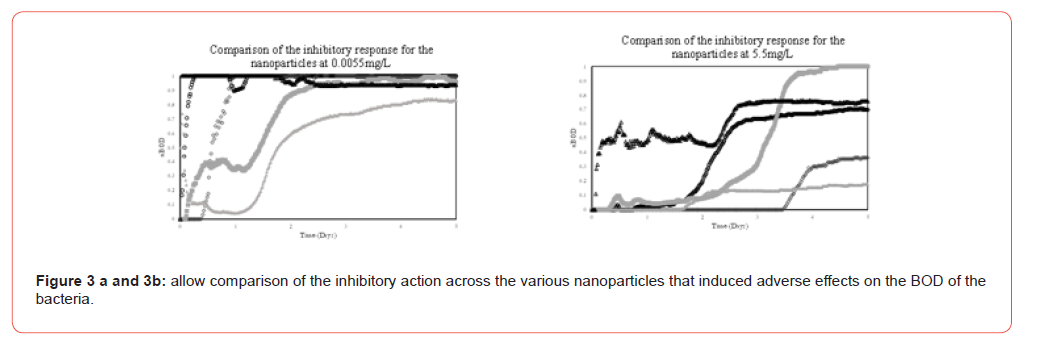
Sometimes, it is essential to compare the effect of two or more nanoparticles on microorganisms. Figure 3 demonstrates the deviation of BOD from the control for the various nanoparticles that exhibited adverse effects at the minimum 0.0055mg/L and the maximum 5.5mg/L concentrations. The normalized values were calculated by dividing the BOD value associated with the presence of the nanoparticle by the corresponding BOD of the control value in the absence of nanoparticles to present deviation of behavior from control conditions. A value of 0 denotes maximum inhibition while a value of 1 denotes an absence of adverse effects. Based on the results depicted in Figure 3a, at the lower 0.0055mg/L concentration, bacteria exposed to CNT and titanium exhibited the lowest adverse response with the bacteria achieving maximum BOD by 0.06 days and 0.2 days. Bacteria in the presence of silver nanoparticles showed an initial delay in growth but achieved BOD levels similar to that of the control by 0.92 days. Bacteria exposed to zinc nanoparticles achieved maximum BOD levels at about 3.4 days and those exposed to copper nanoparticles exhibited the highest negative impact on the BOD without attaining the maximum BOD levels but plateauing after 4 days.
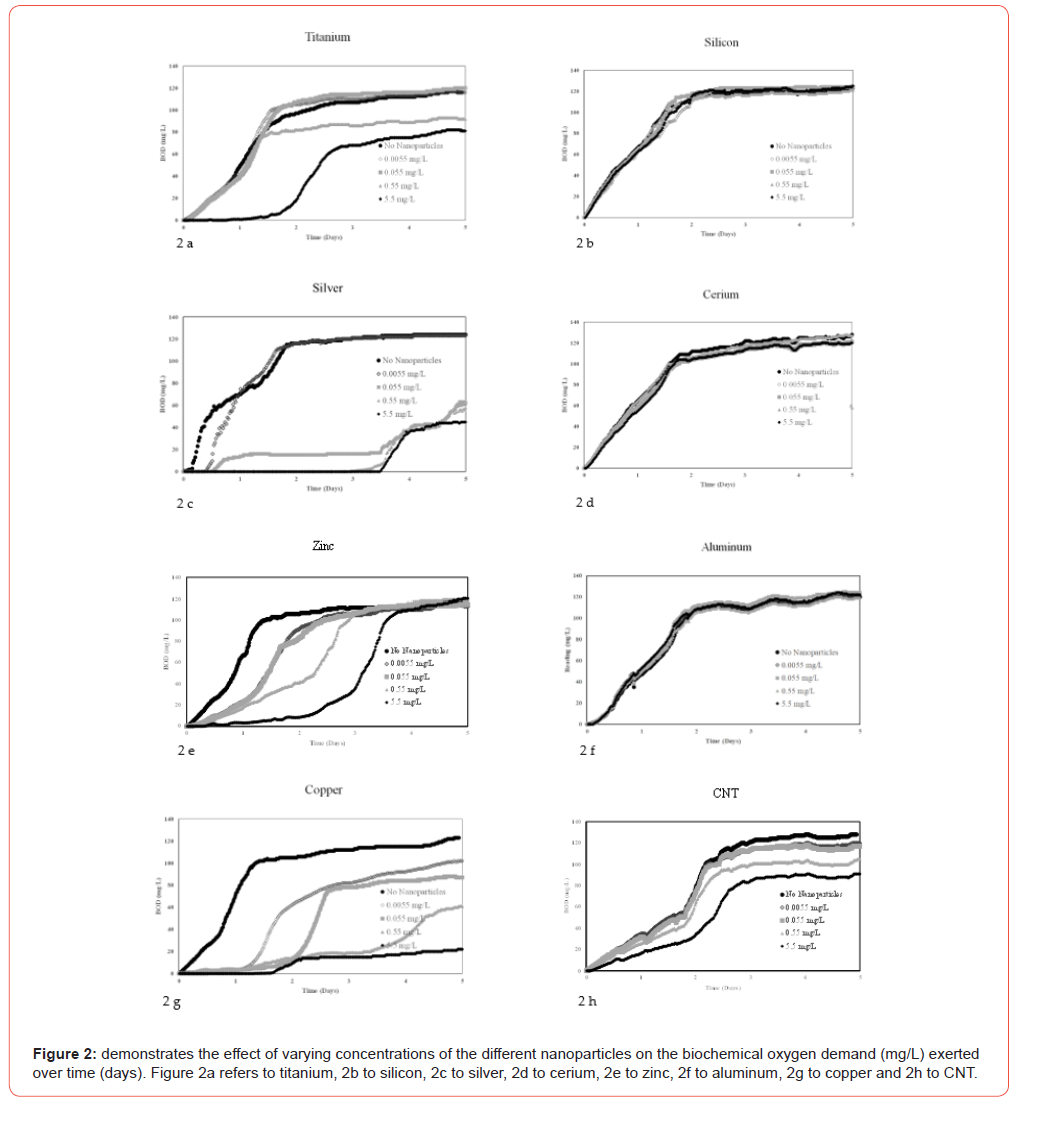
Figure 3b allows for comparison of bacterial response across nanoparticles at the maximum 5.5mg/L concentration tested. Bacteria exposed to zinc nanoparticles demonstrated inhibited activity until about 4 days while those exposed to titanium, silver, copper, and CNT continued to experience stressful conditions without achieving maximum BOD. The data demonstrates that silver and copper evoked maximum adverse response from the bacteria. Bacteria in the presence of CNT and Titanium also experienced delayed and inhibited growth that plateaued at around 2.8 days.
The method of normalizing BOD levels at a specific concentration of nanoparticles with the control permits the comparison of the effect of various nanoparticles on bacterial growth. The method requires all experiments with the different nanoparticles to be performed at uniform conditions. The same method can be extended to study the effect of alternate nanoparticles, other concentrations of interest, or the same nanoparticles employing different bacteria as desired.
Study Implications
As discussed in the article, a surge in nanoparticle production volume is certain in the future. These nanoparticles will eventually enter the environment and result in exposure to living organisms. The BOD experiments were performed across a wide concentration range that are relevant today. The lower concentrations may be representative of nanoparticle concentrations in surface waters and waste water effluents at present. Limited studies have demonstrated the presence of nanoparticles in water [78]. Up to 16μg/L titanium oxide nanoparticles were detected in surface waters in Switzerland and up to 4 μg/L was detected in surface water in Colorado, USA while 86 μg/L titanium oxide nanoparticles was detected in surface water in China. While one study has detected over 40 μg/L of titanium dioxide nanoparticles in waste water treatment plant effluents other studies have detected about 20 μg/L of titanium oxide nanoparticles [79-81]. Another study has detected a maximum of 10.16 mg/L of silver nanoparticles in river water and 20.02 mg/L of silver nanoparticles in sewage in Malaysia [78]. The higher concentrations examined in this study may also be representative of concentrations at points of entry of nanoparticles or areas of accumulation in the environment. Considering current trends these higher concentrations of nanoparticles may be representative of surface and waste water in the near future.
The effect of these nanoparticles on microorganisms is important to understand owing to the smaller size of these organisms and the critical roles they play in the environment and the recent surge in production volumes. The presented research advances existing knowledge by demonstrating the possible effects of the most widely used nanomaterials on bacterial growth.
First, given that nanoparticles can enter the environment during their lifecycle ,they can move between the compartments of air, water, and soil resulting in exposure to living organisms. Accordingly, nanoparticle production, use, and disposal need to be responsibly managed. Second, the study also showed that different nanoparticles evoke a different type of response from bacteria. While some like aluminum, silicon, and cerium oxide may not affect bacterial growth and function, other nanoparticles like titanium, zinc, copper, silver, and carbon nanotubes can yield a reduced growth rate or even inhibit growth after a period of time.
Third, the research demonstrates that the bacterial response to the presence of nanoparticles can vary with the concentration of nanoparticles present. For example, minimum adverse effects were observed with titanium oxide nanoparticles at lower concentrations; but at higher concentrations heightened negative effects were observed with a reduced slope of growth and decreased maximum BOD exerted. Fourth, the effect of a specific nanoparticle concentration on the behavior of bacteria can vary over time. Finally, comparing the effect of multiple nanoparticles to identify materials for a particular purpose can be done by normalizing the BOD values with the control. If the application is to manufacture an antimicrobial agent the more inhibiting nanoparticle can be used while if an application required lesser microbial toxicity response, the nanoparticle with lesser inhibition may be identified. The findings of the research will be useful in the identification of nanoparticles for various applications, the design of nanomaterials, and their overall production, management, and disposal.
As part of this article, we have presented an alternate experimental method that can be used to study the effect of various nanoparticles at other concentrations of interest simultaneously. Therefore, experiments may be conducted with nanoparticles at specific concentrations and differing environmental conditions to make conclusions about specific exposure scenarios. Every experimental run has to be accompanied with a standard run simultaneously under identical conditions.
Despite the study contributions, there are a few limitations of the study that must be acknowledged. First, nanoparticle behavior and interaction with environmental constituents is not completely understood, therefore there are limitations with the generalizability of the study findings to the environment. The inference from the data obtained is not to be taken at absolute value but rather, trends observed may be considered. The role of different environmental constituents can be considered by modifying the environmental conditions and replicating the experiments. Future research may replicate the effort while including naturally present organic matter, and other microorganisms’ representative of communities and ecosystems in the environment. Finally, while the current research effort identified the effect of the nanoparticles, the mechanism of action of these nanoparticles on bacteria still remains elusive and can be investigated in future work. The most widely accepted mechanisms include toxicity mechanisms of most nanoparticles still largely remain unclear. Toxicity mechanisms being currently investigated and recognized include metal ion release, production of reactive oxygen species like free radicals, photocatalysis, phase transformation, and other non-oxidative mechanisms [82-93]. Further research is warranted in elucidating the toxicity mechanism for these nanoparticles and the effects of transformation of nanoparticles in the environment.
Conclusion
The increasing production and use of nanomaterials require us to gain an understanding of the effect of these particles on living organisms. As part of this study, we have demonstrated that certain nanoparticles can impact microbial growth resulting in altered responses to the BOD exerted by the bacteria. Specifically, the study identified that nanoparticles like aluminum, silicon, and cerium oxide exhibit a non-toxic response from bacteria while titanium oxide, zinc oxide, copper oxide, silver, and carbon nanotubes can impede bacterial growth. The investigation also revealed that the response of the bacteria varied as a function of nanoparticle concentration and exposure time.
The results of the research suggest that the benefits of nanotechnology should be considered along with their possible impact on living organisms and ecosystems. While their use in construction, electronics, cosmetics, medicine, and water treatment is extremely beneficial, the potential adverse impacts of exposure to humans and other forms of life should not be overlooked. Development of safe and responsible guidelines for the manufacture, use, and disposal of nanoparticles and nanoparticles containing products will enable the shaping of this promising field by maximizing its potential while delineating and controlling the adverse outcomes. Further research is required to understand the effect nanoparticles may have on natural microbial communities and biofilms.
Credit Author Statement
Albert- Project goals, design of experimentation and data analysis; Ringo, Stokes and Schlicke- Experimentation, Data analysis
Funding
This research was supported, fully or in part, by a Tarleton Faculty-Student Research and Creative Activity Internal Grant.
Conflict of Interest
The authors declare no conflict of interest.
References
- Hansen S Foss, Anders Baun, ES Michelson, A Kamper, P Borling (2009a) "Nanomaterials in Consumer Products." In Nanomaterials: Risks and Benefits pp. 359-367.
- Zhang Yuanyuan, Yu-Rui Leu, Robert Aitken, Michael Riediker (2015) "Inventory of Engineered Nanoparticle-Containing Consumer Products Available in the Singapore Retail Market and Likelihood of Release into the Aquatic Environment." International Journal of Environmental Research and Public Health 12(8): 8717-8743.
- Nowack Bernd, Thomas D Bucheli (2007) "Occurrence, Behavior and Effects of Nanoparticles in the Environment." Environmental Pollution 150(1): 5-22.
- Kettler Katja, Karin Veltman, Dik van de Meent, Annemarie van Wezel, A Jan Hendriks (2014) "Cellular Uptake of Nanoparticles as Determined by Particle Properties, Experimental Conditions, and Cell Type." Environmental Toxicology and Chemistry 33(3): 481-492.
- Gurchumelia L, T Lezhava, A Chirakadze (2017) "Obtaining Metal Nanoparticles Based on “green Chemistry”." KONFRANSIN TƏŞKİLAT KOMİTƏSİ: 233.
- Bundschuh Mirco, Juliane Filser, Simon Lüderwald, Moira S McKee, George Metreveli, et al. (2018a) "Nanoparticles in the Environment: Where do we Come from, Where do we Go to?" Environmental Sciences Europe 30(1): 1-17.
- Gaillet Sylvie, Jean-Max Rouanet (2015) "Silver Nanoparticles: Their Potential Toxic Effects After Oral Exposure and Underlying Mechanisms–a Review." Food and Chemical Toxicology 77: 58-63.
- Hansen S Foss, Anders Baun, ES Michelson, A Kamper, P Borling (2009b) "Nanomaterials in Consumer Products." In Nanomaterials: Risks and Benefits pp. 359-367.
- Hansen Steffen Foss, Evan S Michelson, Anja Kamper, Pernille Borling, Frank Stuer-Lauridsen, et al. (2008) "Categorization Framework to Aid Exposure Assessment of Nanomaterials in Consumer Products." Ecotoxicology 17(5): 438-447.
- Vance Marina E, Todd Kuiken, Eric P Vejerano, Sean P McGinnis, Michael F Hochella Jr, et al. (2015) "Nanotechnology in the Real World: Redeveloping the Nanomaterial Consumer Products Inventory." Beilstein Journal of Nanotechnology 6(1): 1769-1780.
- Giese Bernd, Fred Klaessig, Barry Park, Ralf Kaegi, Michael Steinfeldt, (2018) "Risks, Release and Concentrations of Engineered Nanomaterial in the Environment." Scientific Reports 8(1): 1565.
- Warheit D B (2018) "Hazard and Risk Assessment Strategies for Nanoparticle Exposures: How Far have we Come in the Past 10 Years?" F1000Research 7: 376.
- Mirco Bundschuh, Juliane Filser, Simon Lüderwald, Moira S McKee, George Metreveli, et al. (2018b) "Nanoparticles in the Environment: Where do we Come from, Where do we Go to?" Environmental Sciences Europe 30(1): 1-17.
- Keller Arturo A, Suzanne McFerran, Anastasiya Lazareva, Sangwon Suh (2013) "Global Life Cycle Releases of Engineered Nanomaterials." Journal of Nanoparticle Research 15(6): 1692.
- Krysanov E Yu, DS Pavlov, TB Demidova, Yu Yu Dgebuadze (2010) "Effect of Nanoparticles on Aquatic Organisms." Biology Bulletin 37(4): 406-412.
- Pelletier D A, A K Suresh, G A Holton, C K McKeown, W Wang, et al. (2010) "Effects of Engineered Cerium Oxide Nanoparticles on Bacterial Growth and Viability." Applied and Environmental Microbiology 76(24): 7981-7989.
- Pulit-Prociak, Jolanta, Marcin Banach (2016) "Silver Nanoparticles–a Material of the Future…?" Open Chemistry 14(1): 76-91.
- Niazi Javed H, Man Bock Gu (2009) "Toxicity of Metallic Nanoparticles in Microorganisms-a Review." In Atmospheric and Biological Environmental Monitoring pp. 193-206.
- Rivera-Gil Pilar, Dorleta Jimenez De Aberasturi, Verena Wulf, Beatriz Pelaz, Pablo Del Pino, et al. (2012) "The Challenge to Relate the Physicochemical Properties of Colloidal Nanoparticles to their Cytotoxicity." Accounts of Chemical Research 46(3): 743-749.
- Praetorius Antonia, Martin Scheringer, Konrad Hungerbühler (2012) "Development of Environmental Fate Models for Engineered Nanoparticles A Case Study of TiO2 Nanoparticles in the Rhine River." Environmental Science & Technology 46(12): 6705-6713.
- Jiang Wei, Hamid Mashayekhi, Baoshan Xing (2009) "Bacterial Toxicity Comparison between Nano-and Micro-Scaled Oxide Particles." Environmental Pollution 157(5): 1619-1625.
- Hegde Krishnamoorthy, Satinder Kaur Brar, Mausam Verma, Rao Y Surampalli (2016) "Current Understandings of Toxicity, Risks and Regulations of Engineered Nanoparticles with Respect to Environmental Microorganisms." Nanotechnology for Environmental Engineering 1(1): 5.
- Chatterjee Saptarshi, Arghya Bandyopadhyay, Keka Sarkar (2011) "Effect of Iron Oxide and Gold Nanoparticles on Bacterial Growth Leading Towards Biological Application." Journal of Nanobiotechnology 9(1): 34.
- Fabrega Julia, Samuel N Luoma, Charles R Tyler, Tamara S Galloway, Jamie R Lead (2011) "Silver Nanoparticles: Behaviour and Effects in the Aquatic Environment." Environment International 37(2): 517-531.
- Frenk Sammy, Tal Ben-Moshe, Ishai Dror, Brian Berkowitz, Dror Minz (2013) "Effect of Metal Oxide Nanoparticles on Microbial Community Structure and Function in Two Different Soil Types." PloS One 8(12): e84441.
- Maurer-Jones, Melissa A, Ian L Gunsolus, Catherine J Murphy, Christy L Haynes (2013) "Toxicity of Engineered Nanoparticles in the Environment." Analytical Chemistry 85(6): 3036-3049.
- Podila Ramakrishna, Jared M Brown (2013) "Toxicity of Engineered Nanomaterials: A Physicochemical Perspective." Journal of Biochemical and Molecular Toxicology 27(1): 50-55.
- Radzig MA, VA Nadtochenko, OA Koksharova, J Kiwi, VA Lipasova, et al. (2013) "Antibacterial Effects of Silver Nanoparticles on Gram-Negative Bacteria: Influence on the Growth and Biofilms Formation, Mechanisms of Action." Colloids and Surfaces B: Biointerfaces 102: 300-306.
- Hoecke Karen Van, Joris TK Quik, Joanna Mankiewicz-Boczek, Karel AC De Schamphelaere, Andreas Elsaesser, et al. (2009) "Fate and Effects of CeO2 Nanoparticles in Aquatic Ecotoxicity Tests." Environmental Science & Technology 43(12): 4537-4546.
- Asati Atul, Santimukul Santra, Charalambos Kaittanis, Sudip Nath, J Manuel Perez (2009) "Oxidase‐like Activity of Polymer‐coated Cerium Oxide Nanoparticles." Angewandte Chemie 48(13): 2308-2312.
- Lin Weisheng, Yue-wern Huang, Xiao-Dong Zhou, Yinfa Ma (2006) "Toxicity of Cerium Oxide Nanoparticles in Human Lung Cancer Cells." International Journal of Toxicology 25(6): 451-457.
- Schubert David, Richard Dargusch, Joan Raitano, Siu-Wai Chan (2006) "Cerium and Yttrium Oxide Nanoparticles are Neuroprotective." Biochemical and Biophysical Research Communications 342(1): 86-91.
- Thill Antoine, Ophélie Zeyons, Olivier Spalla, Franck Chauvat, Jerôme Rose, et al. (2006) "Cytotoxicity of CeO2 Nanoparticles for Escherichia Coli. Physico-Chemical Insight of the Cytotoxicity Mechanism." Environmental Science & Technology 40(19): 6151-6156.
- García Ana, Lucía Delgado, Josep A Torà, Eudald Casals, Edgar González, et al. (2012) "Effect of Cerium Dioxide, Titanium Dioxide, Silver, and Gold Nanoparticles on the Activity of Microbial Communities Intended in Wastewater Treatment." Journal of Hazardous Materials 199: 64-72.
- Rajiv S, J Jerobin, V Saranya, M Nainawat, A Sharma, et al. (2016) "Comparative Cytotoxicity and Genotoxicity of Cobalt (II, III) Oxide, Iron (III) Oxide, Silicon Dioxide, and Aluminum Oxide Nanoparticles on Human Lymphocytes in Vitro." Human & Experimental Toxicology 35(2): 170-183.
- Sadiq I Mohammed, Sunandan Pakrashi, N Chandrasekaran, Amitava Mukherjee (2011a) "Studies on Toxicity of Aluminum Oxide (Al 2 O 3) Nanoparticles to Microalgae Species: Scenedesmus Sp. and Chlorella Sp." Journal of Nanoparticle Research 13(8): 3287-3299.
- Yanık Fatma, Filiz Vardar (2015) "Toxic Effects of Aluminum Oxide (Al 2 O 3) Nanoparticles on Root Growth and Development in Triticum Aestivum." Water, Air, & Soil Pollution 226(9): 296.
- Załęska-Radziwiłł Monika, Nina Doskocz (2016) "DNA Changes in Pseudomonas Putida Induced by Aluminum Oxide Nanoparticles using RAPD Analysis." Desalination and Water Treatment 57(3): 1573-1581.
- Seil J T, T J Webster (2012) "Antimicrobial Applications of Nanotechnology: Methods and Literature." International Journal of Nanomedicine 7: 2767-2781.
- Sadiq I Mohammed, Basudev Chowdhury, Natarajan Chandrasekaran, Amitava Mukherjee (2009) "Antimicrobial Sensitivity of Escherichia Coli to Alumina Nanoparticles." Nanomedicine: Nanotechnology, Biology and Medicine 5(3): 282-286.
- Albert Lynal, Lucas Ringo, Mia Schlicke, Shannon Lawless, Sidney Stokes (2020) "Nanoparticles: Pathways into the Environment and Effect on Biological Systems." American Society of Civil Engineers Reston, VA.
- Windler L, Christiane Lorenz, Natalie von Goetz, K Hungerbuhler, M Amberg, et al. (2012) "Release of Titanium Dioxide from Textiles during Washing." Environmental Science & Technology 46(15): 8181-8188.
- Weir Alex, Paul Westerhoff, Lars Fabricius, Kiril Hristovski, Natalie Von Goetz (2012) "Titanium Dioxide Nanoparticles in Food and Personal Care Products." Environmental Science & Technology 46(4): 2242-2250.
- Sengul Ayse Busra, Eylem Asmatulu (2020) "Toxicity of Metal and Metal Oxide Nanoparticles: A Review." Environmental Chemistry Letters: 1-25.
- Gholipour Yousef, Silvana L Giudicessi, Hiroshi Nonami, Rosa Erra-Balsells (2010) "Diamond, Titanium Dioxide, Titanium Silicon Oxide, and Barium Strontium Titanium Oxide Nanoparticles as Matrixes for Direct Matrix-Assisted Laser Desorption/Ionization Mass Spectrometry Analysis of Carbohydrates in Plant Tissues." Analytical Chemistry 82(13): 5518-5526.
- Moret Sébastien, Andy Bécue, Christophe Champod (2016) "Functionalised Silicon Oxide Nanoparticles for Fingermark Detection." Forensic Science International 259: 10-18.
- Nguyen Thien Vuong, Tuan Anh Nguyen, Thi Hau Nguyen (2020) "The Synergistic Effects of SiO2 Nanoparticles and Organic Photostabilizers for Enhanced Weathering Resistance of Acrylic Polyurethane Coating." Journal of Composites Science 4(1): 23.
- Shrestha Annie, Anil Kishen (2016) "Antibacterial Nanoparticles in Endodontics: A Review." Journal of Endodontics 42(10): 1417-1426.
- Zhang Li, Lingli Wu, Yazhu Mi, Youbin Si (2019) "Silver Nanoparticles Induced Cell Apoptosis, Membrane Damage of Azotobacter Vinelandii and Nitrosomonas Europaea Via Generation of Reactive Oxygen Species." Bulletin of Environmental Contamination and Toxicology: 1-6.
- Ece, Benjamin M Geilich, Hilal Yazici, Thomas J Webster (2017) "pH-Controlled Cerium Oxide Nanoparticle Inhibition of both Gram-Positive and Gram-Negative Bacteria Growth." Scientific Reports 7: 45859.
- Das Soumen, Janet M Dowding, Kathryn E Klump, James F McGinnis, William Self, et al. (2013) "Cerium Oxide Nanoparticles: Applications and Prospects in Nanomedicine." Nanomedicine 8(9): 1483-1508.
- Dhall Atul, William Self (2018) "Cerium Oxide Nanoparticles: A Brief Review of their Synthesis Methods and Biomedical Applications." Antioxidants 7(8): 97.
- Bhuvaneshwari M, Sakcham Bairoliya, Abhinav Parashar, N Chandrasekaran, Amitava Mukherjee (2016) "Differential Toxicity of Al 2 O 3 Particles on Gram-Positive and Gram-Negative Sediment Bacterial Isolates from Freshwater." Environmental Science and Pollution Research 23(12): 12095-12106.
- Kulkarni Devdatta P, Ravikanth S Vajjha, Debendra K Das, Daniel Oliva (2008) "Application of Aluminum Oxide Nanofluids in Diesel Electric Generator as Jacket Water Coolant." Applied Thermal Engineering 28(14-15): 1774-1781.
- Sadiq I Mohammed, Sunandan Pakrashi, N Chandrasekaran, Amitava Mukherjee (2011b) "Studies on Toxicity of Aluminum Oxide (Al 2 O 3) Nanoparticles to Microalgae Species: Scenedesmus Sp. and Chlorella Sp." Journal of Nanoparticle Research 13(8): 3287-3299.
- Athanassiou Evagelos K, Robert N Grass, Wendelin J Stark (2006) "Large-Scale Production of Carbon-Coated Copper Nanoparticles for Sensor Applications." Nanotechnology 17(6): 1668.
- Pendashteh Afshin, Mir Fazlollah Mousavi, Mohammad Safi Rahmanifar (2013) "Fabrication of Anchored Copper Oxide Nanoparticles on Graphene Oxide Nanosheets Via an Electrostatic Coprecipitation and its Application as Supercapacitor." Electrochimica Acta 88: 347-357.
- Ren Guogang, Dawei Hu, Eileen WC Cheng, Miguel A Vargas-Reus, Paul Reip, et al. (2009) "Characterisation of Copper Oxide Nanoparticles for Antimicrobial Applications." International Journal of Antimicrobial Agents 33(6): 587-590.
- Singh J, G Kaur, M Rawat (2016) "A Brief Review on Synthesis and Characterization of Copper Oxide Nanoparticles and its Applications." J.Bioelectron.Nanotechnol 1(9).
- Harrison Benjamin S, Anthony Atala (2007) "Carbon Nanotube Applications for Tissue Engineering." Biomaterials 28(2): 344-353.
- Hoenlein Wolfgang, Franz Kreupl, Georg Stefan Duesberg, Andrew Peter Graham, Maik Liebau, et al. (2004) "Carbon Nanotube Applications in Microelectronics." IEEE Transactions on Components and Packaging Technologies 27(4): 629-634.
- Simon-Deckers Angelique, Sylvain Loo, Martine Mayne-L’hermite, Nathalie Herlin-Boime, Nicolas Menguy, et al. (2009) "Size-, Composition-and Shape-Dependent Toxicological Impact of Metal Oxide Nanoparticles and Carbon Nanotubes Toward Bacteria." Environmental Science & Technology 43(21): 8423-8429.
- Desmau Morgane, Andrea Carboni, Maureen Le Bars, Emmanuel Doelsch, Marc F Benedetti, et al. (2020) "How Microbial Biofilms Control the Environmental Fate of Engineered Nanoparticles?" Frontiers in Environmental Science 8: 82.
- Dwivedi Amarendra Dhar, Shashi Prabha Dubey, Mika Sillanpää, Young-Nam Kwon, Changha Lee, et al. (2015) "Fate of Engineered Nanoparticles: Implications in the Environment." Coordination Chemistry Reviews 287: 64-78.
- Madeła Magdalena, Ewa Neczaj, Anna Grosser (2016) "Fate of Engineered Nanoparticles in Wastewater Treatment Plant." Inżynieria i Ochrona Środowiska 19(4): 577--587.
- Part Florian, Nicole Berge, Paweł Baran, Anne Stringfellow, Wenjie Sun, et al. (2018) "A Review of the Fate of Engineered Nanomaterials in Municipal Solid Waste Streams." Waste Management 75: 427-449.
- Espinasse Benjamin P, Nicholas K Geitner, Ariette Schierz, Mathieu Therezien, Curtis J Richardson, et al. (2018) "Comparative Persistence of Engineered Nanoparticles in a Complex Aquatic Ecosystem." Environmental Science & Technology 52(7): 4072-4078.
- Zhang Ming, Junhan Yang, Zhongxia Cai, Yudong Feng, Yafeng Wang, et al. (2019) "Detection of Engineered Nanoparticles in Aquatic Environments: Current Status and Challenges in Enrichment, Separation, and Analysis." Environmental Science: Nano 6(3): 709-735.
- Liu Qifan, John Liggio, Dalibor Breznan, Errol M Thomson, Premkumari Kumarathasan, et al. (2019) "Oxidative and Toxicological Evolution of Engineered Nanoparticles with Atmospherically Relevant Coatings." Environmental Science & Technology 53(6): 3058-3066.
- Pujalte Igor, Denis Dieme, Sami Haddad, Alessandra Maria Serventi, Michele Bouchard (2017) "Toxicokinetics of Titanium Dioxide (TiO2) Nanoparticles After Inhalation in Rats." Toxicology Letters 265: 77-85.
- Abbas Qumber, Balal Yousaf, Muhammad Ubaid Ali, Mehr Ahmed Mujtaba Munir, Ali El-Naggar, et al. (2020) "Transformation Pathways and Fate of Engineered Nanoparticles (ENPs) in Distinct Interactive Environmental Compartments: A Review." Environment International 138: 105646.
- Levard Clement, E Matt Hotze, Gregory V Lowry, Gordon E Brown Jr. (2012) "Environmental Transformations of Silver Nanoparticles: Impact on Stability and Toxicity." Environmental Science & Technology 46(13): 6900-6914.
- Li Yang, Wen Zhang, Junfeng Niu, Yongsheng Chen (2013) "Surface-Coating-Dependent Dissolution, Aggregation, and Reactive Oxygen Species (ROS) Generation of Silver Nanoparticles Under Different Irradiation Conditions." Environmental Science & Technology 47(18): 10293-10301.
- Stankus Dylan P, Samuel E Lohse, James E Hutchison, Jeffrey A Nason (2011) "Interactions between Natural Organic Matter and Gold Nanoparticles Stabilized with Different Organic Capping Agents." Environmental Science & Technology 45(8): 3238-3244.
- Prasath Sriram, Kavitha Palaniappan (2019) "Is using Nanosilver Mattresses/Pillows Safe? A Review of Potential Health Implications of Silver Nanoparticles on Human Health." Environmental Geochemistry and Health 45(1): 2295-2313.
- De Matteis Valeria (2017) "Exposure to Inorganic Nanoparticles: Routes of Entry, Immune Response, Biodistribution and in Vitro/in Vivo Toxicity Evaluation." Toxics 5(4): 29.
- Hou CC, J Q Zhu (2017) "Nanoparticles and Female Reproductive System: How do Nanoparticles Affect Oogenesis and Embryonic Development." Oncotarget 8(65): 109799-109817.
- Syafiuddin Achmad, Salmiati Salmiati, Tony Hadibarata, Ahmad Beng Hong Kueh, Mohd Razman Salim, et al. (2018) "Silver Nanoparticles in the Water Environment in Malaysia: Inspection, Characterization, Removal, Modeling, and Future Perspective." Scientific Reports 8(1): 1-15.
- Peters Ruud JB, Greet van Bemmel, Nino BL Milani, Gerco CT den Hertog, Anna K Undas, et al. (2018) "Detection of Nanoparticles in Dutch Surface Waters." Science of the Total Environment 621: 210-218.
- Wu Shengmin, Shenghu Zhang, Yang Gong, Lili Shi, Bingsheng Zhou (2020) "Identification and Quantification of Titanium Nanoparticles in Surface Water: A Case Study in Lake Taihu, China." Journal of Hazardous Materials 382: 121045.
- Sousa Vânia Serrão, Margarida Ribau Teixeira (2020) "Metal-Based Engineered Nanoparticles in the Drinking Water Treatment Systems: A Critical Review." Science of the Total Environment 707: 136077.
- Antonietta Zoroddu, Maria Serenella Medici, Alessia Ledda, Valeria Marina Nurchi, Joanna I Lachowicz, et al. (2014) "Toxicity of Nanoparticles." Current Medicinal Chemistry 21(33): 3837-3853.
- Dahle Jessica T, Yuji Arai (2015) "Environmental Geochemistry of Cerium: Applications and Toxicology of Cerium Oxide Nanoparticles." International Journal of Environmental Research and Public Health 12(2): 1253-1278.
- Hajipour Mohammad J, Katharina M Fromm, Ali Akbar Ashkarran, Dorleta Jimenez de Aberasturi, Idoia Ruiz de Larramendi, et al. (2012) "Antibacterial Properties of Nanoparticles." Trends in Biotechnology 30(10): 499-511.
- Shameli Kamyar, Mansor Bin Ahmad, Seyed Davoud Jazayeri, Parvaneh Shabanzadeh, Parvanh Sangpour, et al. (2012) "Investigation of Antibacterial Properties Silver Nanoparticles Prepared Via Green Method." Chemistry Central Journal 6(1): 73.
- Wang L, C Hu, L Shao (2017) "The Antimicrobial Activity of Nanoparticles: Present Situation and Prospects for the Future." International Journal of Nanomedicine 12: 1227-1249.
- Becheri Alessio, Maximilian Dürr, Pierandrea Lo Nostro, Piero Baglioni (2008) "Synthesis and Characterization of Zinc Oxide Nanoparticles: Application to Textiles as UV-Absorbers." Journal of Nanoparticle Research 10(4): 679-689.
- Franci Gianluigi, Annarita Falanga, Stefania Galdiero, Luciana Palomba, Mahendra Rai, et al. (2015) "Silver Nanoparticles as Potential Antibacterial Agents." Molecules 20(5): 8856-8874.
- Gao Ang, Ruiqiang Hang, Xiaobo Huang, Lingzhou Zhao, Xiangyu Zhang, et al. (2014) "The Effects of Titania Nanotubes with Embedded Silver Oxide Nanoparticles on Bacteria and Osteoblasts." Biomaterials 35(13): 4223-4235.
- Huang Zhongbing, Xu Zheng, Danhong Yan, Guangfu Yin, Xiaoming Liao, et al. (2008) "Toxicological Effect of ZnO Nanoparticles Based on Bacteria." Langmuir 24(8): 4140-4144.
- Kang Seoktae, Meagan S Mauter, Menachem Elimelech (2008) "Physicochemical Determinants of Multiwalled Carbon Nanotube Bacterial Cytotoxicity." Environmental Science & Technology 42(19): 7528-7534.
- Sabir Sidra, Muhammad Arshad, Sunbal Khalil Chaudhari (2014) "Zinc Oxide Nanoparticles for Revolutionizing Agriculture: Synthesis and Applications." The Scientific World Journal 2014: 925494.
- Xiu Zong-ming, Qing-bo Zhang, Hema L Puppala, Vicki L Colvin, Pedro JJ Alvarez (2012) "Negligible Particle-Specific Antibacterial Activity of Silver Nanoparticles." Nano Letters 12(8): 4271-4275.
-

This work is licensed under a Creative Commons Attribution-NonCommercial 4.0 International License.




