




 Research Article
Investigating the Physical and Chemical Effects of UV Aging on TPO-Modified Asphalt Binder
Received Date: March 21, 2024; Published Date: April 16, 2024
Abstract
All asphalt binders, regardless of modifications, undergo UV-induced physical and chemical changes that affect performance. The impact of UV radiation is a growing area of interest that cannot be ignored as an aging factor. Tire pyrolysis oil (TPO) is a newer binder additive growing in popularity due to its rejuvenating properties. TPO-modified asphalt has been physically characterized, but the material’s impact on UV aging has not been investigated. Most testing for modified asphalt performance focuses on physical testing, but UV aging also induces chemical aging. While physical aging is well standardized, chemical aging can be harder to detect with traditional methods. Additionally, sample preparation and UV sources have varied in the literature, making the characterization of UV aging on modified binders difficult. This study will compare the physical performance parameter (G*/sinδ) DSR testing with chemical FTIR and NMR methodologies. The objective of this study is to detect and compare the physical and chemical changes of TPO-modified binders due to UV aging to better prevent asphalt degradation in the future.
Keywords: Ultraviolet aging; Tire pyrolysis oil; Dynamic shear rheometer; Fourier Transform Infrared spectroscopy; Nuclear magnetic resonance
Introduction
Asphalt binders, a crucial component of asphalt mixtures, are subject to both physical and chemical aging processes over time, inevitably leading to performance degradation [1-3]. Among various aging factors, the influence of ultraviolet (UV) radiation has emerged as a significant concern due to its oxidative impacts that cause both physical and chemical changes [3, 4]. Asphalt modifications aim to mitigate aging-related issues and enhance binder properties and longevity [4-8]. Tire pyrolysis oil (TPO) has been gaining attention as a potentially effective asphalt binder modifier due to its enhancement of aged binder performance properties [9].
The conventional approach to assessing asphalt binder performance relies on physical testing methodologies. Physical aging of asphalt binder is observed with a dynamic shear rheometer as an increase in stiffness and a decrease in elasticity. Stiffness is described as a complex shear modulus (G*) and is the resistance to deformation when repeatedly sheard; a larger G* describes a stiffer binder. Elasticity is described as a phase angle (δ) which is the lag between applied and resulting shear strain; a δ closer to the max of 90˚ indicates a more viscous behavior, while 0º indicates a more elastic behavior. The standard physical performance parameter combines these two values as G*/sinδ. The higher this parameter the stiffer and more elastic the binder’s internal network. When testing unaged or short-term aged binders, the required performance is a minimum value to ensure the binder does not deform under loads. However, it has become increasingly evident that UV aging causes chemical alterations in binders, necessitating a better understanding of both physical and chemical aging [10-15]. Oils are chemically dense and have a lower viscosity and stiffness than asphalt binders. By adding tire pyrolysis oil, the G*/sinδ should decrease, but chemical interactions also impact physical properties. While physical aging assessment has advanced over the years with the introduction of the DSR, the detection and characterization of chemical aging remains a challenge. This challenge is further complicated by the variation of characterization methods [2,16-18].
This research seeks to relate the UV-induced physical and chemical changes on TPO-modified binders by comparing traditional DSR analysis with non-destructive FTIR and NMR chemical testing. This study seeks to contribute to a broader understanding of asphalt binder aging detection, thereby facilitating the development of more effective strategies to mitigate UV-induced degradation and enhance the durability of asphalt pavements.
Materials and Methods
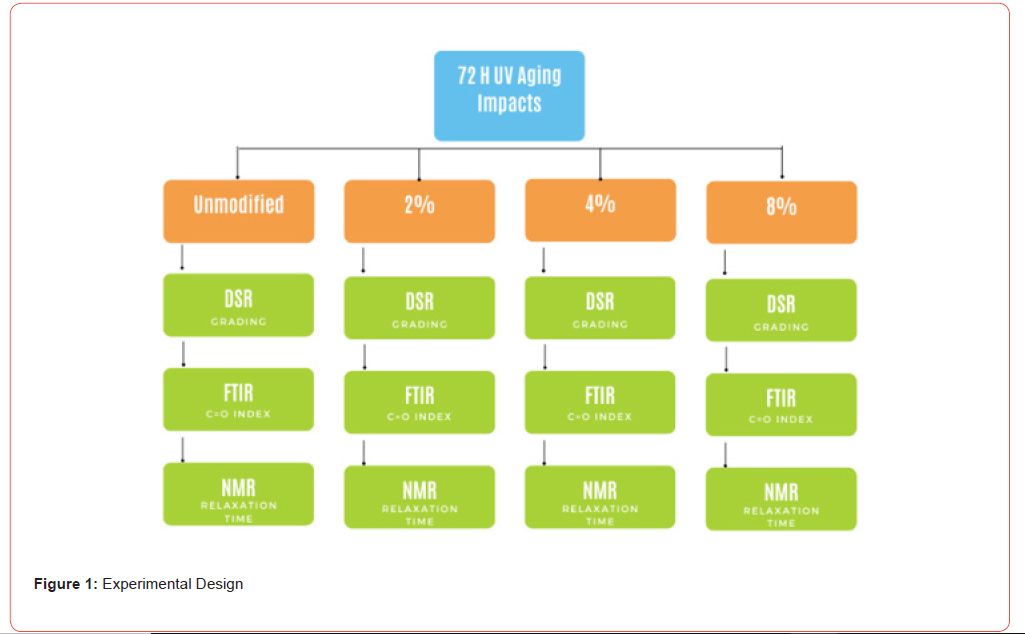
A PG 64-22 Holmes sourced asphalt binder mixed with 2,4, and 8% CarbonCycle tire pyrolysis oil was used for UV aging. A UV aging device was made using a lightbulb with 390-400nm wavelength.
Figure 1
Samples were prepared for UV aging in sample molds measuring 25mm in diameter and 1mm thick. The samples were under UV radiation for 72 hours. FTIR and NMR samples were taken immediately after DSR testing. DSR testing consisted of frequency sweeps from 100 to 0.1 rad/s at temperatures between 70˚C and 40˚C. FTIR testing determined the IR transmitted through the sample between 4000 and 400cm-1. A Thermo Scientific Nicolet iS50 FT-IR was used to collect the FTIR data. Spectra were created with 32 scans in absorbance mode using an ATR crystal. The spectra were normalized to the peak at 2920cm-1, as it was the most prominent in every sample. Carbonyl Indices were calculated according to the following:

and A is the area under the curve of valley-to-valley bands [19].
1H NMR T1 relaxation spectra were acquired using a Bruker
Avance DRX 200-MHz spectrometer. Samples were prepared by
dipping a 2-mm O.D. capillary tube into the heated binder. The capillary
tube was then placed inside a standard 5-mm NMR tube. The
samples were not diluted, and measurements were taken at ambient
temperatures. NMR spin-lattice relaxation data were recorded
with the SIP-R method [19], a recently introduced modification of
the traditional inversion-recovery technique [20]. The recovery delay,
tau, was varied on an exponential time scale (i.e., sampled equidistantly
on a logarithmic t-axis) between 15 μs and 3 s. A five-second
pre-delay was used to allow nuclear magnetization to return to
thermodynamic equilibrium before each scan./p>
Results and Discussion
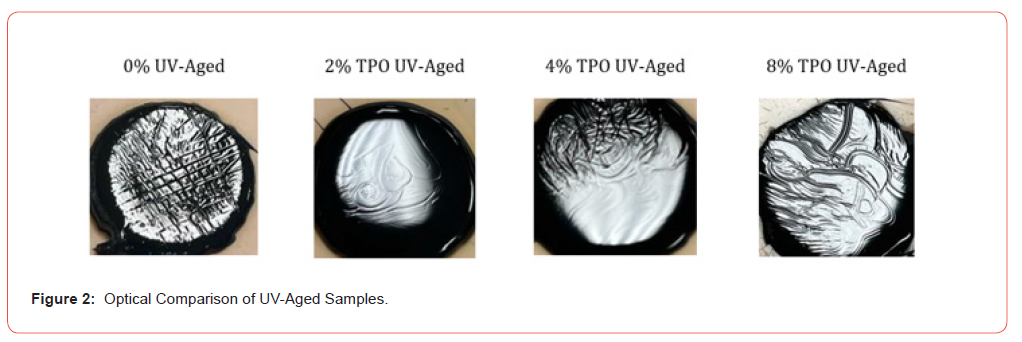
Each sample was UV-aged for 72 hours. An optical comparison was performed on all UV-aged binders as seen in Figure 2. The TPO-modified samples have less microcracking compared to the unmodified binder. However, more TPO results in more micro-cracking, indicating a reaction with the TPO. The unmodified binder has a higher density of grid-like cracking while the modified binders have lower density curved cracking. This cracking is the macrostructure of the material and should be defined by physical DSR testing. However, there are chemical changes in the microstructure that can also explain the resulting macrostructure, necessitating a comparison of both physical and chemical properties. This impact of UV aging cannot be ignored due to the obvious optical evidence of surface changes.
DSR
The most common method to determine asphalt performance is dynamic shear rheometer testing. Figure 3 shows the comparison of viscoelastic properties of TPO-modified UV-aged samples. The 2% and 4% TPO samples had a higher stiffness compared to the unmodified (0%) sample. This is unexpected as the TPO is an oil with a lower viscosity than asphalt. The 8% TPO sample had a lower stiffness compared to the unmodified sample, suggesting that at least 8% TPO is needed to reduce the physical impacts of UV aging as detected by the DSR. According to Superpave grading for a high-performance grade, the stiffness parameter, G*/sinδ, at 10 rad/s is greater than or equal to 1 for original binder and 2.2 for short-term aged binder. The grade for all samples stays at a high-performance grade of 64˚C if considered original binder. If considered short-term aged, the 2% sample would maintain a 64˚C grade while all other samples would be demoted to a 58˚C high-performance grade temperature. These findings would indicate that 72 hours of UV aging is not enough to be considered short-term aging according to standard physical aging testing.
FTIR
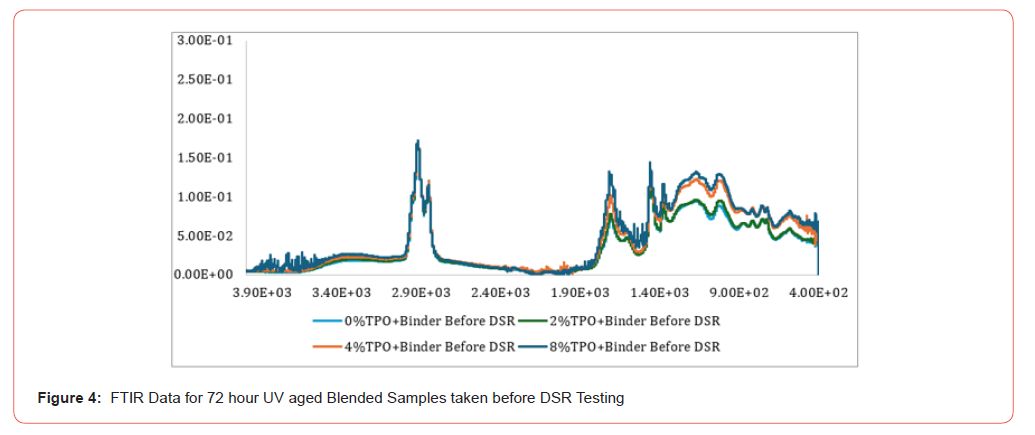
Fourier transform infrared analysis (FTIR) was performed on each UV-aged sample both before and after DSR testing. Figure 4 contains the FTIR data before DSR testing, and Figure 5 contains the FTIR data after DSR testing. There is a noticeable difference in peak intensity and functional groups present. The most noticeable difference is the altered intensities of the 1700cm-1 peak, as well as the region between 400cm-1 and 1400cm-1. Additionally, there is a slight broad peak between 3600cm-1 and 3000cm-1 in the pre-DSR samples, which is indicative of an O-H bond. Considering the presence of the O-H bond, as well as the elevated peaks at 1700cm-1 and more intense fingerprint region (1200-700cm-1), there is most likely water present within the pre-DSR sample. Because these same effects are not present in the after-DSR samples, DSR testing has an effect in removing water as an impurity.
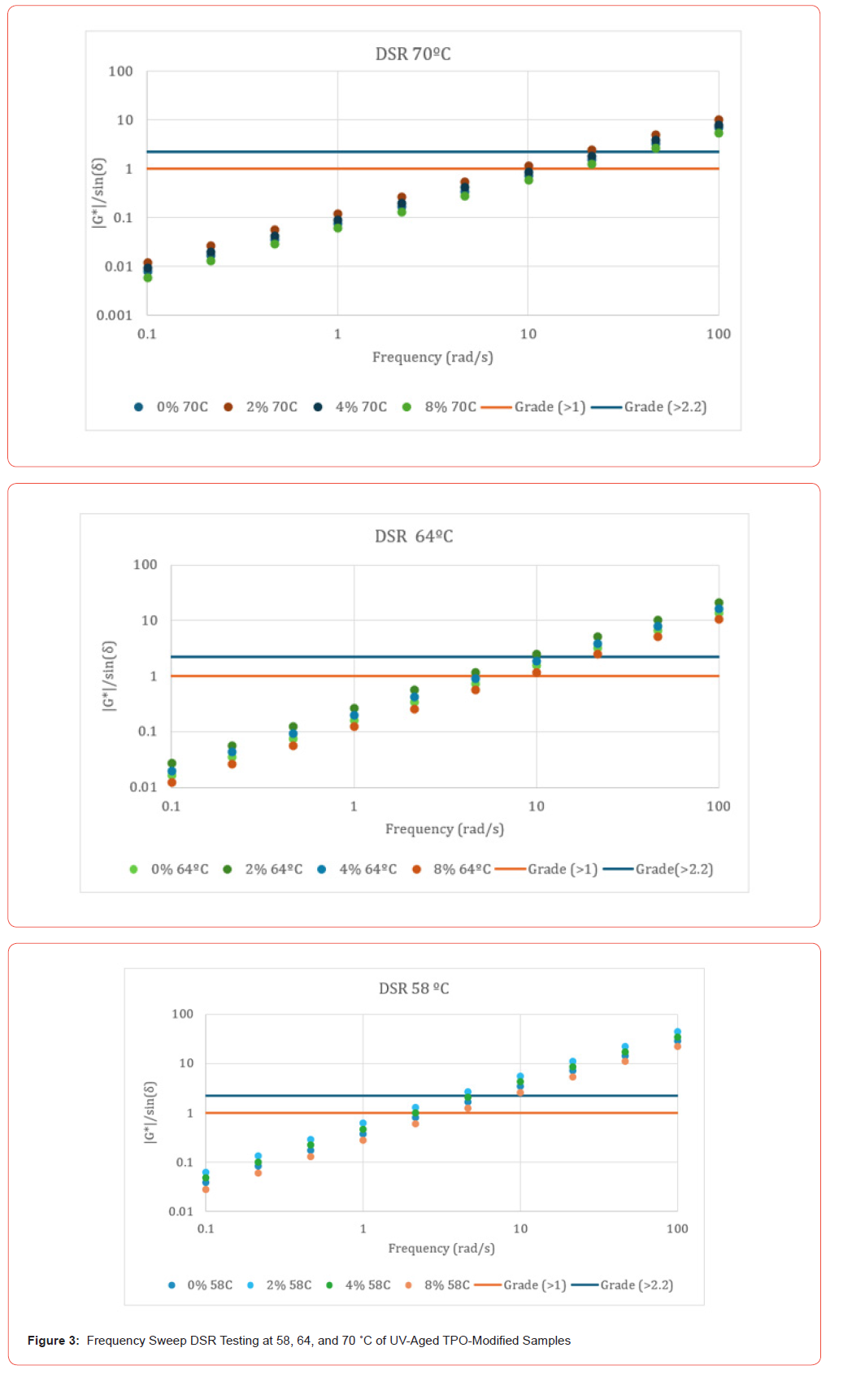
Figure 4 contains the FTIR data taken before the DSR testing. The difference between the intensities of the unmodified and 2% TPO modified binders with the 4% TPO and 8% TPO modified binders indicates that there is an effect of increasing the concentration of TPO within the asphalt binder. Since this effect isn’t noticed in the 2% TPO sample, there must be a minimum amount before the effect is noticeable. The functional group peaks are consistent through each sample, with the broad weak peak at 3600-3000cm-1 (O-H), the alkane peaks at 2920, 2860, and 1460cm-1, the C=O peak at 1700cm-1, a weaker C=C peak at 1600cm-1, S=O peaks at 1300 and 1160cm-1[20, 21]. This S=O bond is most likely a sulfone group, as it relates to these peaks the most. The rest of the fingerprint region is consistent with the post-DSR tested samples and could relate to aromatic compounds, though due to the lack of evidence for C=C bonds at other locations, this is dubious.
Within the after-DSR tested samples, the main functional groups present are C-H bonds (2920,2860,1460), with slight peaks at 1700 (C=O), 1600 (C=C), and various fingerprint peaks [20, 21]. These results are consistent for each percentage of TPO added to the binder, apart from the increase at the 1000cm-1 peak for the blends. This peak most likely relates to S=O bonds and could be the result of a conversion from sulfone compounds to sulfoxide compounds after the DSR testing. Considering that DSR uses both heat and mechanical forces that affect the physical properties of the binder, in Figures 4 and 5 it can be seen that the chemical properties are also affected, and could be a contributor to the change in physical properties. The mechanisms for these changes are unknown, and due to the complexity of the binder chemistry, might be impossible to determine. However, FTIR can detect changes in the chemical functionality, providing more insight into the microstructure.
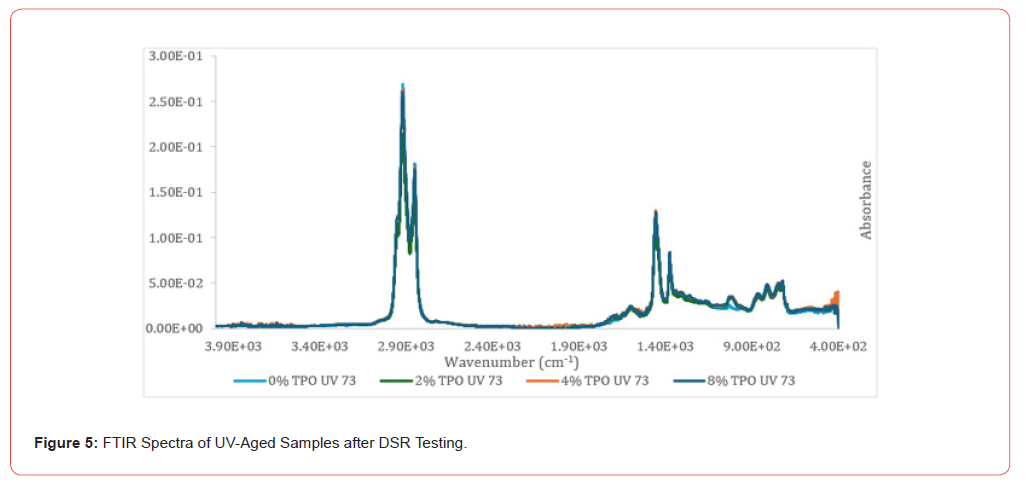
Comparing the carbonyl indices found in Table 1, as seen in Figures 4 and 5, the pre-DSR tested samples have a much larger ratio of C=O groups (cm-1) present than their post-DSR tested counterparts. Additionally, adding more TPO does increase the carbonyl index, which is expected as the TPO does contain carbonyl groups. However, this trend is not experienced between the 4% and 8% TPO blends after DSR testing since they have the same carbonyl index. Nonetheless, the carbonyl index shows a difference between testing methods and indicates a non-decreasing relation in the percentage of TPO.
Table 1:Carbonyl Comparison of UV-Aged Samples After DSR Testing.

NMR
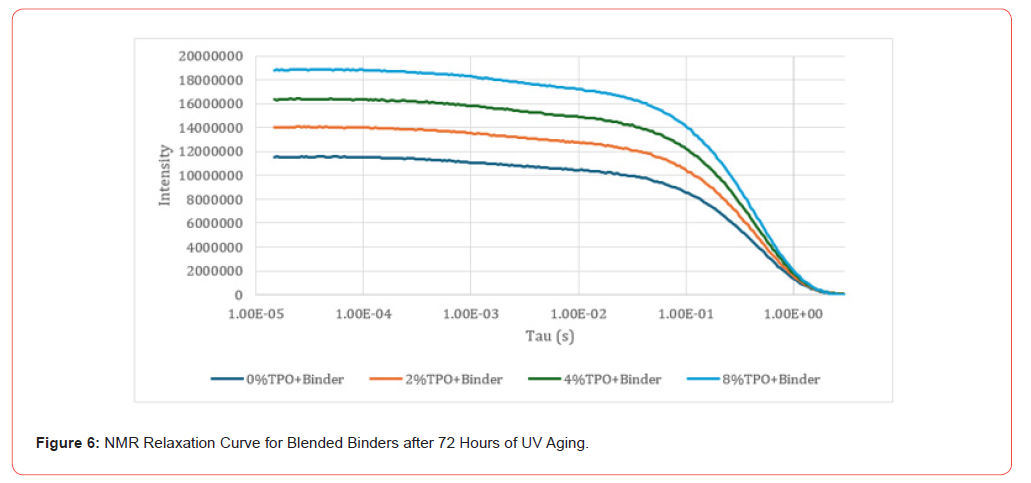
Nuclear magnetic resonance (NMR) relaxometry was used to determine different chemical environments in each sample. The relaxation curves are shown in Figure 6. Each inflection point indicates a distinct chemical environment. All samples have two distinct environments after aging for 72 hours. One inflection point is around 0.002s and the other is around 0.5s; these points are the approximate relaxation times. The 0.5s relaxation time is common to many asphalt binders. Alternatively, the 0.002s relaxation time is an indication of chemical aging since this environment is more crystalline and stiffer, resulting in a faster relaxation time. Other testing has indicated more drastic chemical environment changes after 72 hours of UV aging when just NMR methodologies were implemented. Due to the sampling method in this study, NMR testing was only tested after DSR testing. Like the DSR results, there are slight differences when adding more TPO.
Using TPO, asphalt binders were shown to display physical and chemical changes. Optically, more TPO resulted in more mico-cracking, but less cracking density compared to the unmodified sample. This micro-cracking did not necessarily result in a physically stiffer binder. The 8% TPO sample had the lowest G*/sinδ while the 2% TPO sample had the highest. The FTIR spectra before DSR testing show more of an indication of aging via the carbonyl index, but the before-DSR and after-DSR spectra have similar peaks regardless of TPO percentage. There is a noticeable change in intensity in the 4% and 8% TPO samples before the DSR testing, signifying some synergistic chemical functionality compared to the unmodified and 2% TPO sample. Finally, the NMR relaxation times do not seem to drastically change with TPO percent. The physical and chemical properties were shown to have subtle differences.
The drastic change in the C=O and S=O peaks from the FTIR spectra is an interesting finding. It is expected that UV radiation encourages photo-oxidation [3, 22], so oxygen-containing compounds have become an indication of chemical aging. However, many studies have very small C=O peaks and carbonyl indices as compared to this study’s before-DSR testing [19, 23]. This could be an indication that current sample aging and preparation methods should be better suited to detect heat-sensitive chemical aging. Further testing should compare other modified binders to better understand the relation between physical and chemical changes due to UV aging.
Conclusion
UV aging cannot be ignored when considering modified asphalt degradation factors. The effects of UV aging could be detected with both physical and chemical testing. TPO did exhibit some rejuvenating properties, but the material is also impacted by UV radiation. The major findings are as follows:
- The stiffness parameter (G*/sinδ), was not impacted
enough to change the standard performance grading during 72
hours of UV aging if the binder is considered unaged.
- The 2% and 4% TPO samples had a higher G*/sinδ value
and carbonyl index showing a more aged sample.
- 8% TPO was shown to reduce the impact of UV aging via
DSR testing.
- Chemical changes via FTIR and NMR were potentially impacted
by DSR testing.
- Major functional group impacts (before-DSR) were noticed
in 4% and 8% TPO samples.
- The carbonyl index trend does not decrease with additional
TPO.
- S=O bonds are present, and the conversion of Sulfones to
Sulfoxides could be taking place due to the DSR testing.
Since UV aging is a type of chemical aging [24], chemical methodologies should be further developed and favored due to the impact of physical testing on chemical changes induced by UV aging.
Acknowledgment
The authors would like to acknowledge both the civil engineering and chemistry departments for this collaborative effort. The S&T NMR Institute also played a role in providing chemical materials for this study. We would like to thank Evan Collins, Josh Burris, Ahmed El-Ashwah, and Eslam Deef Allah for their help in the civil department. Additionally, we would like to acknowledge Zac Mayes, Gabriel Riddle, Kait Miles, and Rosalee Brown.
Conflict of Interest
The authors declare no conflicts of interest.
References
- Y Zou (2022) Impact of Aging on Molecular Structure of Asphalts from Different Crude Oils. J Test Eval 50(3): 1-13.
- H Zhang, Z Chen, G Xu, C Shi (2018) Evaluation of aging behaviors of asphalt binders through different rheological indices. Fuel 221: 78-88.
- X He, D Hochstein, Q Ge, A W Ali, F Chen, et al. (2018) Accelerated Aging of Asphalt by UV Photo-Oxidation Considering Moisture and Condensation Effects. Journal of Materials in Civil Engineering 30: 1.
- L Zou, Z Lou, M Li, H Xue, Y Chen, et al. (2021) Study on prevention and treatment strategy of asphalt ultraviolet (UV) aging based on UV climate zoning in China. Applied Sciences (Switzerland) 11: 14.
- F Wang, L Zhang, X Zhang, H Li, S Wu, et al. (2020) Aging mechanism and rejuvenating possibility of SBS copolymers in asphalt binders. Polymers (Basel) 12(1): 92.
- H Yu (2019) Impact of ultraviolet radiation on the aging properties of SBS-modified asphalt binders Polymers (Basel) 11: 7.
- S Zhang, H Hong, H Zhang, Z Chen (2021) Investigation of anti-aging mechanism of multi-dimensional nanomaterials modified asphalt by FTIR, NMR and GPC. Constr Build Mater 305:
- B Li, W Liu, X Nan, J Yang, C Tu, et al. (2023) Development of rejuvenator using waste vegetable oil and its influence on pavement performance of asphalt binder under ultraviolet aging. Case Studies in Construction Materials 18: e01964.
- Kumar R Choudhary, A Kumar (2022) Evaluation of Waste Tire Pyrolytic Oil as a Rejuvenation Agent for Unmodified, Polymer-Modified, and Rubber-Modified Aged Asphalt Binders. Journal of Materials in Civil Engineering 34: 10.
- Bo Li, Jie Han, Xueli Nan, Xiaolan Li, Xiaomin Li, et al. (2023) Adhesion characteristics and spectroscopic analysis of regenerated ultraviolet aged asphalt binder using waste vegetable oil. Case Studies in Construction Materials 18: e01853.
- Z Cao, X Huang, J Yu, X Han, R Wang, et al. (2020) Study on all-components regeneration of ultraviolet aged SBS modified asphalt for high-performance recycling. J Clean Prod 276: 123376.
- F Xiao, D Newton, B Putman, V S Punith, S N Amirkhanian, et al. (2023) A long-term ultraviolet aging procedure on foamed WMA mixtures. Materials and Structures/Materiaux et Constructions 46(12) 1987-2001.
- S Wu, L Pang, G Liu, J Zhu (2010) Laboratory Study on Ultraviolet Radiation Aging of Bitumen. Journal of Materials in Civil Engineering 22(8): 767-772.
- H Wei, Xianping Bai, Guoping Qian, Feiyue Wang, Zhengfu Li, et al. (2019) Aging mechanism and properties of SBS modified bitumen under complex environmental conditions. Materials 12: 7.
- Y Li, Jianlin Feng, Shaopeng Wu, Anqi Chen, Dongliang Kuang, et al. (2022) Review of ultraviolet ageing mechanisms and anti-ageing methods for asphalt binders. Journal of Road Engineering 2(2): 137-155.
- Z Chen, H Zhang, H Duan (2020) Investigation of ultraviolet radiation aging gradient in asphalt binder. Constr Build Mater 246: 118501.
- J Hu (2008) The effect of ultraviolet radiation on bitumen aging depth. Materials 11: 5.
- W Zeng, Shaopeng Wu, Ling Pang, Haohao Chen, Jinxuan Hu, et al. (2018) Research on Ultra Violet (UV) aging depth of asphalts. Constr Build Mater 160: 620-627.
- J Lamontagne, P Dumas, V Mouillet, J Kister (2001) Comparison by Fourier transform infrared (FTIR) spectroscopy of different ageing techniques: application to road bitumens. Fuel Volume 80(4): 483-488.
- Sigma Aldrich, “IR Spectrum Table,” https://www.sigmaaldrich.com/US/en/technical-documents/technical-article/analytical-chemistry/photometry-and-reflectometry/ir-spectrum-table.
- O Chem Online (2024) Infrared Spectroscopy Absorption Table. LibreTexts Chemistry.
- Yousif, R Haddad (2013) Photodegradation and photostabilization of polymers, especially polystyrene: review.
- F Durrieu, F Farcas, V Mouillet (2007) The influence of UV aging of a Styrene/Butadiene/Styrene modified bitumen: Comparison between laboratory and on site aging. Fuel 86(10-11): 1446-1451.
- S Wu (2019) The effect of UV irradiation on the chemical structure, mechanical and self-healing properties of asphalt mixture. Materials 12: 15.
-

This work is licensed under a Creative Commons Attribution-NonCommercial 4.0 International License.




