




 Review Article
Enhancing Composite Layer Performance through Innovative Metaheuristic Optimization
Received Date:January 09, 2026 Published Date: February 12, 2026
Abstract
This paper explores laminated structure optimization using a genetic algorithm. It initiates with an optimization program addressing challenges in discrete and continuous design domains, examining scenarios with fixed parameters: folds, material, and thickness. Primary design variables focus on fold orientation (discrete or continuous). The study transitions to scenarios with variable folds and fold material chosen from predefined lists. Objectives include optimizing structural placement, constraint adherence, and minimizing weight or cost within a multi-objective framework. A genetic algorithm, employing for population diversity, addresses these challenges. Additionally, a rigorously tested hybrid genetic algorithm proves valuable in optimizing laminated structures by reducing computational time and improving result quality.
Keywords: Optimisation; Algorithm; Composites; Metaheuristic; Genetic code.
Introduction
Composite materials, commonly known as composites, are composed of a combination of two or more elements, matrix and reinforcement. Their macroscopic structure differs from alloys, lacking homogeneity. While traditional materials deform uniformly in all three axes (x, y, z), composites exhibit varying behaviors in each direction. Consequently, optimizing the topological design of composite materials poses an engineering challenge to achieve the best mechanical specifications for specific applications.
Recent studies suggest that, in aeronautical and automotive applications, composites are preferred over traditional materials due to their impressive strength-to-weight ratio and high specific stiffness [1]. These qualities make composites highly attractive for designing lighter structures. Since a single piece may experience diverse loading or stress conditions, composites allow for lighter designs by selecting the appropriate number of layers, fiber type, and orientation.
The flexibility in variable selection introduces complexity into design problems, with certain specifications known a priori, such as laminate thickness, orientation options, and material type. Thus, designing a composite structure involves identifying suitable discrete layer orientations and geometric parameters within defined ranges to fulfill the desired strength and stiffness requirements. Previous literature endeavors have aimed to devise a methodology centered on treating design issues related to composite materials as optimization problems, resolving them through the application of metaheuristic techniques. These techniques involve the formulation and utilization of varied methods, ultimately leading to improved and more rapid solutions.
The optimization of composite structures seeks to identify the most effective topological configuration of materials for a specific application. In the realm of optimization problems, the purpose of employing metaheuristics is to address complex scenarios and efficiently explore feasible solutions. This work addresses engineering challenges in optimizing the topological design of composite materials, aiming to tailor mechanical specifications for specific applications. Composites, distinct from homogeneous alloys, exhibit non-uniform behaviors, adding complexity to their optimization.
Generalities and theory
One can find the classic theory of materials in several references, however the non-linear behavior of composites when subjected to external forces or loads makes the study of these materials a challenge in engineering applications. Analyzing and modeling of composites is essential for accurately predicting their behavior in practical scenarios, contributing to the advancement of materials science and engineering.
Nomenclature of composites
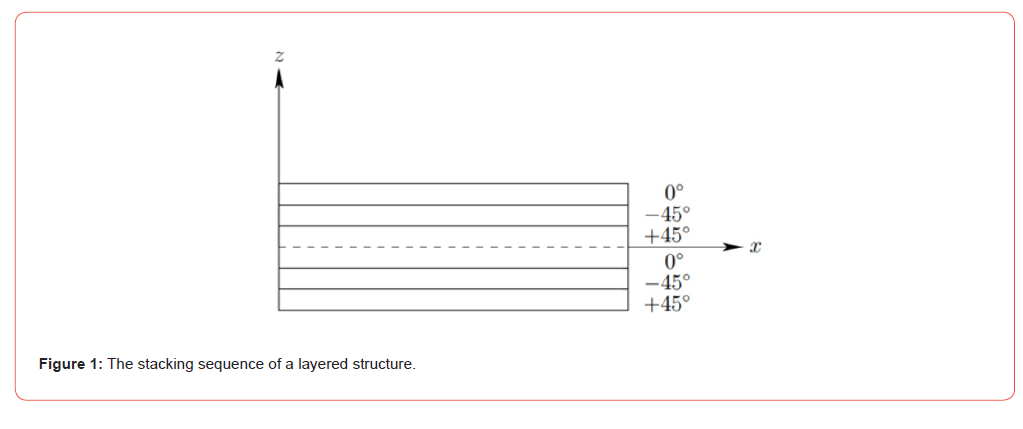
Composites consisting of a layered configuration with a thickness of H comprises a specific quantity, Np, of folds arranged sequentially. Each fold is characterized by its thickness (hk), its orientation (qk), and its material (matk).
There are 2 types of coordinates: global and local coordinate, the global coordinate define by (x,y,z) axes as follow the x axis being oriented along the length of the structure, the y axis along its width and the z axis through its thickness. The local coordinate that refers for each fold is defined by specific axes oriented parallel and perpendicular to the direction of the fibers.
It is essential to understand the arrangement of the folds in the aim of effectively characterize and defining a layered structure. This involves determining both the orientation of each fold and the specific order in which they are stacked. For instance, when examining layered structures with folds of uniform thickness and composed of identical materials, the stacking sequence becomes crucial. In the illustrated example in Figure 1, the stacking sequence for the laminate is denoted as [+45, −45, 0, +45,−45.0]T.
This sequence provides information about the angular orientation of each fold and the overall order in which they are arranged within the structure.
The subscript T outside the square brackets means that the sequence is fully defined.
Lamination theory
CLT or classical lamination theory provides a simplified set of equations to analyze the behavior of laminated composite materials [2]. in the general case of an anisotropic body, Hooke’s law can be written in the following form:

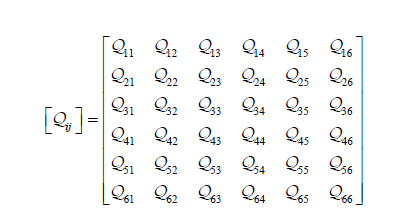
Where Q matrix contains the material properties, this matrix has 36 components for a generic material to fully define the material as shown in equation 2:
Composite laminates are considered thin, allowing the neglect of out-of-plane deformation [3].
This analysis can be simplified as a simple strain problem represented by equation:
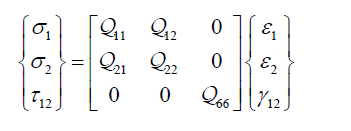
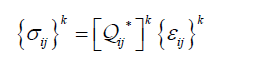
Thus, the number of independent constants necessary for the complete determination of the stiffness matrix in a plane stress state is reduced to four. When rotating the coordinate system by an angle θ, the law holds for each layer k as follows:
Objective Function
Achieving optimal tensile strength in composite layers involves a systematic approach towards formulating and maximizing an objective function that encapsulates the desired mechanical attributes of the material. Tensile strength, a fundamental property, is intricately linked to characteristics such as the material’s inherent strength and stiffness. The proposed objective function is articulated as follows:
Let Fobj symbolize the objective function to be maximized, Rt the targeted tensile strength, σult the ultimate stress, E the modulus of elasticity, and ρ the material density. The objective function takes the form:
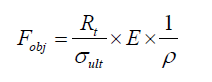
This function amalgamates key factors including tensile strength (Rt/σult ), stiffness (E),and material lightness (1/ρ ). The overarching goal is to maximize this function, thereby seeking a composite material that not only demonstrates heightened tensile strength but also boasts substantial stiffness and optimal lightness.
It is imperative to recognize that the fine-tuning of specific parameters is contingent upon the intricacies of the composite structure, the chosen materials, application conditions, and other pertinent factors. Additionally, the inclusion of supplementary constraints, such as considerations for manufacturing costs and process limitations, becomes crucial when defining the objective function, ensuring that the optimization aligns seamlessly with realistic and practical considerations.
Methodology
The approach illustrated in Figure 2 enables the application of classical lamination theory, consideration of manufacturing process details, examination of external loads subjected to the component of study, and the exploration of viable solutions in the topological design of the component. This approach is as follows: first commencing with the selection of a commercial composite material, considering both its geometric features and mechanical properties and proposing the geometry, a random suggestion of the number of layers, fiber orientation, and stacking sequence is applied.
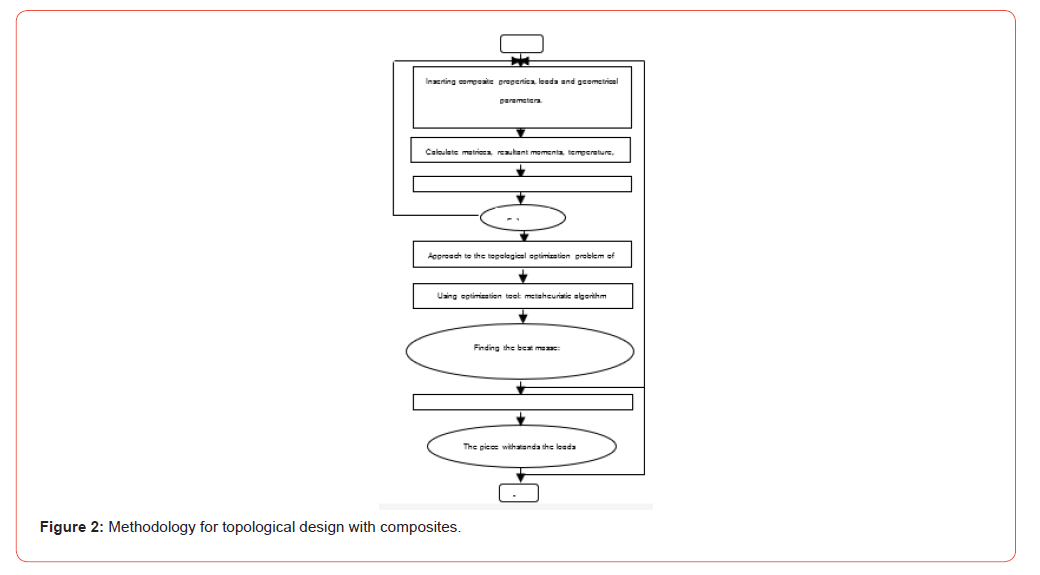
Conducting all necessary calculations based on classical lamination theory and engineering constants, applying an iterative failure criterion until the proposal proves resilient.
The optimization of the proposal through a metaheuristic with the aim of minimizing the piece’s mass in accordance with design constraints and requirements. the finite element analysis enables to validate the obtained topological design to ensure compliance with mechanical requirements. If the design passes this analysis, it is deemed feasible for manufacturing.
It’s important to note that, while the finite element analysis serves to confirm the design, during the calculations using classical lamination theory, the deformations anticipated for the piece under external loads are already taken into account. Therefore, the design is anticipated to withstand the external loads without failure.
Thus, the metaheuristic optimization could lead using different algorithm such as the genetic algorithm (GA) in this algorithm, a population of potential composite configurations is generated, with each configuration represented as a set of parameters such as layer orientation, material type, and thickness. These configurations undergo evolutionary processes, including selection, crossover, and mutation, mimicking the principles of natural selection.
Conclusion
this paper delves into the intricate realm of composite materials, emphasizing their distinctive composition of matrix and reinforcement elements. Unlike traditional materials, composites exhibit non-uniform deformation characteristics, introducing complexity into the optimization of their topological design for specific applications.
The presented methodology focuses on treating composite design challenges as optimization problems, incorporating classical lamination theory and metaheuristic techniques. The stacking sequence of layers plays a pivotal role, showcasing the importance of careful orientation and arrangement. Classical lamination theory and its application in finite element analysis contribute to the thorough exploration and validation of proposed designs.
The utilization of metaheuristic optimization, exemplified by genetic algorithms, further enhances the search for optimal configurations, aligning with design constraints and requirements. This integrated approach holds promise for advancing the field of composite materials and optimizing their mechanical performance for diverse engineering applications.
References
- Ouchte, M Ait El Fqih, J Chafiq, R MatadiBoumbimba, A Mikdam, et al. (2021) Effect of thermal treatment on mechanical properties of sustainable composite: Experimental and simulation study. Composites Theory and Practice pp. 102- 106.
- Arthur E Krupnin, Arthur R Zakirov, Nikita G Sedush, Mark M Alexanyan, Alexander G Aganesov, et al. (2023) Theoretical and Experimental Investigation of 3D-Printed Polylactide Laminate Composites’ Mechanical Properties. Materials 16(22): 7229.
- Derlis Hernandez-Lara, Ricardo Gustavo Rodríguez-Canizo, Emmanuel Alejandro Merchan-Cruz, Alvaro Marcos Santiago-Miguel, Emmanuel Tonatihu Juarez-Velazquez et al. (2022) Optimal design of a foot prosthesis insole with composite materials applying metaheuristic algorithms. Results in Engineering 13(4): 100322.
-

This work is licensed under a Creative Commons Attribution-NonCommercial 4.0 International License.




