



 Research article
Castor Oil Evaluation as a Protection Coating for Sunken Granite Monuments, Alexandria, Egypt
Received Date:November 28, 2024 Published Date: December 16, 2024
Abstract
Alexandria is characterized by many tourist attractions such as Qaitbay Citadel, the Library of Alexandria, the Mast Pillar, the Kom El Shoqafa Tombs, the Roman Theater, the Black Head Temple, in addition to sunken archaeological sites... etc., which leads to the activation of tourism in the city. In general, the beaches of Alexandria, especially Abu Qir Bay and the Eastern Port area, are full of treasures of sunken antiquities that sank due to natural phenomena 15 centuries ago, especially earthquakes that threw many of Alexandria’s buildings, palaces and castles into the sea. The sunken antiquities in Alexandria are located in eight locations: the Qaitbay area, the Eastern Port, and outside the Eastern Port up to Sidi Bishr Beach, the Abu Qir Bay area, Nelson Island, and the Western Port. It is difficult to recover sunken granite antiquities due to their size and heavy weight, in addition to the fear of the antiquity being destroyed during the recovery process. The study suggests displaying granite artifacts in an underwater museum and conducting experiments on similar artifacts in an environmental simulation process by coating granite with Castor oil, which actually showed that coated artifacts are more resistant to fracture than uncoated ones. This was confirmed by X-ray diffraction analyses and scanning electron microscope examination. It was concluded that Castors were successful in acting as an antimicrobial agent that damages granite, and in repelling water as a hydrophobic agent. Therefore, the study recommends more of the same to protect sunken granite artifacts.
Keywords: Tourist attractions; Sunken ruins; Abu Qir Bay; Nelson Island
Introduction
Background:
The search for sunken antiquities in Egypt began with Prince Omar Toson’s fascination with civilization, sparked by an English pilot’s observation over the waters of Abu Qir Bay. This initial curiosity led to the remarkable discovery of a submerged temple dedicated to the goddess Isis, constructed of red granite and measuring 7.5 meters in length. The temple, along with a marble head of Alexander the Great, has since been relocated to the garden of the Maritime Museum in Alexandria [1-4]. Initially, exploration and retrieval of these artifacts were primarily conducted by diving enthusiasts and fishermen. However, in the past decade, the Supreme Council of Antiquities has taken a more organized role in systematically searching for sunken antiquities. These underwater cultural heritage sites are invaluable, representing significant aspects of humanity’s shared history [5-7]. Unfortunately, these sites face increasing threats from looting and exploitation, exacerbated by advancements in exploration techniques that have made the seabed more accessible. The commercialization of these discoveries has led to a profitable but damaging trade in objects found among wrecks and submerged sites. Marine archaeological sites frequently suffer from looting, resulting in the loss of valuable scientific and cultural materials and, at times, the total destruction of these sites. Recognizing the urgency, there has been a pressing need for a comprehensive legal framework to safeguard underwater cultural heritage for the benefit of all humanity [8-10]. Granite monuments in Alexandria face unique preservation challenges due to the multiplicity and overlapping factors of damage. These challenges include exposure to seawater, which introduces salts that accelerate the deterioration process, and microbiological threats that can erode the stone’s structural integrity. Pollution from urban and industrial activities further exacerbates these issues, leading to a complex web of degradation processes [11-14]. The main problem addressed in this study is the preservation of these granite structures, which requires an integrated approach to both isolation from seawater and protection against microbiological threats without harming the biological environment. Effective preservation strategies must encompass advanced materials that provide a barrier against water infiltration, salts, and biological contaminants while being environmentally friendly and sustainable [15-17]. The successful preservation of granite monuments hinges on developing and implementing these multifaceted strategies. By isolating the monuments from seawater and mitigating the impact of microbiological activity, it is possible to protect these structures from further decay. This comprehensive approach ensures that the rich cultural and historical heritage embodied in these monuments can be preserved for future generations, maintaining their educational, cultural, and scientific value [18-21]. Exploring these integrated preservation strategies not only helps protect our shared cultural heritage but also contributes to the advancement of conservation science. By leveraging modern technologies and innovative materials, we can develop sustainable solutions that address the unique challenges faced by submerged artifacts, ensuring their protection and continuity for years to come [22-24].
Topic importance:
The importance of the study lies in the attempt to find new and effective methods for preserving sunken granite artifacts in seawater and preventing their exposure to various environmental deterioration factors.
Study Hypotheses:
Based on previous studies, castor oil is a broad-spectrum antimicrobial agent that can combat biological damage to granite. Additionally, its water resistance will resist other damage caused by seawater.
Study Questions:
The study seeks to answer a crucial question: Could the use of castor oil serve as an effective way to protect sunken granite artifacts from various deterioration agents found in seawater?
What is the insulating capacity of castor oil for granite?
What are the techniques used to protect sunken antiquities?
Study Problem:
Sunken artifacts are exposed to a wide range of harmful factors, including seawater salinity, pollution, temperature fluctuations, and other environmental influences. These elements can lead to severe deterioration, significantly affecting the structural integrity and aesthetic qualities of these precious historic items. The high salinity of seawater can corrode materials, while pollutants can introduce harmful chemicals that speed up deterioration.
Study Objectives:
The study aims to apply the integrated approach to protect submerged granite monuments, using sustainable and environmentally friendly natural materials, which is available in the ability of castor oil, as a material that resists biological damage factors as an antimicrobial that damages granite, and also as a water-repellent material that protects granite from seawater and its salinity that damages the stone.
Literature Review:
The preservation of sunken granite artifacts in Alexandria has garnered significant attention recently, particularly as researchers strive to develop innovative methods to safeguard these invaluable cultural resources from the harsh marine environments. Numerous studies have delved into the factors contributing to the degradation of submerged granite artifacts, emphasizing the critical role of environmental conditions like salinity, temperature fluctuations, and biological growth [25,26]. Salinity accelerates chemical weathering, leading to the dissolution and recrystallization of minerals that weaken the granite. Temperature fluctuations cause expansion and contraction cycles, promoting the development of microcracks2. Biological growth, including bacteria and fungi, further exacerbates the deterioration through biochemical processes [27,28]. For instance, a study by the Rathjen Research Laboratory in Berlin investigated the decay of granite monuments under seawater, revealing that the granite artifacts suffered from severe physical and chemical alterations in their rock-forming minerals. The researchers identified twenty-four new formation minerals as alteration products in the studied samples from the artifacts [29,30]. Castor oil, derived from the seeds of the Ricinus communis plant, has been recognized for its antibacterial and antifungal properties. The primary component, ricinoleic acid, is known to inhibit the growth and replication of various bacterial and fungal colonies. This makes castor oil a potential natural preservative for granite artifacts exposed to marine environments. Studies have shown that castor oil can be used as a water repellent for granite, helping to protect the stone from moisture-induced damage. By creating a hydrophobic layer on the surface of the granite, castor oil reduces water absorption, which in turn minimizes the risk of freeze-thaw cycles and chemical weathering [31-34]. Additionally, the International Committee on the Underwater Cultural Heritage (ICUCH) and the 2001 UNESCO Convention highlight the importance of protecting underwater cultural heritage, which includes stone artifacts like granite that have been submerged for at least a hundred years [35]. Efforts to preserve these artifacts include the use of new materials and technologies to tackle the challenges posed by the underwater environment. For example, Alexandria University has launched a project to excavate and preserve underwater artifacts, aiming to revive tourism and protect Egypt’s underwater heritage [36,37].
Sampling
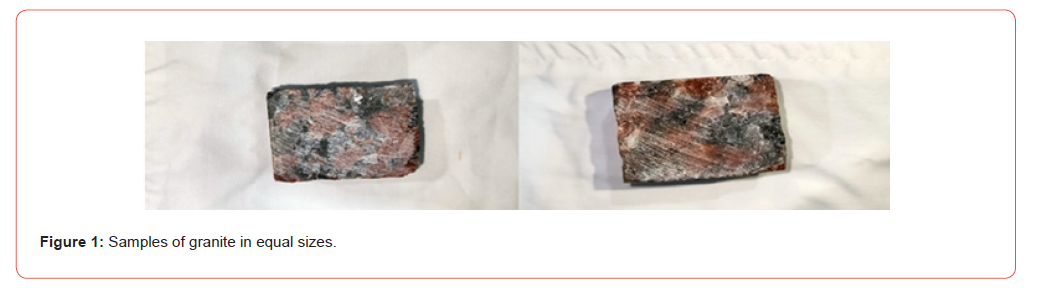
Two pieces of red granite were placed, then one of the two pieces was painted with castor oil and placed in sea water from the Abu Qir area, and the other piece was placed in the same sea water without the oil coating to compare the two pieces after leaving the water.
Methods
A series of procedures were conducted, including a comparison of the weights of the coated and uncoated samples, an assessment of the fracture load test results, as well as analyses using scanning electron microscopy and X-ray diffraction.
Table 1:Specifications of the tested samples.

Testing of mechanical processes (Uniaxial Compression Test):
The fracture load test was conducted in the laboratories of the Faculty of Engineering, Cairo University. This test aims to evaluate the consistency of granite when immersed in water and evaluate the effectiveness of coating with castor oil in protecting granite from various damage factors in seawater. The study focuses on the oil’s ability to enhance the stone’s durability against deterioration. Details of the specifications of the samples tested are given in the table.
Scanning Electron Microscope:
To evaluate the extent of damage and deterioration in stone samples not coated with castor oil, compared to the extent of resilience of those coated with castor oil, an examination was performed using a scanning electron microscope in Cairo University laboratories. This analysis aims to compare the effects of castor oil treatment on the structural integrity of the stone, providing valuable insights into its protective capabilities.
X-ray diffraction:
The examination took place at the laboratories of Cairo University. Typically, the results obtained from X-ray diffraction analysis facilitate comparisons between the damaged archaeological samples and those that have been treated. This comparison reinforces the hypothesis regarding salt damage in the untreated samples when contrasted with the treated ones.
Results
Fracture Load Test:
Table 2 illustrates a significant difference in the fracture load test results between the coated and uncoated specimens, measured in kilonewtons and kilograms.
Table 2:Shows the results of the fracture load test for the samples.

X-Ray Differaction:
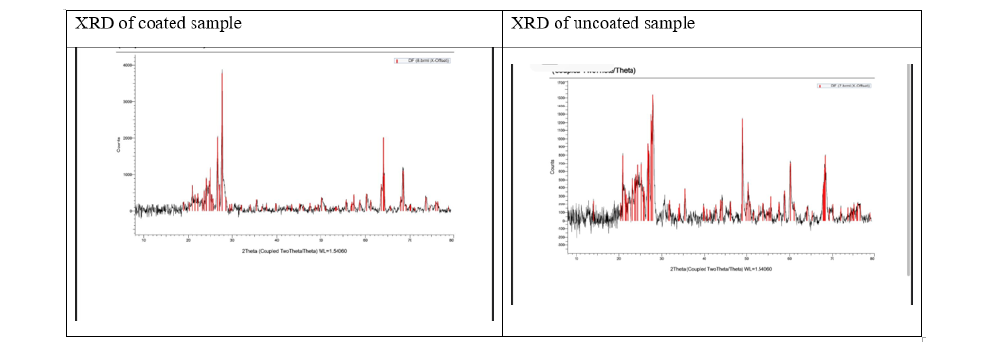
The comparative XRD analysis demonstrates significant differences between the deteriorated and oil-treated granite samples. The deteriorated sample shows clear evidence of weathering through peak modifications, secondary mineral formation, and reduced crystallinity. In contrast, the oil-treated sample exhibits better preservation of original mineralogy, reduced weathering effects, and maintained structural integrity, indicating the effectiveness of oil treatment as a protective measure against sea water deterioration. The results suggest that oil treatment creates an effective barrier against water penetration and ion exchange, thereby preventing the initiation and progression of weathering processes. This has important implications for the conservation of granite structures in marine environments, where sea water exposure poses a significant threat to stone durability.
Table 3:report of X ray diffraction of uncoated samples and coated samples of ma.
Scanning Electron Microscope:
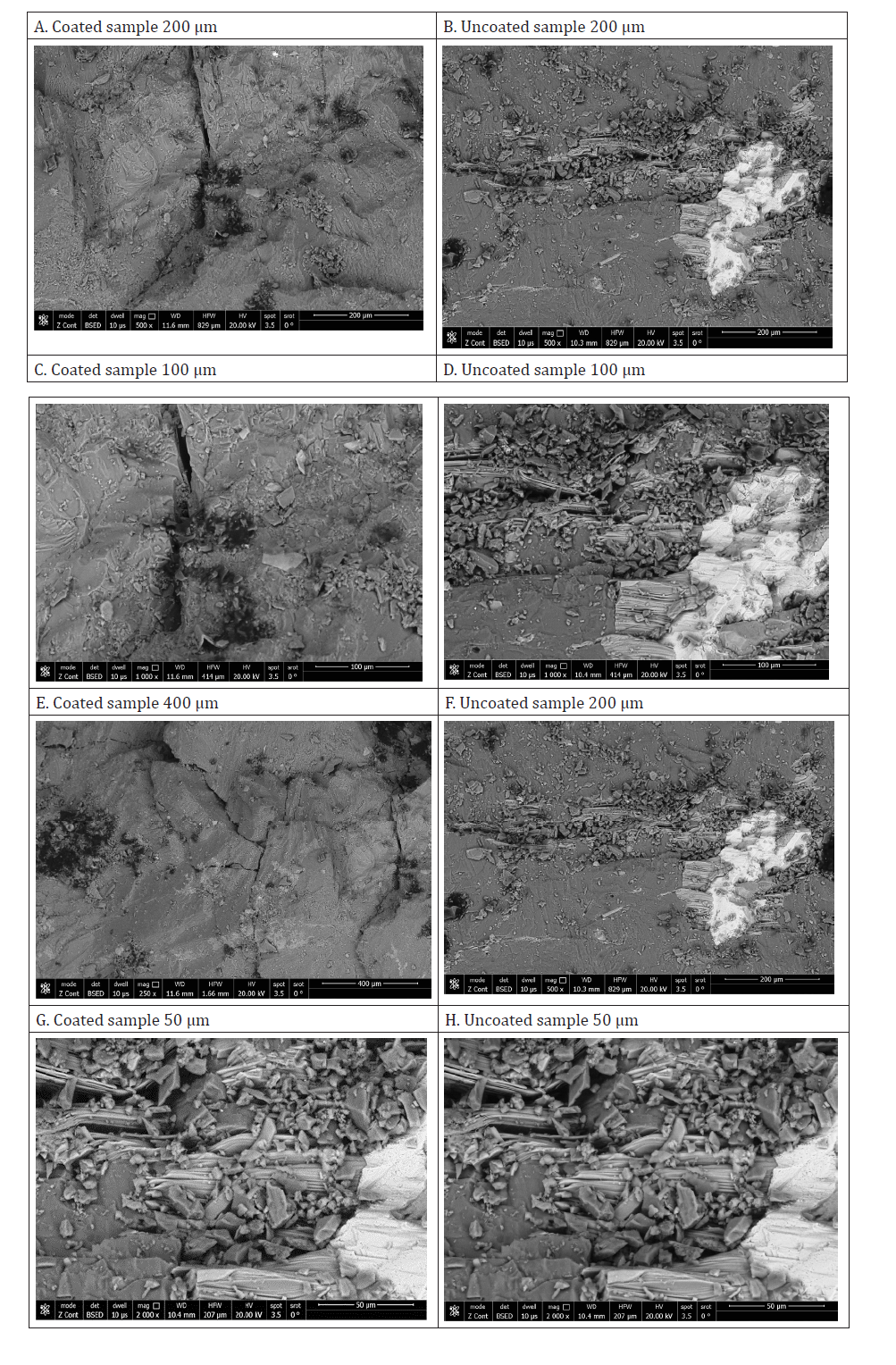
Table 3 presents a comparison of granite samples treated with peppermint oil (A at 200μm, C at 400μm, E at 500μm, and G at 50μm) against those without the oil (B at 200μm, D at 100μm, F at 200μm, and H at 50μm). The observations indicate that the coated samples displayed cohesive particle interactions, whereas the uncoated samples exhibited disintegration along with the presence of large pores and gaps.
Table 4:Scanning electron microscope images of coated and uncoated samples of varying scales.
Discussion
The results of various tests have demonstrated the remarkable ability of castoroil to protect granite artifacts from the deterioration factors present in seawater. The most significant results were observed in the fracture load test, where the granite sample coated with castor oil required approximately 40% greater fracture load compared to the uncoated sample. This substantial increase in required load suggests that castor oil is highly effective in enhancing the structural integrity of sunken granite artifacts, providing robust protection against deterioration factors such as seawater salinity, fungi, and other destructive biological agents.
Conclusion
The study successfully demonstrated the effectiveness of castor oil as a protective coating for sunken granite artifacts against various deterioration factors present in seawater, such as salinity, fungi, and destructive biological agents. The fracture load tests revealed a significant increase in the strength of the granite samples coated with castor oil, while the uncoated samples showed substantial degradation. Scanning electron microscope examinations confirmed the reduced damage in the oil-coated samples, further substantiating the protective role of castor oil. X-ray diffraction analysis highlighted the absence of salt deposits on the treated samples, reinforcing the oil’s ability to prevent salt crystallization. These findings validate the hypothesis that castor oil can serve as a viable, natural preservative for submerged granite artifacts. The study not only highlights the practical application of castor oil in preserving cultural heritage but also paves the way for future research into other eco-friendly preservation methods. This innovative approach ensures the longevity and integrity of underwater artifacts, contributing significantly to the field of marine archaeology and conservation science. By demonstrating the dual benefits of antimicrobial and hydrophobic properties, the research sets a new standard for sustainable and effective preservation techniques, safeguarding these invaluable treasures for future generations.
Recommendation
Following the positive results obtained from the practical application of protecting sunken granite artifacts in seawater by using castor oil as a coating, this success encourages further research to explore the application of similar protective techniques in the submerged archaeological sites of Alexandria, particularly in the Abu Qir area. Long-term studies are recommended to assess the durability of castor oil in various marine environments, as well as comparative analyses with other natural oils to identify the most effective preservation methods. Implementing field trials across different coastal locations can provide valuable insights into its adaptability under varying salinity and temperature conditions. Additionally, integrating castor oil with other conservation techniques may enhance its protective effects. Raising public awareness and educating conservation professionals about the benefits of natural oils in marine archaeology will also be essential for promoting sustainable preservation practices.
Acknowledgment
This research received no external funding.
Conflict of Interest
The authors declare no conflict of interest.
References
- Klemm D D, Klemm R (2001) The building stones of ancient Egypt–a gift of its geology. Journal of African Earth Sciences 33(3-4): 631-642.
- Botros N S (2015) The role of the granite emplacement and structural setting on the genesis of gold mineralization in Egypt. Ore Geology Reviews 70(1): 173-187.
- AbdelMaksoud K M, Emam M A (2019) Hidden geology in ancient Egypt. Geoheritage 11(3): 897-907.
- Harrell J A, Storemyr P (2009) Ancient Egyptian quarries—an illustrated overview. Geological Survey of Norway Special Publication 12(1): 7-50.
- Radwan W (2021) Mystery of sunken antiquities and its effect in promoting tourism in Egypt: Case study alexandria governorate 21(3): 80-100.
- Dwidar S I, Abdelsattar (2019) The Touristic Development of the Archaeological and Heritage Areas in Alexandria City, Egypt. International Journal of Social and Business Sciences 13(2): 244-254.
- El-Sharkawy M, El-Gammal S, Torab M (2024) Karst Archaeology of Taposiris Magna Area, West of Alexandria City, Egypt. 2024(63):539-564.
- Temiño I R Valdés A R (2015) Fighting against the archaeological looting and the illicit trade of antiquities in Spain. International Journal of Cultural Property 22(1): 111-130.
- Erlandson J M (2012) As the world warms: rising seas, coastal archaeology, and the erosion of maritime history. Journal of Coastal Conservation 16(1): 137-142.
- Strati A (2021) The protection of the underwater cultural heritage: an emerging objective of the contemporary law of the sea (23).
- Akarish A I, Shoeib A S, Nageh A, Dessandier D (2012) Mechanism and forms of deterioration recoded from the granitic monumental objects of Alexandria lighthouse, Alexandria, Egypt.
- Majcherek G (2019) Alexandria Kom el‑ Excavations and preservation work in the 2018 season. Polish Archaeology in the Mediterranean 28(2): 21-42.
- Gelany A F, Falana J N, Shiba A S (2020) The Study of Application of Nano Fluid Synthases in the Treatment of Structural Disintegration of Hatshepsut Limestone Temple in Deir El-Bahari 12(04): 5126-5136.
- Abdellah M Y, Gelany A F, Mohamed A F, Khoshaim A B (2017) Protection of limestone coated with different polymeric materials 5(2): 51-57.
- Sonia P, Sravanthi G, Khan I, Pahwa S, Salman Z N, et al (2023) Sustainable Utilization of Natural Stone Resources: Environmental Impacts and Preservation of Cultural Heritage 430(3): 1-10.
- Gomes M L P M, Carvalho E A S, Barreto G N S, Rodriguez R J S, Monteiro S N, et al (2022) Development of sustainable artificial stone using granite waste and biodegradable polyurethane from castor oil. Sustainability 14(11): 6380.
- Levytskyi V G, Tolkach O M (2017) Research of environmentally-friendly utilization methods of the crushed stone waste on granite quarries 2(80): 173-180.
- Geweely N S (2023) New frontiers review of some recent conservation techniques of organic and inorganic archaeological artefacts against microbial deterioration. Frontiers in Microbiology 16(14): 1146582.
- Potysz A, Bartz W (2024) Long-term (bio) deterioration of Fe-containing and Fe-depleted sandstones: An experimental insight into biotic and abiotic interactions. Construction and Building Materials 421: 135700.
- Vlasov D Y, Panova E G, Zelenskaya M S, Vlasov A D, Sazanova K V et al (2020) Biofilms on granite Rapakivi in natural outcrops and urban environment: Biodiversity, metabolism and interaction with substrate. In Processes and Phenomena on the Boundary Between Biogenic and Abiogenic Nature pp. 535-559.
- Pląskowska E, Patejuk K, Lorenc M W, Grzeszczuk J (2024) Lichens and Fungi on Sandstone Tombs at the Historical Jewish Cemetery in Wrocław (Poland). Studies in Conservation 69(1): 58-66.
- Hernandez A C, Sanjurjo-Sánchez J, Alve, C, Figueiredo C A (2024) Study of the Geochemical Decay and Environmental Causes of Granite Stone Surfaces in the Built Heritage of Barbanza Peninsula (Galicia, NW Spain). Coatings 14(2): 169.
- Hernández A C, Sanjurjo-Sánchez J, Alves C, Figueiredo C A (2023) Comparative Study of Deterioration in Built Heritage in a Coastal Area: Barbanza Peninsula (Galicia, NW Spain). Geosciences 13(12): 375.
- Vázquez-Nion D, Troiano F, Sanmartín P, Valagussa C, Cappitelli F, et al (2018) Secondary bioreceptivity of granite: effect of salt weathering on subaerial biofilm growth. Materials and Structures 51(6): 1-13.
- Abuelfadl Othman S (2019) Sunken Cities: Underwater Culture Heritage of Alexandria at Abukir Bay. International Journal of Multidisciplinary Studies in Architecture and Cultural Heritage 3(2): 95-105.
- Abd Elsalam A M Aboul Fotouh M E (2023) The Impact of Climate Changes on the Sustainability of Tourism Activity and Archeological Sites Applied to the City of Alexandria. Journal of Association of Arab Universities for Tourism and Hospitality 24(2): 276-301.
- Chen X, Bai F, Huang J, Lu Y, Wu Y, et al (2021) The organisms on rock cultural heritages: growth and weathering. Geoheritage, 13(3), 56.
- Geweely N S, (2023) New frontiers review of some recent conservation techniques of organic and inorganic archaeological artefacts against microbial deterioration. Frontiers in Microbiology 16(14): 1146582.
- Mansour A, Martizzi P, Ahmed M S, Chiyonobu S, Gentzis T (2024) Weathering Intensity, Paleoclimatic, and Progressive Expansion of Bottom-Water Anoxia in the Middle Jurassic Khatatba Formation, Southern Tethys: Geochemical Perspectives. Minerals 14(3): 281.
- Mahanta B, Ranjith P G, Vishal V, Singh T N (2020) Temperature-induced deformational responses and microstructural alteration of sandstone. Journal of Petroleum Science and Engineering (192): 107239.
- Geweely N S (2022) A novel comparative review between chemical, natural essential oils and physical (ozone) conservation of archaeological objects against microbial deterioration. Geomicrobiology Journal 39(6): 531-540.
- Geweely N S (2023) New frontiers review of some recent conservation techniques of organic and inorganic archaeological artefacts against microbial deterioration. Frontiers in Microbiology 16(14), 1146582.
- Wang H V, Pickett L J, Faraone N (2022) Repellent and acaricidal activities of basil (Ocimum basilicum) essential oils and rock dust against Ixodes scapularis and Dermacentor variabilis ticks. Experimental and Applied Acarology 86(4): 583-598.
- Alam M, Ahmed M, Altaf M, Husain F M (2022) Rapeseed oil-based hippurate amide nanocomposite coating material for anticorrosive and antibacterial applications. Open Chemistry 20(1): 725-735.
- Maarleveld T J (2018) International Committee on the Underwater Cultural Heritage (ICUCH).
- Motawea Hussein SHAIKHON A (2019) Managing underwater heritage in Egypt. International Journal of Advanced Studies in World Archaeology 2(1): 1-13.
- Naguib Mostafa S M (2023) Impact of Egyptian Cultural Policy on Cultural Heritage Sustainability: A Case Study Red Sea (Marsa Alam). International Journal for Tourism, Archeology & Hospitality (IJTAH) 3(2): 290-306.
-

This work is licensed under a Creative Commons Attribution-NonCommercial 4.0 International License.




