




 Review article
Beyond Self-Healing: Toward Autonomous and Adaptive Materials
Received Date:August 13, 2026 Published Date: August 26, 2026
Abstract
Self-healing materials have transformed the traditional concept of material durability by introducing the ability to partially recover functionality following damage. However, the rapid development of responsive and intelligent material systems suggests that self-healing should no longer be regarded as the final stage of material autonomy. A truly autonomous material should be capable not only of repairing damage, but also of sensing changes in its environment, interpreting relevant stimuli, activating an appropriate response, and adapting its properties according to changing conditions. This perspective argues that the future of advanced materials lies in the transition from passive self-repair toward integrated autonomous behavior. Such systems may combine damage sensing, dynamic molecular interactions, reversible structural transformations, selfhealing mechanisms, embedded sensing elements, and eventually computational or biological components. The emerging concept of adaptive materials therefore represents a shift from designing materials with predefined properties toward designing materials capable of changing their behavior during operation. This transition may redefine the role of materials science in applications ranging from infrastructure and aerospace to healthcare, soft robotics, energy systems, and wearable technologies.
Keywords: Self-healing materials; Adaptive materials; Smart materials; Autonomous materials; Responsive materials; Material intelligence; Selfrepair
Introduction: Is Self-Healing Enough?
For most of the history of materials science, durability has been understood primarily as the ability of a material to resist degradation. The ideal material was therefore one that remained as unchanged as possible during operation. Cracking, fatigue, corrosion, wear, thermal degradation, or other forms of damage were treated as failures that had to be prevented or repaired externally. Self-healing materials challenged this paradigm. Instead of simply resisting damage, these materials were designed to recover at least part of their original functionality after damage occurred. Depending on the system, healing may result from intrinsic reversible interactions, dynamic chemical bonds, phase transitions, microencapsulated healing agents, vascular networks, or biological processes [1- 3]. This represented a fundamental conceptual shift: damage was no longer necessarily the end point of material functionality.
However, an important question remains: does a material that can repair itself truly qualify as autonomous? In our view, the answer is not necessarily. Self-healing is an important property, but it represents only one component of a much broader concept of material autonomy. A material that detects a crack and initiates repair is more advanced than a conventional passive material. Yet a material capable of continuously monitoring its structural state, distinguishing between different types of damage, modifying its properties before catastrophic failure, and adapting its response to environmental conditions would represent a substantially higher level of functionality. This distinction may become increasingly important as materials are expected to operate for longer periods under variable and unpredictable conditions. The challenge for the next generation of materials science is therefore not simply to develop better self-healing materials, but to move beyond self-healing toward autonomous and adaptive material systems.
From Passive Materials to Autonomous Systems
The development of advanced materials can be viewed as a gradual transition from passive behavior toward active and adaptive functionality. Traditional materials are primarily characterized by relatively stable properties such as strength, stiffness, conductivity, thermal resistance, or chemical stability. Smart materials introduced the ability to respond to external stimuli such as temperature, light, electric fields, magnetic fields, pH, or mechanical stress [4]. Self-healing materials added another important capability: recovery following damage [1,2].
The next step should be the integration of these functions.
An adaptive material should not merely respond to a stimulus in a predetermined manner. Ideally, its response should depend on the current state of the material and the surrounding environment. In other words, the material should be capable of modifying its behavior according to changing circumstances. This conceptual progression is illustrated in Figure 1, which places self-healing within a broader evolutionary framework leading toward adaptive, autonomous, and potentially learning materials. Here, we propose this progression as a conceptual continuum rather than a rigid classification, ranging from passive materials to potentially learning materials.
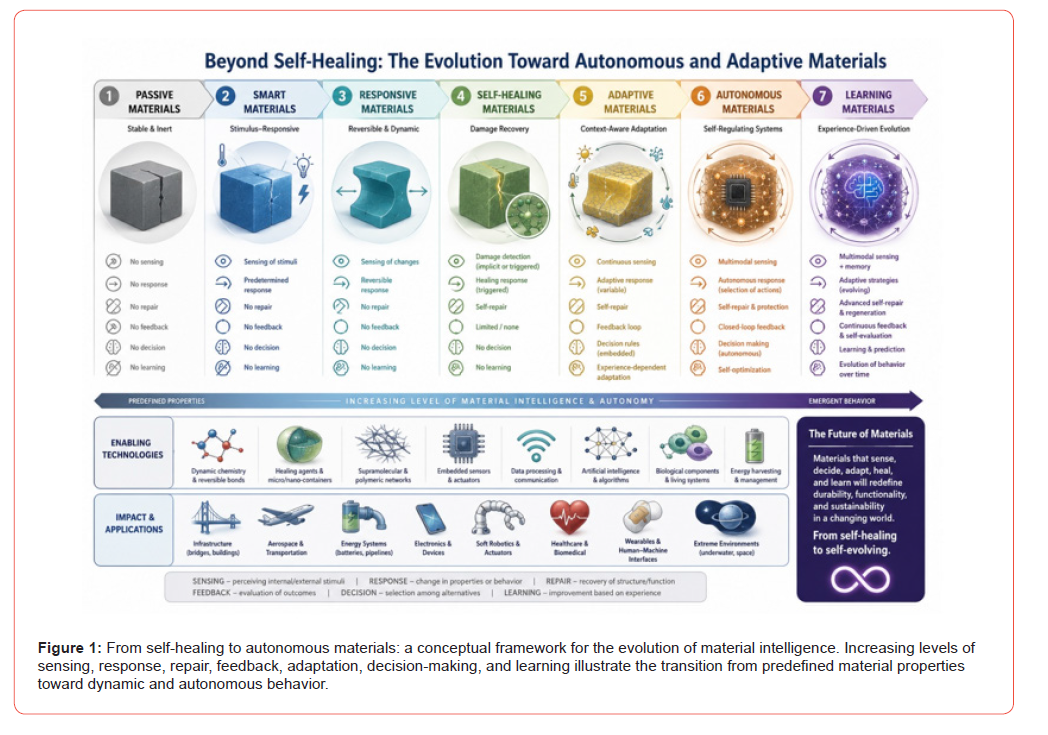
The transition between these categories is not absolute, and many existing materials occupy intermediate positions. Nevertheless, the sequence illustrates an important change in design philosophy. The traditional question in materials science has been: “What properties should this material have?”. The emerging question may instead become: “How should this material behave when its environment changes?”. This represents a shift from designing static properties toward designing dynamic behavior.
Self-Healing as the Beginning, Not the End Point
The current generation of self-healing materials demonstrates that materials can recover functionality after damage. However, several limitations prevent most existing systems from being considered fully autonomous. First, many self-healing mechanisms require a specific trigger. Healing may occur only within a restricted range of temperature, humidity, pH, mechanical deformation, or other environmental conditions. Second, healing capacity is often finite. Extrinsic systems based on encapsulated healing agents, for example, may have limited healing cycles. Third, the material generally does not determine whether healing is necessary or whether the selected healing mechanism is optimal [2,5,6]. These limitations reveal an important conceptual distinction between autonomous healing and autonomous behavior. A material can autonomously heal a crack without being capable of autonomous decision- making. This distinction should not diminish the importance of self-healing research. On the contrary, self-healing provides one of the essential building blocks for future autonomous materials. The challenge is to combine healing with sensing, feedback, adaptation, and potentially learning [7]. A future material could therefore contain several interconnected functions (Figure 2):
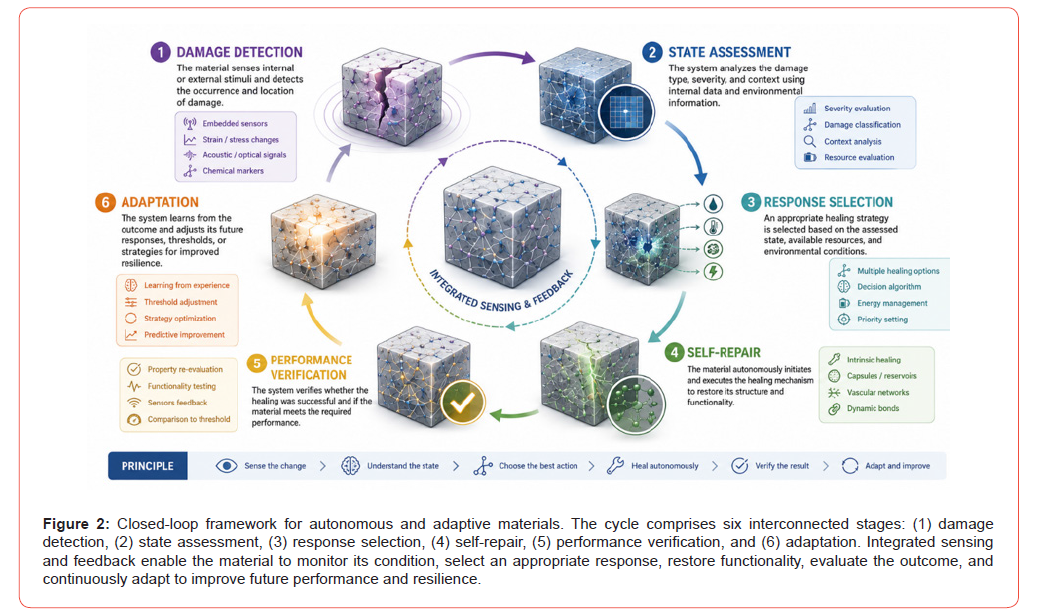
Such a system would be fundamentally different from a material that simply contains a healing agent.
Toward Materials with Internal Feedback
One of the defining characteristics of autonomous systems is feedback. Biological organisms provide perhaps the most sophisticated example. A biological system continuously senses its environment, processes information, modifies its behavior, repairs damage, and reallocates resources according to changing demands. Materials science has traditionally separated these functions. Sensors are manufactured as separate devices, actuators as separate components, and structural materials as passive substrates. The opportunity now exists to integrate these functions. For example, a structural composite could incorporate sensing elements capable of detecting changes in strain or crack formation [8,9]. The information could trigger a local change in material properties or initiate a healing process. Similarly, an adaptive coating could detect changes in the surrounding chemical environment and alter its permeability or protective properties. This suggests that future materials may increasingly resemble integrated systems rather than homogeneous substances. The distinction between a material and a device may consequently become less clear.
Adaptation Is More Than Repair
An important feature of autonomous materials should be the ability to respond not only to damage but also to environmental variability. Consider a material exposed to repeated cycles of temperature, humidity, mechanical stress, radiation, or chemical exposure. A conventional material is expected to maintain its properties despite these changes. A responsive material changes its behavior in response to the stimulus [4]. An adaptive material would go one step further by modifying its functional state according to the history and intensity of environmental exposure [10,11]. For example, an adaptive material could become more flexible under mechanical stress, more resistant under damaging conditions, more permeable when transport is required, or more protective when environmental conditions become hazardous. Such behavior introduces a new design objective: the material should optimize its function continuously rather than simply maintain a predefined state.
This principle may be particularly valuable in applications where environmental conditions cannot be predicted accurately. Such continuous adaptation, however, requires increasingly sophisticated mechanisms for sensing, information processing, and decision-making. Artificial intelligence could provide one pathway toward such computational functionality.
The Role of Artificial Intelligence
The integration of artificial intelligence could further expand the concept of autonomous materials. AI is already increasingly used to predict material properties, optimize compositions, and accelerate materials discovery [12,13]. A more ambitious direction would be to use computational intelligence as part of the operational material system itself. In such a scenario, sensors could continuously collect information about material performance. An algorithm could identify patterns associated with degradation, predict failure, and determine whether a change in material state or a healing response is required. The resulting architecture could be represented as (Figure 3) [10,12,13]:
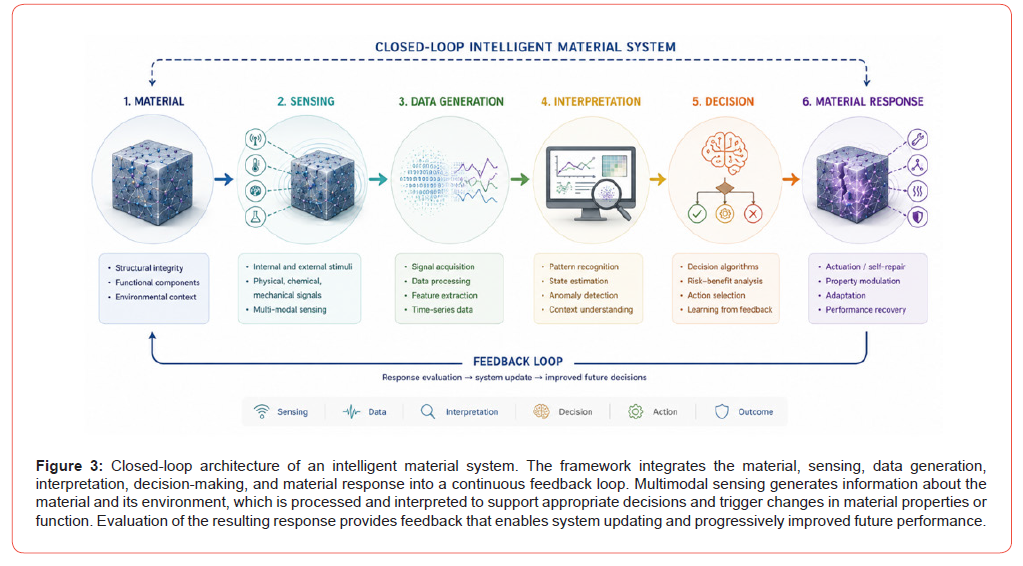
This does not necessarily mean embedding conventional computers inside materials. Instead, computational functionality could become distributed across the material system through responsive molecular networks, embedded electronics, neuromorphic components, or other forms of material-based information processing. Such developments could ultimately lead to materials that do not merely respond to stimuli but select among multiple possible responses. This would represent a significant conceptual step toward material autonomy.
Biological Inspiration and Living Components
Biological systems provide another important source of inspiration for autonomous materials. Living organisms combine sensing, adaptation, repair, energy management, and information processing within highly integrated systems. Recent advances in biohybrid and engineered living materials suggest that some biological functions can increasingly be incorporated into material platforms [14]. The attraction of biological components lies not only in their ability to perform specific biochemical functions, but also in their capacity for adaptation, regeneration, and complex responses to environmental signals. This raises an intriguing possibility: future autonomous materials may not be entirely synthetic. Instead, materials could combine synthetic matrices with biological components, engineered microorganisms, cells, enzymes, or biomolecular networks to create systems capable of sensing and responding to environmental changes [15]. Such systems would challenge the traditional boundary between material and living system. Nevertheless, biological integration also introduces major challenges, including stability, containment, reproducibility, long-term functionality, ethical considerations, and manufacturing scalability. Therefore, living materials should be regarded as one possible pathway toward autonomy rather than a universal solution [16].
The Major Challenge: Defining Material Autonomy
As the field develops, terminology will become increasingly important. Figure 1 illustrates this progression by distinguishing materials according to their increasing capacity for sensing, response, repair, feedback, decision-making, and learning. To improve conceptual clarity, we propose a functional hierarchy consisting of six progressive levels of material intelligence (Figure 1). This can make it difficult to determine how advanced a particular material system actually is.
We propose a six-level conceptual framework for describing increasing levels of functional autonomy in advanced materials. In this framework, ‘smart materials’ is treated as an umbrella concept rather than a separate functional level, whereas the six levels describe progressively increasing material autonomy. The following hierarchy is proposed here as a conceptual framework rather than as an established classification.
Level 1 – Passive: stable predefined properties.
Level 2 – Responsive: changes properties following an external
stimulus.
Level 3 – Self-healing: recovers part of its functionality following
damage.
Level 4 – Adaptive: modifies its response according to environmental
conditions or material state.
Level 5 – Autonomous: integrates sensing, decision-making, response,
and feedback with minimal external intervention.
Level 6 – Learning materials: systems capable of modifying future
responses based on previous states, accumulated information,
or environmental history.
Recent work on learning metamaterials demonstrates that physical material systems can acquire and modify responses through experience, suggesting that learning may represent a plausible extension of adaptive material behavior rather than merely a metaphor borrowed from artificial intelligence [17-19]. This hierarchy should not be interpreted as a rigid classification system. Rather, it may help researchers communicate more precisely about what their materials can actually do. In particular, the term “autonomous” should be used cautiously. A material that requires an externally imposed trigger or periodic human intervention may be self-healing or responsive, but it should not necessarily be considered fully autonomous.
From Materials with Properties to Materials with Behavior
The most important change may therefore be conceptual rather than technological. Materials science has traditionally focused on establishing relationships between composition, structure, processing, and properties [12]. This framework remains fundamental. However, increasingly complex material systems require an additional dimension: behavior over time. Future material design may therefore need to consider not only:
composition → structure → properties
but also:
environment → sensing → response → adaptation → recovery
This perspective could stimulate new collaborations between materials science, chemistry, biology, robotics, electronics, artificial intelligence, and systems engineering. The material of the future may consequently be less like a static object and more like a dynamic system.
Outlook
The transition beyond self-healing will not occur simply by developing materials that heal faster or recover a greater percentage of their original properties. The more fundamental objective should be to create materials capable of understanding, at least in a functional sense, their own state and adapting to changing environmental conditions. Such materials may combine several capabilities that have traditionally been developed separately: structural integrity, sensing, actuation, self-repair, environmental responsiveness, information processing, and adaptation. The most promising systems may therefore not belong to a single material class. Instead, they may emerge from the convergence of polymers, composites, nanomaterials, biomaterials, electronics, living systems, and artificial intelligence. This convergence suggests a broader definition of advanced materials. The material of the future should not simply survive its environment. It should respond to it, adapt to it, and, when possible, recover from the challenges it encounters. Self-healing was an important step toward this vision. The next challenge is to move beyond healing toward materials with autonomy, adaptive behavior, and eventually a limited form of material intelligence.
Conclusion
Self-healing materials have changed the traditional perception of material failure by demonstrating that damage does not necessarily have to represent an irreversible loss of function. Nevertheless, self-healing should be considered a foundation rather than the endpoint of intelligent material development. The next generation of advanced materials should integrate sensing, feedback, adaptation, and autonomous responses with self-repair. Artificial intelligence and biological systems may provide additional pathways toward this objective. Although fully autonomous materials remain largely a future concept, the individual technological components required for their development are already emerging across several fields. The central challenge for materials science is therefore shifting from designing materials that possess desirable properties toward designing materials that can change their behavior when circumstances change. This transition—from static properties to dynamic behavior, and from self-healing to autonomy—may represent one of the most important conceptual directions for the future of materials science.
Acknowledgment
None.
Conflict of Interest
None.
References
- S R White, N R Sottos, P H Geubelle, J S Moore, M R Kessler, et al. (2001) Autonomic healing of polymer composites. Nature 409: 794-797.
- M D Hager, P Greil, C Leyens, S van der Zwaag, U S Schubert (2010) Self-Healing Materials. Advanced Materials 22: 5424-5430.
- C J Hansen, W Wu, K S Toohey, N R Sottos, S R White, et al. (2009) Self-Healing Materials with Interpenetrating Microvascular Networks. Advanced Materials 21: 4143-4147.
- M A C Stuart, W T S Huck, J Genzer, M Müller, C Ober, et al. (2010) Emerging applications of stimuli-responsive polymer materials. Nature Materials 9(2): 101-113.
- C J Hansen, S R White, N R Sottos, J A Lewis (2011) Accelerated Self-Healing Via Ternary Interpenetrating Microvascular Networks. Advanced Functional Materials 21: 4320-4326.
- E L Kirkby, J D Rule, V J Michaud, N R Sottos, S R White, et al. (2008) Embedded Shape-Memory Alloy Wires for Improved Performance of Self-Healing Polymers. Advanced Functional Materials 18: 2253-2260.
- S A Hayes, T J Swait, A D Lafferty (2015) Self-sensing and self-healing in composites. In: Recent advances in smart self-healing polymers and composites. Woodhead Publishing pp. 243-261.
- Z Bekzhanova S A Memon J R Kim (2021) Self-Sensing Cementitious Composites: Review and Perspective. Nanomaterials 11(9): 2355.
- Q Wang, Z Su, L Zhou (2026) A review on self-sensing fiber-reinforced polymer composites: Mechanisms, fabrications, and applications. Measurement 271: 120985.
- R R Silva, G Fatti, E Carlos, G Ferreira, S Goswami, et al. (2026) Functional materials for environmental energy harvesting in smart agriculture via triboelectric nanogenerators. Advanced Functional Materials 36(13): e13924.
- V A Baulin, A Giacometti, D A Fedosov, S Ebbens, N R Varela-Rosales, et al. (2025) Intelligent soft matter: towards embodied intelligence. Soft Matter 21(21): 4129-4145.
- R Ramprasad, R Batra, G Pilania, A Mannodi-Kanakkithodi, C Kim (2017) Machine Learning and Materials Informatics: Recent Applications and Prospects. Materials Science
- A Merchant, S Batzner, S S Schoenholz, M Aykol, G Cheon, et al. (2023) Scaling deep learning for materials discovery. Nature 624: 80-85.
- P Q Nguyen, N M D Courchesne, A Duraj‐Thatte, P Praveschotinunt, et al. (2018) Engineered living materials: prospects and challenges for using biological systems to direct the assembly of smart materials. Advanced Materials 30(19): e1704847.
- T C Tang, B An, Y Huang, S Vasikaran, Y Wang, et al. (2021) Materials design by synthetic biology. Nature Reviews Materials 6: 332-350.
- A Rodrigo-Navarro, S Sankaran, M J Dalby, A del Campo, M Salmeron-Sanchez (2021) Engineered living biomaterials. Nature Reviews Materials 6(12): 1175-1190.
- Y Du, R van Mastrigt, J Veenstra, C Coulais (2026) Metamaterials that learn to change shape. Nature Physics 22: 784-790.
- J Chen, X Miao, H Ma, JB Hopkins, G Huang (2024) Intelligent mechanical metamaterials towards learning static and dynamic behaviors. Materials & Design 244: 113093.
- M Stern, C Arinze, L Perez, S E Palmer, A Murugan (2020) Supervised learning through physical changes in a mechanical system. Proceedings of the National Academy of Sciences of the United States of America 117(26): 14843-14850.
-

This work is licensed under a Creative Commons Attribution-NonCommercial 4.0 International License.




