




 Research article
Beyond Detection: Intelligent Living Biosensors at the Interface of Synthetic Biology and Nanotechnology for Mycotoxin Monitoring
Received Date:June 02, 2026 Published Date: June 10, 2026
Abstract
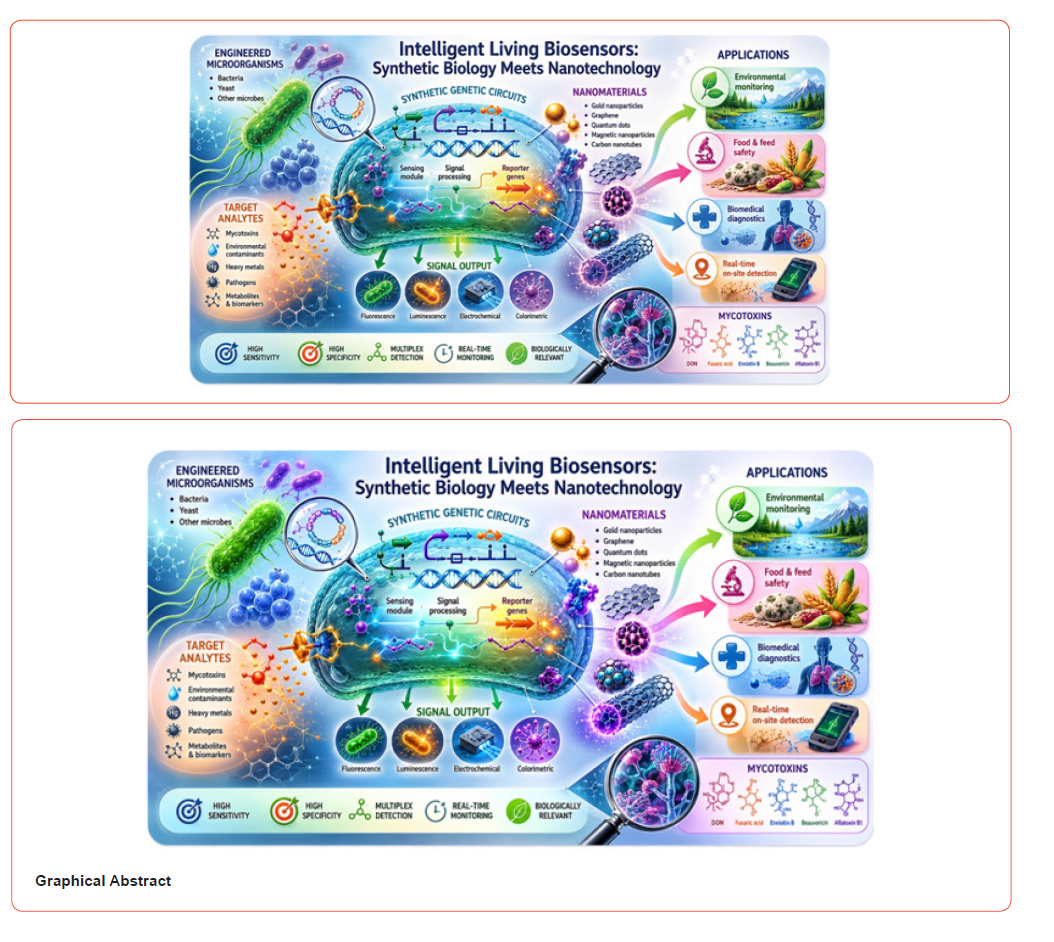
The convergence of synthetic biology and nanobiotechnology is enabling the development of a new generation of intelligent biosensors capable of sensing, processing, and responding to environmental and biological stimuli. Unlike conventional biosensors, genetically engineered microorganisms equipped with synthetic genetic circuits can function as living analytical devices that integrate multiple inputs and generate programmable outputs. The incorporation of nanomaterials further enhances sensor sensitivity, signal transduction efficiency, and operational stability. This perspective discusses the emerging role of engineered microorganisms as living biosensors interacting with nanomaterials and argues that such systems may redefine future approaches to environmental monitoring, food safety assessment, and biomedical diagnostics. Particular attention is given to the opportunities and challenges associated with the integration of synthetic genetic circuits and nanomaterials in the design of autonomous biological sensing platforms.
Keywords: Synthetic biology; Nanobiotechnology; Living biosensors; Genetic circuits; Engineered microorganisms; Nanomaterials; Mycotoxin monitoring; Cellular stress responses; Environmental sensing; Food safety
Introduction
The twenty-first century has witnessed an unprecedented convergence of disciplines traditionally viewed as distinct scientific fields. Advances in molecular biology, genetic engineering, materials science, nanotechnology, and computational biology have collectively transformed our ability to design biological systems with predictable and programmable functions [1,2]. Among the most promising outcomes of this interdisciplinary integration is the emergence of living biosensors—engineered microorganisms capable of detecting specific environmental or biological signals and converting them into measurable outputs.
Traditional analytical methods remain the gold standard for detecting pollutants, toxins, pathogens, and disease biomarkers. Techniques such as chromatography, mass spectrometry, and molecular diagnostics provide high sensitivity and accuracy; however, they often require expensive instrumentation, specialized personnel, and centralized laboratory facilities. Moreover, these approaches typically measure the presence of a compound rather than its biological activity or bioavailability. As a result, there is a growing demand for alternative sensing technologies that are portable, cost-effective, real-time, and capable of operating directly within complex biological or environmental matrices. Living microbial biosensors represent a fundamentally different approach to sensing [3,4]. Rather than relying solely on physicochemical detection, they exploit the natural ability of cells to perceive and respond to environmental changes. Through synthetic biology, microorganisms can be programmed to detect virtually any molecule for which a biological recognition element can be engineered. More importantly, synthetic genetic circuits allow cells not only to sense signals but also to process information, integrate multiple inputs, store biological memory, and execute predefined responses. In this sense, engineered microorganisms increasingly resemble biological computers operating at the cellular level [8,9]. At the same time, nanotechnology has introduced a vast repertoire of materials with unique electrical, optical, magnetic, and catalytic properties. Nanomaterials such as gold nanoparticles, graphene, quantum dots, carbon nanotubes, and magnetic nanoparticles have revolutionized biosensor design by improving signal amplification, response speed, and detection limits. The integration of these materials with living cells creates hybrid bio-nano systems that combine the adaptability of biology with the performance characteristics of advanced materials..
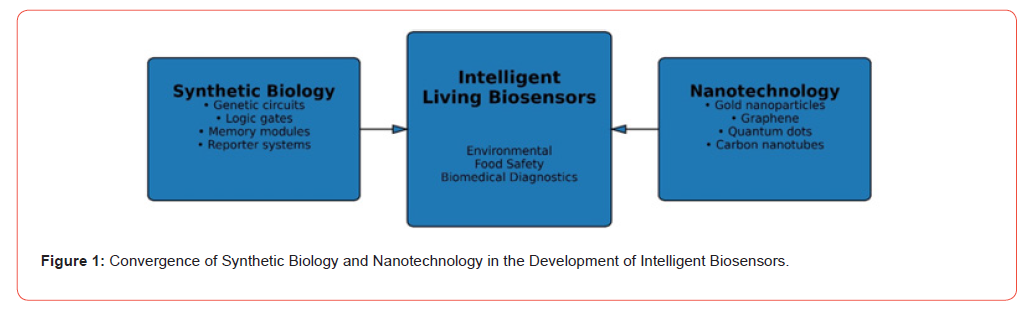
The most significant innovation does not arise from synthetic biology or nanotechnology alone, but rather from their intersection. The ability to engineer microorganisms that can communicate with, respond to, or even construct nanomaterials represents a paradigm shift in biosensor development. Such systems are no longer passive detectors but become dynamic entities capable of environmental adaptation, self-regulation, and autonomous decision-making. The conceptual convergence of synthetic biology and nanotechnology that underpins the development of intelligent living biosensors is illustrated in Figure 1. The importance of these developments extends beyond technological innovation. Environmental pollution, climate change, emerging infectious diseases, antimicrobial resistance, and food contamination are increasingly complex challenges requiring monitoring systems that are scalable, intelligent, and deployable in real-world conditions. Living bio-nano sensors may provide a solution that conventional analytical technologies alone cannot achieve.
From Biosensing to Biological Computation
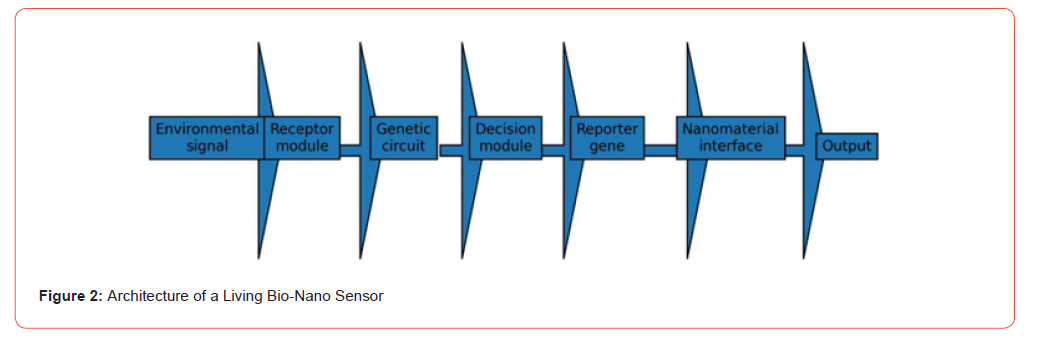
One of the most transformative aspects of synthetic biology is the development of genetic circuits capable of performing computational operations within living cells. Genetic switches, oscillators, memory modules, and logic gates allow microorganisms to process information similarly to electronic systems [5-7]. A generalized architecture of a living bio-nano sensor integrating signal perception, biological computation, and nanomaterialassisted signal transduction is presented in Figure 2. This capability fundamentally changes the concept of a biosensor. Instead of producing a signal whenever a target molecule is present, engineered microorganisms can be programmed to respond only when multiple environmental conditions occur simultaneously. Such biological logic significantly improves specificity and reduces false-positive results. For example, future microbial biosensors could be designed to detect environmental toxins only when pollutant concentrations exceed biologically relevant thresholds and when accompanying stress signals indicate potential ecological risk. This shift from detection toward interpretation represents a major conceptual advance.
Nanomaterials as Active Components Rather than Passive Enhancers
Nanomaterials are often viewed primarily as signal amplifiers. While this role remains important, their future significance may be much broader. Recent advances suggest that nanomaterials can become active participants in biological sensing systems. Nanoparticles can influence gene expression, alter metabolic pathways, facilitate electron transfer, and enable communication between biological and electronic components. Graphene-based interfaces, for example, provide opportunities for direct electrical communication between microbial cells and external devices. In the future, nanomaterials may function as intermediaries translating biological information into digital outputs in real time. Such hybrid systems could bridge the long-standing gap between living cells and electronic technologies [10-12].
Environmental Monitoring: A Transformative Opportunity
The environmental applications of living biosensors may ultimately prove more impactful than their medical counterparts. Current monitoring approaches frequently depend on periodic sampling and laboratory analysis, generating only snapshots of environmental conditions. Engineered microbial biosensors offer the possibility of continuous monitoring. Living sensors deployed in water systems, agricultural environments, or industrial settings could provide real-time information about heavy metals, pesticides, pharmaceutical residues, mycotoxins, and emerging contaminants. Particularly intriguing is the possibility of designing biosensors capable of detecting mixtures of contaminants rather than individual compounds. Environmental exposures rarely occur in isolation, yet most analytical approaches continue to evaluate chemicals separately. Synthetic biology may enable the development of sensors that respond to biologically meaningful exposure scenarios rather than single pollutants.
Mycotoxin Detection: An Emerging Frontier for Living Bio-Nano Sensors
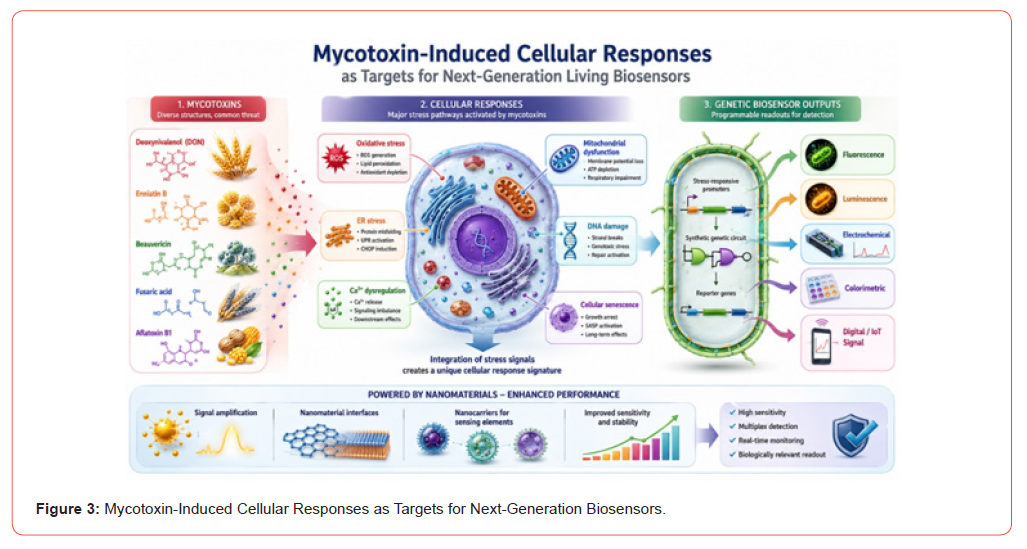
Among the numerous applications of intelligent biosensors, mycotoxin detection represents one of the most promising yet underexplored areas [13,14]. Mycotoxins are secondary metabolites produced by various fungal species, particularly those belonging to the genera Fusarium, Aspergillus, and Penicillium. Contamination of food and feed with compounds such as deoxynivalenol, zearalenone, fumonisins, aflatoxins, beauvericin, and enniatins remains a significant global concern due to their adverse effects on human and animal health [15,16]. Rather than focusing solely on toxin quantification, next-generation living biosensors may exploit characteristic cellular stress signatures induced by mycotoxins, as summarized in Figure 3.
Current analytical methods for mycotoxin detection, including high-performance liquid chromatography and mass spectrometry, provide excellent sensitivity and specificity [17,18]. However, these approaches are expensive, labor-intensive, and require sophisticated laboratory infrastructure. More importantly, they quantify chemical concentrations without directly addressing biological activity. This limitation is particularly relevant because structurally different mycotoxins may induce similar cellular responses, while interactions among co-occurring toxins may generate effects that cannot be predicted from individual toxin concentrations alone. The conceptual transition from concentration-based analytical methods to biologically informed intelligent biosensing platforms is illustrated in Figure 4.
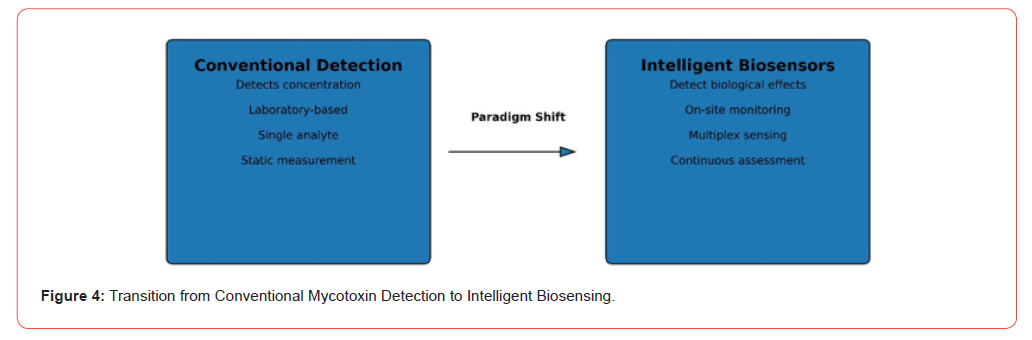
In this context, living biosensors offer a fundamentally different strategy. Instead of detecting the toxin molecule itself, engineered microorganisms can be programmed to respond to toxin-induced cellular stress pathways [2,6]. Synthetic genetic circuits could be designed to monitor molecular events associated with oxidative stress, mitochondrial dysfunction, membrane damage, endoplasmic reticulum stress, DNA damage, or inflammatory signaling. Consequently, the sensor output would reflect not only exposure but also the biological relevance of that exposure. The integration of nanomaterials further expands these possibilities. Nanoparticlebased signal amplification systems may enable the detection of extremely low concentrations of mycotoxins, while graphene or conductive nanomaterials could facilitate real-time electronic readout of cellular responses. Such hybrid bio-nano sensors may combine the sensitivity of advanced analytical methods with the biological relevance of cell-based assays [19,20].
Particularly intriguing is the possibility of developing multiplex biosensors capable of distinguishing between different classes of mycotoxins based on unique patterns of cellular stress responses. For example, one genetic module could respond preferentially to oxidative stress, another to endoplasmic reticulum stress, and a third to mitochondrial dysfunction. The resulting response signature could provide information not only about the presence of a toxin but also about its likely mechanism of action. This systems-level approach represents the future of mycotoxin monitoring. Food and feed contamination rarely involves a single toxin; instead, complex mixtures of regulated and emerging mycotoxins are frequently encountered. Therefore, biosensors capable of evaluating integrated biological responses may ultimately prove more informative than methods focused solely on quantifying individual compounds. Future developments may also enable the deployment of living biosensors directly within food processing chains, agricultural environments, or storage facilities. Such systems could provide continuous monitoring and early warning capabilities, reducing both economic losses and health risks associated with fungal contamination. The convergence of synthetic biology, nanotechnology, and toxicology thus creates an exciting opportunity to transform mycotoxin detection from a static analytical measurement into a dynamic assessment of biological hazard.
Biomedical Diagnostics: Moving Toward Intelligent Detection
Medical diagnostics is another field likely to benefit from bionano sensor technologies. The current generation of diagnostic tests largely focuses on the detection of static biomarkers. However, disease progression is a dynamic process involving complex interactions among cells, tissues, and signaling molecules. Living biosensors could potentially monitor these processes in real time. Engineered microorganisms may be capable of detecting combinations of inflammatory mediators, metabolic alterations, or disease-associated metabolites and translating these signals into measurable outputs. In the longer term, diagnostic systems may evolve into theranostic platforms that not only detect disease but also initiate therapeutic responses. Such autonomous systems remain largely experimental, yet their conceptual foundation already exists within synthetic biology [21,22].
Key Challenges and Ethical Considerations
Despite remarkable progress, several barriers must be overcome before widespread implementation becomes feasible. The most important challenge remains biosafety. The deployment of genetically modified microorganisms outside controlled laboratory conditions raises legitimate concerns regarding ecological impact, horizontal gene transfer, and long-term environmental persistence. Another challenge involves predictability. Biological systems are inherently dynamic and context-dependent. Genetic circuits that function reliably under laboratory conditions may behave differently in natural environments. Furthermore, regulatory frameworks have not yet fully adapted to technologies that combine living organisms with advanced nanomaterials. Future legislation will need to address questions that extend beyond traditional GMO regulations and encompass hybrid biological-material systems.
Future Perspectives
The next decade is likely to witness a fundamental transformation in the design and application of biosensing technologies. Current biosensors primarily function as passive analytical devices that identify the presence of specific molecules. Future systems, however, are expected to evolve into adaptive biological platforms capable of sensing, interpreting, and responding to environmental and physiological changes. One of the most promising directions involves the development of programmable living biosensors equipped with increasingly sophisticated genetic circuits. Advances in synthetic biology are enabling the construction of cellular systems capable of performing complex computational tasks, integrating multiple environmental signals, and generating contextdependent outputs. Such capabilities may allow future biosensors to distinguish between harmless exposure and biologically relevant risk [4,23]. Another important trend is the emergence of bio-nano hybrid platforms. Nanomaterials will likely move beyond their traditional role as signal amplifiers and become active components of sensing systems, facilitating communication between living cells, electronic devices, and cloud-based monitoring networks. This development may pave the way for autonomous environmental surveillance systems capable of continuous real-time monitoring.
In the field of mycotoxin research, future biosensors may increasingly focus on biological response signatures rather than direct toxin quantification. Monitoring pathways associated with oxidative stress, endoplasmic reticulum stress, mitochondrial dysfunction, calcium dysregulation, and cellular senescence could provide a more comprehensive assessment of toxicological risk, particularly in scenarios involving complex mixtures of regulated and emerging mycotoxins. The integration of artificial intelligence, synthetic biology, and nanotechnology may ultimately lead to adaptive biosensor networks capable of learning from environmental data and continuously refining their sensing capabilities. Such systems could transform food safety monitoring, environmental surveillance, precision agriculture, and biomedical diagnostics [24, 25].
Opinion: The Next Decade Will Belong to Adaptive Biosensors
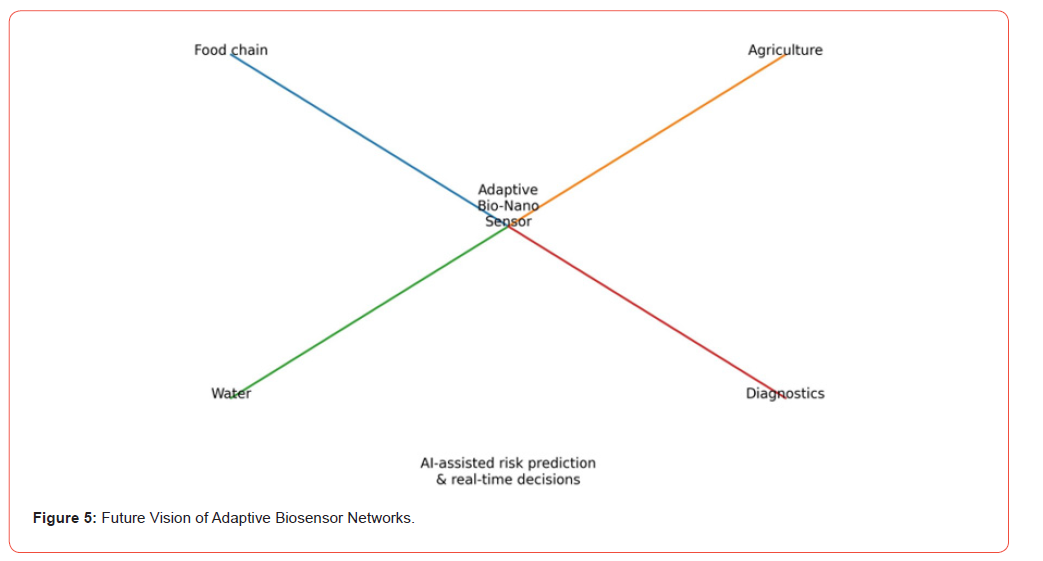
The future of biosensing lies not in achieving ever-lower detection limits but in developing systems capable of contextual interpretation. The next generation of biosensors should not merely answer the question “Is a compound present?” but rather “Does this compound represent a biologically relevant threat under current conditions?” A possible framework for future adaptive biosensor networks integrating environmental, agricultural, food safety, and biomedical monitoring is presented in Figure 5. Synthetic biology provides the computational framework necessary for such interpretation, while nanotechnology offers the material tools required for efficient signal transduction. Together, these disciplines are moving biosensors from passive detection devices toward adaptive biological systems. I believe that within the next decade, the most influential advances will emerge from hybrid platforms in which engineered microorganisms and nanomaterials function as integrated components of autonomous sensing networks. These systems may eventually become as transformative for environmental and biomedical monitoring as microprocessors were for information technology [6,23,25].
Research Gaps
Despite significant advances in synthetic biology and nanotechnology, several critical knowledge gaps continue to limit the practical implementation of intelligent living biosensors. First, most currently available microbial biosensors remain focused on detecting individual compounds. In contrast, real-world environmental and food contamination scenarios typically involve complex mixtures of contaminants. The development of biosensors capable of interpreting combined toxicological effects remains largely unexplored. Second, insufficient attention has been devoted to the use of cellular stress pathways as sensing targets. Although oxidative stress, endoplasmic reticulum stress, mitochondrial dysfunction, and inflammatory signaling are central mechanisms of toxicity, relatively few biosensor platforms have been designed to exploit these pathways as biologically relevant readouts. Third, emerging mycotoxins such as enniatins, beauvericin, and fusaric acid remain significantly understudied compared with regulated mycotoxins such as aflatoxins or deoxynivalenol. Consequently, there is limited knowledge regarding the development of biosensors specifically targeting their biological effects.
Another major gap concerns the interaction between engineered microorganisms and nanomaterials. While numerous studies have demonstrated improved analytical performance following nanomaterial integration, the molecular mechanisms governing these interactions remain poorly understood. Additionally, the long-term stability, biosafety, and environmental behavior of genetically engineered living biosensors have not been sufficiently investigated under realistic deployment conditions. Addressing these issues will be essential for future regulatory approval and public acceptance. Finally, the field lacks standardized frameworks for evaluating biologically relevant sensing performance. Future studies should move beyond traditional analytical metrics and incorporate measurements reflecting biological outcomes, toxicological relevance, and predictive value for risk assessment. Addressing these research gaps will be critical for transforming intelligent living biosensors from promising laboratory concepts into practical tools for environmental monitoring, food safety assessment, and biomedical diagnostics.
Conclusion
The integration of genetically engineered microorganisms, synthetic genetic circuits, and nanomaterials is creating a new class of intelligent biosensors that blur the boundaries between biology and technology. These living bio-nano systems possess capabilities far beyond conventional analytical devices, including environmental responsiveness, signal integration, biological memory, and autonomous decision-making. Although substantial technical, regulatory, and ethical challenges remain, the convergence of synthetic biology and nanobiotechnology is likely to play a central role in the future of diagnostics, environmental surveillance, and food safety monitoring. The development of adaptive, programmable, and self-regulating biosensors may ultimately redefine how society detects and responds to biological and environmental threats.
Acknowledgment
None.
Conflict of Interest
None.
References
- A Khalil, J Collins (2010) "Synthetic biology: applications come of age," Nature Reviews Genetics 11(5): 367-379.
- M Hicks, T T Bachmann, B Wang (2020) "Synthetic Biology Enables Programmable Cell-Based Biosensors," ChemPhysChem 21(2): 132-144.
- L T Bereza-Malcolm, G Mann, A E Franks (2015) "Environmental Sensing of Heavy Metals Through Whole Cell Microbial Biosensors," ACS Synthetic Biology 4(5): 535-547.
- S H N Joshi, C Jenkins, D Ulaeto, T E Gorochowski (2024) "Accelerating Genetic Sensor Development, Scale-up, and Deployment Using Synthetic Biology," Design Research 6: 0037.
- X Guo X, M Li, X Zuo (2024) "Gene circuit-based sensors," Biosensors and Bioelectronics 5(5): 1876-1888.
- Y Cai, Y Wang, S Hu (2025) "Synthetic Gene Circuits Enable Sensing in Engineered Living Materials," Biosensors 15(9): 556.
- X Li, R Daniel (2022) "Synthetic nonlinear computation for genetic circuit design," Current Opinion in Biotechnology 76: 102727.
- D Chandran, F T Bergmann, H M Sauro (2008) "Mathematical modeling and synthetic biology," Drug Discovery Today: Disease Models 5(4): 299-309.
- D Chakraborty, R Rengaswamy, K Raman (2022) "Designing biological circuits: from principles to applications," ACS Synthetic Biology 11(4): 1377-1388.
- S Malik, J Singh, R Goyat, Y Saharan, V Chaudhry, et al. (2023) "Nanomaterials-based biosensor and their applications, Heliyon 9(9): e19929.
- M Ramesh, R Janani, C Deepa, L Rajeshkumar (2023) "Nanotechnology-Enabled Biosensors: A Review of Fundamentals, Design Principles, Materials, and Applications," Biosensors 13(1): 40.
- P Patial, M Deshwal, S Bansal, A Sharma, K Kaur, et al. (2025) "Nanomaterial-Powered Biosensors: A Cutting-Edge Review of Their Versatile Applications," Micromachines 16(9): 1042.
- Y Zhang, L H H Hsu, X Jiang (2020) "Living electronics," Nano Research 13(5): 1205-1213.
- S Liu, W Xu (2020) "Engineered living materials-based sensing and actuation," Frontiers in Sensors 1: 586300.
- R Li, Y Wen, F Wang, P He (2021) "Recent advances in immunoassays and biosensors for mycotoxins detection in feedstuffs and foods," Journal of Animal Science and Biotechnology 12(1): 108.
- X Tang, J Zuo, C Yang, J Jiang, Q Zhang, et al. (2023) "Current trends in biosensors for biotoxins (mycotoxins, marine toxins, and bacterial food toxins): principles, application, and perspective," TrAC Trends in Analytical Chemistry 165: 117144.
- A M Pisoschi, F Iordache, L Stanca, E Mitranescu, L Bader Stoica, et al. (2024) "Biosensors for Food Mycotoxin Determination: A Comparative and Critical Review," Chemosensors 12(6): 92.
- R Szelenberger, N Cichoń, W Zajaczkowski, M Bijak (2024) "Application of Biosensors for the Detection of Mycotoxins for the Improvement of Food Safety," Toxins 16(6): 249.
- M Zhang, X Guo, J Wang (2023) "Advanced biosensors for mycotoxin detection incorporating miniaturized meters," Biosens Bioelectron 224: 115077.
- X Tong, N Chen, M Wang, X Guo (2025) "Advanced biosensor technology for mycotoxin detection," Frontiers in Nutrition 12: 1596690.
- B Sarac, S Yücer, F Ciftci (2026) "Synthetic biology-driven biosensors for healthcare applications," Biosensors and Bioelectronics 291: 118036.
- A Bilir, M Yavuz, U O S Seker, S Dumanli (2025) "Wireless in-body sensing through genetically engineered bacteria," Nature communications 16(1): 10432.
- Y Gao, C Huang, J Deng, L Wang, B Wang (2026) "Programming Next-Generation Synthetic Biosensors by Genetic Circuit Design," Advanced Science 13(14): e24172.
- K Song, H Ji, J Lee, Y Yoon (2025) "Microbial Transcription Factor-Based Biosensors: Innovations from Design to Applications in Synthetic Biology," Biosensors 15(4): 221.
- R Huang, V Kravchik, R Zaatry, M Habib, N Geva-Zatorsky, et al. (2025) "Engineering coupled consortia-based biosensors for diagnostic," Nature Communications 16: 3761.
-

This work is licensed under a Creative Commons Attribution-NonCommercial 4.0 International License.




