




 Opinion article
Artificial Intelligence in Plant Science: Revolution or Research Tool?
Received Date:July 17, 2026 Published Date: July 29, 2026
Abstract
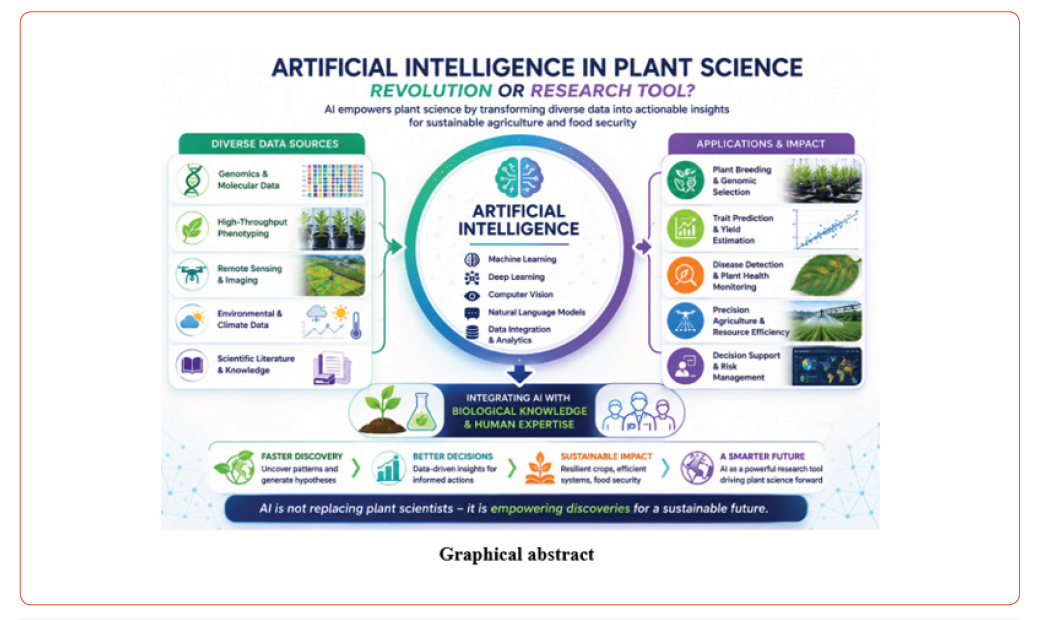
Artificial intelligence (AI) has rapidly emerged as one of the most transformative technologies across scientific disciplines, including plant science. Recent advances in machine learning, deep learning, computer vision, and large language models have expanded the possibilities for plant phenotyping, crop improvement, disease detection, precision agriculture, and scientific knowledge synthesis. While AI is often presented as a revolutionary force capable of fundamentally changing biological research, its actual role in plant science remains a subject of debate. This opinion article examines whether AI should be viewed as a scientific revolution or primarily as an advanced research tool. We argue that AI currently functions as a powerful methodological framework that enhances data analysis, prediction, and decision-making rather than replacing biological understanding. The future impact of AI will depend on the quality of biological data, interdisciplinary collaboration, model transparency, and responsible implementation. Rather than transforming plant science independently, AI is most likely to accelerate discoveries when integrated with traditional experimental approaches and domain expertise.
Keywords: Artificial intelligence, Machine learning, Plant science, Precision agriculture, Phenotyping, Plant breeding, Large language models
Introduction
Plant science is entering an era characterized by unprecedented volumes of biological, environmental, and agronomic data. Advances in genomics, transcriptomics, proteomics, metabolomics, remote sensing, and high-throughput phenotyping have generated datasets of a scale that often exceed the analytical capacity of conventional statistical methods. At the same time, agriculture faces major challenges associated with climate change, biodiversity loss, emerging pathogens, and increasing demands for food production [1].
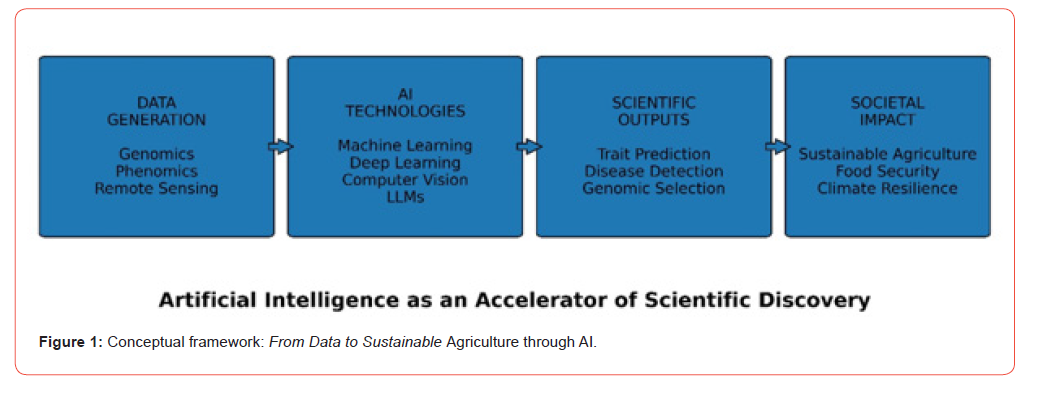
Artificial intelligence has emerged as a promising solution to these challenges. Machine learning algorithms can identify complex patterns within large datasets, generate predictive models, and support decision-making processes across diverse areas of plant research. Figure 1 summarizes the conceptual pathway through which AI converts large-scale biological and environmental data into scientific and societal benefits. From automated disease recognition using smartphone images to genomic prediction in breeding programs, AI applications have expanded rapidly during the last decade [2].
The enthusiasm surrounding AI has led some researchers to describe it as a technological revolution comparable to the advent of molecular biology or genome sequencing. Others argue that AI remains fundamentally a computational tool whose effectiveness depends entirely on the quality of experimental data and biological interpretation. This distinction is important because scientific progress requires not only improved prediction but also a deeper understanding of biological mechanisms.
This opinion article explores the current and future role of artificial intelligence in plant science and discusses whether AI should be considered a revolutionary paradigm shift or an advanced research tool supporting traditional scientific inquiry [2,3].
The Growing Influence of Artificial Intelligence in Plant Science
The integration of AI into plant science has been driven by several converging trends.
First, technological advances have dramatically reduced the cost of data generation [4]. Modern breeding programs routinely generate genomic datasets containing thousands of molecular markers, while drones and satellite platforms continuously collect environmental and phenotypic information at multiple spatial scales [2].
Second, computational resources have become increasingly accessible. Cloud computing and open-source machine learning frameworks allow researchers to develop sophisticated analytical models without requiring specialized hardware infrastructure [5].
Third, advances in deep learning have substantially improved the performance of image-based analyses. Computer vision systems can now identify plant diseases, estimate biomass, classify species, monitor crop growth, and detect stress symptoms with levels of accuracy that often approach or exceed human performance under controlled conditions.
These developments have transformed AI from a niche analytical approach into a central component of modern plant research. The expanding role of AI in plant science can be viewed as a multistage process linking data acquisition, advanced computational analysis, scientific discovery, and practical agricultural outcomes. As illustrated in Figure 1, artificial intelligence serves as an integrative framework that transforms diverse biological and environmental datasets into actionable knowledge supporting crop improvement, plant health management, and sustainable agricultural development.
These opportunities are becoming increasingly evident across several key areas of plant science, including phenotyping, plant breeding, precision agriculture, and knowledge discovery.
Opportunities Created by Artificial Intelligence
Accelerating Plant Phenotyping
One of the most successful applications of AI in plant science is high-throughput phenotyping. Traditional phenotypic assessments are labor-intensive, subjective, and often limited in scale. AI-powered image analysis enables automated measurement of plant traits such as leaf area, canopy architecture, growth dynamics, flowering time, and stress responses [6]. Computer vision approaches can process thousands of images within minutes, providing standardized measurements that improve reproducibility and reduce human bias. This capability is particularly valuable for large breeding programs and ecological studies involving extensive experimental populations [7,8].
Improving Plant Breeding
Plant breeding increasingly relies on predictive approaches that integrate genomic and phenotypic information. Machine learning algorithms can analyze complex genotype–phenotype relationships and identify patterns that may be difficult to detect using conventional statistical methods [1]. Genomic prediction models supported by AI have the potential to accelerate the selection of superior genotypes, reduce breeding cycle duration, and improve the efficiency of crop improvement programs. Such approaches may become especially important in developing cultivars adapted to changing climatic conditions [9,10].
Supporting Precision Agriculture
Precision agriculture represents another area in which AI is expected to have substantial impact. By integrating data from sensors, weather stations, satellites, drones, and field observations, AI systems can optimize irrigation, fertilization, and pest management strategies [2,4]. The resulting improvements in resource-use efficiency may contribute to more sustainable agricultural systems while reducing environmental impacts associated with excessive inputs. In regions experiencing water scarcity or climate-related stress, AI-driven decision support systems could become increasingly valuable [5].
Enhancing Knowledge Discovery
The recent emergence of generative AI and large language models introduces new possibilities for scientific research [2]. These systems can assist researchers in literature exploration, data organization, hypothesis generation, and scientific writing. For plant scientists facing rapidly expanding literature, AI-based tools may improve access to knowledge and facilitate interdisciplinary collaboration. Such applications could help researchers identify emerging trends and knowledge gaps more efficiently than traditional approaches [11].
The Limitations of Artificial Intelligence
Despite its impressive capabilities, AI faces significant limitations that are often overlooked in discussions emphasizing technological optimism [1].
Data Quality Remains the Critical Factor
The accuracy of AI models depends fundamentally on the quality of the underlying data. Incomplete, biased, or poorly curated datasets can lead to inaccurate predictions regardless of algorithmic sophistication [2]. Many plant science datasets remain geographically restricted, environmentally specific, or experimentally heterogeneous. Models trained under controlled conditions may perform poorly when applied in real-world agricultural systems characterized by high environmental variability [12]. Consequently, the principle of “garbage in, garbage out” remains highly relevant in AI-assisted plant research.
Prediction Does Not Equal Understanding
A central limitation of many AI approaches is their emphasis on prediction rather than explanation. Deep learning models often function as “black boxes” whose internal decision-making processes remain difficult to interpret [12]. While a model may accurately predict disease occurrence or crop yield, it may provide limited insight into the biological mechanisms responsible for these outcomes. Scientific progress ultimately depends on understanding causal relationships rather than merely identifying statistical associations. Therefore, AI should complement rather than replace hypothesis-driven experimentation.
Reproducibility and Transparency Challenges
Reproducibility represents a persistent concern in AI research. Model performance can vary depending on training datasets, parameter selection, computational environments, and evaluation procedures. The lack of standardized reporting frameworks further complicates comparisons among studies. Without transparent methodologies and open data practices, the reliability and generalizability of AI-based findings may be difficult to assess.
Risks Associated with Generative AI
Large language models have introduced additional concerns related to scientific integrity. Although these systems can support literature synthesis and scientific communication, they may generate inaccurate statements, fabricated references, or misleading interpretations. Researchers must therefore maintain critical oversight when using generative AI tools. Scientific expertise remains essential for evaluating the accuracy and relevance of AI-generated content.
Revolution or Research Tool?
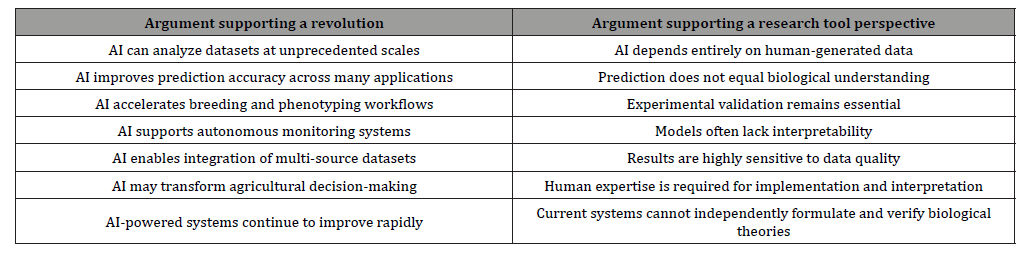
The question posed in the title of this article reflects a broader debate occurring across scientific disciplines. Is AI fundamentally transforming plant science, or is it simply providing researchers with more powerful analytical tools? At present, the evidence suggests that AI functions primarily as an enabling technology rather than an independent scientific revolution. Unlike transformative discoveries such as DNA structure elucidation or genome sequencing, AI does not directly reveal new biological principles. Instead, it enhances our ability to analyze complex datasets and identify patterns within them. Nevertheless, the cumulative impact of these improvements may eventually produce revolutionary consequences. If AI enables researchers to integrate genomic, phenotypic, environmental, and management data at unprecedented scales, it could fundamentally alter how biological questions are investigated and how agricultural systems are managed (Table 1).
In this sense, AI may not be a revolution in itself but rather a catalyst that accelerates scientific and technological transformation [13].
Table 1:Why artificial intelligence is both a transformative opportunity and a scientific challenge in plant science.
Future Perspectives
The future role of AI in plant science will likely depend on several key developments.
First, greater emphasis must be placed on explainable AI approaches capable of linking predictive performance with biological interpretation. Understanding why a model makes a prediction is often as important as the prediction itself [9].
Second, improved data-sharing initiatives and standardized databases will be essential for developing robust and transferable models. International collaboration will play a crucial role in generating datasets that capture diverse environmental and genetic conditions [10].
Third, interdisciplinary education should become a priority [4]. Future plant scientists will increasingly require competencies in data science, programming, and computational biology alongside traditional expertise in genetics, physiology, ecology, and agronomy.
Finally, ethical and responsible AI implementation should remain central to technological development. Transparency, reproducibility, and scientific integrity must guide the integration of AI into research and agricultural practice [5].
Conclusion
Artificial intelligence has become an influential component of modern plant science and offers significant opportunities for advancing research, breeding, phenotyping, and precision agriculture. However, current evidence suggests that AI should be viewed primarily as a powerful research tool rather than an autonomous scientific revolution. Its effectiveness remains dependent on high-quality data, biological expertise, and rigorous experimental validation. The greatest value of AI lies not in replacing scientists but in augmenting their capacity to analyze complexity, generate hypotheses, and make informed decisions. The future of plant science will likely be shaped not by artificial intelligence alone, but by the productive integration of AI technologies with biological knowledge, experimental research, and human creativity. In this context, AI is neither merely a tool nor entirely a revolution—it is an accelerator of scientific discovery whose ultimate impact remains to be determined.
Acknowledgment
None.
Conflict of Interest
None.
References
- M A Farooq, S Gao, M A Hassan, Z Huang, A Rasheed, et al. (2024) Artificial intelligence in plant breeding. Trends in Genetics 40(10): 891-908.
- I Khan, B K Khare (2025) Integrating AI in plant science: A review of applications and future prospects. Plant Gene 44: 100542.
- K R Aashu, M Pant, K Deep (2024) Application of machine learning in agriculture: recent trends and future research avenues. arXiv preprint arXiv:2405. 17465.
- H Storm, S J Seidel, L Klingbeil, F Ewert, H Vereecken, et al. (2024) Research priorities to leverage smart digital technologies for sustainable crop production. European Journal of Agronomy 156: 127178.
- M El Jarroudi, L Kouadio, P Delfosse, CH Bock, AK Mahlein, et al. (2024) Leveraging edge artificial intelligence for sustainable agriculture. Nature Sustainability 7(7): 846-854.
- T Wang, R Tong, T Xu, Y Li, Y Chen (2026) Artificial intelligence in plant science: From image-based phenotyping to yield and trait prediction. Frontiers in Plant Science 16: 1732979.
- Y Wu, G Han, IN Niang, F Ravelombola, M Oliveira, et al. (2026) From UAV Imagery to Agronomic Reasoning: A Multimodal LLM Benchmark for Plant Phenotyping. arXiv preprint arXiv:2604.09907.
- A K Mahlein, J G Arnal Barbedo, K S Chiang, E M Del Ponte, C H Bock (2024) From detection to protection: the role of optical sensors, robots, and artificial intelligence in modern plant disease management. Phytopathology 114(8): 1733-1741.
- A L Garcia-Oliveira, S L Dwivedi, S Chander, C Nelimor, D Abd El Moneim, et al. (2026) Breeding Smarter: Artificial Intelligence and Machine Learning Tools in Modern Breeding—A Review. Agronomy 16(1): 137.
- M J Tanin, D K Saini, P Alagappan, J P Kaur (2026) A review of AI-driven phenomics, genomics, and predictive breeding in wheat. Discover Plants 3(1): 210.
- S Banerjee, T Mallick, A Chakroborty, H N Saha, N T Takur (2025) Evaluation of State-of-the-Art Deep Learning Techniques for Plant Disease and Pest Detection. arXiv preprint arXiv:2508.08317.
- J Ogier du Terrail, T Marchand, V Cabeli, Z Khadir, C Véran, et al. (2026) BOTANIC-0: a series of foundation models for plant genomic data. BioRxiv 2026-02.
- P Schramowski, W Stammer, S Teso, A Brugger, F Herbert, et al. (2020) Making deep neural networks right for the right scientific reasons by interacting with their explanations. Nature Machine Intelligence 2(8): 476-486.
-

This work is licensed under a Creative Commons Attribution-NonCommercial 4.0 International License.




