




 Opinion article
Artificial Intelligence and the Future of Human- Centered Ergonomics: Opportunities and Challenges
Received Date:July 17, 2026 Published Date: July 29, 2026
Abstract
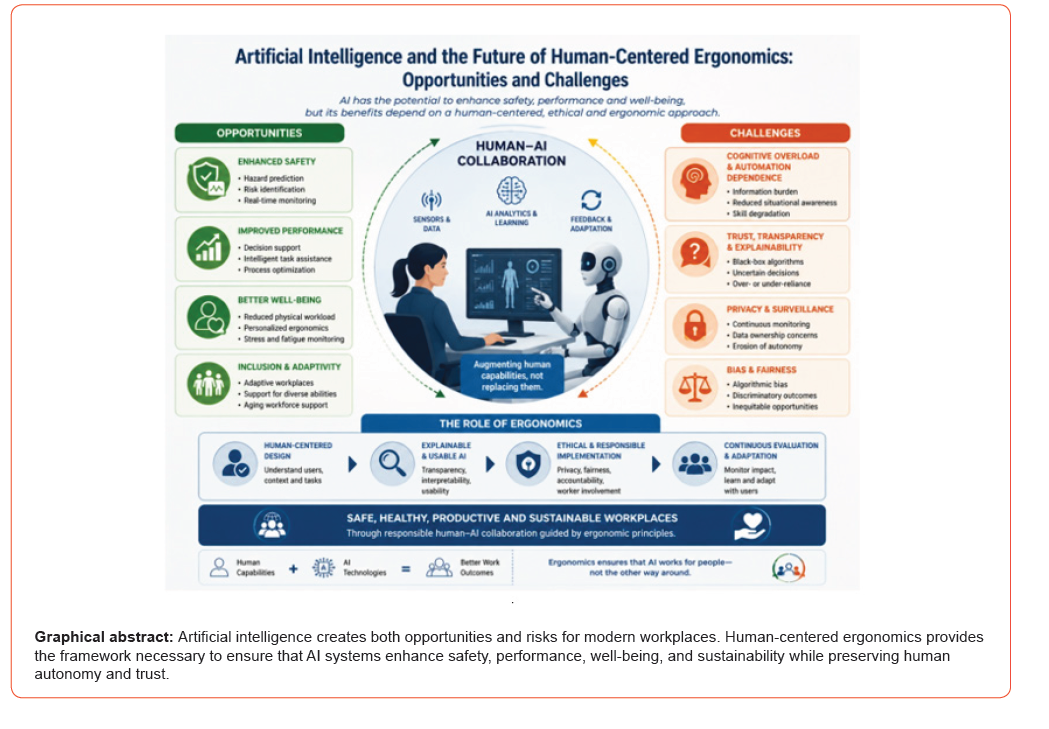
Artificial intelligence (AI) is rapidly transforming the way humans interact with technology, workplaces, and complex socio-technical systems. From intelligent decision-support tools and wearable monitoring devices to autonomous systems and generative AI applications, AI increasingly influences human performance, safety, well-being, and productivity. These developments present significant opportunities for ergonomics, a discipline traditionally focused on optimizing interactions between humans and their environments. At the same time, AI introduces new challenges related to cognitive workload, trust, transparency, autonomy, privacy, and ethical responsibility. This opinion paper discusses the evolving relationship between AI and human-centered ergonomics, highlighting both the potential benefits and emerging risks associated with AI-driven systems. Particular attention is given to the need for maintaining a human-centered perspective in the design and implementation of intelligent technologies. The paper argues that ergonomics must play a central role in ensuring that AI systems enhance rather than diminish human capabilities, safety, and well-being. Future research directions are proposed to support the development of responsible and sustainable human–AI collaboration.
Keywords: Artificial intelligence; Ergonomics; Human-centered design; Human–AI interaction; workplace safety; Cognitive ergonomics; Digital transformation
Introduction
Artificial intelligence (AI) has moved from a largely theoretical concept to a pervasive technology influencing nearly every aspect of modern life [1]. Advances in machine learning, computer vision, natural language processing, and generative AI have enabled intelligent systems to perform tasks previously considered exclusive to human cognition. AI applications are now commonly used in manufacturing, healthcare, transportation, agriculture, education, and office environments.
The growing integration of AI into workplaces has significant implications for ergonomics [2]. Traditionally, ergonomics has focused on adapting tools, tasks, and environments to human capabilities and limitations. The discipline aims to improve safety, efficiency, comfort, and well-being by considering physical, cognitive, and organizational factors. As AI systems increasingly participate in decision-making processes, task execution, and performance monitoring, the nature of human work is changing. Consequently, ergonomics must evolve to address the opportunities and challenges associated with human–AI interaction [3].
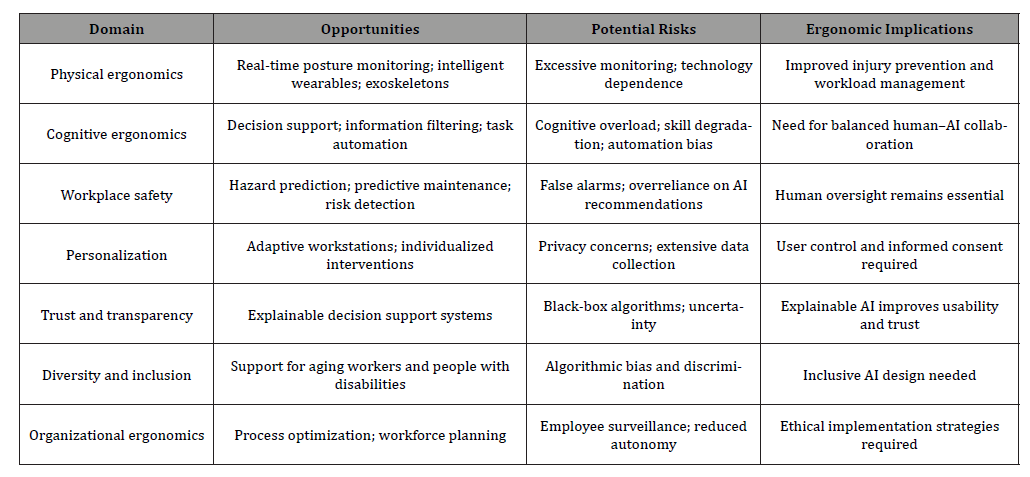
While AI offers considerable potential to reduce physical strain, improve decision-making, and enhance productivity, concerns have emerged regarding excessive automation, cognitive overload, reduced human autonomy, and ethical issues related to surveillance and privacy. These developments raise important questions about how intelligent systems should be designed and implemented to support rather than replace human capabilities. This opinion paper examines these issues and discusses the future role of ergonomics in AI-driven workplaces. A summary of the major opportunities, challenges, and ergonomic implications associated with AI implementation is presented in Table 1.
Table 1:Opportunities and challenges of artificial intelligence in human-centered ergonomics.
Opportunities for Human-Centered Ergonomics
Enhancing Physical Ergonomics
The opportunities and challenges discussed in the following sections are summarized in Table 1 and represent key areas where ergonomic principles can contribute to responsible AI implementation. One of the most promising applications of AI involves reducing physical workload and preventing musculoskeletal disorders. Intelligent wearable devices, sensor networks, and computer vision systems can continuously monitor posture, movement patterns, and biomechanical loads [4]. These technologies enable real-time identification of ergonomic risks and provide immediate feedback to workers [5]. AI-powered exoskeletons represent another important advancement. By adapting assistance levels to individual users and specific tasks, intelligent exoskeletons may reduce fatigue and improve occupational safety in physically demanding industries. Similarly, AI-based predictive maintenance systems can reduce exposure to hazardous environments by identifying equipment failures before accidents occur.
Supporting Cognitive Performance
The increasing complexity of modern work environments has intensified the importance of cognitive ergonomics. AI systems can assist workers by filtering information, prioritizing tasks, and supporting decision-making processes [6]. In healthcare, for example, AI algorithms can analyze large volumes of clinical data and provide recommendations that assist clinicians in diagnosis and treatment planning. Generative AI tools offer additional opportunities by automating repetitive administrative tasks, summarizing information, and facilitating communication [7]. Such systems may allow professionals to focus on higher-value cognitive activities requiring creativity, critical thinking, and interpersonal interaction [8].
Personalized Ergonomics
Traditional ergonomic interventions often rely on population- level recommendations. AI introduces the possibility of highly individualized solutions [9]. By continuously analyzing behavioral, physiological, and environmental data, AI systems can adapt workstations, schedules, and task assignments to the needs of individual workers. Personalized ergonomics may be particularly valuable for aging populations, individuals with disabilities, and workers performing highly specialized tasks. Adaptive technologies could support workforce diversity and inclusion by accommodating a broader range of human capabilities and limitations [1].
Emerging Challenges
Cognitive Overload and Automation Dependence
Although AI systems can reduce cognitive demands, they may also introduce new forms of mental workload. Workers are often required to monitor automated processes, interpret AI-generated recommendations, and intervene when systems fail. Such responsibilities can create complex cognitive demands that differ substantially from traditional task requirements. Overreliance on AI may also lead to skill degradation and reduced situational awareness [10]. When humans become passive supervisors of automated systems, their ability to respond effectively during unexpected situations may decline. Several incidents involving automated transportation systems have demonstrated the potential consequences of excessive automation dependence [6].
Trust, Transparency, and Explainability
Effective human–AI collaboration depends on appropriate levels of trust. Insufficient trust may result in underutilization of useful technologies, whereas excessive trust may encourage unquestioning acceptance of incorrect recommendations [11,12]. Many contemporary AI systems operate as “black boxes,” making it difficult for users to understand how decisions are generated. Limited transparency may reduce user confidence and complicate accountability when errors occur. Ergonomists therefore face the challenge of promoting explainable AI systems that provide meaningful information about their reasoning processes [13,14].
Privacy and Surveillance Concerns
The use of AI-powered monitoring technologies raises important ethical questions. Wearable sensors, cameras, and productivity- tracking systems can generate detailed information about workers’ behaviors and performance [15]. While such data may support safety improvements, they may also contribute to perceptions of excessive surveillance and reduced autonomy. Human-centered ergonomics requires careful consideration of privacy, informed consent, and data governance. Workers should understand what information is collected, how it is used, and who has access to it. Transparent policies are essential for maintaining trust and psychological well-being.
Algorithmic Bias and Fairness
AI systems are only as reliable as the data used to train them. Biased datasets can produce unfair outcomes affecting hiring decisions, performance evaluations, workload allocation, and access to opportunities. Such biases may disproportionately affect vulnerable groups and undermine workplace equity. Ergonomics has historically emphasized designing systems that accommodate human diversity. This principle should be extended to AI development, ensuring that intelligent technologies promote inclusivity rather than reinforce existing inequalities [16].
The Need for Human-Centered AI
The rapid deployment of AI technologies highlights the importance of maintaining a human-centered approach. Human-centered AI emphasizes collaboration rather than replacement, positioning intelligent systems as tools that augment human capabilities [1]. From an ergonomic perspective, successful AI implementation should prioritize human well-being, safety, usability, and autonomy. Technological performance alone should not be considered a sufficient indicator of success. Instead, organizations should evaluate how AI affects employee satisfaction, workload, learning opportunities, and long-term health outcomes. Human-centered AI also requires multidisciplinary collaboration among ergonomists, engineers, computer scientists, psychologists, ethicists, and policymakers. Such collaboration is necessary to ensure that technological innovation aligns with human needs and societal values.
Future Research Directions
Several research priorities deserve attention in the coming years. First, more studies are needed to understand the long-term effects of AI-assisted work on cognitive performance, skill retention, and mental health. Current evidence remains fragmented and often focuses on short-term outcomes. Second, researchers should develop validated methods for assessing human–AI interaction from an ergonomic perspective. Existing ergonomic assessment tools may require adaptation to address the unique characteristics of intelligent systems [17]. Third, greater attention should be given to explainable AI and trust calibration. Understanding how users develop trust in AI systems will be essential for optimizing collaboration and preventing misuse [18,19]. Finally, future research should explore ethical frameworks for AI implementation that balance organizational objectives with worker rights, privacy, and well-being [20].
Conclusion
Artificial intelligence is reshaping the landscape of human work and creating new opportunities for ergonomics. Intelligent systems have the potential to reduce physical strain, enhance cognitive performance, and support personalized workplace interventions. However, these benefits are accompanied by important challenges related to cognitive workload, automation dependence, transparency, privacy, and fairness. The future of ergonomics will depend on its ability to guide the design of human-centered AI systems that augment rather than replace human capabilities. By integrating ergonomic principles into AI development and deployment, organizations can create workplaces that are not only more efficient but also safer, healthier, and more supportive of human well-being. As AI continues to evolve, ergonomics should remain at the forefront of efforts to ensure that technological progress serves human needs and values.
Acknowledgment
None.
Conflict of Interest
None.
References
- B Shneiderman (2022) Human-centered AI: ensuring human control while increasing automation. In Proceedings of the 5th Workshop on Human Factors in Hypertext 1: 1-2.
- D Petrat (2021) Artificial intelligence in human factors and ergonomics: an overview of the current state of research. Discover Artificial Intelligence 1: 3.
- G Grote (2023) Shaping the development and use of Artificial Intelligence: how human factors and ergonomics expertise can become more pertinent. Ergonomics 66(11): 1702-1710.
- M Trstenjak, T Opetuk, G Đukić, H Cajner (2025) Use of Artificial Intelligence (AI) in the Workplace Ergonomics of Industry 5.0. Tehnički Glasnik 19(2): 335-340.
- J Zhang, Q Jia, S Li, S Zhang, G Chen (2026) Intelligent prediction of ergonomics evaluation metrics in human-AI collaboration based on machine learning. International Journal of Industrial Ergonomics 111: 103851.
- J Fiegler-Rudol, K Lau, A Mroczek, J Kasperczyk (2025) Exploring human–AI dynamics in enhancing workplace health and safety: A narrative review. International Journal of Environmental Research and Public Health 22(2): 199.
- Y K Dwivedi, N Kshetri, L Hughes, E L Slade, A Jeyaraj, et al. (2023) Opinion Paper:“So what if ChatGPT wrote it?” Multidisciplinary perspectives on opportunities, challenges and implications of generative conversational AI for research, practice and policy. International Journal of Information Management 71: 102642.
- J C F de Winter, Y B Eisma (2026) Ergonomics and human factors: still fading—and why we need to embrace the AI revolution. Ergonomics 69(3): 418-424.
- British Standards Institution (2019) Ergonomics of Human-system Interaction: Human-centred Design for Interactive Systems. British Standards Institution.
- R Parasuraman, D H Manzey (2010) Complacency and bias in human use of automation: An attentional integration. Human Factors 52(3): 381-410.
- B Leichtmann, C Humer, A Hinterreiter, M Streit, M Mara (2023) Effects of explainable artificial intelligence on trust and human behavior in a high-risk decision task. Computers in Human Behavior 139: 107539.
- K K Wong, Y Han, Y Cai, W Ouyang, H Du, et al. (2025) From trust in automation to trust in AI in healthcare: A 30-year longitudinal review and an interdisciplinary framework. Bioengineering 12(10): 1070.
- Y Rong, T Leemann, T T Nguyen, L Fiedler, P Qian, et al. (2023) Towards human-centered explainable ai: A survey of user studies for model explanations. IEEE Transactions on Pattern Analysis and Machine Intelligence 46(4): 2104-2122.
- T A Bach, A Khan, H Hallock, G Beltrão, S Sousa (2024) A systematic literature review of user trust in AI-enabled systems: An HCI perspective. International Journal of Human–Computer Interaction 40(5): 1251-1266.
- O Giuntella, J Konig, L Stella (2025) Artificial intelligence and the wellbeing of workers. Scientific Reports 15(1): 20087.
- B Ghai (2023) Towards fair and explainable ai using a human-centered ai approach (Doctoral dissertation, State University of New York at Stony Brook).
- E P Yuliatin, R Oktarina (2026) AI-Powered Ergonomic Innovation to Improve Workplace Wellbeing and Productivity. In: Kaburuan, E.R., Goundar, S. (eds) Health Information Science. HIS 2025. Lecture Notes in Computer Science 16392.
- L Sanneman, J A Shah (2022) The situation awareness framework for explainable AI (SAFE-AI) and human factors considerations for XAI systems. International Journal of Human–Computer Interaction 38(18-20): 1772-1788.
- H Yong, O Wumin, Q Zebin, D Hemin, H Jianlong (2026) Human-AI Trust in Medical Contexts Within a Sustainable Innovation Ecosystem: A Theoretical Review and Interdisciplinary Framework. Industrial & Engineering Design 8(1): 1-17.
- I Schröder, C Merlic (2024) Proceedings of the 2023 Laboratory Safety Workshop-Human Factors: Safety and Technology. ACS Chemical Health & Safety 31(6): 438-443.
-

This work is licensed under a Creative Commons Attribution-NonCommercial 4.0 International License.




