



 Research article
An Integrated Approach to Protecting of Sunken Granite Artifacts by Coated with Pumpkin Seed Oil in Alexandria, Egypt
Received Date:November 01, 2024 Published Date: November 21, 2024
Abstract
Numerous challenges face those working in heritage preservation when addressing the conservation of sunken granite artifacts. Granite, a fundamental material in ancient Egyptian construction, architecture, and sculpting, has been used to immortalize figures of old Egyptian leaders. Despite its widespread historical use, preserving granite artifacts underwater, especially in the Mediterranean Sea, poses significant difficulties. The study investigates the protection of sunken granite artifacts from seawater salinity and biological damage caused by bacteria and fungi, previously shown to harm granite. The goal is to find comprehensive solutions to shield granite from seawater salinity and isolate it from harmful microbes. The study hypothesizes that coating a granite sample, similar to the ancient granite, with a material that isolates it from seawater salinity and resists harmful microbes while being environmentally friendly is effective. Pumpkin seed oil was tested as an antimicrobial and hydrophobic agent to repel water from granite. Samples underwent fracture load tests, X-ray diffraction analysis, and scanning electron microscopy. The results showed a significant difference between coated and uncoated samples, demonstrating the success of using pumpkin seed oil in protecting granite. The study recommends further research into sustainable environmental materials for preserving both natural and human heritage.
Keywords: Granite; Pumpkin seed oil; Sunken; Restoration; Protective oil
Introduction
Background:
The Origins of Underwater Archaeology:
Underwater archaeology’s deep roots in the Mediterranean reflect the region’s role as the birthplace of numerous ancient civilizations. This area’s immense cultural heritage and underwater treasures have always been a magnet for archaeologists and historians. The 20th century, especially the 1960s and 1970s, marked a golden era for underwater archaeology, driven by leaps in diving technology and groundbreaking university research. These advancements unlocked previously unreachable underwater sites, allowing for unprecedented exploration. The American Institute of Underwater Research emerged as a key player during this transformative period. They spearheaded innovative preservation techniques to ensure that artifacts brought up from the depths were preserved in top condition. Their work not only advanced the field of underwater archaeology but also set new standards for artifact conservation [1-3]. The methodologies and technologies developed not only improved the preservation of these treasures but also enhanced our understanding of the cultures that created them. Over the decades, the field of underwater archaeology has continued to evolve. Modern techniques and tools, such as remote sensing, underwater robotics, and advanced imaging technologies, have revolutionized the way we study submerged antiquities. These advancements have expanded the scope of underwater archaeology, allowing for more comprehensive and detailed studies of sites. They have also facilitated the discovery of new sites, providing fresh insights into ancient maritime trade routes, shipwrecks, and sunken cities. This evolution in technology has made it possible to map and analyze vast underwater landscapes with unprecedented accuracy. Remote sensing technologies, like sonar and magnetometry, can detect hidden structures and objects below the seabed, while underwater robotics and autonomous vehicles enable exploration of deep and treacherous areas that were previously inaccessible to divers. Advanced imaging technologies, including 3D photogrammetry and LiDAR, provide detailed and high-resolution images of underwater sites, helping archaeologists create precise digital reconstructions of ancient structures and artifacts. These tools have not only enhanced the accuracy of archaeological documentation but also allowed for virtual preservation and public accessibility through digital platforms. The integration of these advanced techniques has transformed underwater archaeology from a primarily discovery- focused discipline to one that emphasizes thorough analysis, preservation, and interpretation of underwater cultural heritage. Through these innovations, researchers can piece together the stories of ancient civilizations and their interactions with the marine environment, shedding light on the interconnectedness of human societies across time [4-7].
Definition of the term (Sunken Antiquities):
Submerged monuments are underwater archaeological remains that UNESCO defines as traces of human existence submerged for at least 100 years. Their classification is based on their location and factors such as changes in sea level. Studying these sites requires specialized techniques and tools that differ significantly from traditional survey methods. These techniques include acoustic imaging and side-scan sonar, which can produce three-dimensional images of underwater objects [8-10]. Additionally, remote-operated vehicles (ROVs) and autonomous underwater vehicles (AUVs) are used to explore areas that are difficult for divers to access. These tools allow scientists to collect precise data about submerged archaeological sites without causing any harm. Analyzing samples taken from these sites using advanced methods like electron microscopy and spectroscopic analysis helps in understanding the materials used in creating the artifacts and how they have been affected by the marine environment [11,12]. This type of research not only aids in preserving these artifacts but also provides new insights into ancient civilizations and their interaction with their environment. By understanding the materials and methods used in preservation, we can reconstruct historical contexts more accurately. With continuous advancements in technology, the possibilities for researching and preserving submerged monuments are expanding, allowing us to discover more about humanity’s past and protect these treasures for future generations. Such efforts underscore the importance of integrated interdisciplinary approaches in heritage conservation [13,14].
The Importance of Underwater Cultural Heritage:
Sunken archaeological sites are invaluable for preserving artifacts in good condition due to the protective aquatic environment. These sites also provide a visually striking experience for visitors, resembling scenes from science fiction. When visitors explore these underwater worlds, they are transported back in time, gaining a realistic glimpse into the daily life of ancient communities at the time of submergence. These sites contain architectural structures and everyday artifacts that offer both scholars and visitors a direct window into a rich and diverse history. The integration of history with nature is particularly captivating, as ancient tales become part of the current marine ecosystem [15-17]. Moreover, underwater archaeological research contributes to the development of new conservation techniques, enhancing our understanding of ancient civilizations and their interactions with their environments. These discoveries enrich museums and exhibitions with new information and details, broadening public understanding of human history. Thanks to modern technologies like acoustic imaging and remote- operated vehicles, it is now possible to explore these sites in ways that were previously unattainable, opening new horizons for historical understanding and preservation [18-20].
Ancient Granite Quarries and Their Use Throughout the Historical Ages in Egypt:
Ancient granite quarries in Egypt are a crucial part of the country’s construction history, reflecting the ingenuity and skill of early builders. Granite was not only used for constructing iconic pyramids and ancient temples, but it also played a pivotal role in the construction of obelisks, statues, and other monumental structures that have withstood the test of time. These quarries, such as the “mountain granite” quarries in the Pharaonic Island and the “rock granite” quarries in Luxor, were renowned for producing high-quality stone. The granite extracted from these sites was particularly prized for its durability and aesthetic appeal, contributing to the grandeur of the ancient Egyptian civilization. The meticulous process of quarrying, transporting, and shaping granite highlights the advanced engineering techniques of the time. These historical sites remain a testament to the resourcefulness and sophistication of ancient Egyptian culture [21-23]. Throughout the ages, granite was employed in numerous important buildings, including Buddhist, Christian, and Islamic temples. It was also used in the construction of forts, walls, and ancient houses. Granite was a favored building material due to its durability and strength, and its use has continued into modern times [24-27].
Factors and phenomena of granite deterioration:
Granite deterioration occurs due to a combination of environmental and biological factors. Prolonged exposure to acidic rain or water causes chemical weathering, leading to the dissolution of minerals like feldspar and quartz. Physical weathering, driven by temperature fluctuations, results in freeze-thaw cycles that cause the granite to crack and fragment. High salinity levels, particularly in marine environments, contribute to salt crystallization within the stone’s pores, exacerbating structural weaknesses [28-30]. Biological factors, such as microbial colonization, also play a significant role in granite degradation. Microorganisms like bacteria, fungi, and lichens produce organic acids that chemically interact with the granite, causing pitting and surface erosion. Furthermore, mechanical stress from root growth of plants in cracks can enlarge fissures and accelerate deterioration. Combined, these factors create a complex interaction of processes that gradually compromise the integrity and aesthetic of granite structures over time [31-33].
Study Hypotheses:
This study hypothesizes that pumpkin seed oil, in addition to being an antibiotic for bacteria and fungi that damage granite, acts as an antibiotic and a protective layer for granite similar to the sunken archaeological granite, and in a similar environment of seawater in the Aboukir area.
Study Questions:
Through research we tried to find answers to many questions:
1) What are the risks and damages that may face sunken
granite and how can they be treated?
2) What are the capabilities of pumpkin seed oil to protect
granite from damage?
3) What is the ability of treated granite to withstand pressure
after being protected?
Study Problem:
Study problem lies in the difficulty of retrieving sunken granite artifacts and displaying them in an underwater museum without protecting them from the harmful factors of the marine environment. These include seawater salinity, bacteria, and fungi that damage the granite. This necessitates a comprehensive study to develop a technique for protecting the submerged granite artifacts. The technique must repel water, protect the granite from water and its salinity, and be antibacterial and antifungal. Additionally, the material should be natural, environmentally friendly, and harmless to marine life.
Study Objectives:
The aim of this study is to develop and validate an integrated approach for the protection of sunken granite artifacts located in Alexandria, Egypt. By combining advanced hydrophobic and antimicrobial treatments, this research seeks to create a comprehensive preservation strategy that addresses the multifaceted challenges posed by the marine environment. Specifically, the study will investigate the effectiveness of pumpkin seed oil as a natural, environmentally friendly coating that repels water and resists biological colonization. Through rigorous testing and analysis, the research aims to provide a sustainable solution for the long-term conservation of these valuable historical assets, ensuring their preservation for future generations.
Literature Review:
The preservation of sunken granite artifacts has garnered significant attention within the field of underwater archaeology [34]. Previous studies, such as those by Bass (2011) and Pournou (2016), have extensively documented the challenges posed by the marine environment, particularly the effects of seawater salinity, biological colonization, and physical stress on submerged artifacts [35]. Methods for protecting underwater cultural heritage have evolved significantly, as outlined by Lenihan (2020) and Martin (2020), who discuss the advancements in conservation techniques and materials over recent decades [36], Specifically, the use of natural, environmentally friendly materials has emerged as a promising approach. Recent research highlighted by Abd-el-Maguid (2012) emphasizes the necessity of developing integrated preservation strategies that combine physical barriers and antimicrobial treatments to safeguard these valuable historical assets. This study builds upon these foundational works by exploring the efficacy of pumpkin seed oil as a hydrophobic and antimicrobial coating, aiming to provide a comprehensive solution for the long-term protection of sunken granite artifacts in Alexandria, Egypt [37].
Sampling and Treatment Processes
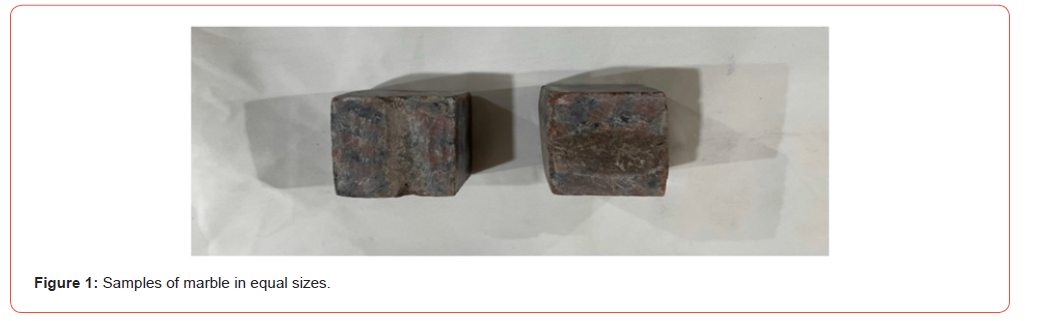
Two granite samples were prepared for this study. The first sample was subjected to sea water exposure to simulate natural weathering conditions, while the second sample was treated with a protective oil coating. Both samples were obtained from the same source material to ensure compositional consistency for comparative analysis. Figure 1 shows the preparation of marble samples of equal sizes for the experiment.
Examination processes
Three examination techniques were used, fracture load test, scanning electron microscopy, and X-ray diffraction, in the laboratories of Cairo University, the study used a Bruker D8 Advance X-ray Diffractometer with Cu-Kα radiation (λ = 1.5406 Å), operating at 40 kV and 40 mA. Scanning parameters included a 2θ range of 14° to 79°, a step size of 0.02°, and a scan speed of 2°/min. The Lynx Eye XE detector and a zero-background silicon holder were employed, with DIFFRAC.EVA software utilized for peak identification and phase analysis.
Results
Uniaxial Compression Test:
In the Soil and Foundations Laboratory at the Faculty of Engineering, Alexandria University, a fracture resistance test was meticulously carried out. This test aimed to measure the cohesion of granite stones when submerged in water, comparing samples that were coated with pumpkin seed oil to those that were left uncoated. The test results provided crucial insights into the effectiveness of the oil coating in enhancing the granite’s resistance to underwater damage, highlighting its potential as a protective agent against the harsh marine environment. Through this comprehensive analysis, the study sought to validate the viability of natural oils as sustainable preservation methods for submerged artifacts. Table 1. Illustrate result of compression test:
Table 1:Result of compression test.

X-Ray Differaction:
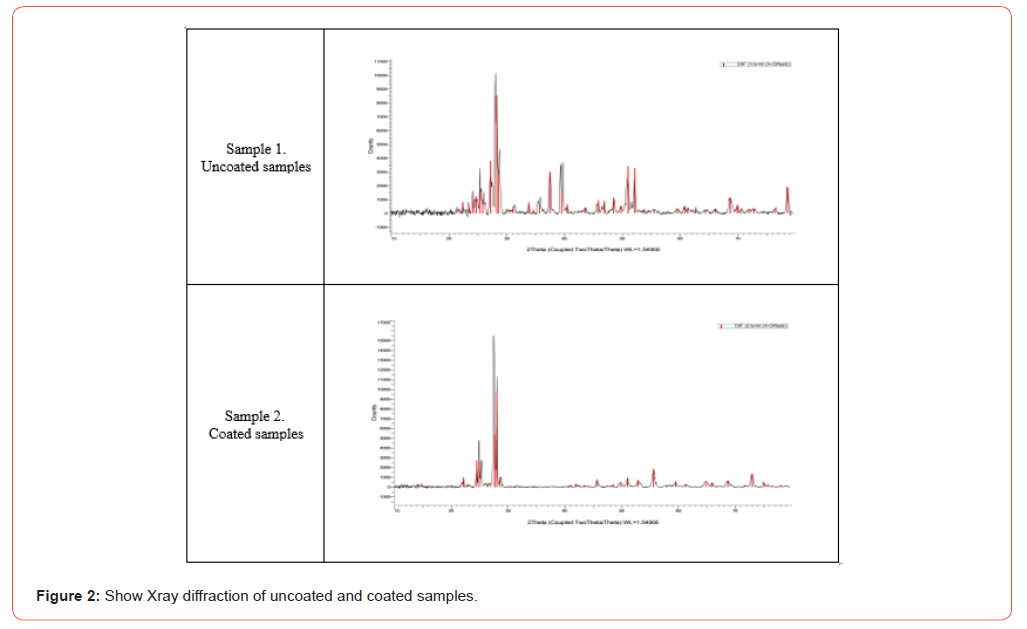
The XRD patterns revealed distinct differences between the deteriorated and oil-treated granite samples. The deteriorated granite (Sample 1) showed multiple crystalline phases with varying intensities, notable for primary peaks at 28.238° (100% intensity), 27.223° (44.9%), and 50.955° (40%). Secondary peaks included 37.448° (35.7%) and 52.125° (38.5%), while minor peaks ranged between 20° and 25° (2.6% to 17%) and 60° to 75° (3.4% to 13.6%). Conversely, the oil-treated granite (Sample 2) displayed significant differences in peak intensities and positions, with primary peaks at 28.001° (100%), 27.695° (54.7%), and 24.520° (27.5%). Secondary peaks included 55.605° (19%) and 72.934° (14.3%), and minor peaks ranged between 14° and 23° (1.8% to 9.9%) and 41° to 52° (1.6% to 8.4%). Figure 2. Show Xray diffraction of uncoated and coated samples.
Scanning Electron Microscope:
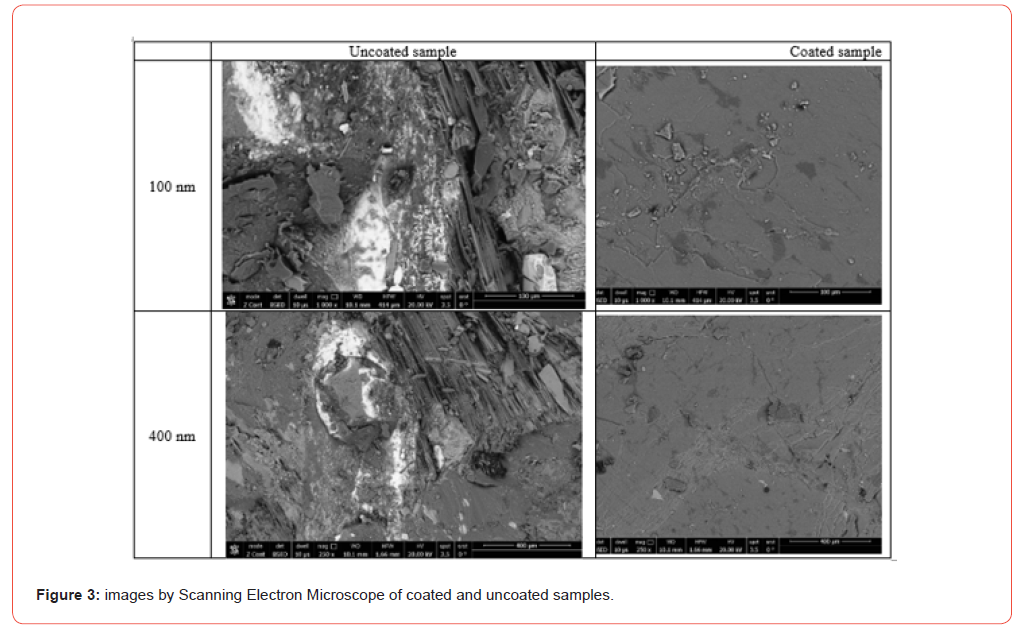
Figure 3. Shows images by Scanning Electron Microscope of coated and uncoated samples, Comparison of granite samples exposed to damage factors in an environment simulating sunken granite monuments, and another sample in the same environment but coated with pumpkin seed oil, shows the appearance of white color in the samples, which usually shows the deposition of salts on the surfaces of granite grains, while it did not appear in the coated sample coated with oil with a hydrophobic property. As previous research has mentioned that granite is exposed to biological damage and salt damage, the results show the extent of failure in the durability of uncoated granite, which confirms the success of the process of coating granite with pumpkin seed oil in protecting granite from damage factors in the marine environment.
Discussion
The XRD patterns reveal significant mineralogical changes in deteriorated granite due to seawater exposure, compared to oil-treated samples. Deteriorated granite shows feldspar degradation, clay mineral formation, and partial quartz dissolution. Key weathering mechanisms include hydrolysis, ion exchange, and physical deterioration due to salt crystallization. Conversely, oil-treated granite exhibits preserved crystal structures, reduced weathering, and maintained integrity, demonstrating the protective benefits of oil treatment. This study highlights the importance of preventive measures to protect granite structures in marine environments. The comparison of granite samples under simulated marine conditions highlighted significant differences between the uncoated and oil-coated stones. The uncoated granite exhibited a noticeable white coloration, indicative of salt deposition on the granite grains’ surfaces. In contrast, the pumpkin seed oil-coated sample maintained its integrity and showed no signs of this salt deposition, thanks to the oil’s hydrophobic properties. This observation aligns with previous findings that granite is prone to biological and salt damage in marine environments. The results underscore the vulnerability of uncoated granite to deterioration, emphasizing the protective effectiveness of the pumpkin seed oil coating. This innovative approach proves to be a promising method for safeguarding submerged granite monuments from damage, potentially extending their lifespan and preserving their historical and cultural significance. The success of this coating process opens new avenues for employing natural oils as sustainable preservation solutions in marine archaeology.
Conclusion
The process of coating granite with pumpkin seed oil was able to act as a waterproof and salt-repellent layer, preventing water from seeping into the stone and limiting the disintegration caused by the impact of water. Thanks to this, the damage caused by the salinity of seawater was stopped. In addition, previous studies have confirmed that pumpkin seed oil has antibacterial properties. The comparison of granite samples under simulated marine conditions highlighted significant differences between the uncoated and oil-coated stones. The uncoated granite exhibited a noticeable white coloration, indicative of salt deposition on the granite grains’ surfaces. In contrast, the pumpkin seed oil-coated sample maintained its integrity and showed no signs of this salt deposition, thanks to the oil’s hydrophobic properties. This observation aligns with previous findings that granite is prone to biological and salt damage in marine environments. The results underscore the vulnerability of uncoated granite to deterioration, emphasizing the protective effectiveness of the pumpkin seed oil coating. This innovative approach proves to be a promising method for safeguarding submerged granite monuments from damage, potentially extending their lifespan and preserving their historical and cultural significance. The success of this coating process opens new avenues for employing natural oils as sustainable preservation solutions in marine archaeology.
Recommendation
After the success of the practical application in the process of protecting granite submerged in sea water by coating it with pumpkin oil, this has added a scientific benefit in the sciences that apply the protection of submerged granite antiquities with such techniques, and it may be our new line to establish highly distinguished Egyptian museums from father to son.
Acknowledgement
None.
Conflict of Interest
None.
References
- Norwich J (2007) The Meddle Sae: A History of The Mediterranean. Vintage Books, London.
- Flemming NC (2004) Submarine Prehistoric Archaeology of the North Sea. Council for British Archaeology, York.
- Oikonomopoulou K (2018) The long-term effects of Underwater Archaeological Parks on the Preservation of Underwater Cultural Heritage. An Overview.
- Bass G F (2011) Archaeology Beneath the Sea. Thames & Hudson.
- Marveled TJ, Guérin U, Egger B (2013) Manual for Activities Directed at Underwater Cultural Heritage. UNESCO.
- Henderson J (2013) Maritime Archaeology. Springer.
- Bass G F (2005) A History of Seafaring: Navigating the World’s Oceans. National Geographic Society.
- UNESCO (2002) UNESCO Convention on the Protection of the Underwater Cultural Heritage 2001.)
- Bass G (1970) Archaeology Underwater Harmondsworth: Penguin pp. 13-20.
- Bowens A (2009) Underwater archaeology: the NAS guide to principles and practice. Blackwell Publishing, Oxford pp. 96-170.
- Lenihan DJ (2020) "Recent Advances in Underwater Archaeology." In Science and Technology in Historic Preservation1و
- Martin CJM (2020) Underwater Archaeology. In Encyclopedia of Global Archaeology, Springer.
- Abd el Maguid MM (2012) Underwater Archaeology in Egypt and the Protection of its Underwater Cultural Heritage. Journal of Maritime Archaeology 7(1): 193-207.
- Martinez IN, Davidde B, Masiello A (2022) Deep Water Surveys and Excavations in the Mediterranean. Journal of Nautical Archaeology.
- Flemming NC (2004) Submarine Prehistoric Archaeology of the North Sea: Council for British Archaeology, York.
- Pournou A (2016) Preserving Maritime Cultural Heritage. Springer.
- Bass GF (2011) Archaeology Beneath the Sea. Thames & Hudson.
- Maarleveld TJ, Guérin U, Egger B (2013) Manual for Activities Directed at Underwater Cultural Heritage UNESCO.
- Henderson J (2013) Maritime Archaeology. Springer.
- Kimberly Williams MA (2004) AlexandrIa and the sea, MartIme origins and underwater explorations, ISBN: 1-4107-4409-4 (e-book) pp.129.
- Abu Amin Sherine Kamal Amin, ScientIfic Methods for Treating and Preparing Recovered Granite Antiquities, Master’s Thesis, Restoration Department (Sculpture), Faculty of Fine Arts, Alexandria University, (2015) pp. 23.
- Ward C (2004) Deep-water Archaeological Survey In the Black Sea: 2000 Season. The International Journal of Nautical Archaeology, 33(1): 2-13.
- Kimberly Williams MA (2004) AlexandrIa and the Sea, Maritime Origins and Underwater Explorations, ISBN: 1-4107-4409-4 (e-book) pp.129.
- Bard KA, Fattovich R (2010) Spatial Use of the Twelfth Dynasty Harbor at Mersa Wadi Gawasis for the Seafaring Expeditions to Punt. Journal of Ancient Egyptian Interconnections 2(3): 1-13.
- Bokova I (2013) Director-General of the United Nations Educational, Scientific and Cultural Organization (UNESCO) Guide to the Summary Work of the Daily Cultural and Cultural Sector as a Result of the UNESCO Agreement: UNESCO, Paris.
- Pavlogeorgatos G (2003) Environmental Parameters in Museums. Building and Environment 38(12): 1457-1462.
- International Journal of Rock Mechanics (1987) Mining Sciences and Geomechanics 24(4): 247-250.
- Yan Xi, Junhao Xing, Hailong Jiang, Lifeng Fan, Jun Li, et al. (2023) Pore characteristic evolution and damage deterioration of granite subjected to the thermal and cooling treatments combined with the NMR method. Bulletin of Engineering Geology and the Environment.
- Wei Chen, Wen Wan, Yanlin Zhao, Qiuhong Wu, Huan He, et al. (2022) Experimental Study on Damage Properties of Granites Under Flowing Acid Solution. Frontiers in Earth Science.
- L F Fan, B Qiu, J W Gao, X L Du (2023) A Real-Time Visual Investigation on Microscopic Progressive Fatigue Deterioration of Granite Under Cyclic Loading. Rock Mechanics and Rock Engineering.
- Wu Y, Peng K, Zou Q, Long K, Wang Y (2022) Tensile properties and damage evolution laws of granite after high-and low-temperature cycles. Natural Resources Research 31(3): 1289-1306.
- Shen Y, Yuan J, Hou X, Hao J, Bai Z, et al. (2021) The strength changes and failure modes of high-temperature granite subjected to cooling shocks. Geomechanics and Geophysics for Geo-Energy and Geo-Resources 7(1): 1-18.
- Smith R, Johnson T (2021) Effects of Hydrothermal Alteration on Granite Microstructure. Journal of Mineralogy and Petrology 56(3): 245-260.
- Bass G F (2011) THE DEVELOPMENT OF MARITIME. The Oxford handbook of maritime archaeology.
- Tzavela, E, Pournou A A (2016) preliminary study on coal cubes found at a Roman wreck off the Island of Kasos.
- Nghi N Q, Lenihan M H, Saint-Pierre C, Phuong N T M, Dan P H (2020) Managing social risks and impacts from hydropower development: sharing experience from a medium-sized dam project in Vietnam. World Bank.
- Abd-el-Maguid M M (2012) Underwater archaeology in Egypt and the protection of its underwater cultural heritage. Journal of Maritime Archaeology 7(1): 193-207.
-

This work is licensed under a Creative Commons Attribution-NonCommercial 4.0 International License.




