


 Opinion
Sustainability Beyond Green-Washing
Received Date: January 05, 2026; Published Date: January 13, 2026
What Is Sustainability?
Today everybody talks about sustainability. Products, new or old, they all are suddenly becoming sustainable products. The consumer is looking for better and more sustainable products and the industry has adjusted quickly coming up with green washing marketing campaigns. Nearly everything is marketed as sustainable today. But what is the real meaning? Is there something with real impact to our environment? Is there something we could do for improving sustainability? Not just by green-washing words but by real facts? First, we have to understand the facts, then we can make a plan taking action towards real sustainability. Let’s have a look at some facts published elsewhere.
2. Key Lab for Sport Upper Materials of Fujian Province
Facts
Our climate is changing. Humanity faces the biggest challenge of their life time and already yearly damage and loss through climate change is tremendous. However, most people still ignore what is happening and reject taking meaningful action. Where does climate change come from? Let’s have a look at the CO2 concentration on earth over time. Around 50 Mio years ago CO2 concentration on earth was much higher than today, see Figure 1. Over millions of years the CO2 concentration lowered down until ending up around 200 ppm, that was the last million years. The ice ages happened during local minimum concentration followed by warm periods with higher CO2 concentration. Around 700000 years ago the first Human, so called Homo Sapiens appeared on earth, at a CO2 concentration of around 200 ppm. Human species over their whole life time were always living on a planet with CO2 concentrations around 200 -220 ppm.
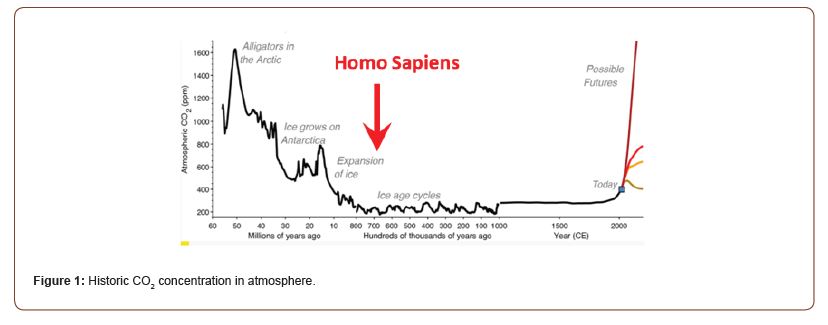
Now within the last 100 years CO2 levels significantly rose and today we measure around 400 ppm, about the double of CO2 concentration than human species ever has experienced in history. And shockingly it is still moving up exponentially very fast. That is nothing really unusual for our planet Earth but it is a massive change for human mankind. This cannot be ignored anymore. Our future depends on how we can adjust to massively higher CO2 levels, or better we find a way to control CO2 concentration for keeping our life as we are used to live.
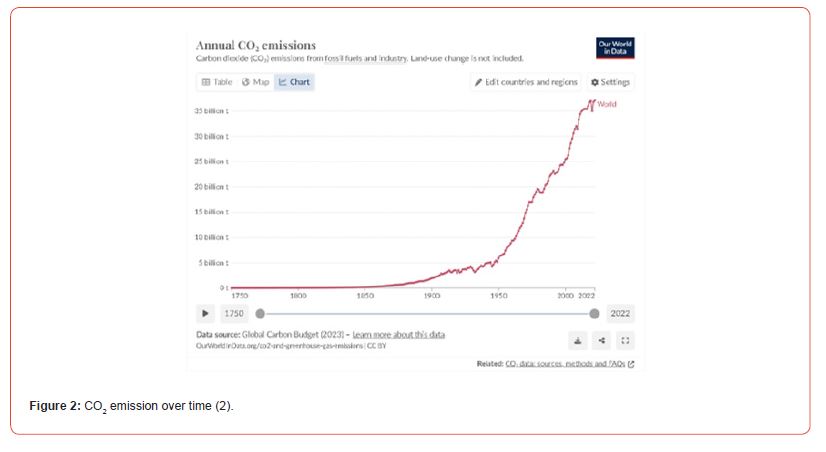
We are talking so much about sustainability, but what is really happening? Have a look at the CO2 emission in the last couple of hundred years. Figure 2 shows the obvious massive increase in CO2 emission over the last 100 years. This is dramatically changing the environment we are living in. During the Covid pandemic the CO2 emissions dropped a little but now up to higher than ever before. Although many countries committed limiting CO2 emission in future unfortunately the reality looks different (1).
Sustainability consideration needs to address these facts to be meaningful. In our modern world two major sustainability challenges could be identified:
1. Greenhouse gas emission and climate change
2. Plastic waste, the topic most sustainability thinking is all about nowadays
Plastic Waste
Let’s start looking at the plastic waste discussion. Yes, many garments and shoes contain at least some parts of plastic. Plastic waste contaminates our world, the sea, the mountains and landscape. However, is this really a problem of plastic? Plastic is a wonderful material, light weight, durable, moisture resistant, CO2 efficient and easy to recycle. Without plastic the world would look different today. Plastic waste will occur. Plastic waste in the sea is not a problem of plastic but a problem of people. Why people cannot throw plastic into a waste bin and return it for recycling? What would happen if we throw all the other material into the sea? Wood, glass, metal, stones? Would that be less damaging? The answer is clearly no. The problem with plastic is it is too cheap to collect. We do not face a problem with plastic waste but we face a problem with people throwing plastic into the environment without collection it. This needs mainly education, responsibility and a waste collection system. In many cases plastic offers much less CO2 footprint than other alternatives. For example, compare a paper bag with a plastic bag. A paper bag contributes more than 3 times more to CO2 footprint than a plastic bag, and plastic bags could easily be reused where paper bags often break already during their first use case. What we really need is a comprehensive plastic waste collection system and meaningful plastic recycling. And when it comes to recycling, we need to think much wider than today’s narrowminded view. Figure 3 schematically shows the wider recycling approach through chemical recycling.
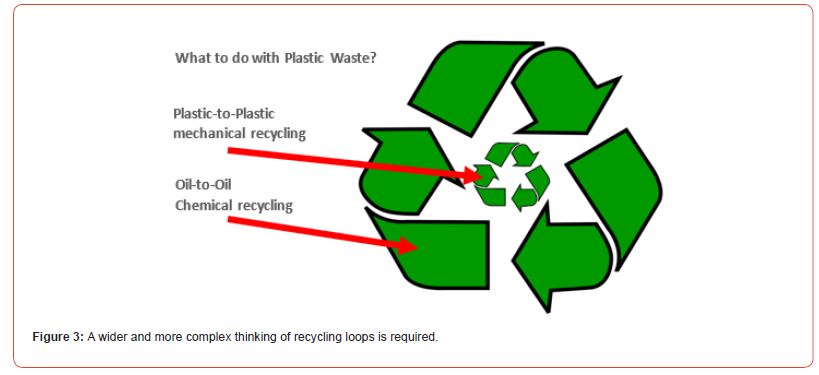
Most consumers believe a T-shirt should be recycled to become a T-shirt again. A shoe should become a shoe again. This is a very simplified narrowminded point of view and has nothing to do with sustainability. Looking at nature, recycling in a natural way happens very different. A dead Elefant will not become an Elefant anymore. Why should a shoe become a shoe again? Is there any logic? Or are we too simple minded to understand complex processes? What we really need is chemical recycling. Chemical recycling of plastic in a way that we break down complex plastic mixtures into single molecules for chemical industry. Like oil we dig out of the ground we can refine plastic waste and produce all the chemical products we need, from medicine to polyester. This can be done the same way with mixed plastic waste. No need to make even plastic again, we could use it to make medicine, electronic or anything else with the base chemicals, and sure we could also make plastic again. We need sophisticated chemical recycling systems.
Greenhouse Gas Emission and Climate Change
Greenhouse gas emissions are our biggest problem we face today as described above. Looking at the historic CO2 concentration the question appears what happened to all the CO2 50 million years ago? Where did it go? CO2 cannot just disappear and the carbon needs to be somewhere. The answer could be found in oil. Many millions of years ago plants and microbes found a paradise on earth and were growing massively. Later they sediment to the sea floor and were compressed under high pressure and temperature. During millions of years all this biomass turned into crude oil. Today we dig it out and burn it, releasing the CO2 again. What we have to understand is crude oil is a 100 % bio material. Oil is a wonderful carbon storage material. Without oil capturing the high concentration of CO2 human mankind would not be here today. For our sustainability we should always be aware about that fact. Oil and durable plastic we make out of oil are wonderful carbon capturing materials. Ideally, we should never release the once captures carbon out of these materials. Whenever we burn oil, or plastic, we make the biggest mistake releasing CO2 which was safely captured.
We need to change our mind focusing on greenhouse gas emissions when talking about sustainability. It is not very meaningful talking about bio products and plastic as something opposite. At the end both, crude oil-based products and plantbased products are all 100% bio material and it just does not make sense focusing on the so called “bio materials”. A much better differentiation is looking at the CO2 cycles of various materials. There are carbon capturing materials, such as crude oil, durable plastic and shell fish sediments for example. These materials keep the carbon locked in for a long time, in the case of oil for millions of years. Let’s call these materials the long CO2 cycle materials. The so called “bio materials” based on freshly grown plant s like wood, cotton, natural fibers in general, are on the other side. They capture CO2 during their growth but quickly release CO2 again during bio degradation at the end of their life time. Let’s call that short CO2 cycle. Now, thinking about sustainability and the actual situation we face we need to re-evaluate our thinking. Short CO2 cycle materials are nice to have in an environment where everything keeps constant. Carbon is captured and release all the time with CO2 levels staying constant. However, as we have seen above, today we face about double CO2 concentration than 100 years ago and rapidly increasing CO2 emissions worldwide. Focus on long CO2 cycle materials seems to be the best solution. We need to capture CO2; we need to produce durable materials which can keep the carbon locked in for extremely long time and we should never release the captured CO2. That means burning material is the worst thing we could possibly be doing. It does not matter weather bio mass, oil or plastic. Burning and releasing CO2 is wrong. Whenever we have bio mass capturing carbon we should keep the carbon insolid state. Biodegradation is our biggest problem, not a solution. Biodegradation is a kind of cold fire releasing CO2. Biodegradation is our biggest problem right now. Permafrost is melting, large amounts of biomass are starting degradation and releasing CO2. This is hard to stop now but producing bio degradable industrial materials is not very smart when it comes to CO2 emissions. Nobody would construct a car with optimized corrosion for biodegradation. The opposite is done, automotive coatings today protect the metal of the car, extend its life time and guarantee functionality. Why fashion and shoes should be biodegradable? Compromising on durability and function and releasing CO2 during biodegradation is not a good solution. It is obviously wrong thinking and the wrong direction for sustainability. What we need is durable materials, carbon capturing and storage and recycling without releasing CO2.
Solutions
When it comes to sustainability considerations we should focus on the facts and not emotional green thinking. Plastic in most cases is the most environmentally friendly solution with lowest CO2 footprint. Durability is more important than biodegradation when it comes to CO2 cycles. Sustainability today means focusing on long CO2 cycle materials with long term CO2 storage effects. These materials should be recycled without releasing the captured CO2. Wherever possible mechanical recycling of thermoplastic materials is the most efficient solution. However, in reality this can only be done with a small fraction of all the plastic waste we generate as high purity of the incoming materials is required.
For the big quantity of plastic waste, mixed materials, contaminated and colorful materials a full chemical recycling needs to be applied. Breaking the polymers and compounding additives into single basic molecules will allow feeding them back into the normal chemical process industry for creation of virgin like new products. Technically this is very well possible but often is disregarded as too expensive compared to new products made of crude oil. As long as we do not fairly pay for the environmental damage it will be cheaper manufacturing new oil-based products and burning the waste materials. Releasing CO2 is the unacceptable result. However, if cost constrains are the real hurdle for chemical recycling and oil is cheap, we could also think about feeding the mixed plastic waste back into the very long CO2 cycle. This could practically be done by burying plastic waste where it comes from, down in the cavities of the oil fields. There the plastic waste will slowly turn back to become oil over millions of years in a natural chemical recycling process. Most important will be keeping the carbon captured, whatever we do. Turning fresh plant materials into durable plastic could also be a solution for carbon capturing. Biodegradation should be avoided as durability of products is compromised and CO2 is released during the biodegradation process.
References
- https://www.unep.org/resources/emissions-gap-report-2024
- https://ourworldindata.org/greenhouse-gas-emissions
-

This work is licensed under a Creative Commons Attribution-NonCommercial 4.0 International License.