

 Review Article
A Multi-Dimensional AI Platform for Transparency in Ethical Working Conditions
Received Date: June 12, 2026; Published Date: June 23, 2026
Abstract
This paper discusses the need for design and development of a comprehensive platform to digitally capture data on working conditions across
multiple industries, through development of an AI/machine learning system that leverages multiple sources of data to create transparency to the
public, to investors, and other key stakeholders that seek to promote individual freedom, free markets, competition, and entrepreneurship. The data
could be used to produce a multi-dimensional transparency index that succinctly summarizes working practices within multiple industries that
relies on multiple sources of data. This index could be employed to inform multiple stakeholders:
(1) Governments: Improve the visibility of human labor practices for monitoring compliance to evolving government regulations.
(2) Small to medium-sized brands: provide reliable ethical factory data to support sustainable sourcing; and (3) Consumers: Support decisionmaking
for sustainable purchases.
(4) Larger brands: Provide a reliable third-party vehicle for communicating their efforts to support labor rights to consumers.
(5) Investors: Provide a reliable index to support investment in ESG-targeted organizations.
(6) Factory owners: Provide a reliable indicator of opportunities to continuously improve working conditions for workers.
(7) Factory and agricultural workers: Provide a vehicle to identifying poor practices in the workplace, and offering opportunities to seek
employers with better working conditions. The platform could leverage multiple sources of data to overcome previous attempts to provide
transparency to the public on workers’ right to work in a safe and ethical workplace.
Introduction
Despite decades of press coverage, initiatives to improve labor practices in global supply-chains have generated limited benefits for factory workers in developing countries. For instance, reports continue to document incidents of modern slavery, unsafe working conditions, and unfair wages occurring in apparel factories. A critical aspect that has helped lead to these poor practices is a widespread lack of transparency in apparel supply chains. Specifically, downstream brands, retailers, and importers lack visibility into the practices of their direct manufacturers (i.e., Tier 1), as well as the unmonitored working conditions of extended supply chain actors (i.e., Tiers 2 and above). As governments increase the requirements for monitoring labor and human rights, the lack of visibility into labor working conditions creates challenges for companies like Amazon to identify such risks in their supply chains and remedy issues when discovered.
Social Compliance Audits (SCAs) are the predominant method used by organizations to monitor, enforce, and measure labor compliance amongst suppliers. Social compliance auditing represents a growing industry, with an estimated value of $300M+ in 2022. While the use of SCAs to monitor opaque supplier operations has steadily increased since the early 21st century, typically, only large firms can afford to employ supply base audits. The cost and resources required to conduct audits often precludes small and medium brands from ensuring their suppliers are meeting social compliance standards. There are more than one hundred different types of SCA’s (in the apparel industry alone), including those conducted by third parties, brands’ internal representatives, or those generated by factories through self-assessments. This makes it exceptionally difficult to weed through and understand which SCA’s are more robust in its methodology and truthful in reporting results.
The SCA process is commonly determined by the buying organization’s code of conduct which reflects their unique commitment to ethical supply chain practices. In most cases, a single auditor or team, will visit a supplier’s facility for 1-2 days to assess compliance. The auditor will carefully walk through a facility, asking a long set of predetermined audit questions (typically involving pass/fail, yes/no, data collection, and qualitative responses). Despite their limitations, a single audit generates a wealth of information on the social compliance performance of a facility.
Vast amounts of audit data for apparel factories have been generated over several decades. Most apparel facilities are audited at least once every other year, with tens of thousands of audits being conducted annually in the apparel industry. Yet, this data is rarely used for purposes beyond providing a temporary checklist to illustrate compliance with a brand’s code of conduct requirement. Audit documents are commonly saved in PDF formats and are not coded or digitized for later analysis. Audit data is not shared with the public, nor is it shared between companies in within the same industry and are merely a “snapshot” in time.
In short, consumers, investors, governments, small brands, and factory owners need an improved approach for assessing whether a product and/or organization is pursuing an ethical approach to managing labor rights in the supply chain.
The Problem
Clearly, supplier audits are not enough, especially given the
digital transformation underway in so many industries. Our prior
project funded by the Templeton Charitable Foundation, the Ethical
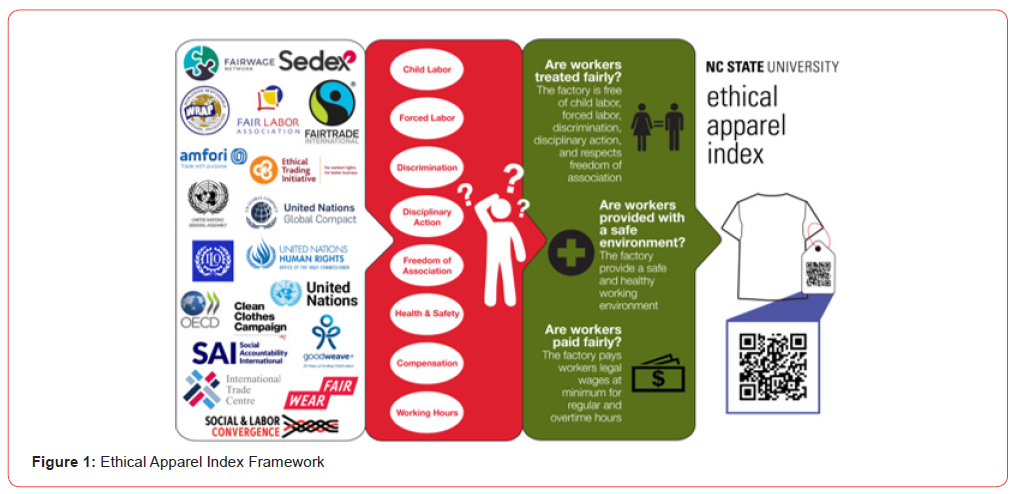
Apparel Index, created a system for simplifying multiple social audit
frameworks and summarizing the outcomes in a simplified format
(see Figure 1). The format answers three essential questions:
1. Are workers paid fairly?
2. Are workers treated fairly? and
3. Are workers operating in a safe working environment?
While these questions appear to be simple, the reality is that answering them involves an incredible amount of complexity in terms of measurement, assessment methods, and human bias (see our HBR article for further discussion on this development). Second, these questions need to be answered across multiple industries. While our prior work has focused on the apparel sector, due to the proliferation of unsafe working conditions highlighted in the press, the reality is that horrific working conditions exist in multiple industries. This proposal will focus on four primary industries that are known to have the most egregious working conditions: electronics, mining, agriculture, and apparel. These four industries will be targeted as they are also the most commonly discussed in the press.
Third, even when working condition audit data are available, brands, retailers, and manufacturers are loath to share this data with consumers, for fear of negative press and retribution. As we note, there is no such thing as a “perfect” factory or working environment, and our goal is to establish a baseline for improvement, and then to continuously improve and work on ways to address shortcomings. But this is not a message that brands and retailers wish to convey to consumers, as there have been so many negative repercussions in the press. The issue then, is to find other means for assessing how well an organization is doing, relative to a “baseline” level of compliance.
To achieve this goal, we need to rely on more than one source of data. Simply relying on audit data is not enough. Our research through the EAI revealed that there are many different types of audits, and considerable variation and bias in how the data is collected, disseminated, and validated, and represents only a single moment in time. We are therefore seeking a new approach, that will rely on multiple forms of data inputs to create a more holistic and validated approach for assessing how organizations treat workers in their supply chains. This means moving beyond simply digitizing supplier audit data, but to create a platform that accesses multiple forms of data to summarize and capture supply chain compliance to labor rights, which is accessible to consumers and brands using AI, Large language models, and machine learning.
By creating a multi-dimensional index that is digestible to multiple stakeholders, it can be made available to various parties to ensure well-informed decision-making, especially at the point of retail consumption, investing, sourcing decisions, marketing, and government monitoring. The data will serve as the cornerstone for numerous initiatives we plan to undertake which will foster ethical working practices within the apparel and food industry. Increased transparency will benefit a wide array of parties, including small and medium-sized apparel brands serving retailers, ESG (Environmental, Social, and Governance) investors, brands, government regulators, and of course retail customers. We also anticipate that the tools and methods we are proposing can be leveraged to (i) create insights into potential channels for counterfeit products and establish guidelines for stemming the tide of counterfeit goods and (ii) expand online retailers’ ability to monitor third-party sellers.
The Need for Multiple Data Sources in Creating an Ethical Working Index
To ensure a valid approach, our data sources for an Ethical
Index must meet several criteria:
a. It will rely only partially on brands to share factory data, as
they have been reluctant to do so in our experience. A bottomup
approach that requires manufacturers to share their data is
required.
b. It is based on evidence that is valid and available, including
publicly available data and worker voice data, as well as field
observations.
c. It will combine multiple forms of observations and data
using a structured analytical approach to create a standardized
and reliable metric that assesses ethical working conditions.
d. It offers the ability to identify sources for all data,
permitting further analysis and recommendations for brand
managers, investors, factory owners, and government
regulators.
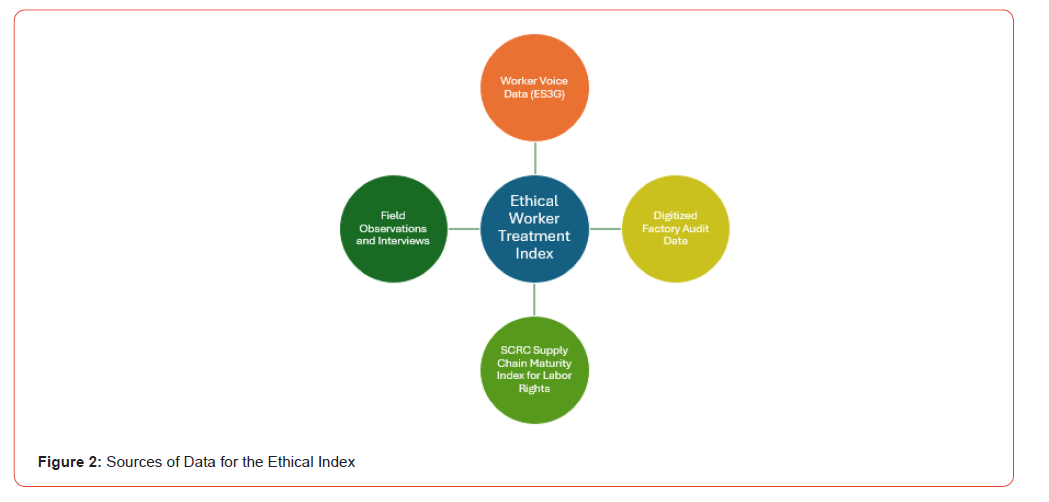
Based on our research to date, we have continued to encounter resistance to data sharing and transparency. However, our research team has achieved several critical milestones in pursuit of increased transparency of working conditions and has led us to conclude that four sources of data are available, as shown in Figure 2. Our in-depth discussions with parties in all these sectors have been encouraging, and we are confident that our work to date will prove to be successful.
References
- https://www.rfa.org/english/news/uyghur/uyghur-forced-labor-factory-07142023151509.html
- https://www.washingtonpost.com/world/2020/02/12/nandan-denim-fire/
- https://www.vogue.com/article/garment-workers-and-trade-unions-call-for-better-wages-for-workers
- https://www.fashionrevolution.org/transparency/
- https://www.hrw.org/report/2022/11/15/obsessed-audit-tools-missing-goal/why-social-audits-cant-fix-labor-rights-abuses
- Anner M, Bair J, Blasi J (2017) The Relevance of Twentieth-Century New York Jobbers’ Agreements for Twenty-First-Century Global Supply Chains. Achieving Workers' Rights in the Global Economy, 239.
- https://hbr.org/2022/11/consumer-pressure-is-key-to-fixing-dire-labor-conditions-in-the-clothing-supply-chain
-

This work is licensed under a Creative Commons Attribution-NonCommercial 4.0 International License.