


 Research Article
Obesity in Wolverhampton: Epidemiological Patterns and Ethnic Differences in BMI among Diabetes Patients
Received Date: May 29, 2026; Published Date: June 09, 2026
Abstract
Obesity is a public health priority linked to chronic disease, reduced quality of life, and health system burden. This paper presents the epidemiology of obesity in Wolverhampton, UK, and analyses ethnic differences in body mass index (BMI) among local diabetes patients. National and local data from the National Child Measurement Programme, OHID Obesity Profile, and Wolverhampton’s Pharmaceutical Needs Assessment (2025–2028) indicate that adult obesity prevalence in Wolverhampton (33%) exceeds regional (28%) and national (26%) averages, with physical inactivity at 36% and marked childhood inequalities by deprivation. A whole-systems approach is required. Additionally, an independent samples t-test compared BMI between South Asian (n=152, mean=27.26, SD=4.78) and non–South Asian (n=448, mean=28.34, SD=5.23) diabetes patients. The mean difference (1.08 BMI units) was statistically significant (t=-2.248, p=0.025), but in the opposite direction of the hypothesis that South Asian patients have higher BMI. The null hypothesis is rejected. Practical significance is modest. Limitations include unmeasured confounding and cross-sectional design. Recommendations include upstream environmental actions, school-based interventions, and culturally competent weightmanagement pathways. Further prospective studies adjusting for socioeconomic and clinical covariates are warranted.
Keywords:Obesity; Epidemiology; Wolverhampton; BMI; South Asian; Health inequalities; Public health
Introduction
Obesity is a significant population health issue since it is linked to an increased risk of morbidity (such as type 2 diabetes, cardiovascular disease, and certain cancers), poor quality of life, and high burden on the health system [1]. In standard practise in the UK, obesity in adults is often determined by Body Mass Index (BMI), with a BMI of 30kg/m2 or above constituting obesity [2]. Although BMI is popular in surveillance and service planning, it fails to represent the distribution of fat and the composition of the body completely, and thus, its interpretation needs to be cautious and integrated with the larger clinical and general health context [3]. In an epidemiological sense, obesity cannot be regarded as the mere consequence of a personal decision. It shows the way the everyday behaviours (diet, physical activity, sleep) are influenced by the social determinants, including income, housing, education, neighbourhood settings, and health-promoting resources [1,3]. It implies that obesity prevention must be approached at a population level (schools, workplaces, communities, and healthcare) and not just a piece of advice provided in clinics [3].
On the global level, fatness and obesity have been rising in most nations and regions, and the WHO terms this as an ongoing health issue that has been associated with the change in food environments, marketing, sedentary living, and the overall social and economic transition [1]. According to official monitoring systems in England, the average proportion of adults with excess weight and the average proportion of children with excess weight are exceptionally high, and there are evident inequalities by deprivation and other population traits [4,5].
This paper has two aims: (1) to describe the local epidemiology of obesity in Wolverhampton using national and local surveillance data, and (2) to analyse whether BMI differs between South Asian and non–South Asian diabetes patients in Wolverhampton, testing the hypothesis that South Asian patients have a higher BMI.
Methods
Epidemiological overview (Wolverhampton context)
Data were extracted from public health surveillance systems. National and local trends were obtained from the WHO [1], OHID Obesity Profile [4,5], National Child Measurement Programme (NCMP) via NHS England Digital [2], and Sport England Active Lives survey [6]. Local estimates were derived from Wolverhampton City Council’s Pharmaceutical Needs Assessment (PNA) 2025–2028 [7] and the Wolverhampton Public Health Annual Report 2021/22 [8]. Adult obesity was defined as BMI ≥30 kg/ m². Physical inactivity was defined as less than 30 minutes of moderate activity per week. Childhood overweight/obesity was measured at Reception (age 4–5) and Year 6 (age 10–11). Google Scholar and other search engines, including PubMed and Scopus, were used to identify relevant peer-reviewed articles, government reports, and public health surveillance data. Search terms included combinations of “obesity,” “epidemiology,” “BMI,” “Wolverhampton,” “South Asian,” “diabetes,” “health inequalities,” “physical inactivity,” and “childhood overweight.” Results were restricted to English-language publications and official UK sources published from 2020 onwards, with priority given to NHS, NICE, OHID, WHO, and Wolverhampton City Council documents.
Statistical data analysis (BMI comparison)
A secondary dataset of diabetes patients in Wolverhampton was analysed. The sample comprised 600 patients, categorised as South Asian (n=152) or non–South Asian (n=448). BMI was measured as a continuous variable. An independent samples t-test was used to compare group means. The hypothesis tested was that South Asian patients have a higher BMI. Assumptions of independence, approximate normality (justified by central limit theorem given sample sizes), and homogeneity of variance (standard deviations: 4.78 vs. 5.23, relatively close) were considered. Statistical significance was set at p<0.05.
Results
Local epidemiology of obesity in Wolverhampton
Recent evidence on the local level shows that the rate of adult obesity is more prevalent in Wolverhampton than in the West Midlands and England. The PNA 2025–2028 report for Wolverhampton reports that 33% of adults were obese in 2022/23, compared with 28% in the region and 26% in the nation [7].

Table 1: Adult Obesity and Physical Inactivity Prevalence (2022/23).

This implies that Wolverhampton has a greater responsibility in terms of the health risks and service demand of obesity than most other local authorities [3].
The risk factor related to obesity is also physical inactivity, and the PNA states that in 2022/23, obesity risk is 36% among adults in Wolverhampton compared to national (26%) and regional (29%) averages [7].

This is consistent with the measurement strategy in the Sport England Active Lives survey, which categories adults as inactive when they are under 30 minutes of activity every week [6]. A combination of increased obesity rates and increased inactivity implies that it may be more challenging to control weight within populations [9].
There is also a great local challenge among childhood indicators. According to Wolverhampton Public Health Annual Report (2021/22), 28.6% of children are overweight or obese at Reception, and this percentage increases to 42% by Year 6, with the difference across wards being strongly associated with deprivation [8]. These figures are not the most recent, as they refer to the data of 2019/20, but their epidemiological value to Wolverhampton is that (1) they indicate a significant rise during the primary school years and (2) high inequalities pattern that the local interventions should take into consideration [8].
Table 2: Childhood Overweight/Obesity Prevalence in Wolverhampton (2019/20).

*Source: City of Wolverhampton Council (2022) – Wolverhampton Public Health Annual Report 2021/22*.
Note: Data show a 13.4 percentage point increase during primary school years.
BMI comparison between South Asian and non–South Asian diabetes patients
Descriptive statistics: The mean BMI for the non–South Asian group (28.34, SD=5.232) exceeded that of the South Asian group (27.26, SD=4.779) by 1.08 units, indicating a modest but observable difference. Standard deviations suggest considerable overlap in BMI distributions between groups. The smaller South Asian sample (N=152) may be more susceptible to the influence of extreme values.
Inferential results: The independent samples t-test produced t = -2.248, with a two-tailed significance of 0.025. Since 0.025 is less than the conventional significance level of 0.05, the observed difference is statistically significant. The negative t-value indicates that the first-coded group (South Asian) has a lower mean than the second-coded group (non–South Asian).
Discussion
Determinants driving obesity in Wolverhampton Applying a key concepts model:
a) Structural and socio-economic factors (upstream): Socioeconomic
disadvantage is linked to increased obesity risk
as it affects affordability of food, housing, exposure to stress,
and health-promoting opportunities [1,5]. The reported ward
difference in childhood obesity/overweight in Wolverhampton,
closely related to deprivation, means that upstream
determinants are probably at the core of local obesity trends [8].
b) Environmental determinants (obesogenic environments):
High concentration of fast-food outlets, inaccessibility of
healthy affordable foods, and non-walkable neighbourhoods b) Environmental determinants (obesogenic environments):
High concentration of fast-food outlets, inaccessibility of
healthy affordable foods, and non-walkable neighbourhoods.
c) Social and community determinants (midstream):
The sharp rise in overweight/obesity between Reception
and Year 6 indicates risk accumulation during primary
school years, supporting whole-school interventions [3,8].
d) Downstream determinants: Diet quality, portion size,
sedentary behaviour, sleep, genetics, and medication effects all
play a role. NICE emphasises stigma-free care and understanding
that body weight is shaped by factors beyond individual control [3].
Interpretation of statistical findings
The hypothesis that South Asian diabetes patients have a higher BMI is rejected. The data show that South Asian patients have a statistically significantly lower mean BMI than non–South Asian patients (p=0.025). Practical significance is modest (1.08 BMI units). Whether this difference is clinically meaningful depends on risk thresholds for diabetes complications; however, ethnic differences in body composition (e.g., higher visceral adiposity in South Asians at lower BMI) may mean that BMI alone underestimates metabolic risk.
Strengths of the analysis
First, the large overall sample size (N=600) enhances reliability and statistical power. Second, clear comparison groups simplify interpretation. Third, BMI is a widely used measure, allowing standard statistical techniques. Fourth, statistical significance indicates that observed differences are unlikely due to random variation.
Limitations of the dataset and analysis
Confounding factors such as age, sex, socioeconomic status, diabetes duration, pharmacotherapy, lifestyle, and comorbidities were not considered; differences in these variables may explain BMI differences rather than ethnicity. BMI itself is a limited proxy, as it does not reflect adipose tissue distribution, which influences diabetes risk. Unequal cohort sizes may affect variance assumptions and make the smaller group more sensitive to anomalies. The cross-sectional design captures only a single measurement, preventing causal inference. Finally, findings are specific to diabetic patients in Wolverhampton and may not generalise to other populations or non-diabetic groups.
Public health impact on local action
High levels of obesity increase demand for prevention and support activities, such as weight management and physical activity programmes, and are linked to increased risk of chronic conditions needing continuous treatment [1]. The adult obesity level (33%) and high inactivity rates in Wolverhampton indicate that prevention and early intervention strategies should be comprehensive instead of focusing only on treatment of downstream complications [7].
Conclusion
In conclusion, obesity in Wolverhampton represents a significant public health challenge shaped by complex and interrelated social, environmental, and behavioural determinants.
The epidemiological evidence demonstrates persistent inequalities, with higher levels of obesity and physical inactivity concentrated in deprived communities and among vulnerable population groups, including children and ethnic minority communities. These trends increase the long-term burden of chronic conditions such as type 2 diabetes, cardiovascular disease, and poor mental health, placing additional pressure on local health and social care services.
A whole-systems approach is therefore essential to address the root causes of obesity and reduce health inequalities across the city. Evidence-informed strategies focusing on healthier environments, strengthened community and school-based interventions, and integrated health and care pathways provide the most sustainable and equitable response. Early prevention, culturally appropriate programmes, and improved access to local support services are particularly important in increasing engagement and improving long-term health outcomes.
Future epidemiological research should continue to investigate the relationship between deprivation, ethnicity, lifestyle behaviours, and obesity outcomes within Wolverhampton. Ongoing monitoring of local surveillance data and evaluation of interventions will be necessary to ensure policies remain responsive, effective, and aligned with the needs of the population. Through coordinated action between public health agencies, healthcare providers, schools, local authorities, and communities, Wolverhampton can work towards reducing obesity prevalence and improving population health and wellbeing.
Proposed epidemiological study to investigate further
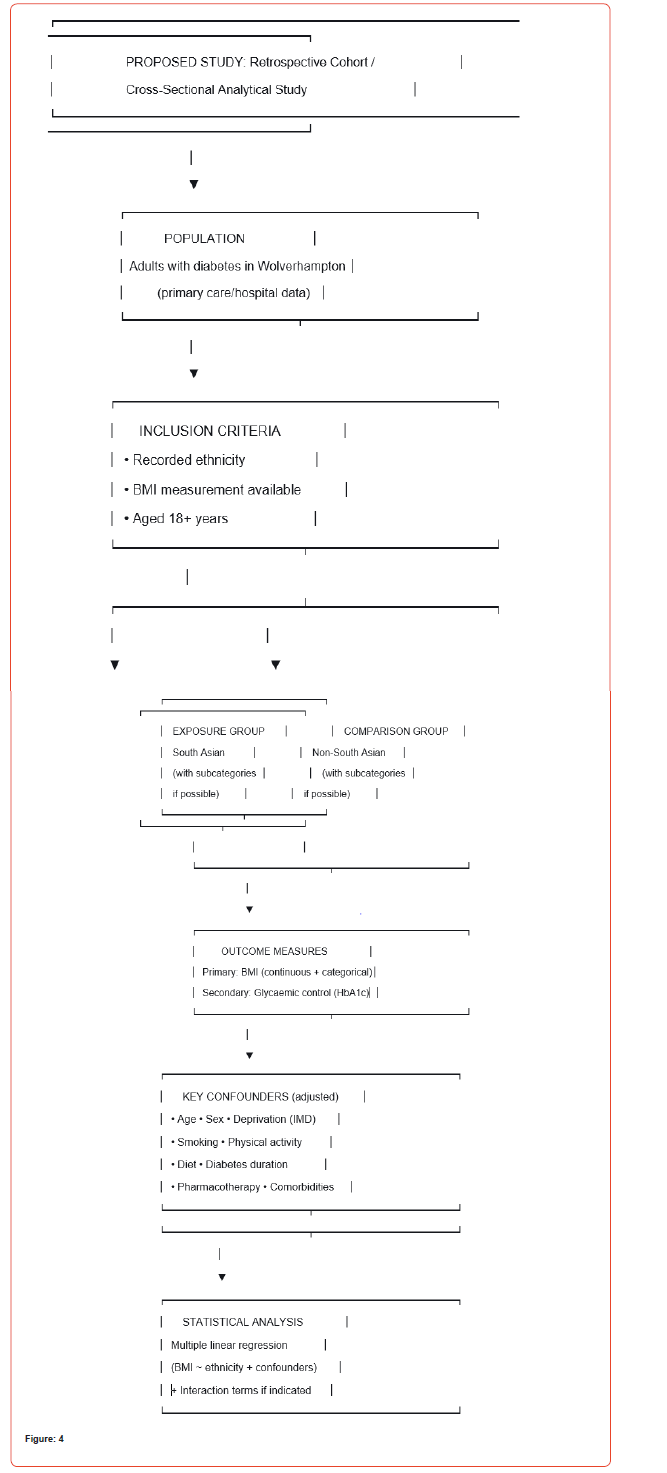
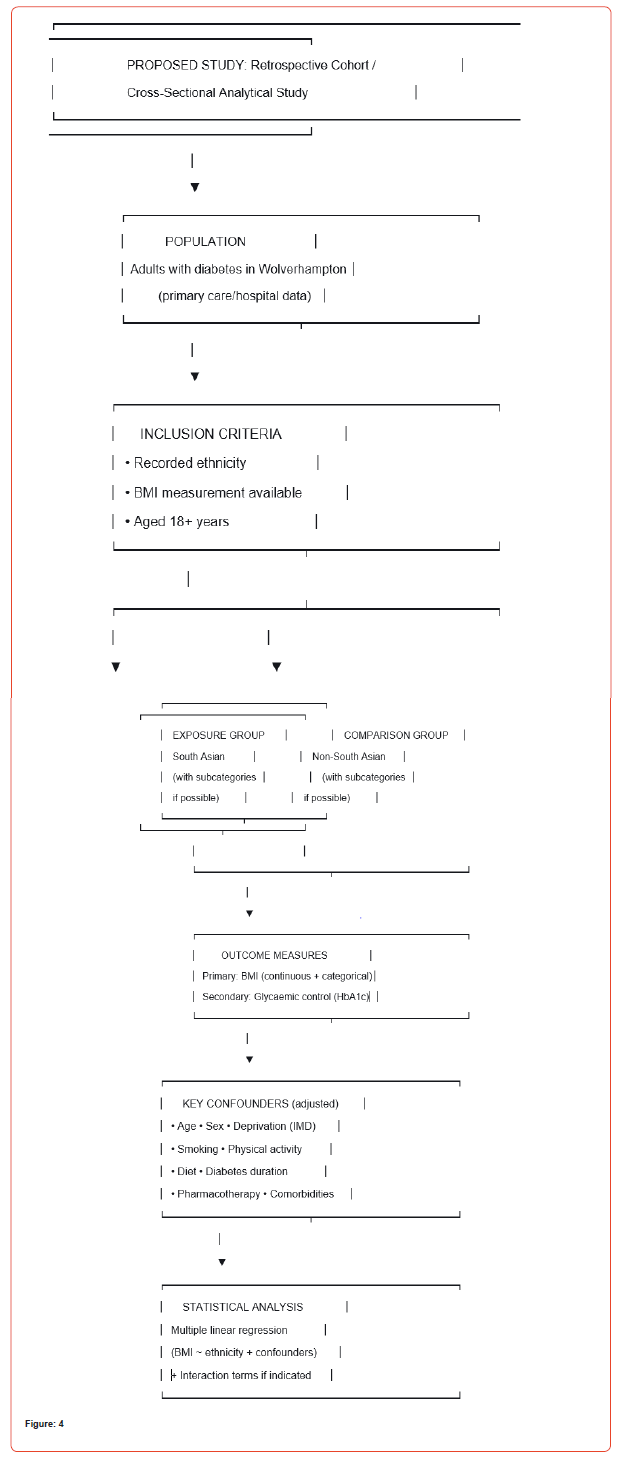
A robust empirical study is needed to clarify the relationship between BMI and ethnicity among diabetic patients. A retrospective cohort or cross-sectional analytical study using primary care or hospital data in Wolverhampton is recommended, including adults with recorded ethnicity. BMI should be measured continuously and categorically (healthy/overweight/obese), with ethnicity as the primary exposure (South Asian vs. non– South Asian, with subcategories if possible). Key confounders include age, sex, deprivation, smoking, physical activity, diet, diabetes duration, pharmacotherapy, and comorbidities. Regression modelling can assess whether ethnic differences in BMI persist after adjusting for these variables and evaluate impacts on diabetes outcomes such as glycaemic control [10,11].
Acknowledgment
None.
Conflict of interest
No conflict of interest.
References
- World Health Organization (WHO) (2025) Obesity and overweight.
- NHS (2024) National Child Measurement Programme, England, 2023/24 School Year.
- National Institute for Health and Care Excellence (NICE) (2025) Overweight and obesity management (NG246): Overview.
- Office for Health Improvement and Disparities (OHID) (2024a) Obesity Profile: November 2024 update. London: Department of Health and Social Care.
- Office for Health Improvement and Disparities (OHID) (2024b) Obesity Profile: Statistical Commentary, November 2024. London: Department of Health and Social Care.
- Sport England (2025) Active Lives Adult Survey November 2023 24 Report.
- City of Wolverhampton Council (2025) Pharmaceutical Needs Assessment Sensitivity: PROTECT.
- City of Wolverhampton Council (2022) Public Health Annual Report 2021-22.
- City of Wolverhampton Council (2024) Planning for health in Wolverhampton: Evidence base for the Wolverhampton Local Plan Policy HW1 – Health and Wellbeing.
- NHS (2023) Obesity.
- Office for Health Improvement and Disparities (OHID) (2024c) Obesity, Physical Activity and Nutrition Profile (Fingertips). London: Department of Health and Social Care.
-

This work is licensed under a Creative Commons Attribution-NonCommercial 4.0 International License.