


 Research Article
An Elementary Proof of the Intersection Number Property
Received Date: March 10, 2026; Published Date: March 25, 2026
Abstract
Using only double-counting combinatorial arguments and elementary algebra—without incidence matrices, eigenvalue theory, or other advanced tools—we establish a complete characterization of 2-designs based on their block intersection numbers. Specifically, we prove that a 2−(υ,k,λ) design has constant block intersection numbers if and only if it is symmetric (b =υ). The two directions are treated separately but with unified elementary methods, making the proof accessible to readers with a basic background in combinatorics.
MSC2020 Classification 05B05, 97H20
Keywords: Block design; Intersection number
Introduction
A 2−(υ,k,λ) design (also called a balanced incomplete block design) is an incidence structure consisting of a set P of υ points and a collection B of b blocks, each block being a k-subset of P , such that every point appears in exactly r blocks and every unordered pair of distinct points appears together in exactly λ blocks. The parameters satisfy the fundamental relations

Fisher’s inequality b ≥υ is one of the earliest and most important results in design theory. When b =υ (hence r = k), the design is called symmetric; when b>υ, it is called nonsymmetric. Symmetric designs possess many remarkable properties; for instance, any two blocks in a symmetric design intersect in exactly λ points. This classical result has been proved in various ways, including incidence matrix methods and combinatorial arguments. For further standard notation and definitions, the reader is referred to sources such as [1,2].
The study of block intersection numbers—the sizes of intersections between distinct blocks—has been a fruitful area in design theory. For a 2-design, let x1,x2,...,xs denote the distinct intersection numbers. The number s and the values of the i x ’s provide deep information about the structure of the design. For example, it is known that a 2-design with exactly one intersection number must be symmetric, and a 2-design with intersection numbers 0 and 1 only must be a nonsymmetric 2−(υ,k,1) design (i.e., a finite projective plane or a Steiner system). These results are usually derived using linear algebra. A quasi-symmetric 2-design is a nontrivial 2-design with exactly two intersection numbers [5].
Recently, several studies on quasi-symmetric designs have been conducted, please refer to [3,4,6,7].
In this paper, we give a completely elementary proof of the fundamental equivalence concerning block intersection numbers. Our main result is the following theorem.
Theorem 1.1 (Intersection Number Property). For a
2−(υ,k,λ) design, the following are equivalent:
(i) The design is symmetric, i.e., b=υ.
(ii) Any two distinct blocks intersect in a constant number of
points (necessarily λ).
The proof proceeds in two directions, each established as a lemma using only double-counting and elementary algebra. Lemma 3.1 shows that symmetric designs have constant intersection number, while Lemma 4.1 shows that if a design has constant intersection number, then it must be symmetric. Together they yield the desired characterization.
Notation and Common Setup
For any fixed block B0, let the intersections with the other
b−1 blocks be  The total number of unordered pairs of points in B0 is
  . Each such pair lies in B0 and in exactly λ−1 other blocks, so

Consider the sum S of all block intersection sizes over unordered distinct block pairs:
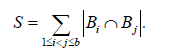
Counting by points, each point belongs to r blocks and therefore
contributes 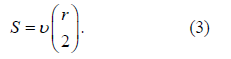 to S. Hence

Equations (2) and (3) will be the starting points for both directions of the proof.
Symmetric Designs Have Constant Intersection Number
Lemma 3.1. If a 2−(υ,k,λ) design is symmetric (b=υ ), then
for any two distinct blocks Bi,Bj we have 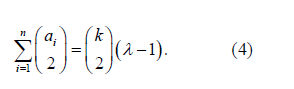 , the block
intersection number is constant.
, the block
intersection number is constant.
Proof. Assume the design is symmetric, so b =υ and r = k. From (1) we have λ(υ−1) = k(k−1). Fix a block B0 and let the intersection sizes with the remaining n =υ−1 blocks be a1,...,an. Equation (2) becomes
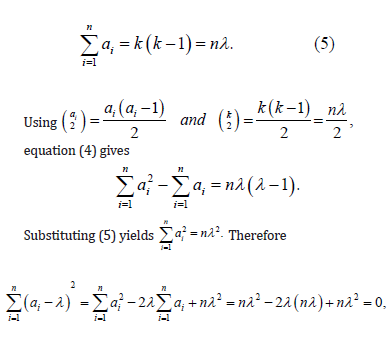
Counting incidences of points of B0 with other blocks: each of the k points of B0 lies in k−1 other blocks, so

so ai = λ for every i. Since B0 was arbitrary, any two blocks in a symmetric design intersect in exactly λ points.
Constant Intersection Number Implies Symmetry
Lemma 4.1. If a 2-(υ,k,λ) design has constant block
intersection numbers (i.e.,),  for all i ≠ j then the design must be symmetric (b =υ ).
Proof. Assume there exists a constant μ such that 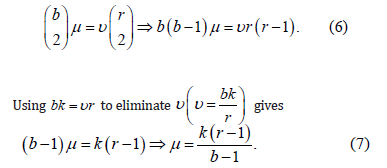 for all distinct blocks Bi,Bj.
We shall show that b =υ.
From (3) we obtain

Under the constancy assumption, every block B0 ≠ B satisfies xB = μ. Equation (2) becomes

Substituting (7) into (8) and simplifying (cancelling a factor k) yields

Now eliminate λ using the basic relation  Substitute this into the right-hand side of (9):

The left-hand side of (9) is  Hence (9) is equivalent to

Using υ =bk/r we express everything in terms of b, k, r. After straightforward algebraic manipulation, one obtains

Now suppose, for contradiction, that the design is nonsymmetric, i.e., b>υ. Then b−υ>0 and k−r<0. For b >υ>k>2, one checks that the right-hand side is strictly negative, implying that the left-hand side of (10) is negative. But equation (10) requires this expression to be zero. This contradiction shows that our assumption b >υ is impossible. Therefore, we must have b =υ, i.e., the design is symmetric.
The Proof of Main Theorem
Proof. If the design is symmetric, Lemma 3.1 gives constant intersection number. Conversely, if the design has constant block intersection numbers, Lemma 4.1 forces b =υ, hence the design is symmetric.
Conclusion
Using only double-counting and elementary algebra, we have proved that a 2-design has constant block intersection numbers precisely when it is symmetric. The proof is self-contained and avoids any advanced machinery such as incidence matrices, eigenvalue theory, or other advanced tools. This elementary approach makes the result accessible to students and researchers with a basic background in combinatorics, and it provides a clear illustration of the power of combinatorial counting arguments.
Conflicts of Interest
The authors declare no conflicts of interest.
Funding
This work is supported by the National Natural Science Foundation of China (No:11801092).
References
- CJ Colbourn, JH Dinitz (2007) The CRC Handbook of Combinatorial Designs, CRC press, Boca Raton, FL.
- ES Lander (1983) Symmetric Designs: An Algebraic Approach. London Mathematical Society Lecture Note Series (74). Cambridge University Press, Cambridge.
- JB Lu, Y Zhuang (2025) Flag-transitive point-primitive quasi-symmetric 2-designs with block intersection numbers 0 and y ≤ 10, Discrete Math 348(5):114398.
- JB Lu (2025) Flag-transitive point-primitive quasi-symmetric 2-designs and exceptional groups of Lie type, Electron J Comb 32(3): #P3.13.
- MS Shrikhande, SS Sane (1991) Quasi-symmetric designs, Publisher: Cambridge University Press.
- WB Zhang, ZL Zhang, SL Zhou (2026) On flag-transitive quasi-symmetric 2-designs, Designs, Codes and Cryptography 94(04): 1-20.
- WB Zhang, SL Zhou (2023) Flag-transitive quasi-symmetric designs with block intersection numbers 0 and 2, Journal of Algebra and Its Applications 22(04): 2350093.
-

This work is licensed under a Creative Commons Attribution-NonCommercial 4.0 International License.