


 Research Article
A Return to Origins: The Singularity of Rebounding Oscillations of Matter, Space, And Time
Received Date: June 01, 2026; Published Date: June 12, 2026
Abstract
Modern cosmology integrates general relativity, quantum field theory, and precision observational data to construct a coherent model of the universe’s origin and evolution. The ΔCDM paradigm-Δ representing dark energy and CDM representing cold dark matter-successfully explains large-scale structure, cosmic microwave background anisotropies, and nucleosynthesis. Yet the fundamental nature of dark matter and dark energy remains unknown. Increasingly, alternative models-particularly cyclic cosmology-are being explored to address conceptual issues such as the initial singularity, entropy accumulation, and the arrow of time. Cyclic models propose that the universe undergoes repeated phases of expansion, turnaround, contraction, and bounce, potentially avoiding the need for a true beginning. These frameworks draw from string theory, brane cosmology, and loop quantum gravity. This article expands each major cosmological topic, integrates cyclic interpretations where relevant, and evaluates how these models reshape our understanding of cosmic origins and destiny.
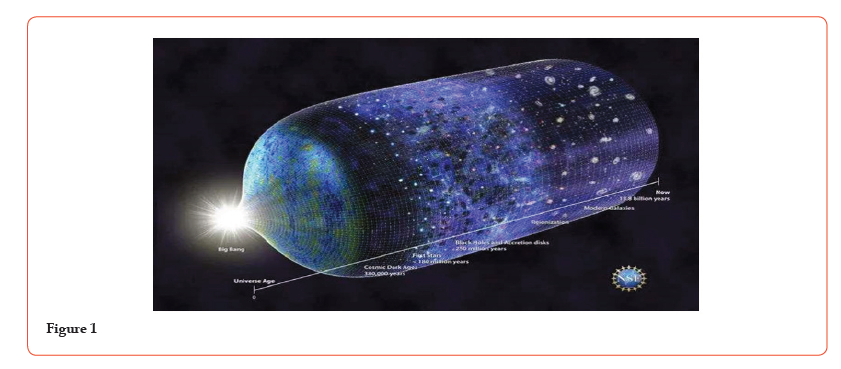
Introduction
Cosmology has evolved into a precision science supported by high-resolution measurements of the cosmic microwave background, large-scale galaxy surveys, and gravitational-wave observations. The discovery that only about five percent of the universe consists of baryonic matter has forced theorists to consider physics far beyond the Standard Model. The remaining ninety-five percent-dark matter and dark energy-governs cosmic structure and expansion, yet their physical nature remains elusive. This discrepancy motivates alternative frameworks, including cyclic models that reinterpret cosmic history as an oscillatory process rather than a one-time event. Cyclic cosmology suggests that the universe may not have originated from a singularity but from a previous contracting phase, potentially resolving the conceptual problem of infinite density. These models also offer new interpretations of entropy, proposing mechanisms by which entropy is diluted or resetbetween cycles. The introduction of cyclic ideas does not replace ΔCDM but enriches the theoretical landscape by offering alternative explanations for observed phenomena. As observational precision increases, cosmology is transitioning from descriptive to diagnostic, testing competing models against increasingly fine-grained data [1]. The interplay between theory and observation continues to shape our understanding of the universe’s past and future.
Mathematical Notes — Section 1 (Introduction)
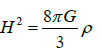
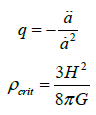
The Standard Model of Cosmology (ΔCDM)
The ΔCDM model is built on the framework of general relativity and assumes a homogeneous and isotropic universe described by the Friedmann–Lemaître–Robertson–Walker (FLRW) metric. In this model, the universe is composed of approximately 5% ordinary matter, 27% dark matter, and 68% dark energy. Dark matter provides the gravitational scaffolding for galaxy formation, while dark energy drives the accelerated expansion of the universe. ΔCDM incorporates cosmic inflation, a rapid expansion in the early universe that explains the observed flatness, homogeneity, and isotropy. Despite its successes, ΔCDM faces challenges, including the Hubble tension, the nature of dark matter, and the cosmological constant problem. These issues motivate the exploration of alternative models, such as cyclic cosmology, which aim to provide a more complete understanding of the universe [2,3].
Mathematical Notes — Section 2 (ΔCDM)
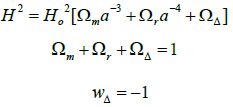
The Big Bang and Cosmic Inflation
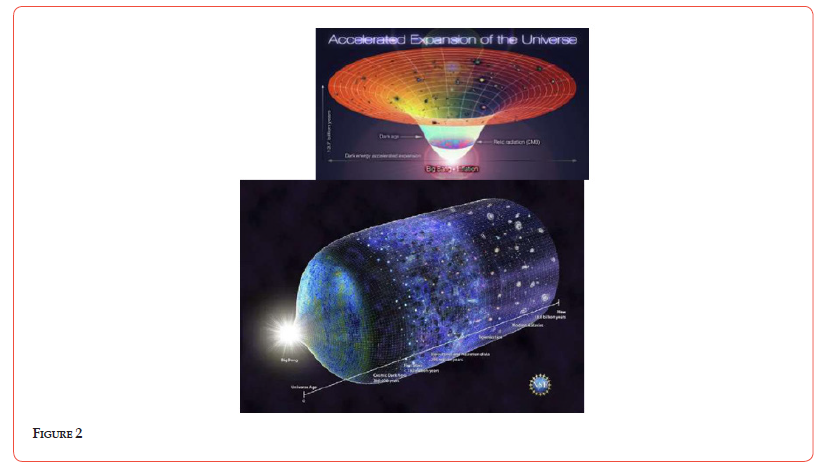
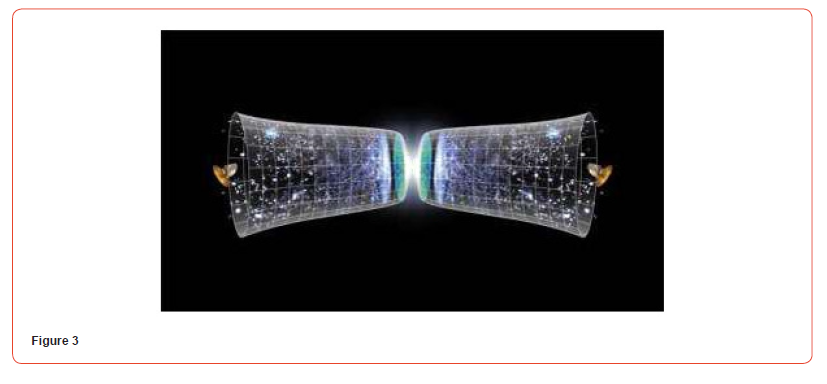
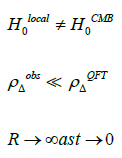
The Big Bang theory posits that the universe began in a hot, dense state and has been expanding ever since. Cosmic inflation, a brief period of exponential expansion, was introduced to address several problems in the original Big Bang model, including the horizon, flatness, and monopole problems. Inflation stretches quantum fluctuations to cosmic scales, seeding the formation of large-scale structure. These fluctuations are observed as temperature anisotropies in the cosmic microwave background. While inflation is widely accepted, its underlying mechanism remains uncertain. Various models propose different scalar fields and potentials, but none have been definitively confirmed. Cyclic cosmology offers an alternative explanation for these observations without requiring a period of inflation.
Mathematical Notes — Section 3 (Big Bang & Inflation)
Problems with the Standard Model
Despite its successes, the ΔCDM model faces several unresolved issues. The cosmological constant problem arises from the discrepancy between the observed value of dark energy and theoretical predictions from quantum field theory, which differ by many orders of magnitude. The nature of dark matter remains unknown, with no direct detection despite extensive searches. The Hubble tension, a discrepancy between local and early-universe measurements of the Hubble constant, challenges the consistency of ΔCDM. Additionally, the initial singularity predicted by general relativity suggests that the theory breaks down at the beginning of the universe [4]. These problems motivate the exploration of alternative cosmological models, including cyclic cosmology, which aims to address some of these issues.
Mathematical Notes — Section 4 (Problems with ΔCDM)
Cyclic Cosmology: An Overview
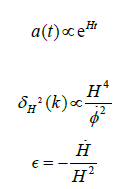
Cyclic cosmology proposes that the universe undergoes repeated cycles of expansion, contraction, and rebirth. Unlike the standard Big Bang model, cyclic cosmology avoids the initial singularity by introducing a bounce mechanism. Each cycle begins with a hot, dense state similar to the Big Bang but arises from the collapse of a previous universe. Cyclic models draw inspiration from various theoretical frameworks, including string theory, brane cosmology, and loop quantum gravity. These models aim to address the shortcomings of ΔCDM by providing natural explanations for the arrow of time, entropy evolution, and the observed large-scale structure. Cyclic cosmology offers a compelling alternative to the standard model, though it faces its own challenges and requires further observational support [5,6].
Mathematical Notes — Section 5 (Cyclic Overview)
The Bounce Mechanism
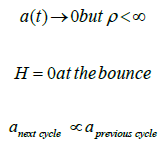
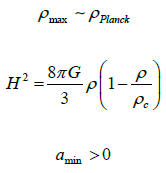
The bounce is the central feature of cyclic cosmology, replacing the singularity of the Big Bang with a transition from contraction to expansion. Various theoretical frameworks propose different mechanisms for the bounce. In loop quantum cosmology, quantum geometric effects create a repulsive force at high densities, preventing the formation of a singularity. In string theory and brane cosmology, the bounce may result from the collision of higher-dimensional branes. Modified gravity theories introduce additional terms in the gravitational action that allow for nonsingular cosmological solutions. The bounce mechanism must satisfy several conditions, including stability, consistency with observations, and the ability to generate the observed spectrum of perturbations. Understanding the bounce is crucial for evaluating the viability of cyclic cosmology [7-9].
Mathematical Notes — Section 6 (Bounce Mechanism)
Entropy and the Arrow of Time
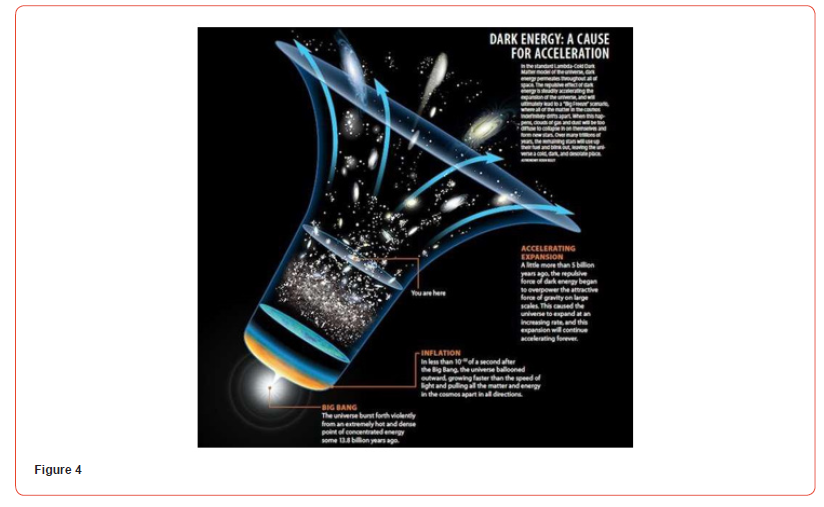
Entropy plays a central role in cosmology, as it determines the arrow of time and the thermodynamic evolution of the universe. In the standard model, entropy increases monotonically, raising questions about the low-entropy initial state of the Big Bang. Cyclic cosmology offers potential solutions by proposing mechanisms for entropy dilution or removal between cycles. Some models suggest that entropy is diluted during the expansion phase, while others propose that black holes evaporate completely before the bounce. The arrow of time may emerge naturally from the dynamics of the bounce, with entropy resetting or reorganizing in each cycle. Understanding entropy in cyclic cosmology is essential for determining whether such models can be physically consistent [10].
Mathematical Notes — Section 7 (Entropy & Time)
Cosmic Acceleration and Dark Energy
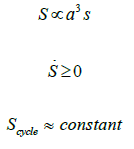
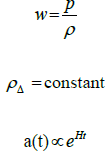
Dark energy drives the accelerated expansion of the universe, a discovery that revolutionized cosmology. In ΔCDM, dark energy is modeled as a cosmological constant with an equation of state equal to negative one. Cyclic cosmology offers alternative interpretations, suggesting that dark energy may evolve over time or emerge from higher-dimensional dynamics. Some cyclic models require dark energy to dominate at late times to trigger a turnaround, reversing expansion into contraction. Others propose that dark energy decays during contraction, altering the energy budget before the bounce. Understanding the nature of dark energy is crucial for evaluating the viability of cyclic cosmology and its predictions for the future of the universe [11,12].
Mathematical Notes — Section 8 (Dark Energy)
Structure Formation in Cyclic Models
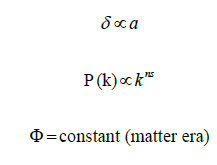
Structure formation in cyclic cosmology must reproduce the observed distribution of galaxies, clusters, and large-scale structure. In standard cosmology, quantum fluctuations during inflation seed the formation of structure. Cyclic models propose alternative mechanisms, such as the amplification of perturbations during contraction. These perturbations must survive the bounce and evolve consistently with observations. Some models predict distinctive signatures in the power spectrum, including deviations from scale invariance or suppressed small-scale clustering. Understanding structure formation in cyclic cosmology is essential for comparing these models to ΔCDM and evaluating their observational viability [13].
Mathematical Notes — Section 9 (Structure Formation)
The Cosmic Microwave Background in Cyclic Cosmology
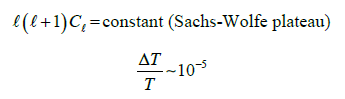
The cosmic microwave background (CMB) provides a snapshot of the universe approximately 380,000 years after the Big Bang. In ΔCDM, the CMB anisotropies arise from quantum fluctuations stretched by inflation. Cyclic cosmology offers alternative explanations, suggesting that perturbations generated during contraction can produce similar anisotropies. Some cyclic models predict distinctive signatures in the CMB, such as non-Gaussianities or largescale anomalies. Observations of the CMB play a crucial role in testCitation: Dr. Todd Brower*. A Return to Origins: The Singularity of Rebounding Oscillations of Matter, Space, And Time. Iris Jour of Astro & Sat Communicat. 2(1): 2026. IJASC.MS.ID.000530. DOI: 10.33552/IJASC.2026.02.000530. Page 6 of 11 ing cyclic cosmology and distinguishing it from inflationary models. Understanding the CMB in cyclic cosmology requires detailed modeling of perturbations across the bounce [14].
Mathematical Notes — Section 10 (CMB in Cyclic Models)
Large-Scale Structure and the Cosmic Web
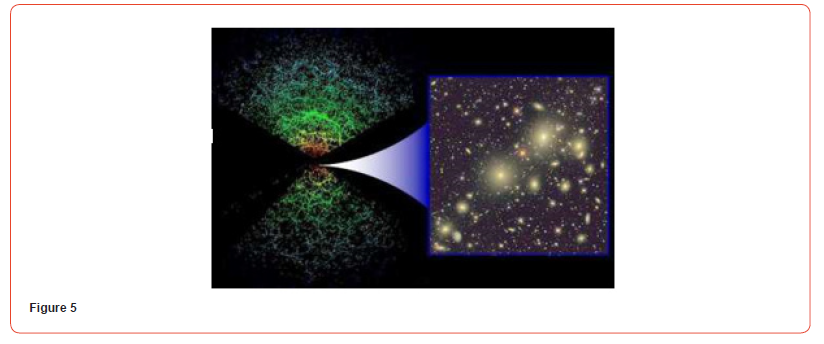
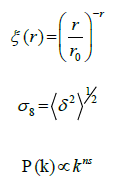
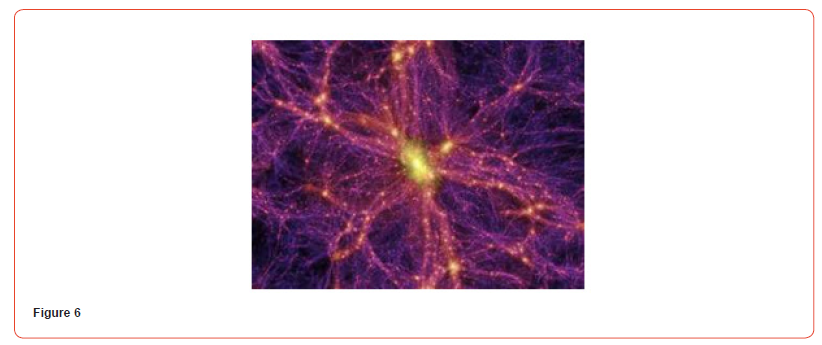
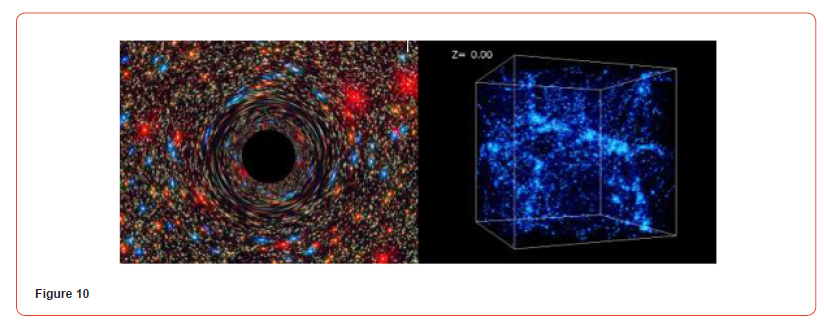
The large-scale structure of the universe consists of galaxies, clusters, filaments, and voids forming a cosmic web. In ΔCDM, this structure arises from the growth of small initial density perturbations amplified by gravity. Cyclic cosmology must reproduce this structure without relying on inflation. Some cyclic models propose that perturbations grow during the contracting phase, producing a nearly scale-invariant spectrum. The cosmic web provides a powerful observational test for cosmological models, as its statistical properties are sensitive to the underlying physics. Measurements of galaxy clustering, baryon acoustic oscillations, and weak gravitational lensing help constrain the growth of structure. Cyclic models must match these observations while offering alternative explanations for the origin of perturbations. Understanding the formation of the cosmic web is essential for evaluating the viability of cyclic cosmology [15,16].
Mathematical Notes — Section 11 (Large-Scale Structure)
Black Holes in Cyclic Cosmology
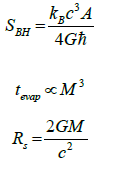
Black holes play a significant role in the evolution of the universe and present unique challenges for cyclic cosmology. In standard cosmology, black holes grow over time and contribute significantly to the entropy of the universe. Cyclic models must address how black hole entropy is managed between cycles. Some models propose that black holes evaporate completely through Hawking radiation before the bounce, removing their entropy from the universe. Others suggest that black holes may play an active role in triggering the bounce or influencing the dynamics of contraction. Understanding the behavior of black holes in cyclic cosmology is crucial for ensuring that entropy does not accumulate indefinitely across cycles. Observational evidence of primordial black holes or deviations in black hole evaporation rates could provide insights into the viability of cyclic models [17].
Mathematical Notes — Section 12 (Black Holes)
Quantum Fields Across the Bounce
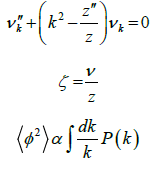
Quantum field theory in curved spacetime plays a central role in understanding the behavior of perturbations across the bounce. In cyclic cosmology, perturbations generated during contraction must pass through the bounce and reappear in the expanding phase. This requires a consistent treatment of quantum fields in a background that transitions from contraction to expansion. Some models propose that perturbations remain continuous across the bounce, while others suggest that matching conditions must be applied. The behavior of quantum fields across the bounce determines the spectrum of primordial perturbations and influences the formation of large-scale structure. Understanding these processes is essential for evaluating the predictions of cyclic cosmology and comparing them to observations [18,19].
Mathematical Notes — Section 13 (Quantum Fields)
Dark Matter vs. Dark Energy
Dark matter and dark energy represent two fundamentally different components of the universe’s energy budget. Dark matter clusters under gravity, forming halos that shape the cosmic web, while dark energy appears to be uniformly distributed and exerts negative pressure, driving cosmic acceleration. In ΔCDM, dark energy is modeled as a cosmological constant with an equation of state equal to negative one. Cyclic cosmology offers alternative interpretations, suggesting that dark energy may evolve over time or emerge from higher-dimensional brane dynamics. Some cyclic models require dark energy to dominate at late times to trigger a turnaround, reversing expansion into contraction. Others propose that dark energy decays during contraction, altering the energy budget before the bounce. Distinguishing between dark matter and dark energy is essential for understanding cosmic evolution across cycles [20-23].
Mathematical Notes — Section 14 (Dark Matter vs. Dark Energy)
The Future of the Universe
The Big Freeze (Heat Death)
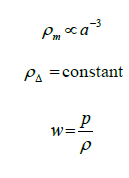
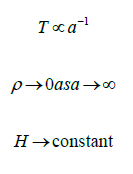
The Big Freeze scenario predicts that the universe will expand forever, gradually cooling as stars exhaust their nuclear fuel. Over trillions of years, star formation will cease, and the universe will become increasingly cold and dark. In ΔCDM, this is the most widely accepted long-term fate. Cyclic cosmology challenges this scenario by proposing that expansion will eventually reverse, preventing eternal cooling. Whether this occurs depends on the behavior of dark energy [24,25].
Mathematical Notes — Section 16.1 (Big Freeze)
The Big Rip
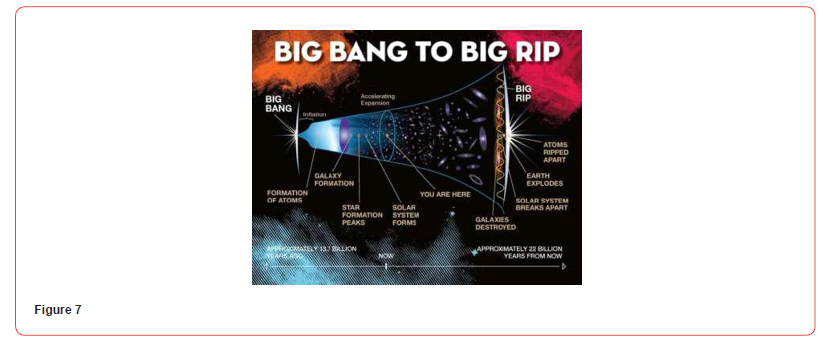
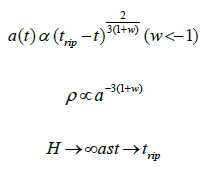
The Big Rip scenario arises if dark energy has an equation of state less than negative one, causing the expansion rate to accelerate without bound. In this case, the scale factor diverges in finite time, tearing apart galaxies, stars, and even atoms. While current observations do not strongly favor phantom energy, it remains a theoretical possibility.
Mathematical Notes — Section 16.2 (Big Rip)
The Big Crunch
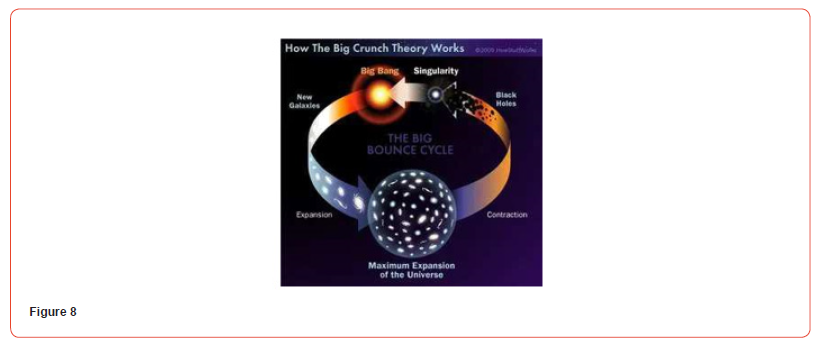
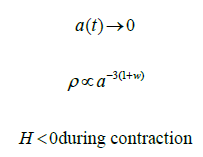
The Big Crunch scenario predicts that the universe will eventually stop expanding and begin contracting. This requires that the total energy density exceed the critical density or that dark energy decays or reverses sign. In cyclic cosmology, the Big Crunch is not an endpoint but a transitional phase. Instead of collapsing into a singularity of infinite density, the universe reaches a finite minimum scale factor where quantum gravity effects become dominant. These effects generate a repulsive pressure or modified spacetime geometry that halts the collapse and initiates a new expansion phase. This bounce replaces the classical singularity and provides a natural mechanism for resetting cosmic conditions between cycles. Whether a Big Crunch occurs depends critically on the long-term behavior of dark energy. If dark energy decays, reverses sign, or emerges from higher-dimensional dynamics, contraction becomes possible. The Big Crunch therefore plays a central role in many cyclic models, offering a bridge between successive cosmic epochs [26-28].
Mathematical Notes — Section 16.3 (Big Crunch)
Conclusion
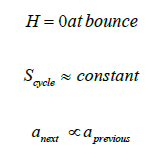
Modern cosmology presents a universe that is vast, dynamic, and deeply mysterious. The ΔCDM model successfully explains many observations but leaves fundamental questions unanswered. Cyclic cosmology offers an alternative framework that addresses some of these issues, particularly the initial singularity and entropy accumulation. By proposing that the universe undergoes repeated cycles of expansion and contraction, cyclic models provide a new perspective on cosmic origins. Observational tests, such as measurements of primordial gravitational waves and non-Gaussianities, will play a crucial role in evaluating cyclic scenarios. Whether the universe is a one-time event or an eternal cycle remains one of the most profound questions in science [29].
Mathematical Notes — Section 16 (Conclusion)

Observational Tests for Cyclic Cosmology (Addendum Material)
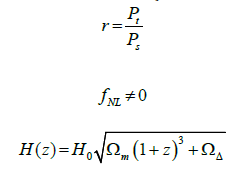
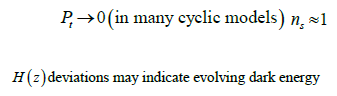
Cyclic cosmology must be testable to be scientifically viable. One of the most important observational tests involves the search for primordial gravitational waves, which inflation predicts but many cyclic models suppress. Another test involves non-Gaussianities in the cosmic microwave background. Large-scale anomalies, such as hemispherical asymmetry or the cold spot, may also provide clues. Observations of large-scale structure and the late-time behavior of dark energy further constrain cyclic models. Measurements of the Hubble parameter at different epochs may reveal deviations from ΔCDM that cyclic models can naturally explain. The absence of certain relics—such as topological defects—may also support cyclic scenarios. Together, these observational avenues form a comprehensive framework for evaluating the viability of cyclic cosmology [30].
Mathematical Notes — Section 17 (Observational Tests)
Entropy and the Arrow of Time in Cyclic Models
Entropy poses a major challenge for cyclic cosmology. In a universe that undergoes repeated cycles, entropy would be expected to accumulate, eventually preventing future cycles. Cyclic models propose mechanisms for entropy dilution, often during the expansion phase when the universe becomes extremely large. Some models suggest that black holes evaporate completely before the bounce, removing major entropy reservoirs. Others propose that entropy is redistributed or effectively reset during the bounce due to quantum gravitational effects. The arrow of time may emerge naturally from the dynamics of the bounce, with entropy gradients defining temporal direction in each cycle. Understanding entropy evolution is essential for determining whether cyclic cosmology can remain consistent across an infinite sequence of cycles [31].
Mathematical Notes — Section 18 (Entropy & Arrow of Time)
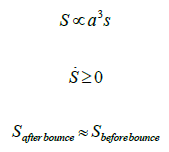
Quantum Gravity and the Bounce Mechanism
The bounce requires a mechanism capable of preventing the formation of a singularity. Classical general relativity predicts that a contracting universe collapses into infinite density, so quantum gravity must intervene. Loop quantum gravity suggests that spacetime is quantized at the smallest scales, preventing infinite curvature. String theory provides another avenue, particularly through brane cosmology, where brane collisions can generate periodic bounces. Modified gravity theories introduce additional terms that allow for nonsingular cosmological solutions. Each framework offers a different physical interpretation of the bounce, but all share the goal of replacing the classical singularity with a finite, well-defined transition [32].
Mathematical Notes — Section 19 (Quantum Gravity & Bounce)
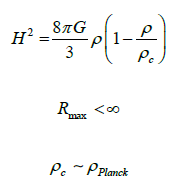
Philosophical Implications of a Cyclic Universe
A cyclic universe challenges traditional assumptions about cosmology and metaphysics. If the universe has no beginning and no end, the question of “Why is there something rather than nothing?” takes on a new dimension. Instead of a singular creation event, existence becomes an eternal process. The concept of time becomes more complex, as the bounce may represent a boundary where conventional notions of past and future break down. The idea of eternal recurrence, explored in ancient philosophy, finds new relevance in modern cosmology. Cyclic models also raise questions about determinism, causality, and the nature of physical law across cycles [33].
Mathematical Notes — Section 20 (Philosophical Implications)
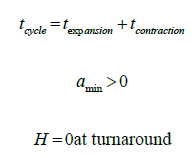
Future Directions in Cyclic Cosmology Research
Cyclic cosmology is entering a new era of theoretical and observational development. Advances in gravitational-wave astronomy may soon provide direct tests of bounce models. Next-generation CMB experiments will probe the primordial universe with unprecedented precision. The study of dark energy remains central, as its long-term behavior determines whether a future contraction is possible. Numerical simulations of contracting universes are becoming increasingly sophisticated, allowing researchers to model perturbations across the bounce. Interdisciplinary research—spanning quantum gravity, thermodynamics, and astrophysics—is expanding the conceptual foundations of cyclic models. As observational capabilities grow, cyclic cosmology may transition from speculative theory to testable framework [34-36].
Mathematical Notes — Section 21 (Future Directions)
References
- Einstein A (1915) Die Feldgleichungen der Gravitation. Sitzungsber. Preuss. Akad. Wiss. Berlin 48: 844-847.
- A Friedmann (1922) Über die Krümmung des Raumes. Z. f. Phys 10: 377-386.
- Lemaître AG (1931) A homogeneous universe of constant mass and increasing radius accounting for the radial velocity of extragalactic nebulae. Mon. Not. R. Astron. Soc 91(5): 483-490.
- Tolman RC (1934) Relativity, Thermodynamics and Cosmology, Oxford University Press, Oxford PP. 591.
- Weinberg S (1989) The Cosmological Constant Problem. Rev. Mod. Phys 61(1): 1-23.
- Guth AH (1981) Inflationary universe: A possible solution to the horizon and flatness problems. Phys. Rev. D 33(2): 347-356.
- Linde AD (1983) Chaotic Inflation. Phys. Lett. B 129: 177-181.
- Mukhanov VF, Chibisov GV (1981) Quantum fluctuations and a nonsingular universe. JETP Lett 33: 532-535.
- Smoot GF, Bennett CL, A Kogut, Wright EL, J Aymon, et al. (1992) Structure in the COBE DMR first-year maps. Astrophys. J. Lett 396: L1-L5.
- N Aghanim, Yashar Akrami, M Ashdown, Jonathan Aumont, Carlo Baccigalupi, et al. (2020) Planck 2018 results. VI. Cosmological parameters, Astron. Astrophys 641: A6.
- G Hinshaw, D Larson, Eiichiro Komatsu, DN Spergel, CL Bennett, et al. (2013) Nine-year Wilkinson Microwave Anisotropy Probe observations: Cosmological parameter results. Astrophys. J. Suppl. Ser 208(2): 19.
- AG Riess, Alexei V. Filippenko, Peter Challis, Alejandro Clocchiatti, Alan Diercks, et al. (1998) Observational evidence from supernovae for an accelerating universe. Astron. J 116(3): 1009-1038.
- S Perlmutter, G Aldering, G Goldhaber, Richard Knop, P Nugent, et al. (1999) Measurements of Ω and Λ from 42 high-redshift supernovae. Astrophys. J 517(2): 565-586.
- V Springel, Simon D M White, Adrian Jenkins, Carlos S Frenk, Naoki Yoshida, et al. (2005) Simulations of the formation, evolution and clustering of galaxies and quasars. Nature 435(7042): 629-636.
- JF Navarro, CS Frenk, S White (1997) A universal density profile from hierarchical clustering. Astrophys. J 490(2): 493-508.
- S White, MJ Rees (1978) Core condensation in heavy halos: A two-stage theory for galaxy formation and clustering. Mon. Not. R. Astron. Soc 183(3): 341-358.
- PAR Ade, RW Aikin, D Barkats, SJ Benton, CA Bischoff, et al. (2014) BICEP2 I: Detection of B-mode polarization. Phys. Rev. Lett 112(2): 24110185-24110198.
- AG Riess, Stefano Casertano, Wenlong Yuan, Lucas M Macri, Dan Scolnic (2019) Large Magellanic Cloud Cepheid Standards Provide a 1% Foundation for the Determination of the Hubble Constant and Stronger Evidence for Physics beyond ΛCDM. Astrophys. J 876(1): 85.
- A Vilenkin (1983) Eternal inflation and the present universe. Phys. Rev. D 27: 2848-2855.
- PJ Steinhardt, N Turok (2002) A cyclic model of the universe. Science 296(5572): 1436-1439.
- J Khoury, BA Ovrut, PJ Steinhardt, N Turok (2001) The ekpyrotic universe. Phys. Rev. D 64: 123522.
- M Bojowald (2001) Absence of singularity in loop quantum cosmology. Phys. Rev. Lett 86(23): 5227-5230.
- Ashtekar A, T Pawlowski, P Singh (2006) Quantum nature of the Big Bang. Phys. Rev. Lett 96(14): 141301.
- SW Hawking (1974) Black hole explosions? Nature 248: 30-31.
- JD Bekenstein (1973) Black holes and entropy. Phys. Rev. D 7: 2333-2346.
- SW Hawking (1975) Particle creation by black holes. Commun. Math. Phys 43: 199-220.
- RM Wald (1994) Quantum Field Theory in Curved Spacetime and Black Hole Thermodynamics. University of Chicago Press.
- RR Caldwell, M Kamionkowski, NN Weinberg (2003) Phantom energy: dark energy with w <--1 causes a cosmic doomsday. Phys. Rev. Lett 91(7): 071301.
- AG Riess et al. (2004) Type Ia supernova distances at redshift >1. Astrophys. J 607: 665-687.
- PJE Peebles, B Ratra (2003) The cosmological constant and dark energy. Rev. Mod. Phys 75: 559-606.
- DH Lyth, AR Liddle (2009) The Primordial Density Perturbation. Cambridge University Press.
- S Dodelson (2003) Modern Cosmology. Academic Press.
- EW Kolb, MS Turner (1990) The Early Universe. Addison-Wesley.
- T Clifton, PG Ferreira, A Padilla, C Skordis (2012) Modified gravity and cosmology. Phys. Rep 513: 1-189.
- PAM Dirac (1937) The cosmological constants. Nature 139: 323.
- R Penrose (2010) Cycles of Time: An Extraordinary New View of the Universe. Bodley Head.
-

This work is licensed under a Creative Commons Attribution-NonCommercial 4.0 International License.