


 Opinion Article
The Infinite Orchard: Cultivating Learning Beyond the Institutional Gate
Received Date:June 08, 2026; Published Date:June 23, 2026
Abstract
Education has evolved from teacher-centered approaches, where knowledge transmission was controlled by instructors, to student-centered models that emphasize learner engagement, autonomy, and experiential learning. While both paradigms have contributed significantly to educational development, they continue to operate largely within an institution-centric framework that positions educational institutions as the primary agents of learning. Such an approach often overlooks the broader social, economic, and experiential environments that shape human development, creating gaps between academic learning and the realities of personal, professional, and societal life. This paper argues for a transition from institution-centric education to an ecocentric, multi-institutional learning ecosystem. Drawing on ecological perspectives of human development and contemporary educational thought, it proposes a model in which learning is co-created through the collaborative engagement of educational institutions, families, communities, industries, governments, non-governmental organizations, and training agencies. Within this framework, educational institutions serve as coordinators of a broader ecosystem rather than sole providers of knowledge. The proposed model seeks to integrate academic learning with real-world experiences, skill development, social participation, and lifelong learning opportunities. Such an approach has the potential to enhance learner preparedness for independent living, strengthen employability, improve industry–education alignment, reduce workforce training costs, and increase the social relevance of educational institutions. The paper concludes that meaningful educational transformation requires moving beyond institutional boundaries toward a collaborative and adaptive learning ecosystem capable of supporting holistic human development in an increasingly complex and interconnected world.
Keywords:Ecocentric education, educational ecosystem, multi-institutional learning, learner development, industry–academia collaboration, lifelong learning
Introduction
Teacher-centric education was the dominant form of formal education. Even today, it is in practice, especially in the early phases of education, that a student gets teaching that is designed by the teacher. Teachers not only assumed the primary role of educating students, but they also considered the most important factor in the education process, even more than the learner. The teacher was the decision maker on who should be the beneficiary, when, and how. The classroom was engaged through structured and contentdriven activities. Students depend upon teachers and textbooks; the learning method was memorization, and the emphasis was on a uniform learning experience of disciplined students (Cicchelli [1]; Hancock et al., [2]; Mascolo [3]). Historically, this approach was relevant in contexts where knowledge was scarce, specialized, and required preservation. Teachers were regarded as custodians of knowledge, and education played a vital role in maintaining cultural continuity and intellectual traditions (Lathan [1]). Later, it was noticed that teacher-centric education is rigid- always emphasizing standardization and uniformity and being less inclusive- restricting the learner, experiences, creativity, critical thinking, and autonomy (Cicchelli [1]). Educators found that the teacher-centric education is less engaging, restricts free thinking, and is not connected to the real world of the learner. These limitations disconnect students from the teacher, process, and learning (Mascolo [3]). The essential model was student-centric education where the concurrent life learner, teacher, and the world were discussed in classrooms; and the future of the educated and the application of knowledge became the end topic of every classroom discussion (DeVries & Kohlberg, [4]; Fosnot & Perry [5]). This progressive and constructive educational thought emphasized practicum along with classroom learning Dewey, 1938). This emphasised practicum in which the learner has to take decision and solve problems under the guidance and supervision of the teacher. The role of the teacher shifted to a facilitator who motivates students to learn, guide him to make decisions, and supervise in problem solution activities (Hancock et al., [2]).
Though teacher-centric and student-centric models have contributed significantly to improving engagement, relevance, and personal meaning in education, both continue to function largely within a relatively closed, institution-centric framework, which is a simplistic model. But education has a complex model that has many stakeholders and many processing layers. (Kruss, McGrath, Petersen, & Gastrow [6]). In these approaches, educational institutions are viewed as the primary authorities responsible for knowledge transmission, personal development, professional preparation, and socialization of students. Such a structure often creates an implicit monopoly over the educational process, where learning is confined within institutional boundaries, and the contributions of other social systems remain underutilized (Mulisa,[8]). As a result, the role of families, communities, industries, NGOs, peer networks, and experiential environments in shaping human development receives limited recognition. This lack of inclusiveness restricts education from becoming a truly collaborative and socially distributed process. In a rapidly changing world, where identity, skills, values, and adaptability are shaped across multiple environments, education requires a more open, interconnected, and ecologically inclusive framework rather than one dominated by a single institutional system (Bronfenbrenner [8,9]).
The institution-centric education has limited interaction with industry and the real-world experience of individuals. Education is handled by academicians who hold academic degrees and often have limited industry experience. They refer to textbooks, case studies, and research articles from an academic perspective and engage in classroom teaching within the scope of the syllabus and the limited time allotted to them. There are many other inherent and structural reasons for that. The outcome is the occurrence of past-oriented learning supported by easily explainable examples and case studies. This leads to a disconnect between the academic world and the real and independent life of a future student. The grade obtained by students does not reflect their growth and merit.
Students’ academic performance does not reflect their growth and merit. The impact of an institution-centric approach to education is not negligibly small, but gravely unproductive because institution-centric education lacks integration with real-world contexts such as:
I. Industry and the community;
II. Lack of opportunities to learn from industry experts and
practitioners;
III. Less focus on skill development;
IV. Industries spend time and money on training fresh
graduates; and
V. Limited conversion of students in to a productive workforce.
Since education is a formative period before independent living, the institution-centric approach will limit the growth and development of the individual, especially in third-world countries/ developing countries, where the challenges are the large student population and standardization of the education system. The concept of learning/formation for life is compromised. Though teacher-centric and student-centric approaches have contributed significantly to educational progress, their institution-centric orientation limits their ability to address the complex, multi-layered nature of human development and adequately prepare learners for the dynamic demands of future personal, social, and professional life (Roseth et al., [10]; Yigezu [11]).
Institutional-Centric to Ecocentric / Multi- Institutional Education
Existence is highly connected to relevance. If the existence of an institution is not relevant, replacement happens, be it in industry or educational institutions. An important challenge faced by educational institutions in developing countries is the migration of students to developed countries for better education, career, and living options. Today’s world and future belong to one who can collaborate, be it in an individual, educational, or industry setting. Because capturing the amount of change will be impossible for individual entities. There is a high chance to institutional centric approach will fail in the short run. The solution is a multiinstitutional, eco-centric approach. Zhang and Maesako [12] assert that in today’s dynamic world, education must be offered in a ubiquitous environment. Decades ago, Wilder (1981) had communicated that education needs to follow a complex ecological model to meet the meaningful attainment of its outcomes. serve learners. Educational institutions must partner with industries, NGOs, training firms, and the community. And these partners must train students with their experience and expertise, along with the fundamentals they learn with the help of their teachers. The curriculum developers must ensure the participation of the partners and coordinate their engagement not only in training, but also in the assessment of student merits. An academician must do research and an internship with partners. This will not only help them gain skills and support their students, but also enable them to work with industry experts to design a training curriculum for practitioners’ lifelong learning. The role of an educational institution would be the maintainer of the educational ecosystem, where collaboration transforms education into a shared responsibility, creating a learning ecosystem that is contextual, applied, and responsive. And its natural outcome would be that the prodigy who was co-creator and is ready to embark on life with minimum supervision and training, and led by passion and inspiration.
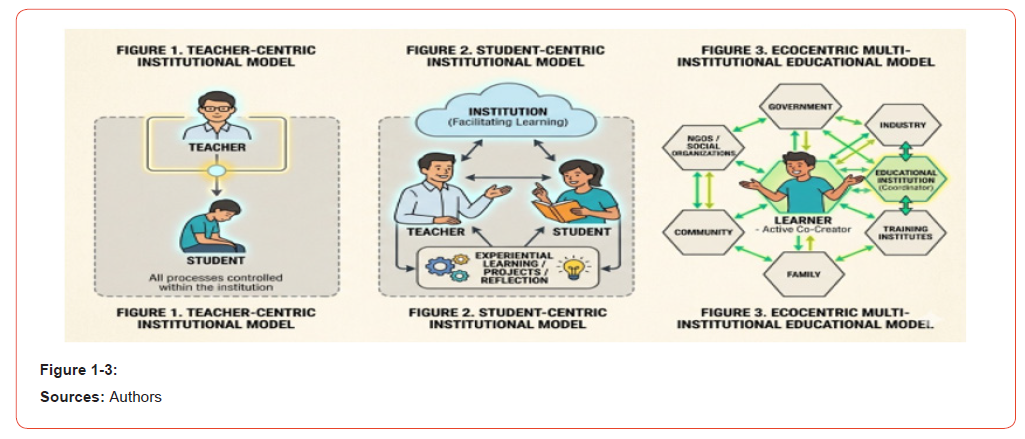
Figure 1 collectively illustrate the transformation of educational paradigms from a conventional teacher-centric institutional model to a more collaborative and ecocentric framework of learning. Figure 1 presents the traditional teacher-centric model in which the teacher occupies the central position in the educational process, exercising primary control over knowledge transmission and classroom activities, while the student remains a passive recipient within the institutional structure. Figure 2 depicts the student-centric institutional model, in which learning becomes more interactive and participatory through experiential activities, projects, and reflective practices, facilitated by both teachers and institutions. Figure 3 further extends this evolution by introducing an ecocentric multi-institutional educational model that situates the learner at the center of a wider network of stakeholders, including family, community, government, industry, social organizations, educational foundations, and training institutes. This model emphasizes collaborative engagement, co-creation of knowledge, and the integration of diverse social and institutional actors in the learning process.
The benefits of such an ecocentric multi-institutional approach
would be highly promising:
I. Formation of students for responsible, effective, and
satisfying living,
II. Easy transition to independent life roles,
III. Solution to underemployment and unemployment, and
poor living standards of educated,
IV. High level of student satisfaction,
V. Improved status of education institutions, and
VI. Industry can cost-cut on training of freshers.
There are challenges for the ecocentric approach, such as
I. Difficulty in changing the mindset of management and
teachers to take up the change challenge,
II. The limited number of academicians with industry
experience,
III. Industry experts consider that teaching is the role they
can take up after retirement,
IV. Industry has hesitation to spend their valuable time with
educational institutions, and so on.
There are solutions, too. For example, joint-curriculam creation by all the identified partners, industry-linked projects can be included in module preparation; faculty promotion and incentives can be given to teachers upon completing industry experiencebased faculty development program, a professor of practice faculty positions can be created in education institutions for industry experts, accreditation agencies must give more weight to industry partnerships and industry projects of educational institutions, and direct job placement by industry partners can be another criterion for industry’s ranking on social value.
Declaration of Interest
None
Acknowledgement
None
References
- Cicchelli T (1983) Forms and functions of instruction patterns: Direct and nondirect. Instructional Science Lathan J (Eds.), Complete guide to student-centered vs. teacher-centered learning. University of San Diego 12: 43-53.
- Hancock D R, Bray M, Nason S A (2003) Influencing university students’ achievement and motivation in a technology course. The Journal of Educational Research 95: 365- 372.
- Mascolo M (2009) Beyond student-centered and teacher-centered pedagogy: Teaching and learning as guided participation. Pedagogy and the Human Sciences 1(1): 3-27.
- DeVries R, Kohlberg L (1987) Programs of early education: the constructionist view. New York: Longman.
- Fosnot C T, Perry R S (2005) Constructivism: A psychological theory of learning. In: C. T. Fosnot (Eds.), Constructivism: Theory. Perspectives and Practice. Teachers College Press, New York, NY, pp. 8-38.
- Kruss G, McGrath S, Petersen I H, Gastrow M (2015) Higher education and economic development: The importance of building technological capabilities. International Journal of Educational Development 43: 22-31.
- Mulisa F (2019) Application of bioecological systems theory to higher education: Best evidence reviews. Journal of Pedagogical Sociology and Psychology 1(2): 104-115.
- Bronfenbrenner U (1977) Toward an experimental ecology of human development. Am Psychol 32: 513-531.
- Bronfenbrenner U (1994) Ecological models of human development. In: International encyclopedia of education, M. Gauvain, M. Cole (Eds.), New York, NY: Freeman, pp. 37-43.
- Roseth C J, Johnson D W, Johnson R T (2008) Promoting early adolescents’ achievement and peer relationships: the effects of cooperative, competitive, and individualistic goal structures. Psychological Bulletin 134: 223-246.
- Yigezu M (2013) Funding higher education in Ethiopia: Modalities, challenges, opportunities and prospects. In D. Teferre (Eds.), Funding Higher Education in Sub-Saharan Africa. London: Palgrave Macmillan UK, pp. 38-70.
- Zhang H, Maesako T (2009) A Framework of learner development ecosystem for designing a ubiquitous educational informational infrastructure. Journal of Software 4(2): 124-131.
-

This work is licensed under a Creative Commons Attribution-NonCommercial 4.0 International License.