


 Research Article
Inclusive and Pro-poor Financial System in Africa: Does Islamic Finance Development Matter in Artificial Intelligence Era?
Received Date:May 16, 2026; Published Date:May 29, 2026
Abstract
Why African financial system is less developed in general and how to improve his impact on real economy? Is Islamic finance development instrumental for inclusive and pro-poor financial system in Africa in artificial intelligence era? Does it matter in improvement of financial development impact on GDP per capita in particular? Are findings valid when we consider non-Muslim countries? This paper assesses the Ben Jedidia and Ben Ayed [1] conclusions in the African context. Thus, the intuition was to assess if Islamic finance can be instrumental in the way toward pro poor and inclusive financial system in Africa through improvement of financial development impact on GDP per capita. A TSLS-IV estimation technique is applied to undertake the analyses. In the analyses, while the Islamic finance dimensions have been approximated by the gap between M3 and Credit from banking and financial system, the financial development dimension was captured by an indicator constructed with Principal component analyses. The main finding is that Islamic finance is a powerful tool for pro poor and inclusive financial system in Africa regardless the fact that they are Muslim country or not. African countries regardless the fact that they are Muslim or not, should put emphasis on Islamic finance development for pro poor and inclusive financial system and thus pro poor economic growth. This paper has tested the Ben Jedidia and Ben Ayed [1] hypotheses in the continent where concerns of less develop financial system, poverty and low economic development are most acute.
Keywords:Financial deepening; Islamic finance; Economic growth; Risk, profits and Losses sharing; Participative Financial intermediation. Artificial intelligence era.
JEL Classification: G20, O11, Z12.
Introduction
A number of stylized facts observed worldwide suggest that Islamic finance is on the right track to foster inclusive and pro poor financial sector development and stability through deepening financial system impact on economic growth (Ben Jedidia and Ben Ayed [1]). They also outperformed conventional financial institutions, including during periods of financial turmoil. As widely argued by scholars and practitioners, the Islamic finance industry has weathered the financial crisis relatively better than the convention al financial market positioning itself as a potential stabilizer of the global financial system [Hasan & Dridi [2], Aziz Zeti [3], Chapra [4], Siddiqi [5]]..
Nevertheless, despite its impressive expansion and performance, several remaining issues and challenges need to be addressed for the Islamic finance industry to fully meet its promises, particularly in Africa. For instance, there is still significant skepticism as to whether Islamic finance has a captive market in the Muslim population. In addition, Islamic finance products and services are often accused of mimicking those of the conventional financial system, while some criticisms consider the Islamic financial system as window dressing.
Islamic banks constitute the core of Islamic financial sphere, head the savings investment process and thereby the economic growth process1. Islamic banks are invited to respect many principles such as: “Riba” prohibition, Interdiction of speculation and “gharar”, Interdiction of investment in illicit sector, Profits and Losses Sharing (PLS) principle and Asset Backing principle. So, Islamic banks are different from conventional ones in both assets and liabilities sides. The Main Islamic bank’s financing characteristics are Musharaka and Mudaraba2. Investment accounts constitute the Islamic bank deposits particularity. Then, compared to conventional financial intermediation, the specific Islamic intermediation is participative financial intermediation: Mudharaba and Musharaka financing using funds of “investment accounts”3. So, within this description framework, we can highlight the potential extent to which this distinctive financial intermediation (which is participative) can promote economic growth in the world in general and in Africa in particular.
The objective of this research paper is therefore to contribute into the debate and help clarify those issues by shedding light on the essence of Islamic finance market, its relevance, performance and potential benefits and challenges for Africa in terms of inclusive and pro poor financial system development by empirically demonstrate it. By using an empirical econometric model, we are going to test the indirect effect of Islamic finance on the impact of financial deepening on economic growth in Africa with instrumental variable methodology. This will permit to check if Islamic finance can be used as an instrument to foster the impact of financial deepening on economic growth. For relative homogeneity purpose we are going to consider some sub Saharan African and Maghreb countries as a sample.
This paper on a first note contributes to existing literature by examining the concerns highlighted at the first paragraph of this introduction. Secondly, the use of much recent data (2002-2011) provides more updated policy implications. Thirdly, the focus on Africa where financial development and pro poor and inclusive economic growth debates are most tensed, helps elicit some glaring issues on structural adjustment policies (financial liberalization for the most part) imposed by the International Monetary Fund (IMF) and World Bank (WB) in bid to improve human development.
The paper will be organized as follows:
Section 1 will provide a literature review on the role of Islamic
finance development for pro poor and inclusive financial system.
Section 2 will provide an empirical investigation firstly directly
and indirectly testing if Islamic finance can be instrumentalized for
a higher financial depth impact on pro poor economic development
in Africa (Both Muslim and non-Muslim countries in one part and
only Muslim countries in other part).
Section 3 will conclude with policy recommendation.
Can Islamic finance development improve inclusive and pro-poor aspect of financial system in Africa? A brief literature review
There are several positions, both empirical and theoretical stating about the positive and/or negative role of Islamic finance development for a pro-poor and inclusive financial system and thus pro-poor economic growth.
Ben Jedidia and Ben Ayed [1] by checking the extent to which Islamic participative financial intermediation can enhance economic growth arrived to the conclusion that participative intermediation is effective and competitive in the growth and development agenda since besides sharing risk, management stimulates financial transactions and helps promote technological innovation. However, according to them, many difficulties at both macroeconomic and microeconomic levels are likely to hinder their contributions to economic development and need to be overcome by enhancing the relationships between Islamic banks-sukuk markets and establishing suitable policy reforms. These theoretical findings at the base of our hypothesis have been undertaken by several author empirically. However most or all of these works have not been applied in the context of Africa.
1 Islamic finance includes an increasingly range of institutions such as commercial banks, investment banks, takafuls, investment
companies, all respecting Islamic religion. But, islamic commercial banks dominate the market of financial Islamic assets with 73% while
takuful, sukuks issues represent respectively 1% and 11% (IFSL estimated based on The Banker, Ernst & Young at end 2008).
2 Musharaka is equity participation (active participation) of islamic bank in the capital of a firm. Mudaraba is a passive participation where
Islamic bank is an investor that provides the capital full amount while the client is responsible of business management. Profits are shared
in agreed portion but potential losses are supported by the islamic bank only except in case of manager negligence. However, Islamic banks
offer other particular financing such as Zakat financing and commercial financing based on Salam and Istisn’a.
3 The Banks act as managers of these deposits and allow them to financing project.
According to Johnson, K.,[6], highlighted firstly that Islamic banking is currently one of the fastest growing segments of the financial market industry, operating in over 75 countries through 300 institutions. Secondly by empirically analyzing the economic growth determinative power of Islamic banks, he confirmed past research for which Muslim prevalence in a population is found to be the most significant determinant of the diffusion of Islamic banks. His research results also showed that Islamic banks are not significantly correlated with economic growth and especially that after accounting for the intensity of Islamic banking, this effect became much less statistically significant, suggesting that some of the effect of convergence may operate through the propensity to adopt Islamic banking.
Ercument Aksak and Mehmet Asutay [7] show that developments in the Islamic finance industry in the last two decades have significant impact on both economies of Muslim geography and global financial markets. These developments starting from the introduction of Islamic Finance indices in conventional financial markets in the equity side of these capital markets, followed by financial innovations, such as seminal sukūk issuances captured the attention of the global financial system. According to him, this continuous growth potentially has had two main influences in the global financial system: Firstly, the development of Islamic finance has added new and novel veins supporting the global financial markets, increasing the potential pool supporting the system and secondly, investors and entrepreneurs with solid business ideas and innovations, but also with the moral and ethical concerns have gained an opportunity to provide and maintain a financing resource for their businesses. This inevitably suggests additional support for the real economies which also indicate that there is still a much higher potential to develop into for Islamic finance.
Said Al Hallaq [8] shows that Islamic banks development has had mixed success in Jordan; Indeed, according to him, “the existence of Islamic banks has proven to be for the benefit of the entire economy”. Some other authors have highlighted the role of participative financial intermediation in promoting economic growth; According to them in an ideal Islamic world, contracts are free from gharar, opportunism, asymmetric information. So, financial markets can ensure direct optimal financial contracts excluding financial intermediation. However, in Islamic countries, financial markets are “underdeveloped” despite the recent development of sukuks (Abdmoulah [9]). Henceforth, their capacity to drain funds is limited compared to that of Islamic banks. Islamic countries lack a performing accountancy system and also the domestic character of firms. According to Rajan et Zingales [10], legal system problems conduct to favor banking financing rather than market financing. Then, Islamic banks present comparative advantage on Islamic markets.
Some other author have also highlighted the potential reduction of informational and transaction costs and efficiency of saving-investment process within the experimentation of Islamic finance. Islamic banks provide a more important signal of information than the short-run financing (Ben Jedidia, [12]) and permit to reinforce the confidence in firms financed by banks; Moreover, participative intermediation constitutes a source of important information related to the situation of firms. Also, the integration of business world helps Islamic banks to provide a better collection of information at lower costs. This bank produces more accurate information about firms notably due to “the imperative of good evaluation” since the choice of projects influences not only bank’s return but also those of its depositors-investors. Unlike “credit scoring” subject to an important standardization, Islamic financing always requires complex and specific evaluations for each case. So, participative financial intermediation guarantees an efficient process of saving-investment that stimulates economic development and generates productive economic activity. Furqani and Mulyany [12] conclude to a bidirectional relation between Islamic banking development and investment: an increase of Islamic bank financing “stimulates an entrepreneurial response in the productive sectors” and leads to more investments.
Islamic financial system can play a vital role in the development of Islamic countries thanks to the further saving mobilizing outside the conventional interest system (Iqbal [13]). It is really adapted to “growth-enhancing functions” (Habib, [14]). Social justice and particularly the elimination of extreme poverty are among priority areas of Islamic financing strategies (Khan and Khan [15]).
However, as noted by Marvakis [16], many authors suggest that Islamic laws aren’t able to stimulate economic development. Since 1965, Weber considered that Islamic values constitute an obstacle to development. Moreover, according to Kjetil [17], the pragmatic and fruitful development strategy leads to a limited integration of this finance in traditional and rural sector only. Based on popular and limited financial instruments, the Islamic financial system may be weaker in delivering the needed financial services of growth as the monitoring of managers and risk reduction (Honohan, 2001). As a sample, the pure Islamic financial system in Sudan doesn’t contribute to economic growth, it also fails to mobilize resources for investment (Al-Jarhi and Hussein, 2002).
While this past literature has established ambiguously that the development of financial institutions as a determinant of economic growth, empirical research on the correlation of the diffusion of Islamic banking with economic growth, in Africa especially, is limited. This is the main justification of the redaction of this paper since he would have therefore a certain value added. Within this framework, we intend now to proceed the empirical analyses.
Data, Model and Methodology
Data and model
We examine a sample of 31 countries from African Development Indicators (ADI) of the World Bank (WB) in one hand and of 5 countries of North Africa (Muslim countries). Owing to constraints in data availability and in a bid to obtain more updated policy implications, the data-set spans from 2010-2023. Details of summary statistics (Appendix 1) and presentation of the selected African countries (Appendix 2) are in the appendices. In the selection of variables, while the Islamic finance dimensions have been approximated by the gap between M3 and Credit from banking and financial system, the financial development dimension was captured by an indicator constructed with Principal component analyses.
Formulation of financial deepening indicator for all the 30 African countries
The purpose behind the construction of a composite indicator is the ambition to have an accurate quantification that brings the maximum of possible information on the economy concerned. For this purpose, several techniques exist for the construction of an indicator such as data analysis, quadratic analysis and weighed mean method. Like Gries et al. [18], we are going to use the technique of principal component analysis, which is the most popular for the construction of the composite index of financial deepening. This is a widespread technique and more used in the multivariate analysis. Moreover, this methodology is one of the oldest in multivariate statistical analysis initially introduced by Pearson [19] and Hotelling [20].
Three indicators were selected, which made possible to use data on the 31 countries of Sub-Saharan Africa and the 5 Maghreb countries. Further financial markets deepening aspect has been neglected since the sub-region financial market is still in its infancy and there is a lack of statistical data. The first financial indicator measures the amount of credit involved in the private sector relative to the size of the economy; Specifically, the variable domestic credit to the private sector measures all private resources used to finance the private sector divided by GDP. The second indicator, “Bank Credit” is closely related to the first one but specifically takes into account the ratio of domestic credit provided by the banking sector relative to GDP. The third indicator used in the construction of the financial index measures the overall size of financial intermediation or financial depth. In fact, these variables are sensitive to the size, diversification and efficiency of financial intermediation and thus of financial deepening.
The results of the factor analysis show that the first axes explain 81.15% of the total variance of the sample during the period, which fully justifies the extraction and use of this single component for the construction of our index. Indeed, this axis corresponds to an eigenvalue greater than 1 as a condition of the choice of a single component with reference to Kaiser [21] and Jolliffe [22] analyses.
Endogenous variable
The dependent variables are the “GDP per capita growth” (LNPIBPT) indicator used to capture the level of pro poor economic development in Africa; Consistent with the literature pro poor economic development analyses.
Exogenous variable
The endogenous-explaining (exogenous) variable is the index of financial deepening (LNAPFIN) previously constructed with the Principal Component Analyses.
Instrumental variables
Borrowing from Lalountas et al. (2011) the instrumental variables in linear estimations include indicators of Islamic finance (LNISFIN) previously constructed (in levels and first differences).
Control variables
For the first stage estimation, we have retained the following variable usually presented as a potential determinant of financial deepening (Nguena, 2013): Interest rate (TXINT); Savings rate (TXEP); Population density (DENS); Real exchange rate (TXCHA); Reserves (RES).
For the second stage estimation, we have considered another
control variable usually presented in the estimation of economic
growth equation by several authors such as:
i. LNINF: The logarithm of the simple index of inflation. It takes
into account the aspect of monetary policy credibility.
ii. LNTXENOPT: The logarithm of the growth rate of per capita
nominal balances;
iii. LNOUV: The logarithm of the coefficient of trade openness is
reflected by the ratio (Exports + Imports) / GDP;
iv. LNKAOPEN: The logarithm of financial liberalization;
v. LNTXINV: This is the logarithm of the ratio (gross fixed capital
formation + changes in inventories) / GDP;
vi. LNCAPHUM: This is the logarithm of the total level of primary
enrollment. In the current analysis of economic growth, the
human factor plays a major role and the theory of endogenous
growth now tends to measure all indicators that reflect the level
of development of the human factor in each society. By the
availability of data leads us to limit the total public expenditure
on education (as a percentage of GDP).
Methodology
In line with Lalountas et al. (2011) we use Two-Stage Least Squares (TSLS) as estimation approach. We adopt the following steps in this approach. Firstly, we justify the choice of the estimation technique (TSLS over OLS) with the Hausman test for endogeneity. Secondly, we demonstrate that instrumental variable (Islamic finance indicator) is exogenous to the endogenous components of the economic growth channel, conditional on other covariates (control variables). Lastly we investigate the validity of the Islamic finance instrument with the Sargan-OIR (Over Identifying Restrictions test). The TSLS-IV estimation method adopted by this study will entail the following steps.
First-stage regression:

4 For the need of analyses and taking care of context homogeneity, we have considered only North Countries as Islamic countries namely: Morocco, Algeria, Tunisia, Egypt and Libya.
Second-stage regression:

The independent control variables are represented by X in the two equations. In Eq. (1) and Eq. (2), and respectively denote the disturbance terms. The Islamic finance index (LNISFIN) represents the instrument. APFIN stands for financial deepening while PIBPT entails the level of per capita GDP.
For robustness purposes, the empirical analysis will estimate with and without HAC (Heteroscedasticity and Autocorrelation Consistent) standard errors. However, we are going to present and interpret only the result of the analyses with HAC.
Estimation Result and Interpretation
This section addresses the ability of the exogenous components of financial deepening to account for differences in the GDP per capita; the ability of the Islamic finance instrument to explain variations in the endogenous components of financial deepening and the possibility of the Islamic finance instrument to account for the GDP per capita beyond financial deepening channels. To make these assessments, we use the panel TSLS-IV estimation method with financial and trade liberalization measures as instrumental variables. The tables below are presenting the result of our estimation.
Financial deepening and Islamic finance
Table 1 below assesses the validity of the Islamic finance instrument in explaining cross-country differences in financial deepening.
Table 1:Financial deepening and Islamic finance instrument
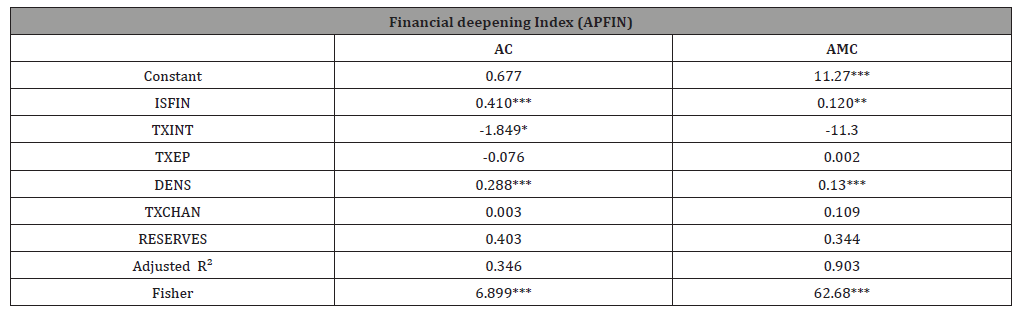
*,**,***: significance levels of 10%, 5% and 1% respectively. AC: African Countries. AMC: African Muslim Countries. Explanatory variables are: Islamic
finance development index (ISFIN); Interest rate (TXINT); Savings rate (TXEP); Population density (DENS); Real exchange rate (TXCHA); Banking
reserves (RES).
Source: Author calculation.
Clearly, it could be observed that distinguishing African countries by implementing Islamic finance help explain cross-country differences in financial deepening. Based on the Fisher-test, the instruments taken together enter significantly in all regressions at the 1% significance level for the most part. It is worth noting this is the first stage of the IV estimation approach where-by Islamic finance instruments must be exogenous to the endogenous components of financial deepening and second-stage regression control variables, conditional on other covariates (first-stage control variables). Most of the coefficients are significant with the right signs and the following could be established.
i. Islamic finance improves financial deepening level both in Africa globally and in African Muslim countries. These findings are consistent with recent African literature. The positive effect of Islamic finance on financial deepening could be elucidated by the participative intermediation and therefore the cheapest cost of the credit and the inclusiveness of the financial system it implies.
ii. Interest rate has a negative effect on financial deepening for all African countries but there is no significant impact when we consider only African Muslim countries. This is consistent with the theoretical point of view that low level of interest rate implies a modification of portfolio by increasing the demand of other asset and therefore financial deepening.
iii. Density is good for financial deepening;
iv. The other variable does not have a significant impact on the
dependent variable.
Given the validity of joint significance (Fisher test) in estimated coefficients, we proceed with the second-stage of the TSLS approach.
GDP per capita, financial deepening and Islamic finance
Tables 2 bellow investigate two main issues:
i. The ability of the financial deepening channel to explain changes
in the GDP per capita and;
ii. The possibility of the Islamic finance instrumental variables explaining changes in the GDP per capita beyond the financial deepening channel. Whereas we address the first issue by investigating the significance of estimated coefficients, the second is assessed by the Sargan-OIR test for instrument validity. The null hypothesis of the Sargan test is the view that the instruments account for GDP per capita dynamics only through the financial deepening channel. Thus, a rejection of the null hypothesis is the rejection of the view that the instruments explain GDP per capita dynamics through no other mechanisms than financial deepening channels. The Hausman-test for endogeneity precedes every TSLS-IV regression and thus justifies the choice of the estimation approach. The null hypothesis of this test is the stance that OLS estimates are consistent and efficient. Thus, a rejection of the null hypothesis points to the concern of reverse causality (endogeneity) and hence lends credit to the TSLS-IV estimation approach. Else, we model by OLS under strict exogeneity in the financial deepening channel.
Table 2 presents second-stage results with HAC. As concerns
the first issue, based on results presented below, the following
could be established:
i. Financial deepening improves the level of GDP per capita when
instrumental Islamic finance variables are linear.
ii. Also, financial deepening increases GDP per capita even when
we consider only African Muslim countries.
iii. Control variables are not all significant. However, we can notice
the negative impact of inflation in one hand and positive
impact of nominal cash flow per capita, commercial openness
(only for African Muslim countries) and investment on GDP
per capita.
Table 2:IV regressions with HAC.
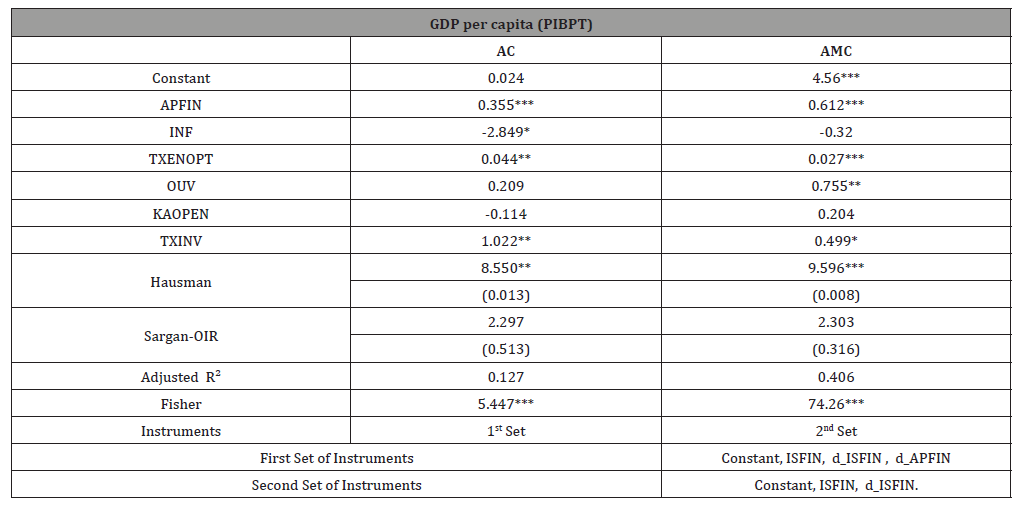
*,**,***: significance levels of 10%, 5% and 1% respectively. HAC: Heteroscedasticity and Autocorrelation Consistent. AC: African Countries. AMC:
African Muslim Countries. Explanatory variables are: Financial deepening index (APFIN); Inflation rate (INF); Nominal cash balance per capita rate
(TXENOPT); Commercial oppeness (OUV); Financial oppeness (KAOPEN); Investment rate (TXINV).
Source: Author calculation.
Result Discussion and Policy Implication
Before delving into the discussion of results, it is vital to highlight the hypotheses motivating this paper. Ben Jedidia and Ben Ayed [1] by checking the extent to which islamic participative financial intermediation can enhance economic growth arrived to the conclusion that participative intermediation is effective and competitive in the growth and development agenda since besides sharing risk, management stimulates financial transactions and helps promote technological innovation. However, according to them, many difficulties at both macroeconomic and microeconomic levels are likely to hinder their contributions to economic development and need to be overcome by enhancing the relationships between Islamic banks-sukuk markets and establishing suitable policy reforms. These theoretical findings at the base of our hypothesis have been undertaken by several authors empirically. However most or all of these works have not been applied in the context of Africa.
We have tested these hypotheses in Africa (separately Muslim countries and all African countries) from different methodological and contextual standpoints. In the analysis, the economic and social dimensions of inclusive and pro poor financial system have been reflected in financial deepening. For clarity in elucidations, we shall dissect the hypotheses in the light of our empirical results based on our two samples.
Hypothesis 1: Islamic finance is a powerful tool in GDP per capita improvement in Africa. (True). Our analysis demonstrates that Islamic finance instrumented on financial deepening mitigates (ameliorates) GDP per capita in Africa. In plainer terms, Islamic finance can be used as an instrumental tool for the improvement of GDP per capita through financial deepening. As a policy implication, there is need for Islamic finance development to go hand in glove before such an achievement could be discounted. This positive outcome could emanate from the specificity of participative intermediation. Therefore, this finding broadly confirms the theoretical underpinning from Ben Jedidia and Ben Ayed [1].
Hypothesis 2: Islamic finance is a powerful tool in GDP per capita improvement in African Muslim countries. (True). Indeed, Islamic finance is also an important tool in the improvement of GDP per capita in African Muslim countries. This result confirms also the theoretical conclusion of Ben Jedidia and Ben Ayed [1].
Conclusion and Policy Recommendation
A number of stylized facts observed worldwide suggest that Islamic finance is on the right track to foster inclusive and pro poor financial sector development and stability through deepening financial system impact on economic growth (Ben Jedidia and Ben Ayed [1]). They also outperformed conventional financial institutions, including during periods of financial turmoil. As widely argued by scholars and practitioners, the Islamic finance industry has weathered the financial crisis relatively better than the conventional financial market positioning itself as a potential stabilizer of the global financial system (Hasan & Dridi [2], Aziz Zeti [3], Chapra [4], Siddiqi [5]).
Over the past decades in Africa, the issue and search for strategies of poverty reduction through GDP per capita improvement based on a pro poor and inclusive financial system have grown in importance as a topic of public debate and a major criterion by which the civil society evaluates public authorities. This increased attention is motivated by the realization among international development experts that development requires above all good and new practices. As we have argued at the beginning of this work, in the African continent we can notice an underdeveloped and less inclusive financial system as general characteristics along with generally bad performance in terms of poverty reduction and wealth creation and distribution. Considering the specifies of Islamic finance characteristics and its relative success in solving or contribute to reduce previous problem in the area it is implemented; African countries could find a way to undertake this specific financial system as an instrument to foster the impact of financial deepening on the real economy (poverty reduction through more inclusive financial system).
Our empirical study has permit to highlight the potential of Islamic finance to foster financial deepening impact on GDP per capita in Africa independently to the fact that the countries are Muslim or not. This finding is going in the same view with some other research output on the same issue. Indeed some other author have highlighted the potential reduction of informational and transaction costs and efficiency of saving-investment process within the experimentation of Islamic finance in other context. According to them Islamic banks can provide a more important signal of information than the short-run financing (Ben Jedidia [11]) and permit to reinforce the confidence in firms financed by banks; Moreover, participative intermediation specifically correlated to the Islamic finance constitutes a source of important information related to the situation of firms. Also, the integration of business world helps Islamic banks to provide a better collection of information at lower costs than the conventional banks; This bank produces more accurate information about firms notably due to “the imperative of good evaluation” since the choice of projects usually influences not only bank’s return but also those of its depositors-investors. Indeed unlike “credit scoring” subject to an important standardization, Islamic financing always requires complex and specific evaluations for each case. So, participative financial intermediation guarantees an efficient process of saving-investment that stimulates economic development and generates productive economic activity. Furqani and Mulyany [12] concluded also to a bidirectional relation between Islamic banking development and investment: an increase of Islamic bank financing “stimulates an entrepreneurial response in the productive sectors” and leads to more investments. We can take these explanations as the reason why Islamic finance implemented in Africa could have a success since it can permit to solve some problem the traditional financial system could not. As a conclusion and base on our empirical research results, we can therefore argue that Islamic finance development can be used as a good instrument for a more inclusive and pro-poor financial system [23].
An important limitation to take into account is that studies of this kind depend to a great extent on the integrity of the proxy for Islamic finance obtained from perception-based measures. Thus, omitted variables and may substantially influence perceptions on GDP per capita grow and consequently bias the link between Islamic finance instruments, the financial deepening indicator and GDP per capita measures. However, to the best of our knowledge there are no better measurements of Islamic finance applied to the African context than those based on data from African Development Indicators of the World Bank. Also, the application of an estimation approach that accounts for endogeneity addresses the concerns of omitted variables and bias in the perception-based measures.
Declaration of Interest
None
Acknowledgement
None
References
- Ben Jedidia K, Ben Ayed N (2012) Islamic Participative Financial Intermediation and Economic Growth. Journal of Islamic Economics, Banking and Finance 56(8): 3.
- Hasan M, Dridi J (2010) The effects of Global crisis on Islamic and conventional banks: A comparative study. International Monetary Fund Working paper.
- Aziz, Z (2009) Islamic Finance and financial stability. Opening remarks at the Bank Negara malaysia High Level Conference on Financial Stability.
- Chapra, U (2008) Discussion Forum on the Financial Crisis: Comments from Islamic Perspective. IIUM Journal of Economics and management 16(2).
- Siddiqi M N (2008) Discussion Forum on the Financial Crisis: Comments from Islamic Perspective. IIUM Journal of Economics and management 16(2).
- Johnson K (2013) The Role of Islamic Banking in Economic Growth. CMC Senior Theses, pp. 642.
- Ercument Aksak, Mehmet Asutay (2011) Does Islamic Finance Make the World Economically and Financially Safer? Islamic Finance and Its Implications on Sustainable Economic Growth. Communication at the 8th International Conference on Islamic Economics and Finance.
- Said Al Hallaq (2006) Contribution of Islamic Banks to the Development of the Jordanian Economy. Islamic Finance News Guide.
- Abdmoulah, Walid (2010) Testing the Evolving Efficiency of Arab stock markets. International Review of Financial Analysis 19(1): 25-34.
- Rajan Raghuram G, Zingales Luigi (1998) Financial Dependence and Growth. The American Economic Review 88(3): 559-586.
- Ben Jedidia Khoutem (2010) L’intermédiation financière des banques islamiques. Conférence internationale : Les développements récents en économie financière, Sousse, Tunisie, pp. 15-16.
- Furqani Hafas, Mulyany Ratna (2009) Islamic Banking and Economic Growth: Empirical Evidence from Malaysia. Journal of Economic Cooperation and Development 30(2): 59-74.
- Iqbal Munawar, Ahmad Ausaf (2005) Islamic Finance and Economic Development; Palgrave Macmillan: New York, pp. 304.
- Habib Ahmed (2005) The Islamic Financial System and Economic Growth: An Assessment. M. Iqbal, A. Ahmad (Eds.), Islamic Finance and Economic Development, Palgrave Macmillan: New York.
- Khan Feisal (2010) How ‘Islamic’ is Islamic Banking. Journal of Economic & Behavior Organization 76(3): 805-820.
- Mavrakis Nadia, Islamic Finance (2009) A Vehicle for Economic Development. Michael Brandel (supervising professor), The University of Texas at Austin.
- Kjetil Bjorvatn (1998) Islamic Economics and Economic Development. Forum for development studies 2: 229-243.
- Gries T, Kraft M, Meierrieks D (2011) Financial Deepening, Trade Openness and Economic Growth in Latin America and the Caribbean. Applied Economics 43(30): 4729-4739.
- Pearson K (1901) On Lines and Planes of Closest fit to Points in Space. Philosophical Magazine. Series 6(2): 559 - 572.
- Hotelling H (1933) Analysis of a Complex of Statistical Variables into Principal Components. Journal of Educational Psychology. 24: 498-520.
- Kaiser H F (1974) An Index of Factorial Simplicity. Psychometrika 39: 31-36.
- Jolliffe I. T (2002) Principal Component Analysis (2nd), Springer, New York.
- Datuk R (2012) Islamic Finance: An Alternative Funding Source for the African Development Bank? AfDB Economic Brief.
-

This work is licensed under a Creative Commons Attribution-NonCommercial 4.0 International License.