


 Research Article
A Review of the Adverse Impacts of Excessive Artificial Intelligence Use in Daily and Professional Life
Received Date:August 11, 2026; Published Date:September 17, 2026
Abstract
Artificial intelligence (AI) tools are now widely used in day-to-day work such as writing, coding, reporting, research, decision-making, video editing, presentation, meeting arrangement, emailing, and many other personal and workplace operations, offering measurable gains in speed and convenience. However, a rapidly growing body of empirical, survey-based, and neurophysiological evidence indicates that habitual, low-effort delegation of cognitive and occupational tasks to AI carries high costs. This review synthesizes recent literature on the adverse consequences of AI overuse across four domains: cognitive decline and skill atrophy; psychosocial and mental-health strain; occupational disruption; and privacy, security, and ethical over-trust. Drawing on survey data, randomized controlled trials, and neural-monitoring studies, we describe a reinforcing “cognitive-offloading loop” in which fluent AI assistance reduces the practice needed to sustain independent skill, and we summarize labor-market and mental-health indicators showing rising AI-related anxiety. We conclude that the harms of AI overuse are not intrinsic to the technology but emerge from unregulated, unreflective patterns of use, and we propose research and policy directions for balanced human–AI collaboration.
Keywords:Artificial intelligence; Cognitive offloading; Overreliance; Digital wellbeing; Workplace automation; Human–AI interaction
Introduction
Artificial intelligence (AI) systems, particularly large language models (LLMs) and generative assistants, have moved within a few years from experimental tools to default infrastructure for writing, coding, research, customer service, personal decision-making, and many other tasks. Genuine efficiency gains have driven adoption, yet the same properties that make AI convenient, namely its fluency, availability, and low friction, create conditions for overuse: a pattern of reliance in which humans habitually delegate tasks they are otherwise capable of performing, without engaging in the effortful practice needed to sustain the underlying skill (Risko & Gilbert [1]).
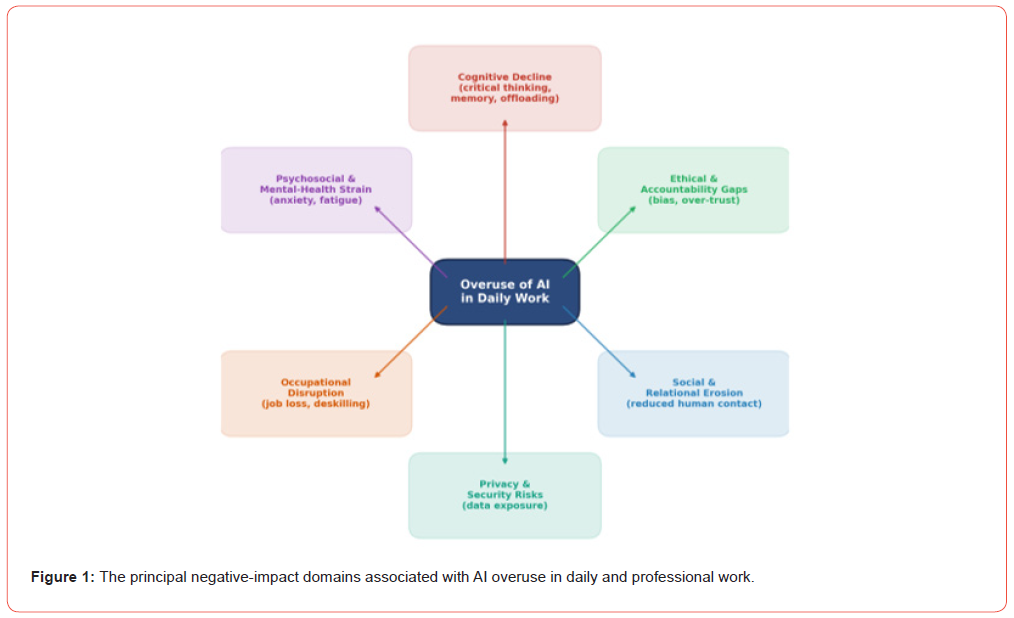
This review paper examines the negative consequences of such overuse in daily work and professional life. Rather than treating AI harms as a single, undifferentiated risk, we organize the literature into four interconnected domains, summarized in Figure 1: cognitive decline, psychosocial and mental health strain, occupational disruption, and privacy, security, and ethical overtrust. The objective is to provide researchers, educators, and policymakers with a structured, evidence-based overview suitable for guiding future empirical work and governance frameworks.
Methodology
This review draws on peer-reviewed studies, preprints, and institutional survey reports published between 2025 and 2026, identified through targeted searches of recent literature on AI overreliance, cognitive offloading, workplace AI adoption, and AI-related psychological distress. Priority was given to empirical studies with verifiable sources, including randomized controlled trials, EEG-based neural measurement, and large-sample surveys, and to reports from established labor-market and workplaceanalytics organizations.
Cognitive Decline and Skill Atrophy
The most extensively documented consequence of AI overuse is a decline in critical thinking and independent cognitive performance. In a mixed-methods study of 666 participants, Gerlich [2] found that heavy AI tool use was associated with reduced critical-thinking ability, an effect mediated by cognitive offloading, the transfer of mental effort onto an external system. Gerlich [2] further identified a pattern the author terms “cognitive laziness”: a measurable decline in the inclination to engage in deep, reflective thinking as a consequence of persistent AI reliance.
Neurophysiological evidence reinforces these survey findings. In an EEG-based study of essay writing involving 54 participants, Kosmyna et al., [3] found that participants who relied exclusively on an AI assistant showed weaker brain connectivity and reduced memory retention compared with participants who wrote unaided; notably, these effects persisted even after AI assistance was withdrawn, a pattern the authors term “cognitive debt.” Kim et al., [3] similarly argue, in a conceptual review of algorithm dependence, that the fluency with which generative AI provides solutions creates a feedback loop in which users progressively delegate more cognitive work to AI systems, with the long-term consequence of atrophying their own capacities.
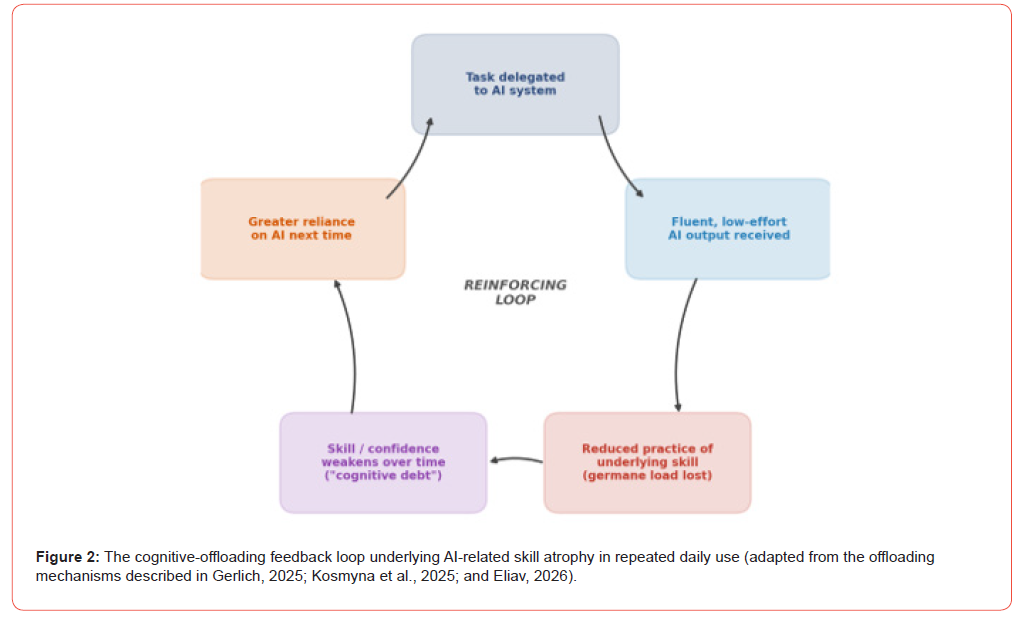
Mechanistically, this pattern is consistent with cognitive load theory: germane cognitive load, the effortful processing responsible for durable schema formation, must be experienced for learning and skill retention to occur (Sweller, Van Merriënboer, & Paas [4]). When AI absorbs this load, the practice needed to sustain a skill is lost. This dynamic echoes an earlier, pre-AI precedent: Sparrow, Liu, and Wegner [5] showed that the mere expectation of having external information readily searchable reduced spontaneous memory encoding, such that people remembered where to find information rather than the information itself. Eliav [6] extends this logic into a formal “Delegation Feedback Loop” model, in which growing AI capability progressively lowers the complexity threshold at which humans choose to delegate rather than think, further reducing the practice required to maintain cognitive capacity. Figure 2 depicts this reinforcing feedback loop, in which repeated delegation to AI produces short-term fluency at the cost of long-term competence, in turn increasing future reliance on the tool.
Psychosocial and Mental-Health Strain
Beyond cognition, overuse of and anxiety about AI are associated with measurable psychological strain. A large-sample survey of knowledge workers by Lee et al., [7] found self-reported reductions in cognitive effort and confidence when generative AI was used routinely for tasks previously requiring independent judgment. Complementing this workplace evidence, clinical researchers have proposed a distinct presentation, “AI Replacement Dysfunction” (AIRD), describing anxiety, insomnia, identity loss, and hopelessness experienced by workers navigating AI-driven role change (McNamara et al., [8]).
Notably, psychological harm is not confined to those who have already lost employment. Anticipatory anxiety, the fear that one’s role may soon be automated, appears sufficient to alter behavior and wellbeing: survey data collected in 2026 indicate that a substantial share of workers who believe automation is imminent report reduced investment in their careers, even when their own position is not at immediate risk (Mercer, 2026). This suggests that the psychosocial costs of AI overuse extend across entire organizations rather than being limited to directly displaced individuals.
Occupational Disruption and Deskilling
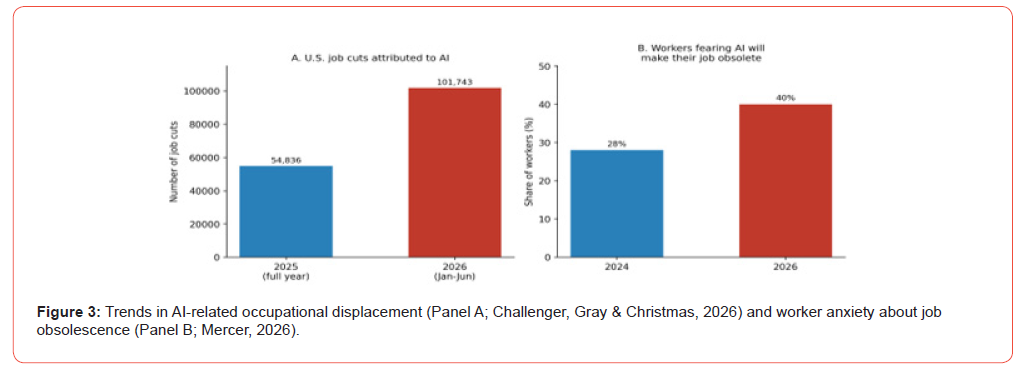
Labor-market data show a rapid rise in AI-attributed workforce reductions. Employer job-cut reports compiled by Challenger, Gray & Christmas [9] attribute a substantially larger number of layoffs to AI in the first half of 2026 than were recorded for the whole of 2025. This near doubling reflects both direct task automation and organizational reallocation of budgets toward AI capability. In parallel, the proportion of workers who fear AI will render their jobs obsolete has risen over the same two-year period (Mercer [10]; see Figure 3). While the World Economic Forum [11] projects that AI may create as many or more jobs than it displaces globally over the coming decade, the transition is markedly uneven: workers in repetitive, task-based, and administrative roles face concentrated risk, while the psychological and financial costs of transition often fall on individuals well before new roles materialize.
Occupational overuse of AI also produces an indirect harm: deskilling among workers who remain employed. Kim et al., [12] argue that when routine judgment tasks are consistently delegated to AI, professionals may lose the tacit expertise built through repeated independent practice, creating long-term organizational vulnerability if AI systems fail, are unavailable, or produce errors that go undetected because human oversight capacity has atrophied.
Privacy, Security, and Over-Trust
Everyday AI use frequently involves submitting sensitive personal, financial, or proprietary information to third-party systems, often with limited user understanding of downstream data retention or security safeguards. Overuse compounds this risk: as AI is woven into more daily tasks, correspondingly more sensitive data passes through external systems, widening the exposure to data breaches and unauthorized secondary use. A related risk is automation bias, the tendency to over-trust AI-generated outputs without independent verification, which can allow factual errors or biased recommendations to propagate unchecked into decisions with real consequences (Risko & Gilbert, 2016).
Discussion
Across the domains reviewed, the evidence converges on a common structural cause: it is not AI itself that produces harm, but patterns of use in which convenience substitutes for the effortful engagement that builds and maintains human competence, wellbeing, and judgment (Eliav, 2026). This reframes the policy question from “should AI be used” to “how should AI use be structured” so that efficiency gains do not come at the cost of skill retention, mental health, or accountable decision-making. Promising directions include design principles that keep humans actively “in the loop” rather than passively supervising AI output, workplace policies that pair automation with retraining and transparent communication to reduce anticipatory anxiety, and educational practices that use AI to support rather than replace the deliberate practice underlying skill acquisition (Sweller et al., 1998).
This review has limitations characteristic of a narrative synthesis: it does not perform formal meta-analytic pooling of effect sizes, and much of the underlying evidence, particularly on longterm cognitive and mental-health outcomes, remains correlational or based on early, not-yet-peer-reviewed studies (Kosmyna et al., 2025; Eliav, 2026). Future research should prioritize longitudinal and causal designs that track cognitive, occupational, and psychological outcomes over multi-year periods of varying AIusage intensity.
Conclusion
The overuse of AI in daily and professional work carries documented risks to critical thinking, mental health, employment security, and data privacy. These risks are mechanistically linked through a reinforcing cycle of cognitive offloading and are already visible in labor-market and workforce-survey data. Recognizing AI overuse as a structural pattern of interaction, rather than an unavoidable property of the technology, opens a constructive path toward interventions in design, workplace policy, and education that preserve the benefits of AI while safeguarding the human capacities it is meant to complement.
Declaration of Interest
None
Acknowledgement
None
References
- Risko E F, Gilbert S J (2016) Cognitive offloading. Trends in Cognitive Sciences 20(9): 676-688.
- Gerlich M (2025) AI tools in society: Impacts on cognitive offloading and the future of critical thinking. Societies 15(1): 6.
- Kosmyna N, Hauptmann E, Yuan Y T, Situ J, Liao X H, et al., (2025) Your brain on ChatGPT: Accumulation of cognitive debt when using an AI assistant for essay writing task. arXiv:2506.08872.
- Sweller J, Van Merriënboer J J G, Paas F G W C (1998) Cognitive architecture and instructional design. Educational Psychology Review 10(3): 251-296.
- Sparrow B, Liu J, Wegner D M (2011) Google effects on memory: Cognitive consequences of having information at our fingertips. Science 333(6043): 776-778.
- Eliav N (2026) The cognitive divergence: AI context windows, human attention decline, and the delegation feedback loop. arXiv:2603.26707.
- Lee H P, Sarkar A, Tankelevitch L, Drosos I, Rintel S, et al., (2025) The impact of generative AI on critical thinking: Self-reported reductions in cognitive effort and confidence effects from a survey of knowledge workers. Proceedings of the 2025 CHI Conference on Human Factors in Computing Systems, pp. 1-22.
- McNamara, S (2025) Artificial Intelligence Replacement Dysfunction (AIRD): A call to action for mental health professionals in an era of workforce displacement. Cureus 17(9): e93026.
- Lobdel, N (2026) Challenger Report: June Layoffs Cool to 45,849, Down 53% From May; AI Leads Reasons for Fourth Consecutive Month. Challenger, Gray & Christmas, Inc. | Outplacement & Career Transitioning Services.
- com (2026) Solving the human-machine equation.
- World Economic Forum (2025) The Future of Jobs Report 2025.
- Kim KA, Kim J M, Kim S G (2026) From algorithm aversion to AI dependence: Deskilling, upskilling, and emerging addictions in the GenAI age. Consumer Psychology Review.
-

This work is licensed under a Creative Commons Attribution-NonCommercial 4.0 International License.