



 Research Article
Translation into Brazilian Portuguese, Cross-Cultural Adaptation, and Initial Validation of the Paediatric Palliative Screening Scale (PaPaS Scale) - Brazilian Version of the Pediatric Palliative Care Screening Scale (PaPaS-Br)
1Quality of life team of Barretos Children’s Cancer Hospital - Brazil
2Research support center of Barretos Children’s Cancer Hospital - Brazil
3Statistics department of Barretos Children’s Cancer Hospital - Brazil
Received Date: March 03, 2026; Published Date: March 11, 2026
Abstract
The proper and timely integration of Pediatric Palliative Care in the care of children and adolescents with life-threatening or life-limiting
illnesses is still neglected. Several reasons have been proposed, among which uncertainty regarding patient identification is considered a key factor.
The Pediatric Palliative Care Screening Scale (PaPaS Scale) is a clinical instrument whose objective is to assist healthcare professionals in identifying
children with palliative care needs.
Objective: This study aimed to translate and culturally adapt the PaPaS into Brasilian Portuguese, and to evaluate its reliability and validity in
the new version.
Methodology: The translation process followed internationally accepted guidelines for cross-cultural adaptation of instruments. Steps included
forward translation by bilingual experts, synthesis of translations, back-translation, review by a multidisciplinary expert committee, and pre-testing
with pediatric healthcare professionals. Psychometric evaluation was conducted using measures of internal consistency (Cronbach’s alpha).
Results: Content validity assessed by an expert panel revealed no barriers to comprehension or application of the instrument. Pre-testing
confirmed that items were clear, relevant, and easily understood by clinicians, ensuring semantic and conceptual equivalence. Thirty-eight
participants (32%), consisting of physicians and nurses, analyzed three fictitious oncology clinical cases using the final translated scale. Internal
consistency analysis yielded an overall Cronbach’s alpha of 0.8, indicating good reliability.
Conclusion: The translation and adaptation of the PaPaS preserved its psychometric properties, making it a reliable tool for identifying pediatric
patients in need of palliative care in the target language. The adapted scale facilitates early identification and referral, supports clinical decisionmaking,
and enables international comparisons in pediatric palliative care research. Future studies should assess its applicability in diverse clinical
settings.
Keywords: Child; Pediatrics; Palliative care; Assessment; Needs
Introduction
Palliative care specifically directed at children and adolescents gained international recognition in 1997 with the publication of A Guide to the Development of Children’s Palliative Care Services by the Royal College of Paediatrics and Child Health in collaboration with the Association for Children’s Palliative Care (ACT). In this and subsequent editions, pediatric pathologies were consolidated into four major groups, reinforcing network-based care, multiprofessional coordination, advance care planning, and a sustainable development vision for services [1]. These concepts gained worldwide visibility following the merger with Children’s Hospice UK and the emergence of the organization Together for Short Lives (TFSL) [2].
However, more than a decade later, evidence shows that the potential benefits of timely and appropriate integration of specialized pediatric palliative care services into patient care remain neglected. Several reasons have been proposed, among which uncertainty regarding patient identification is considered a key factor.
Although populations of children eligible for PPC have been defined, identifying individual patients who would benefit from Pediatric Palliative Care remains challenging in clinical practice. The ACT classification of children and adolescents with life-threatening or life-limiting conditions—despite being didactic—does not reflect disease spectrum, severity, subsequent complications, or the impact on the child and family. Disease trajectories are often uncertain and may vary widely, even among children with the same diagnosis, with the possibility of transitioning between groups as the condition progresses [3].
In Brazil, there are unfortunately no data regarding the number of children and adolescents requiring palliative care, nor the number of professionals involved or their level of training. Given the multidimensional nature of PPC and the complexity of outcomes, the use of standardized and validated instruments is essential. In adults, screening instruments often focus on life expectancy estimation and are linked to end-of-life decisionmaking. In children, however, palliative care objectives are more diverse, aiming to adapt treatments, improve quality of life through effective symptom control, and alleviate the emotional burden on parents and families. A rapid and feasible screening instrument that can support non-specialist teams in caring for children is therefore needed. Considering eligibility based on needs, several initiatives have been attempted, such as the Delphi study described in The Spectrum of Children’s Palliative Care Needs: a classification framework for children with life-limiting or life-threatening conditions, which is still in early validation stages [4].
A promising screening tool was developed by Eva Bergstrasser and colleagues in 2013: the Pediatric Palliative Screening Scale (PaPaS Scale) [5]. Its aim is to support healthcare professionals in identifying children with palliative care needs through subjective and contextual factors, such as family-perceived suffering. The instrument assesses palliative care needs in patients aged 1 to 19 years. Although newborns and infants represent a significant proportion of children who could benefit from PPC, they were excluded due to their specific needs [6].
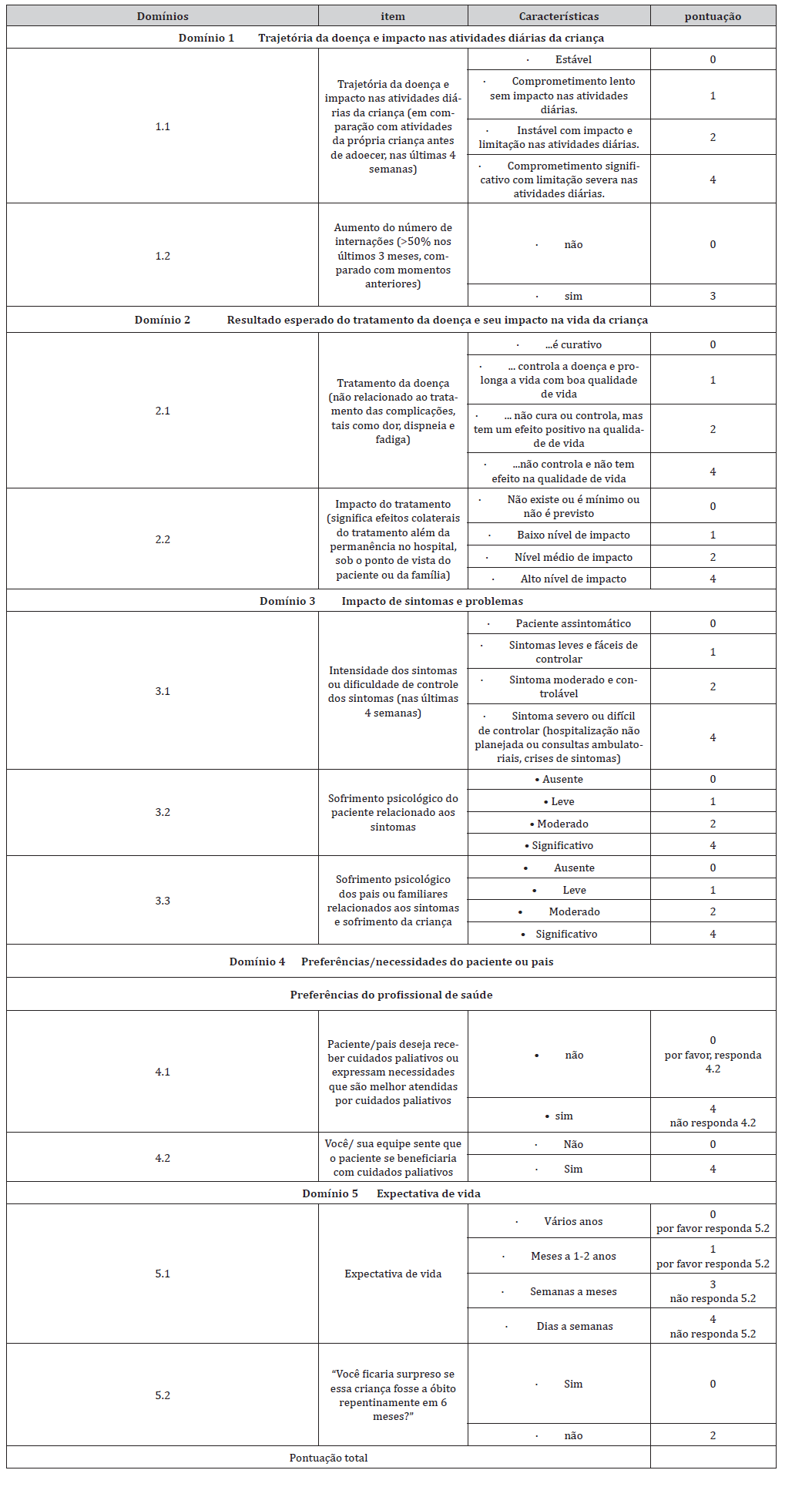
Through semi-structured interviews and focus group discussions, five domains were defined, assessing clinical, functional, and psychosocial dimensions. Each domain includes two to three questions, totaling 11 items, with response options scored from 0 to 4. In clinical practice, the integration of palliative care should occur gradually across three levels of care, rather than at a single point in time. This is reflected in the scoring model:
• Phase 1: Introduction of Palliative Care (10–14 points):
Consider introducing the concept of PPC
• Phase 2: Palliative Care Approach (15–24 points): Basic
symptom control combined with disease-directed treatment
• Phase 3: Focus on Palliative Care (>25 points): PPC
becomes the primary focus of the care plan
The PaPaS Scale is currently one of the most frequently cited tools in the literature, demonstrating good discriminative capacity between patients with lower and higher complexity [7]. The original author applied the scale in the Swiss/German context. The instrument has been validated in European Portuguese [8] and Korean [9], both demonstrating good validity and reliability, underscoring its robustness. Formal linguistic validation in Spanish has not yet been conducted [10,11]. Its clinical utility has been demonstrated in real-world settings through agreement between specialists and non-specialists [9].
Given the absence of Portuguese-language instruments with this scope in Brazil, the objective of this study was to translate, culturally adapt, and conduct the initial validation of the Pediatric Palliative Screening Scale (PaPaS Scale) for Brazilian Portuguese.
Materials And Methods
Study Design
This was a quantitative methodological study involving translation, cross-cultural adaptation, and validation of a scale for the Brazilian pediatric population. The first phase consisted of translation and cultural adaptation of the original English PaPaS Scale into Brazilian Portuguese. The second phase evaluated the psychometric properties of the Brazilian version using three fictitious clinical cases. Prior to initiating the process, contact was established with the scale’s author, Eva Bergstrasser, who granted authorization.
Phase 1: Translation and Cross-Cultural Adaptation
The original English version of the Pediatric Palliative Screening Scale (PaPaS Scale) was used, following the methodology proposed by Beaton et al. in Guidelines for the Process of Cross-Cultural Adaptation of Self-Report Measures [12]. Two independent Brazilian translators, one physician and one non-physician, fluent in English, performed the initial translations (T1 and T2). These versions were compared with the original instrument to identify equivalences and discrepancies, resulting in a synthesized version (T12).
Two additional translators, native English speakers fluent in Portuguese and blinded to the original version, independently performed back-translations (B1 and B2). A consensus meeting produced a final back-translated version (B12), adapted to the Brazilian context.
An expert panel of five multidisciplinary professionals evaluated versions T12 and B12 for semantic, idiomatic, cultural, and conceptual equivalence. Content Validity Index (CVI) was calculated using a four-point Likert scale. Items with an average CVI ≥ 0.8 were considered equivalent and appropriate for measuring the construct [13]. Experts were free to suggest modifications or exclusions of culturally inappropriate items.
The preliminary version underwent pre-testing by a committee of five pediatric palliative care specialists, who assessed content clarity and comprehension. Following approval, all documents were sent to the original author. After favorable feedback, psychometric validation was initiated.
Phase 2: Psychometric Properties (Scale Validation)
Participants and Eligibility Criteria
Ethical principles were observed in accordance with Resolution 510/2013. The study was approved by the Research Ethics Committee (CAAE: 81083124.8.0000.5437).
The study was conducted in a pediatric oncology hospital in Brazil that treats over 300 new cases annually and has a specialized pediatric palliative care team. The sample consisted of 48 physicians and 71 nurses without formal palliative care training, totaling 119 participants (convenience sample). Participants received informed consent forms and three fictitious cases via email, along with the final translated scale (PaPaSBr). Data were collected and stored in REDCap, in compliance with the Brazilian General Data Protection Law (LGPD).
Statistical Methods
Descriptive statistics included means, standard deviations, medians, minimums, maximums, and percentages. Content validity was assessed using the CVI. Reliability was evaluated through internal consistency using Cronbach’s alpha. Analyses were performed using IBM SPSS Statistics and R software, with a significance level of 5%.
Results
Content Validity
Translations and back-translations were analyzed by a multidisciplinary panel to assess semantic, idiomatic, cultural, and conceptual equivalence. All items achieved an average CVI ≥ 0.8. Minimal adjustments were made following pre-testing to ensure linguistic equivalence. Thirty-eight non-palliative care professionals (32%) analyzed three fictitious oncology cases using the final Brazilian version, now named the Brazilian version Pediatric Palliative Care Screening Scale (PaPaS-Br).
Descriptive Analysis
The first case had a mean score of 18 points (SD = 6), indicating a need for a Palliative Care Approach. With regard to disease-directed treatment goals, 42% of professionals indicated that the aim was to control the disease and prolong life with preserved quality of life, whereas 58% reported that the goal was neither cure nor disease control, but rather to achieve a positive impact on quality of life. The second and third cases had mean scores of 30 points (SD = 3) and 31 points (SD = 4), respectively, corresponding to a Focus on Palliative Care. In the second case, 94% of respondents reported that the patient would benefit from palliative care, and 100% indicated that they would not be surprised if the child died within six months.
In the third case, 84% of participants reported that the patient showed significant impairment with severe limitations in activities of daily living. This was attributed to a high treatmentrelated burden (89%), severe symptoms (89%), and psychological distress experienced by parents or family members related to the child’s symptoms and suffering (95%). More than two-thirds of professionals (71%) indicated that the patient and/or parents wished to receive palliative care or expressed needs that are more appropriately addressed by palliative care services.
Overall, these findings demonstrate a clear association between higher PaPaS-Br scores, greater clinical complexity, and, consequently, an increased need for pediatric palliative care.
Reliability
Reliability determines whether the results are consistent and reproducible. Assessment of temporal stability (test–retest reliability) was not applicable in this study, as the questionnaire is intended to evaluate needs, which are dynamic and may change over time. Internal consistency, commonly assessed using Cronbach’s alpha, refers to the degree of homogeneity among participants’ responses to the items that comprise the scale. Analysis based on the three clinical cases yielded an overall Cronbach’s alpha of 0.8, indicating good reliability.
Discussion
The initiation of palliative care remains a global challenge, particularly in resource-limited settings. Healthcare professionals must recognize the importance of early implementation of palliative care, as this approach ensures improved quality of life for patients.
This study aimed to describe the translation, cross-cultural adaptation, and validation of the Brazilian version of the Pediatric Palliative Care Screening Scale (PaPaS-Br), following international standards. The instrument is intended to support timely referrals and may be used by different healthcare professionals to assess children and adolescents with a wide range of potentially lifethreatening or life-limiting conditions.
The process included translation, back-translation, synthesis of translations, and content evaluation by an expert panel, considering semantic, idiomatic, cultural, and conceptual dimensions, with no need for major reformulations. The pre-test conducted by the expert committee assessed the content, clarity, and comprehensibility of each scale item, and no barriers to understanding or application of the questionnaire were identified.
By employing an internationally established and widely used methodology for translation, cross-cultural adaptation, and psychometric evaluation of instruments, this study provides evidence supporting the validity of the PaPaS-Br scale in Brazilian Portuguese.
Validation was conducted in a pediatric oncology hospital. Although only one third of the invited physicians and nurses responded to the survey, it is noteworthy that all participants were pediatric oncology specialists (non-palliative care providers). Even so, internal consistency analysis yielded a Cronbach’s alpha of 0.8.
A notably high proportion of professionals reported perceiving that patients would benefit from palliative care (92%, 94%, and 91% for each case, respectively). Furthermore, even when analyzing fictitious clinical cases, professionals were able to identify that patients and/or parents wished to receive palliative care or expressed needs that are better addressed by palliative care teams (68%, 53%, and 71%).
The “surprise question” (“Would you be surprised if this child died within six months?”) also showed high agreement among professionals (82%, 100%, and 100% for each case, respectively). This variable was one of the strongest predictors of palliative care need (life expectancy < 12 months) in the ordinal logistic regression analysis performed by the original author [6].
With regard to pediatric cancer, it is essential to acknowledge the substantial variability in prognosis and disease trajectories across different types of childhood cancer. Nevertheless, it is widely accepted that the implementation of Pediatric Palliative Care improves the quality of life of children and families, reduces symptom burden, lowers healthcare costs and intensive care unit admissions at the end of life, facilitates death at home, and is not associated with reduced patient survival [14].
Despite these well-documented benefits, Pediatric Palliative Care remains underutilized in Brazilian pediatric oncology practice, even though the National Policy for Pediatric Oncology Care, established by Law No. 14,308/2022, includes palliative care [15]. To support integration, international literature proposes several “triggers” for specialized pediatric palliative care, such as diagnosis of a tumor with an event-free survival estimate below 40% using current therapies, relapsed or progressive disease, prolonged hospitalization, and management of complex needs such as refractory pain or the introduction of new medical devices [14].
It has been suggested that pediatric oncologists would benefit from the use of specific tools to define the complexity of patients’ needs, as regular use of such instruments has been associated with earlier referral to Pediatric Palliative Care and consequent improvements in quality of life [16].
Overall, and particularly in Brazil, there is a scarcity of instruments suitable for clinical use in pediatric populations, especially screening tools that are easy to apply, rapid, useful, and feasible across different care settings (inpatient and outpatient).
Most available instruments are developed in other countries. Semantic, idiomatic, conceptual, and cultural equivalence, along with pre-testing, were therefore essential in adapting the instrument to the Brazilian context. Once validated for use in Brazil, the PaPaSBr scale is expected to help professionals recognize that palliative care eligibility should not be based exclusively on life expectancy. Despite its limitation in applicability to children under one year of age, the scale emphasizes the patient’s overall complexity rather than prognosis alone.
Although all necessary steps for validating the Brazilian Portuguese version were completed, this study has some limitations. These include the sample size and the use of fictitious oncology cases, restricted to Group I patients (potentially lifethreatening conditions). Nevertheless, this study can be considered an important first step toward the early integration of pediatric palliative care.
Conclusion
This is a pioneering study in the Brazilian context, involving the translation, cross-cultural adaptation, and validation of the Pediatric Palliative Care Screening Scale (PaPaS). The results indicate that the instrument is culturally adapted and demonstrates valid and reliable psychometric properties. Future studies are needed to evaluate the scale in larger, multicenter samples.
Declarations
Authors’ Contributions
EB contributed to the conception and design of the study,
manuscript drafting, and submission.
TMVF coordinated the project.
APA and CAG contributed to data acquisition.
WYH contributed to data analysis and interpretation.
All authors reviewed and approved the final version of the
manuscript.
Funding
The authors declare that no funding or research grants were received for the conduct of this study or the preparation of the manuscript.
Conflicts of Interest
The authors declare that they have no financial or personal conflicts of interest that could have influenced the objectivity or validity of this research.
Permission Statement
Dr. Eva Bergstrasser, author of the Paediatric Palliative Screening Scale (PaPaS Scale), granted authorization for the translation, crosscultural adaptation, and validation of the instrument into Brazilian Portuguese. Following publication, the instrument may be freely used for both clinical practice and research purposes.
Acknowledgement
The authors would like to thank the translators, the expert panel, and the specialist committee for their valuable contributions to this study.
ANEXO
ANEXO
Escala de Triagem de Cuidados Paliativos Pediátricos (Escala PaPaS-Br)
References
- ACT (2009) A Guide to the Development of Children’s Palliative Care Services. 3nd ed. Bristol: Association for Children’s Palliative Care.
- https://www.togetherforshortlives.org.uk/app/uploads/2018/03/TfSL-A-Guide-to-Children%E2%80%99s-Palliative-Care-Fourth-Edition-5.pdf
- Chong PH, Soo J, Yeo ZZ, Ang RQ, Ting C (2020) Who needs and continues to need paediatric palliative care? An evaluation of utility and feasibility of the Paediatric Palliative Screening scale (PaPaS). BMC palliative care 19(1): 18.
- Shaw KL, Brook L, Mpundu-Kaambwa C, Harris N, Lapwood S, et al. (2015) The spectrum of children's palliative care needs: a classification framework for children with life-limiting or life-threatening conditions. BMJ supportive & palliative care 5(3): 249-258.
- Bergstraesser E, Hain RD, Pereira JL (2013) The development of an instrument that can identify children with palliative care needs: the Paediatric Palliative Screening Scale (PaPaS Scale): a qualitative study approach. BMC palliative care 12(1): 20.
- Bergstraesser E, Paul M, Rufibach K, Hain RD, Held L (2014) The Paediatric palliative screening scale: further validity testing. Palliative medicine 28(6): 530-533.
- Papa S, Mercante A, Giacomelli L, Benini F (2023) Pediatric palliative care: Insights into assessment tools and review instruments. Children 10(8): 1406.
- Palare MJ, Tavares F, Machado MD (2023) Validation of the European Portuguese version of a pediatric palliative needs assessment tool: the pediatric palliative screening scale. Acta Médica Port 36(5): 326-335.
- Song IG, Kwon SY, Chang YJ, Kim MS, Jeong SH, et al. (2021) Paediatric palliative screening scale as a useful tool for clinicians’ assessment of palliative care needs of pediatric patients: a retrospective cohort study. BMC palliative care 20(1): 73.
- Ugaz C, Ortiz I, Soto G, Morales R, Vasquez L (2021) Pediatric Palliative Screening Scale in pediatric cancer patients: A qualitative study approach. Pediatric Blood & Cancer 68(12): e29249.
- Clinical complexity and need for palliative care in non-oncological patients with special health care needs. Andes pediatr. 2025; 96(5): 628-635.
- Beaton DE, Bombardier C, Guillemin F, Ferraz MB (2000) Guidelines for the process of cross-cultural adaptation of self-report measures. Spine 25(24): 3186-3191.
- Alexandre NM, Coluci MZ (2011) Content validity in the development and adaptation processes of measurement instruments. Ciência & Saúde Coletiva 16(7): 3061-3068.
- Benini F, Avagnina I, Giacomelli L, Papa S, Mercante A, et al. (2022) Pediatric palliative care in oncology: basic principles. Cancers 14(8):1972.
- https://www.planalto.gov.br/ccivil_03/_ato2019-2022/2022/lei/l14308.htm
- Andriastuti M, Halim PG, Kusrini E, Bangun M (2020) Correlation of pediatric palliative screening scale and quality of life in pediatric cancer patients. Indian J. Palliat. Care 26(3): 338-341.
-

This work is licensed under a Creative Commons Attribution-NonCommercial 4.0 International License.




