

 Opinion article
The Management of Developmental Defects of Enamel using Silicon/Calcium-Based Technology: A Light at the end of the Tunnel
1TRIALS, Oral Health & Technologies, Brazil
2Private practice of Pediatric Dentistry, Universidade Federal de São Paulo, Brazil
3Graduate Program in Pediatric Dentistry, Institute and Research Center São Leopoldo Mandic, Brazil
Received Date: November 14, 2024; Published Date: November 21, 2024
Abstract
Enamel Development Defects (EDD) are some of the dilemmas that can be found in a daily clinical routine. EDD are disorders of dental enamel (lack of mineral formation) that impacts the tooth’s shape, structure, and appearance. Also, most of the time it presents dentin hypersensitivity. These issues have encouraged scientists all over the globe to develop new materials for oral health care. In this sense, a novel bioactive silicon dental gel associated with calcium (Si/Ca protocol) reveals promising results against dental erosion, tooth demineralization, and sensitivity. Also, the rapid mineral formation in the internal structures of dental tissues when the Si/Ca protocol was applied is a valuable support in EDD structures with poor or no mineral formation. In this regard, fast pain relief occurs with an improvement of the patient’s quality of life since first use. The application of Si technologies in EDD is as new as the evidence. As a result, it appears that using the Si/Ca protocol deserves more clinical investigations, making it a viable option for the future of EDD care.
Keywords: Enamel Development Defects; Molar Incisor Hypomineralization; Dentifrice; Silicon; Dentin hypersensitivity
Introduction
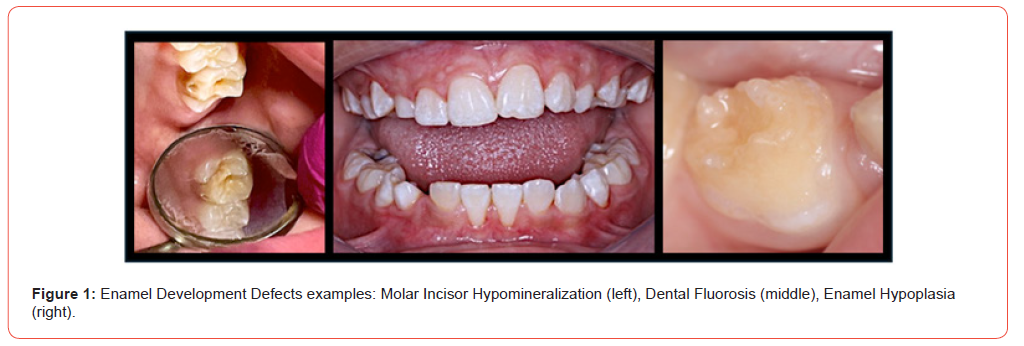
Enamel Development Defects (EDD) have become increasingly common in clinical practice, becoming a challenge for dental professionals. EDD have been linked to decreased activity of enamel-forming ameloblasts, resulting in the formation of deformed enamel structures [1] (Figure 1). The Molar Incisor Hypomineralization (MIH) is the most evident disorder of tooth enamel development (lack of mineral formation) that impacts the tooth’s shape, structure, and appearance. Treatment of EDD is often complex due to the variability of clinical manifestations, particularly in MIH-affected teeth with potential dentin hypersensitivity, which could impact in a negative way the patient’s quality of life [2].
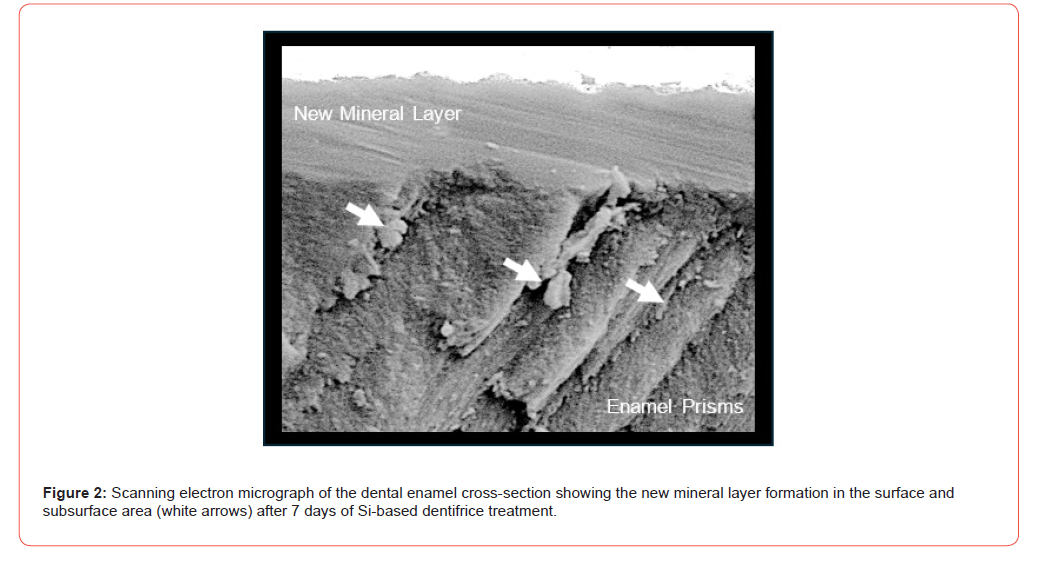
New approaches to managing EDD have emerged, particularly those using silicon (Si) compounds [3,4]. Si in formulations enhances the ability to “build” new minerals by acting as an apatite phase nucleator [4-6]. Furthermore, since dentifrices are the most used oral hygiene products in the population, they appear to be the most straightforward and comprehensive method of treating EDD. In this regard, Sampaio et al. (2024) stated that Si-based dentifrices have demonstrated strong evidence of reducing dentin hypersensitivity and promoting enamel-dentin repair by forming a Si-containing mineral layer [5] (Figure 2).
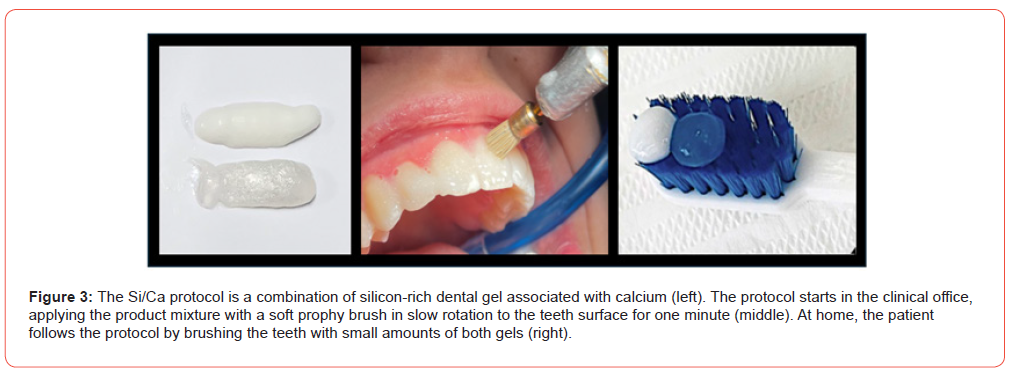
Recently, a bioactive silicon dental gel associated with calcium (Si/Ca protocol) (REFIX® Booster System – Dentalclean US LLC, FL, USA) has been studied. Figure 3 illustrates the Si/Ca protocol that consists of two dentifrices: crystallizer gel containing silicon and phosphate (gray) and accelerator gel containing calcium (white). The Si/Ca protocol begins in a clinical office and continues at home. In Office: equal amounts of both gels are dispensed into a mixing block or dappen dish; after 10 seconds of mixing the gels, apply the mixture using a soft prophy brush in slow rotation to the tooth surface for one minute. At home: The patient receive instruction to brush their teeth at least two times per day, using small amounts of both gels directly on the toothbrush.
The combination of these elements can accelerate the mineral deposition in dental tissues [6]. This novel clinical protocol can treat and prevent dental erosion, tooth demineralization, and sensitivity [6-11]. Furthermore, according to [2], the use of the Si/Ca protocol for patients with MIH conditions reveals promising results; since fast pain relief occurs, an improvement of the patient’s oral health and emotional condition was reported.
The rapid mineral formation in the internal structures of dental tissues when the Si/Ca protocol was applied [6-8] is a valuable support in EDD structures with poor or no mineral formation. Other studies that are taking place in Brazilian EDD Research Centers using the Si/Ca protocol have also shown aesthetic results without pain and mineral gain since first treatment session.
The scientific literature has shown that Si dentifrices have laboratory and clinical efficacy in dental tissue regeneration and tooth sensitivity relief [3-11]. The application of Si technologies in EDD is as new as the evidence. As a result, it appears that using Si/ Ca protocol deserve more clinical investigations, making it a viable option for the future of EDD care.
Acknowledgement
None
Conflicts of Interest
The authors declare no conflict of interest, with the exception of Fabiano Vilhena, who has served as a consultant for Dentalclean.
References
- Nota A, Palumbo L, Pantaleo G, Gherlone EF, Tecco S (2020) Developmental Enamel Defects (DDE) and Their Association with Oral Health, Preventive Procedures, and Children's Psychosocial Attitudes towards Home Oral Hygiene: A Cross-Sectional Study. Int J Environ Res Public Health 17(11): 4025.
- Inchingolo AM, Inchingolo AD, Viapiano F, Anna Maria Ciocia, Irene Ferrara, et al (2023) Treatment approaches to molar incisor hypomineralization: A systematic review 12(22): 7194.
- Gorini FV, Moreira KMS (2024) Silicon-rich technology combined with calcium for dentin hypersensitivity management in molar incisor hypomineralization. Int J Case Rep Images.
- Oliveira AFB, Costa BMM, Forte AG (2024) Beyond Fluoride: Exploring Silicon's Potential for Dental Repair and Caries Prevention. Preprints, 2024102237.
- Sampaio FC, Oliveira AFBd, Fernandes NLS, Ana Carolina Cheron Gentile, Giovanna Bueno Marinho et al (2024) Silicon-, Silica-, and Silicate-Toothpastes for Remineralization and Repair of Teeth: A Scoping Review 4(4): 467-486.
- Athanasiadou D, Eymael D, Hajhamid B, Carneiro KMM, Prakki A (2024) Chemical and ultrastructural characterization of dentin treated with remineralizing dentifrices 15(1): 25.
- Oliveira AFB, Nunes VRR, da Cunha JL (2024) Biomimetic and protective effects of bioactive toothpastes on eroded enamel surfaces, Braz. Oral Res.
- Vilhena FV, Grecco SDS, Gonzalez AHM, D'Alpino PHP (2023) Regenerative and protective effects on dental tissues of a fluoride-silicon-rich toothpaste associated with a calcium booster: an in vitro study 11(6): 153.
- Alonso RCB, Oliveira LD, Silva JAB, Williane Bernadete BS, Lúria Ribeiro de SLF, et al (2024) Effectiveness of bioactive toothpastes against dentin hypersensitivity using evaporative and tactile analyses: A randomized clinical trial 4(1): 36-49.
- Reis ALM, dos Reis MC, Mazzola T, da Cruz Pegoraro JV, de Lima DC, Fernandes LA (2022) A novel clinical protocol for dentin hypersensitivity management based on regenerative dental gel associated with calcium: A case study in a patient with periodontal disease. Int J Case Rep Images 14(1):70-74.
- Fernandes LA (2024) Evaluation of the efficacy of dentin hypersensitivity treatment associating a regenerative dental gel with a calcium booster: a randomized clinical study. J Clin Exp Dent.
-

This work is licensed under a Creative Commons Attribution-NonCommercial 4.0 International License.