

 Research Article
Role of Probiotics (Lactobacillus/Bifidobacterium and Enterococcus Faecium) in Acute Diarrhea; A Randomised Control Trial
Department of Pediatrics, University of the Lahore, Pakistan
Received Date: May 23, 2021; Published Date: July 29, 2021
Abstract
Background: Probiotics are frequently used in diarrhea, but little is known about the comparative effect of different types of probiotics. Mostly
studies are about individual probiotics.
Objective: To compare the efficacy of two different probiotics (lactobacillus/Bifidobacterium and enterococcus faecium) in clinical improvement
and shortening the hospital stay in acute diarrhea in children age ( 2 months to 5 years).
Material and methods: It is experimental study (RCT) done on 310 patients carried out by department of pediatrics, Avicenna Medical College,
Lahore (Jan 2019-June 2019). They were randomly divided into two groups. One group was given lactobacillus/Bifidobacterium 161 (51.9%) and
another enterococcus faecium 149 (48.1%). Female patients were 162 (52.3%) and male were (47.7%). 47.8% of group 1 respond to treatment in
first 48 hours of starting treatment compared to 22.8 patients in group 2. In Group 1 total 96.2% of patient responded in 72 hours whereas 83.8% in
group 2. Similarly, 93.7% showed improved condition in group1 and 81.8% (group-2) improved and discharge from hospital in 72 hours.
Conclusion: Lactobacillus/ Bifidobacterium were found to be more effective than Enterococcus faecium in reduction in the duration of diarrhea
and hospital stay in this study.
Introduction
Probiotics have been widely used and studied extensively in the prevention and treatment of diarrheal diseases in pediatric populations over the past several years. The first person who introduced the concept that live microorganisms are beneficial for health was Dr. Elie Metchnikoff, a Russian laureate. 1n 1965 Lilly and Stilwell introduced the term “Probiotics” and they describe growth promoting factors produced by these microorganisms [1].
A consensus definition of the term “probiotics”, based on the available information and scientific evidence, was adopted after a joint Food and Agricultural Organization of the United Nations and World Health Organization expert consultation. In October 2001, this expert consultation defined Probiotics as: “live microorganisms which, when administered in adequate amounts, confer a health benefit on the host” [2].
Mechanisms of action of probiotics include altering the intestinal “micro ecology” (e.g., reducing harmful organisms in the intestine), producing antimicrobial compounds (substances that destroy or suppress the growth of microorganisms), and stimulating the body’s immune response [3,4]. Probiotics are often lactic acid bacteria from the Lactobacillus or Bifidobacterium groups. Within each group, there are different species such as Lactobacillus acidophilus and Bifidobacterium bifidus, and within each species there are different strains. Probiotics such as Saccharomyces boulardii are yeasts, which are different from bacteria.
Medical research reveals that some strains are more beneficial than others, with effectiveness depending on a number of factors, but a lot of confusion exist about which probiotics are best and whether they should be recommended for certain condition. Probiotics must also be resistant to gastric acid digestion and to bile salts to reach the intestinal intact, and they should be nonpathogenic. Most probiotics are strains of Bifidobacterium or Lactobacillus species. Some are derived from the intestinal microbiota of healthy humans, and others are nonhuman strains used in the fermentation of dairy products. Species from other bacterial genera such as Streptococcus, Bacillus, and Enterococcus have also been used as probiotics, but there are concerns surrounding the safety of such probiotics because these genera contain many pathogenic species, particularly Enterococcus [5]. Nonbacterial microorganisms such as yeasts from the genus Saccharomyces have also been used as probiotics. Many probiotics are effective in preventing antibiotic-associated diarrhea [6], including the yeast Saccharomyces boulardii and the bacterium Lactobacillus acidophilus in combination with L. bulgaricus, L. rhamnosus strain GG, and Enterococcus faecium strain SF68. A separate meta-analysis of randomized controlled trials has shown a variety of probiotics (including Lactobacillus species, Enterococcus species, and S. boulardii) to be effective in the treatment of infective diarrhea in both adults and children [7].
Material and Method
The study was conducted in Avicenna Hospital, a 550 bedded tertiary care teaching hospital with established pediatrics ICU and ward. It is situated in Lahore district and serves a population who are mainly (90%) rural. It acts as referral center for many rural health centers around the hospital. Patients included were those admitted in ward, aged 2 months to 60 months, with the diagnosis of acute diarrhea. Diarrhea was defined according to WHO guidelines as having three or more stools in 24 hours with a consistency that was watery than usual. This study was conducted on 310 patients in age group of 2 months to 60 months (5years). These patients randomized in two groups (1&2) using sealed envelope technique. Out of these 310 patients 161 were included in group one, 149 were in group 2 and all the patients completed the trial.
Group 1 was treated with probiotics formula containing Bifidobacterium and lactobacillus sachet each of which contain probiotics millions CFU. Out of these 90% were Bifidobacterium ,10% lactobacillus paracasei and L. casei and S Thermophilus. Group 2 was given the formula that contains Enterococcus faecium SF68. Each capsule provides 75 million live bacteria.
Exclusion criteria were established as duration more than 4 days, blood in stools, chronic malabsorption and use of antibiotics in past 7 days. Primary outcome of the study was clinical improvement at 48 hours and secondary outcome was hospital stay after 72 hours.
Results
Total patients were 310, out of these 161 (51 .9%) were included in group one, 149 (48.1%) were in group 2 and all the patients completed the trial. Also 148 (47.7%) were male and 162 (52.3%) were female. It was observed that 31.6% (98) patients were 2-12 months of age while 68.13% (212) belong to 13-60 months.
With the therapy it was noted that improvement response was quite different and statistically significant in both groups. It was noted that 77(47.8%) patients in group1 and 34 (22.8%) patients in group 2 showed improvement in 48 hours. Similarly, at 72 hours 93.7% (155) in group1 patients and compared to 125 (81.8%) patients in group 2. Six patients in group 1(3.7%) and 24(16.1%) in group 2 responded after 96 hours. This was statistically significant (P value (0.000).
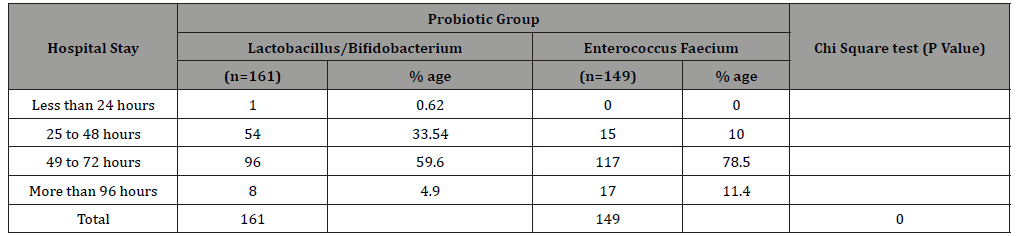
As for hospital stay is concerned 55 (34.16%) patients in group 1 were discharged compared to 15 (10.07) of group 2 in 48 hours while 151 (93.76%) and 132 (88.5%) patients were discharged in 72 hours respectively which again were statistically significant (P value 0.000) (Table 1-5).
Table 1:Probiotic groups.

Table 2:Probiotic groups.

Table 3:Probiotic groups.

Table 4:improvement time (Both Groups).
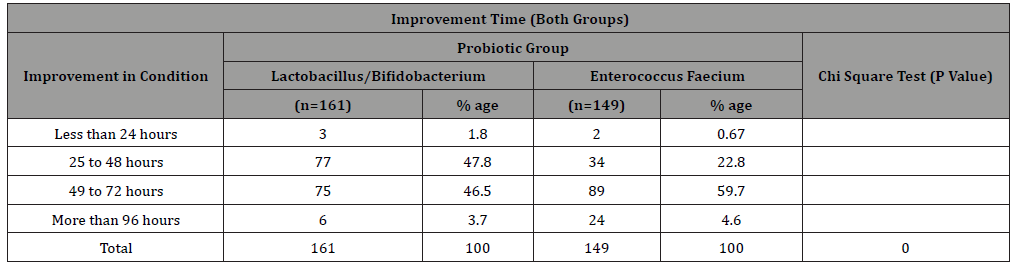
Table 5:Hospital Stay.
Discussion
Diarrhea can result from an altered balance of bacteria in the gut. Probiotics help restore balance by providing a higher level of good bacteria. This can promote normal bowel function and shorten the duration of diarrhea. Probiotics are used for different diarrheal conditions in children since long but recently there is rising trend for their use. Although pooled analyses have shown significant treatment effects of probiotics, different probiotics can have different effects in both in vivo and in vitro analyses [5]. The clinical or laboratory effects of one probiotic cannot be assumed for another probiotic species or for different strains of the same species [6].
Diarrhea remains the leading cause of death in children below 5 years of age. It is also the reason for a considerable morbidity in children of all ages throughout the globe. Bifidobacterium species are found to be very effective in treating diarrheal illness as in our study Bifidobacterium and lactobacillus was found [3] to be more effective than others [8,9]. Study done by Allan SJ and Wareham k et al also shows that duration of diarrhea was reduced by Bifidobacterium and lactobacillus [10].
American Academy of Pediatrics and European Society of Pediatric Gastroenterology Hepatology and Nutrition (ESPGHAN) have concluded that preparations containing probiotics shorten the duration and reduce the severity of acute diarrhea in children. Safety of probiotics is established in healthy infants and children. Some pediatric physicians still do not use probiotics for acute diarrhea owing to lack of guidelines by WHO, FDA or Pediatric practice regulating bodies.
Our results also showed significant reduction in hospital stay and recovery time. Both were statistically significant and consistent with similar results of other studies [9,11]. They also find that some probiotics had early response compared to other probiotics.
A low-cost probiotic intervention capable of reducing the risks of diarrhea in younger children, can have significant impact on the developing world. The cost, standardized dose and efficacy of probiotics needed to be assessed based on large scale multicenter, high quality studies before advocating its use in children with diarrhea. Efficacy of probiotics is not only strain but dose dependent also. Moreover, safety of these probiotics especially in immunocompromised and severely malnourished children needs to be evaluated carefully.
Our study also showed that Lactobacillus/Bifidobacterium were found to more have an early response and reduce the duration of diarrhea and hospital stay than Enterococcus faecium. No significant adverse effects were observed during study period in any of the patient in either of the group [12-15].
Conclusion
Lactobacillus/Bifidobacterium were found to be more effective than Enterococcus faecium in reduction in the duration of diarrhea and hospital stay in this study.
Acknowledgement
None.
Conflict of Interest
No conflict of interest.
References
- Anirban Mandal, Puneet Kaur Sahi (2017) Probiotics for Diarrhea in Children. Archives 1(2): AV5-AV12.
- Mauro Batista de Morais, Cristina Miuki Abe Jacob (2006) The role of probiotics and prebiotics in pediatric practice. J Pediatr (Rio J) 82(5 Suppl): S189-197.
- Johnston BC, Supina AL, Ospina M, Vohra S (2007) Probiotics for the prevention of pediatric antibiotic-associated diarrhea. Cochrane Database Syst Rev (2): CD004827.
- Ouwehand AC (2015) The role of probiotics in digestive health. Nutrition and Dietary Supplements 7: 103-109.
- Michael de Vrese, Philippe R Marteau (2007) Probiotics and Prebiotics: Effects on Diarrhea. J Nutr 137(3 Supply 2): 803S-811S.
- Sazawal S, Hiremath G, Dhingra U, Malik P, Deb S, et al. (2006) Efficacy of probiotics in prevention of acute diarrhea: a meta-analysis of masked, randomised, placebo-controlled trials. Lancet Infect Dis 6(6): 374-382.
- Monique Santos do Carmo, Camilla itapary dos Santos, Mizael Calácio Araújo, Jorge Alberto Girón, Elizabeth Soares Fernandes, et al. (2018) Probiotics, mechanisms of action, and clinical perspectives for diarrhea management in children. Food Funct 9(10): 5074-5095.
- Hickson M, D’Souza AL, Muthu N, Rogers TR, Want S, et al. (2007) Use of probiotic Lactobacillus preparation to prevent diarrhea associated with antibiotics: randomized double-blind placebo-controlled trial. BMJ 335(7610): 80.
- Guandalini S (2011) Probiotics for prevention and treatment of diarrhea. J Clin Gastroenterol 45 Suppl: S149-S153.
- Allen SJ, Wareham K, Wang D, Bradley C, Sewell B, et al. (2013) A high-dose preparation of lactobacilli and bifidobacteria in the prevention of antibiotic-associated and Clostridium difficile diarrhoea in older people admitted to hospital: a multicenter, randomised, double-blind, placebo-controlled, parallel arm trial (PLACIDE). Health Technol Assess 17(57): 1-140.
- FAO/WHO (2002) Guidelines for the Evaluation of Probiotics in Food. London Ontario, Canada.
- Metchnikoff E (1907) The prolongation of life. Optimistic studies. Translated and edited by P Chalmers Mitchell. London: Heinemann.
- Alfredo Guarino, Andrea Lo Vecchio, Roberto Berni Canani (2009) Probiotics as prevention and treatment for diarrhea. Curr Opin Gastroenterol 25(1): 18-23.
- Mimi Pham, Daniel A Lemberg, Andrew S Day (2008) Probiotics: sorting the evidence from the myths. Med J Aust 188(5): 304-308.
- Geoffrey A Preidis, Colin Hill, Richard L Guerrant, BS Ramakrishna, Gerald W Tannock, et al. (2011) Probiotics, Enteric and Diarrheal Diseases, and Global Health. Gastroenterology 140 (1): 8-14.
-

This work is licensed under a Creative Commons Attribution-NonCommercial 4.0 International License.