

 Case Report
Mucositis and Rash- when the Clue is in Respiratory Symptoms
Department of Pediatrics and Neonatology Service, University of Tâmega e Sousa Local Health Unit, Portugal
Received Date: April 01, 2025; Published Date:April 09, 2025
Introduction
With the preventive measures implemented during the COVID-19 pandemic, Mycoplasma pneumoniae infection became residual worldwide and remained so until the second quarter of 2023, when it increased exponentially in China, with subsequent globalization [1]. The recent resurgence of this agent has been associated with the usual cases of pneumonia and their complications, as well as less common forms of presentation, such as encephalitis and severe mucocutaneous involvement [1]. RIME (Reactive Infectious Mucocutaneous Eruption) is an entity with a clinical presentation along the lines of Stevens-Johnson Syndrome/ Toxic Epidermalecrolysis, but with a different pathophysiology, a milder course and generally a good prognosis [2]. Its diagnostic criteria have recently been established: mucocutaneous eruption with one or more locations, involving less than 10% of the body surface; presence of some vesiculobullous or target lesions; no history of recent use of drugs related to the condition; prodrome of symptoms such as fever, malaise, runny nose in the previous 7 days; clinical, imaging or radiological evidence of an infectious agent responsible (most commonly Mycoplasma pneumoniae, respiratory viruses and Chlamydia pneumoniae) [2,3]. Therefore, it corresponds to an entity characterized predominantly by mucositis, especially of the oral mucosa (hemorrhagic crusts and ulcers of the tongue and jugal mucosa), but with possible involvement of the ocular mucosa (eyelid edema and purulent conjunctivitis associated with photophobia) and urogenital mucosa (urogenital ulcers), whether or not associated with a sparse cutaneous exanthema (vesiculobullous lesions in 80% of cases, although they can take on other patterns) [2,4]. This entity primarily affects children (average age 12 years) and is rare in adults, with some authors suggesting that age should be included as a diagnostic criterion. It predominates in males and in the winter months [2].
Clinical Case
A previously healthy 7-year-old female child. She was seen in the Emergency Department of a group III hospital for a high fever of 5 days’ duration, a productive cough and previous rhinorrhea. She complained of intense odynophagia, with progressively worsening refusal to eat and bilateral red eyes which started on the day she went to the emergency department. There was no history of taking drugs other than paracetamol and ibuprofen. On objective examination, he was in reasonable general condition, with sunken eyes, discrete polymorphous exanthema in the inguinal region, neck and face; bilateral conjunctival erythema with purulent exudate, infracentimeter right anterior cervical adenopathy, painless, mobile and elastic in consistency. In the oropharynx, he had mucositis with some ulcerated lesions on the jugal mucosa, limiting the opening of the oral cavity. An analytical study showed a normal blood count, increased C-reactive protein (102.7 mg/L), slightly increased sedimentation rate (10 mm/h); normal ferritin, albumin, total proteins, liver function and lipid profile. TDAR (Group A Stretococcus Rapid Antigen Diagnostic Test), Antistreptolysin O titer and negative Epstein Barr Virus and Cytomegalovirus serologies. Leucocyturia (21.9/uL) and erythrocyturia (14.7/uL). Negative blood culture and uroculture. Negative respiratory virus molecular panel. The chest X-ray showed bilateral perihilar infiltrates. Due to the initial suspicion of incomplete Kawasaki disease, she was evaluated by Pediatric Cardiology, with a normal echocardiogram and started on IV immunoglobulin 2g/Kg in infusion, aspirin and intravenous fluid therapy. The patient was transferred to her local hospital for monitoring and continued care.
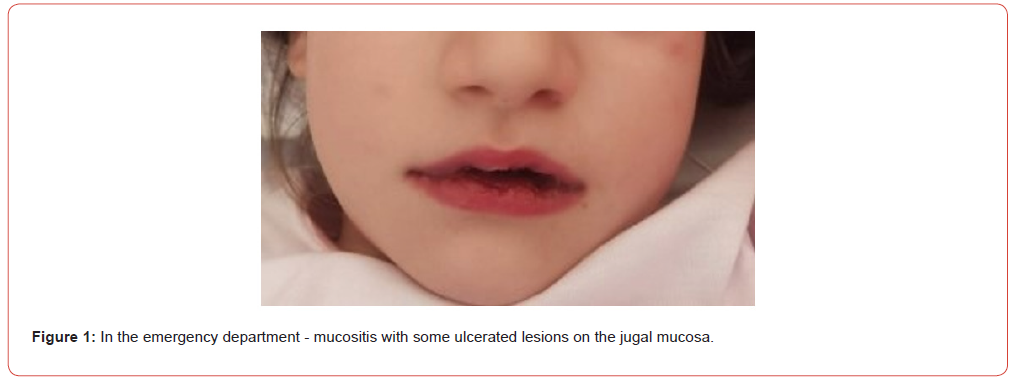
During hospitalization, due to a continuing fever 48 hours after the intravenous immunoglobulin (D3 hospitalization), the patient was given the same dose again. On D4 of hospitalization, the rash resolved, but the oral lesions worsened, characterized by marked erythema and lip edema with friability of the mucosa, hemorrhagic crusted lesions on the perioral and jugal mucosa (Figure 2). Concomitantly, conjunctival erythema worsened, with exudation and bullous lesions on the eyelids, leading to ocular closure (Figure 2). Due to the predominant involvement of the mucous membranes (conjunctival and oral) associated with respiratory symptoms (frequent productive cough and dispersed wheezing on lung auscultation) and the failure to meet all the criteria for incomplete Kawasaki disease, the hypothesis of RIME due to Mycoplasma pneumoniae was put forward. PCR for Mycoplasma in bronchial secretions and serology were requested, and oral azithromycin 10 mg/Kg/day was started (which was followed for 5 days). As the fever persisted on D6 of hospitalization, intravenous methylprednisolone 2 mg/Kg/day (5 days) was added, with a subsequent reduction to 1 mg/Kg/day, when the positive results of the PCR and serology for Mycoplasma were known. He underwent a total of 12 days of corticosteroid therapy. She underwent supportive treatment with sucralfate and analgesic mouthwash for oral lesions, eye lubrication (artificial tears) and lip mucosa lubrication. Nutritional support via nasogastric tube. She was seen by an ophthalmologist on the 6th day of hospitalization, who prescribed topical prednisolone and chloramphenicol.
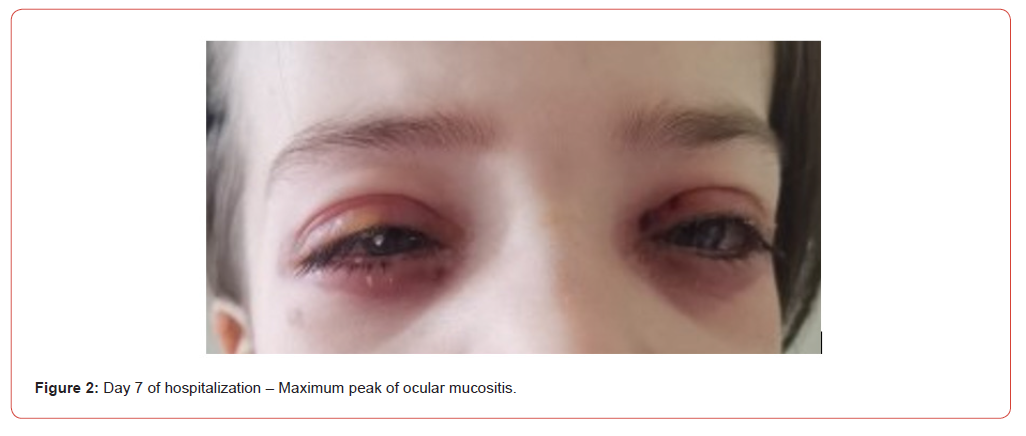
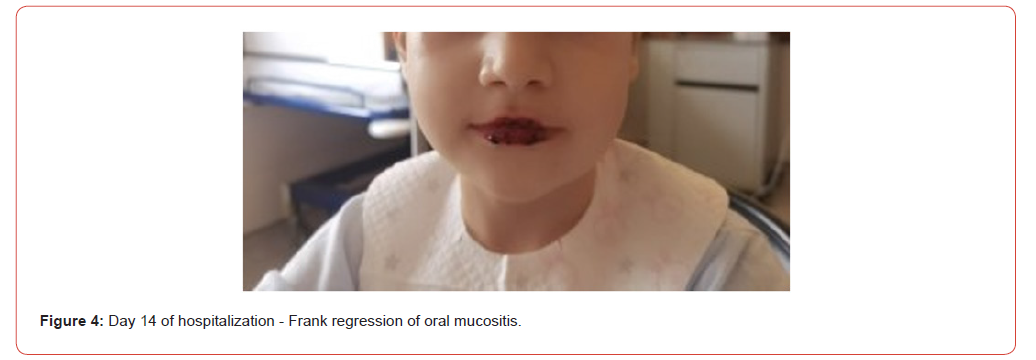
She became apyretic on the 7th day of hospitalization, with oral lesions peaking between the 5th and 7th days (Figure 3). She began to tolerate oral liquid feeding on the 13th day of hospitalization. She was discharged on the 14th day of hospitalization (Figure 4) and referred to an outpatient general paediatrics clinic.
Discussion/Conclusion
This clinical case illustrates a rare extrapulmonary manifestation of Mycoplasma pneumoniae infection, with a prevalence of 1.0% to 5.0% described in the literature [5]. The current emergence of new cases may be related to the sustained suppression of Mycoplasma pneumoniae during the COVID-19 pandemic associated with an exceptionally high resurgence of infections, resulting in a greater number of severe forms, as well as extrapulmonary manifestations [1].
The lesions on the oral and conjunctival mucous membranes developed progressively until they reached the exuberance characteristic of RIME, which led in this case to the hypothesis of Kawasaki disease, also questionable as it did not fully meet the criteria.
The diagnosis of Mycoplasma pneumoniae infection can be made by PCR (polymerase chain reaction) of nasopharyngeal swabs or by serum dosage of specific IgM and IgG. Although PCR is highly sensitive and specific, it can remain positive for months after infection, making it difficult to distinguish between acute and old infection. IgM titers begin to rise 7 to 9 days after infection, peak at 3 to 6 weeks and persist for months. IgG increases and peaks 2 weeks after IgM and persists for years [6]. Thus, both IgM and IgG can be normal in the acute phase and it may be necessary to repeat the serologies to document the infection. In our clinical case, PCR, IgM and IgG were all positive at the time of collection.
There is still no consensus on the treatment of RIME, which is mostly supportive. In its approach, the multidisciplinary involvement of Dermatology, Ophthalmology and Infectious Diseases is suggested, whenever available. It includes: fluid therapy and nutritional support; pain control; oral mucosal care (anaesthetic and antiseptic mouthwash, moisturizing the lip mucosa), ocular care (artificial tears), urogenital care (topical corticosteroids) [2,7]. With regard to adjuvant therapy, the use of macrolides could be considered if there is clinical, laboratory and/or radiological evidence of atypical pneumonia, although it remains to be seen whether it shortens the period of RIME manifestations. Systemic corticotherapy is indicated in RIME with extensive mucositis and/or severe symptoms, namely prednisolone 1 mg/Kg/day for a short course of 5-10 days, without the need for progressive dose reduction. There have also been reports of other immunomodulatory drugs being used, such as intravenous immunoglobulin, cyclosporine and etanercept [8-11]. In this clinical case, intravenous immunoglobulin was initially used, followed by intravenous methylprednsiolone 2 mg/Kg/day, according to the regimen used in incomplete Kawasaky’s disease, until Mycoplasma infection was confirmed, since this was the initial diagnostic hypothesis and they are also used in the treatment of RIME.
The prognosis for RIME is generally good, as was also seen in this clinical case, with full recovery. However, there is a risk of mucocutaneous sequelae in approximately 10% of cases, namely post-inflammatory depigmentation, scars and synechiae, as well as dry eye, corneal ulcers, blindness and eyelash loss. According to the latest literature, recurrence can occur in 8% of cases. After discharge, it is important to refer patients to an outpatient clinic for follow-up based on the specific sequelae and to be informed about the risk of recurrence.
Therefore, RIME is a recent entity, with diagnostic criteria that have been established since 2015, when we started talking about MIRM (Mycoplasma pneumoniae-induced rash and mucositis) and which we now know can be associated with other agents, with cases described with respiratory viruses, namely SARS cov2 [2]. Despite the exuberance of the condition, it has a good prognosis, so it is important to know about this entity in order to take it into account in the current epidemiological context.
Funding Sources
There were no external funding sources for the realization of this study.
Provenance and Peer review
Not commissioned; externally peer reviewed.
Confidentiality of Data
The authors declare that they have followed the protocols of their work center on the publication of patient data.
Consent for Publication
Consent for Publication
Acknowledgement
We would like to thank the patient and her family for granting us permission to publish this case report to help future patients with RIME.
Conflicts of Interest
The authors declare that there were no conflicts of interest in carrying out this work.
References
- Meyer Sauteur PM, Beeton ML; European Society of Clinical Microbiology and Infectious Diseases (ESCMID) Study Group for Mycoplasma and Chlamydia Infections (ESGMAC), and the ESGMAC Mycoplasma pneumoniae Surveillance (MAPS) study group (2024) Mycoplasma pneumoniae: delayed re-emergence after COVID-19 pandemic restrictions. Lancet Microbe 5(2): e100-e101.
- Canavan TN, Mathes EF, Frieden I, Shinkai K (2015) Mycoplasma pneumoniae-induced rash and mucositis as a syndrome distinct from Stevens-Johnson syndrome and erythema multiforme: a systematic review. J Am Acad Dermatol 72(2): 239-245.
- Ramien ML, Bahubeshi A, Lara-Corrales I, Pope E, Levy ML, et al. (2021) Blistering severe cutaneous adverse reactions in children: proposal for paediatric-focused clinical criteria. Br J Dermatol 185(2): 447-449.
- Poddighe D, Bruni P (2017) Mycoplasma pneumoniae-induced rash and mucositis (MIRM): an unusual mild skin rash associated with severe mucosal involvement. BMJ Case Rep 2017: bcr2017220749.
- Oliveira B, Costa S, Sá J, Castro Gomes G (2024) Mucosite e Rash Induzidos por Mycoplasma Pneumoniae: Relato de Um Caso Clínico e Revisão da Literatura. SPMI CR 2(1): 4-7.
- Lee WJ, Huang EY, Tsai CM, Kuo KC, Huang YC, et al. (2017) Role of Serum Mycoplasma pneumoniae IgA, IgM, and IgG in the Diagnosis of Mycoplasma pneumoniae-Related Pneumonia in School-Age Children and Adolescents. Clin Vaccine Immunol 24(1): e00471-16.
- McPherson T, Exton LS, Biswas S, Creamer D, Dziewulski P, et al. (2019) Association of Dermatologists' guidelines for the management of Stevens-Johnson syndrome/toxic epidermal necrolysis in children and young people, 2018. Br J Dermatol. 181(1): 37-54.
- Li HO, Colantonio S, Ramien ML (2019) Treatment of Mycoplasma pneumoniae-Induced Rash and Mucositis with Cyclosporine. J Cutan Med Surg 23(6): 608-612.
- Santos R, Angélica M, Vieira R, Brito C (2017) Mycoplasma pneumoniae-induced rash and mucositis: a recently described entity 2017: bcr-220768.
- Miller MM, Kamath S, Hughes M, Harter N, Luu M (2021) Evaluation of Etanercept for Treatment of Reactive Infectious Mucocutaneous Eruption. JAMA Dermatol 157(2): 230-232.
- Tonkin R, Ladha MA, Johnson N, Astle WF, Britton A, et al. (2022) Reactive infectious mucocutaneous eruption – repeat etanercept after intravenous immunoglobulin: A case report. SAGE open medical case reports 10: 2050313X2211178-8.
-

This work is licensed under a Creative Commons Attribution-NonCommercial 4.0 International License.