


 Research Article
Valgus Knee Deformities in Total Knee Replacement: Prevalence, Demographic Profile, Surgical Strategies and Complications from A Five- Year Experience in South-Western Nigeria
Received Date:May 06, 2026; Published Date:May 19, 2026
Abstract
Background: Total knee replacement (TKR) in patients with valgus knee deformity poses unique technical challenges due to soft tissue
imbalance, bone defects and altered limb alignment. There is limited data on this subset of TKR population in our environment.
Objective: To evaluate the prevalence and demographic profile, surgical challenges and complications of valgus knees in TKR over a five-year
period in a tertiary centre in South-Western Nigeria.
Methods: This retrospective cohort study of patients with valgus knee deformity who underwent TKR between years 2020 and 2024. Inclusion
criteria were patients with pre-operative valgus”≥” 10degrees and a minimum follow-up of 12months. Data collected included demographic
characteristics, Body Mass Index (BMI), Valgus angle, intra-operative techniques, challenges and Complications.
Results: A total of 392 TKRs were carried out during the years under study. Out of these, 129(32.9%) knees were valgus, 241(61.5%) knees
were varus and the remaining 22(5.6%) knees had neutral alignment. There was female preponderance with mean age at presentation of 62.5(±7.8)
years. Most (69.1%) of the patients were obese. Ranawat Grade II was the most common deformity and Medial parapatellar arthrotomy was the
most common approach. Most surgeons preferred pie-crusting of the tight lateral structures and Posterior stabilised (PS) implants were adequate
in most valgus knees. Lateral soft tissue contracture and patellar tracking restoration were main challenges in most cases. The complications were
residual valgus, foot drop, patellar maltracking, hematoma, infection and periprosthetic fractures.
Conclusion: The prevalence of pre-operative valgus knees among TKR patients is gradually increasing in South- western Nigeria with female
preponderance and Ranawat type II being the most common. Medial parapatellar approach remains the workhorse for TKR. Despite technical
challenges, careful surgical planning and lateral soft tissue release yields favorable outcomes.
Keywords:valgus knees, TKR, prevalence, demography, surgical techniques, south-western Nigeria.
Abbreviations: Total Knee replacement- TKR; Electronic Medical Report- EMR, Body Mass INdex- BMI; Knee Society Score- KSS; Posterior stabilized - PS; Constrained Condylar knee-CCK; Distal femoral valgus correction angle -DFVCA; Tibial Tubercle Osteotomy- TTO
Introduction
Valgus knee deformity remains one of the more challenging presentations encountered in total knee replacement (TKR). It is defined as a lateral deviation of the mechanical axis of 10° or more, measured from the center of the hip, knee, and ankle on fulllength standing radiographs [1]. Unlike the more common varus deformity, valgus alignment exaggerates the lateral angulation of the knee, resulting in disproportionate load transmission across the lateral compartment. This leads to progressive degenerative changes, altered patellofemoral tracking, and significant functional impairment. The complexity of valgus knees arises from a combination of osseous abnormalities, soft tissue contractures, and ligamentous insufficiency, all of which must be addressed to achieve optimal outcomes following arthroplasty [1-3].
Globally, valgus deformities account for approximately 10–15% of knees requiring TKR [1,4-6], though prevalence varies across populations. Demographic factors such as age, sex, and underlying etiologies-including rheumatoid arthritis, post-traumatic sequelae, and congenital dysplasia-contribute to the burden of disease [5,6]. In sub-Saharan Africa, and particularly Nigeria, the epidemiology of valgus knees in TKR remains underreported, making regional data valuable for understanding patterns of presentation and outcomes. In the south-eastern part of Nigeria, Katchy et al reported a prevalence of 26.5% of valgus knees in TKR population [7]. South African and Asian studies also highlight a higher prevalence of valgus phenotypes compared to global averages, underscoring the importance of documenting regional trend and outcomes [8,9].
Surgical management of valgus knees requires meticulous planning and execution. Techniques often involve correction of osseous deformity through precise bone cuts, release of tight lateral structures, and ligament balancing. Depending on the severity of deformity and instability, constrained or semi-constrained prostheses may be required. Despite advances in surgical technique and implant design, complications such as residual instability, peroneal nerve injury, and patellar maltracking remain significant concerns [10]./p>
This study presents a five-year experience from a regional tertiary centre in South-Western Nigeria, focusing on the prevalence, demographic characteristics, surgical techniques employed, and complications encountered in the management of patients with valgus knees undergoing TKR. By documenting these findings, we aim to contribute to the growing body of literature on valgus knee arthroplasty and provide insights relevant to both regional and global orthopedic practice.
Methodology
This retrospective Cohort Study was conducted at a regional orthopaedic hospital after ethical clearance was obtained from Institutional Health Research Ethics Committee. The sample size was determined with the formula for estimating prevalence n= Z2 x P (1-P)/(e)2. The sample size (n) was based on the anticipated 16.7% prevalence of valgus deformity in TKR population in our institution as reported by Alatishe et al [11]. The margin of error or precision of the estimate needed to be within 5% point as assessed by the 95% confidence interval for the TKR population prevalence was 12-22%. Hence, a minimum sample size of 110 participants was deemed adequate and the p-value of <0.05 was termed significant. Convenience non- probability sampling technique was used in recruiting eligible patients via searching of case notes and Electronic Medical Record (EMR) platform. The inclusion criteria was TKR patients who presented to our facility with knee osteoarthritis and pre-operative valgus deformity “≥” 10degrees with minimum follow-up of 12months. Patients who had corrective osteotomies, revision TKR, inflammatory arthropathy, those with neutral knee alignment or varus deformity and those with missing information were excluded from the study. The data included demography ( Age, gender , duration of symptoms, weight, laterality) and clinical information such as degree of valgus , body mass index (BMI), ligament laxity, intra-operative findings and technique, type of implant used, surgical challenges and complications. This information were entered into a proforma designed for this research.
Outcome measures were to determine the prevalence of valgus deformity among TKR population within the 5-year period, to determine the demography (age, gender, and Body Mass Index), to identify the most common type of valgus knee using the Ranawat classification system, to state the different surgical techniques and treatments and to highlight the early complications.
Statistical Analysis: The analysis was done using the IBMStatistical Package for Social Sciences (SPSS) version 24.0 (IBM Corp; Armonk, NY, USA). Descriptive variables was presented in mean and standard deviations using frequency tables and charts while categorical data was presented in percentages. The prevalence of valgus knees was calculated by the number of valgus TKR divided by total TKR population x100%. The most common valgus deformity based on Ranawat Class, surgical approaches and techniques were presented as categorical variables and the complications were presented in proportions and categorized. The mean difference between the pre- operative and post-operative knee society scores (KSS) was analyzed using a paired T-test.
Results
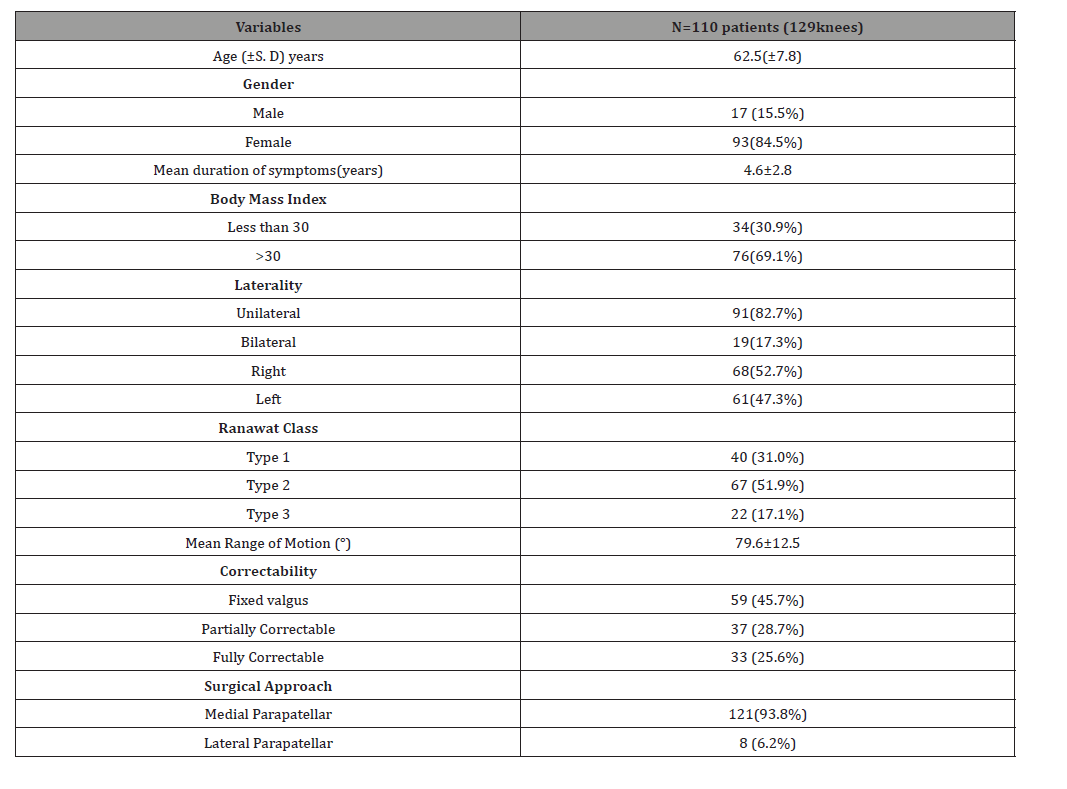
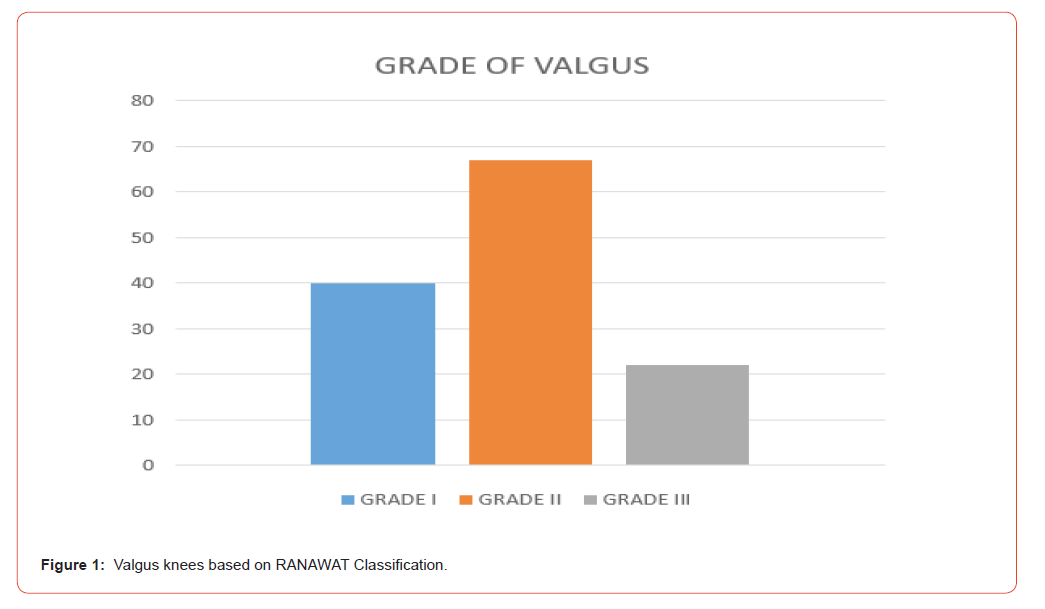
A total of 392 TKRs were performed during the five-year period. Out of these, 129(32.9%) knees were valgus, 241(61.5%) knees were varus and the remaining 22(5.6%) knees had neutral alignment. The mean age at presentation of patients with valgus knees was 62.5(±7.8) years and the age range of 42- 80years was recorded. There was female preponderance with male to female ratio of 1:6.6 and the right knee was the mostly operated side. The mean duration of symptoms was 4.6±2.8 years. The BMI was categorized as non-obese and obese with the latter accounting for about two-thirds (Table 1). Pre-operative flexion contracture was seen in 34 of 129 valgus (26.4%) and extension lag recorded in 18cases (14%). The coronal alignment ranged from valgus of 12- to- 45 degrees with fixed valgus seen in 57 (45.7%) cases. Ranawat Grade II was the most common deformity recorded and the mean pre-operative Range of Motion (R.O.M) was 79.6±12.5°. The most common approach was Medial parapatellar (Table 1). The bony changes or remodeling were distal femur hypoplasia(lateral) and posterolateral defect of the tibial plateau.
Table 1: Demography and Baseline Characteristics of Valgus TKR patients.
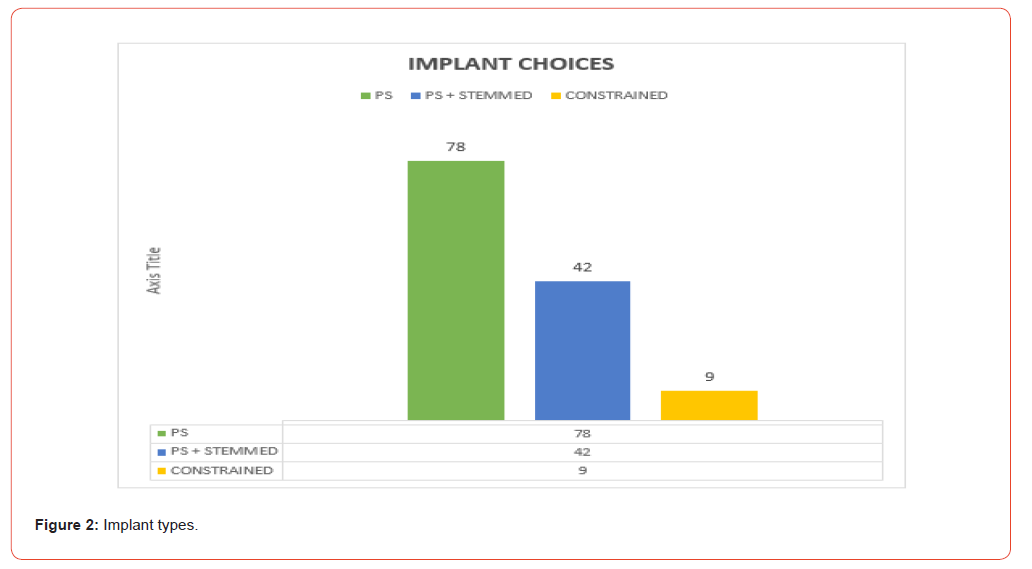
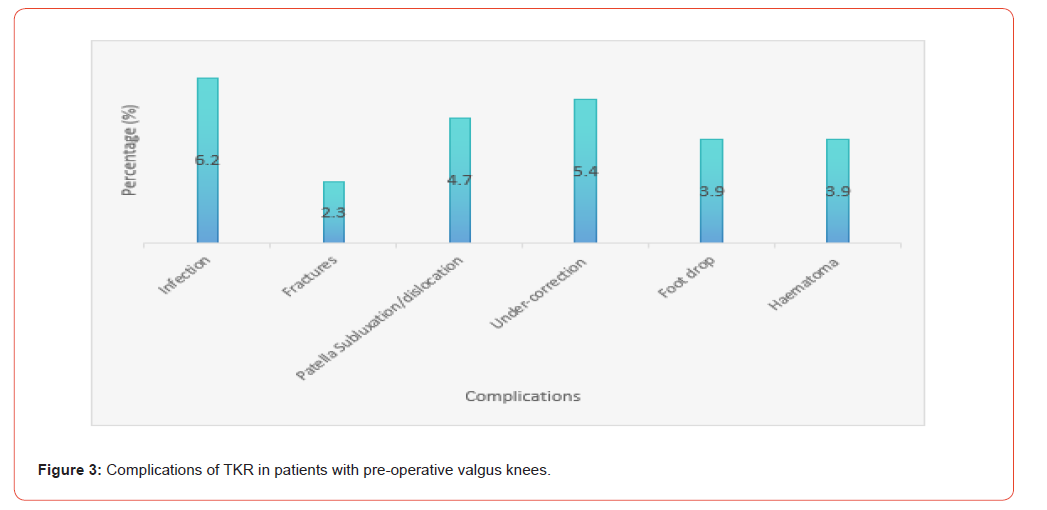
The distal femur valgus correction angle was varied based on surgeon’s preference. The techniques employed for lateral release of the tight structures where necessary included pie-crusting and subperiosteal release from Gerdy tubercle. The implants used were Posterior stabilized (PS) with or without tibial extension rod and constrained condylar knee (CCK). The surgical challenges were mostly encountered in type III Ranawat knees and these included restoration of patellofemoral alignment, soft tissue balancing and non-availability of fully constrained implants. There was improvement in the mean KSS from pre-operative values of 32.7±10.2 (knee) and 39.9±19.4 (function) to post-operative values of 82.4±9.0 (knee) and 89.7±6.0(function) at 12months follow-up (p <0.001). Complications included under-correction, patella subluxation/dislocation, foot drop, hematomas, Infection and fractures (Figure1-3).
Discussion
Valgus knee deformity has traditionally been reported as less common than varus deformity in patients undergoing TKR, with global prevalence ranging between 10–15% [1-4]. However, regional studies have demonstrated considerable variation. Katchy et al. reported a prevalence of 26.5% among 68 consecutive TKR patients in southeastern Nigeria, while our current study observed a higher prevalence of 32.9% in the southwestern region. When compared with international data, the Nigerian prevalence remains lower than 41.8% reported among South-African patients and 56.5% observed in Chinese TKR patients [8,9]. Nonetheless, the Nigerian figures represent a significant departure from the established global average of 10-15%, underscoring the importance of regional epidemiological data in reshaping surgical practice. The surge in valgus knees in our center may reflect evolving local demographics, referral patterns, or disease characteristics unique to our population. This trend challenges the long-standing assumption that valgus deformity is relatively uncommon and emphasizes the importance of adapting surgical practice to local epidemiological realities. By refining surgical strategies and embedding valgus correction techniques into routine training, institutions can ensure that surgeons are not only technically proficient in TKR techniques, but confident in handling these complex valgus knees.
The mean age of 62.5years in our study is in keeping with a study published in the Nigerian Journal of Clinical Practice that found the mean age to be 63.54 ± 0.62 years, with a range of 55- 77 years [7]. Another study reported a mean age of 63.7 years among TKR patients with pre-operative valgus deformity [12]. These studies suggest that the average age of TKR patients with pre-operative valgus deformity is likely in the mid-60s to early 70s. The female predominance of valgus knees in this study aligns with the literature and this could be linked to biomechanical, hormonal and lifestyle factors [13]. About two-third of the patients with valgus knees were obese in this study, supporting established evidence that obesity is a strong predisposing factor to knee osteoarthritis, including those that have valgus knees. Although available evidence suggests that obesity does not significantly influence the development or magnitude of valgus alignment [14- 16], it may affect the outcome of TKR. To optimize surgical results in this subgroup, our practice favors the use of tibial extension rods in patients with a body mass index (BMI) greater than 35 kg/m². This approach reflects a tailored strategy to address the mechanical challenges posed by obesity, thereby improving implant stability and long-term outcomes.
Several classification systems have been proposed to guide surgical management. Ranawat et al. (2005) described three types: Type I, reducible deformity with intact medial stabilizers (<10° valgus); Type II, fixed deformity with elongated medial stabilizers (10–20° valgus); and Type III, severe deformity with incompetent medial structures (>20° valgus) [1]. Mulaji (2014) expanded this into six types, distinguishing reducible from fixed deformities and incorporating recurvatum and extra articular valgus deformities [17]. More recently, Yang et al. (2021) proposed a radiographic classification emphasizing the relative contribution of femoral versus tibial deformity [18]. Each system provides valuable guidance in predicting the need for soft tissue release, medial ligament augmentation, and the level of prosthetic constraint required. In our study, we adopted the Ranawat classification, with Type II deformity being the most common presentation; differing from global reports where Type I predominates [1]-likely reflecting late presentation in our region. The most frequently encountered bony changes in our study were distal femoral hypoplasia and posterolateral tibial plateau defects.
The medial parapatellar approach remains the most commonly utilized technique in TKR, including in valgus knees, due to its familiarity and ease of execution. However, in severe valgus deformities, this approach limits direct access to contracted lateral structures, making adequate release more technically demanding [1]. To address this, Keblish introduced the lateral parapatellar approach, which allows direct access to tight lateral stabilizers while preserving attenuated medial structures [19]. In our study, lateral approach was reserved for Ranawat Type III knees. Although some studies suggest advantages of the lateral approach-such as improved coronal alignment, better patellar tracking, and reduced need for constrained implants [20]-comparative evidence shows no clear superiority over the medial approach. Outcomes including functional scores, alignment, patient satisfaction, and complication rates appear comparable [21,22]. Thus, the choice of approach should be individualized, based on deformity severity and surgeon experience.
Valgus knees require modification of standard bone resection techniques. The distal femoral valgus correction angle (DFVCA) is often reduced to 3–5°, preventing overcorrection while maintaining joint line height [1]. Accurate femoral alignment requires medialization of the intramedullary entry point to account for lateral condyle hypoplasia. Posterior condylar referencing is unreliable in this setting, so alternative landmarks such as the transepicondylar axis and Whiteside’s line are preferred. In our practice, we favor a measured resection technique using Whiteside’s line perpendicular to the transepicondylar axis, before soft tissue balancing. The other method is a gap-balancing technique which optimizes rotational alignment and ensure symmetric flexion and extension gaps, thereby reducing the risk of patellar maltracking and improving overall prosthetic function [1,4,6,18]. Tibial resection is referenced from the preserved medial plateau, with 6–8 mm of bone removed, while avoiding excessive resection of the deficient lateral plateau. This conservative approach preserves bone stock and facilitates use of augments or stemmed components when addressing lateral tibial defects [1,4,6].
Soft tissue balancing is central to valgus TKR. Ranawat’s algorithm emphasizes selective lateral release after bone cuts, while preserving the popliteus tendon for flexion stability [1]. In our patients, this was achieved either by pie-crusting or subperiosteal release of the tight lateral structure after gap tensioning with laminar spreader. Whiteside et al [23] distinguishes structures affecting flexion stability (Lateral collateral ligament, popliteus) from those influencing extension stability (Iliotibial Band, posterolateral capsule), tailoring releases accordingly. Other authors have proposed alternative sequences, but the consensus remains that releases should be progressive and guided by intraoperative gap assessment, avoiding medial instability [24-26]. In severe deformities, the attenuated medial collateral ligament (MCL) complicates balancing. Surgeons must avoid both under release (residual valgus) and over release (iatrogenic instability). If medial laxity persists, thicker inserts or conversion to a constrained condylar knee (CCK) implant may be required. Medial soft tissue procedures, such as MCL advancement or imbrication, can restore tension when medial structures are insufficient [22].
In our patients, most knees were successfully stabilized with PS implants, which provided significant outcomes in Ranawat Type I and II deformities. Patients requiring CCK implants were predominantly those with Ranawat Type III deformities, where medial stabilizers were incompetent and soft tissue balancing alone was insufficient to achieve knee stability. Due to the nonavailability of hinge constraint implants in our setting, few patients with severe Type III valgus deformities underwent CCK implantation combined with MCL advancement procedures. These combined strategies yielded favorable outcomes, underscoring the importance of adapting implant selection and surgical technique in limited resource scenario while maintaining stability and function.
Valgus knees often present with a lateralized tibial tubercle and hypoplastic lateral trochlea, increasing the Q angle and predisposing to patellar subluxation which we experienced in some of our patients. Intraoperative assessment of patellar tracking using the “no thumb” or stitch technique is essential. Corrective measures include selective lateral retinacular release, patellar resurfacing with medialized components, or tibial tubercle osteotomy (TTO). While TTO facilitates exposure and realignment, it carries risks such as wound complications and nonunion. Where resurfacing is performed, medialized components or selective resurfacing strategies are often preferred to optimize patellar tracking [27].
Complications in valgus TKR are influenced by deformity severity, surgical technique, and rehabilitation quality. Neurovascular and mechanical complications deserve particular attention. Common peroneal nerve palsy is a recognized hazard, reported in approximately 1.9% of severe valgus corrections [28]. In our study, the incidence of peroneal nerve palsy was 3.9%, which may reflect the severity of deformity, as Ranawat Type II was the most common presentation requiring substantial correction and soft tissue balancing. This complication is typically attributable to traction neurapraxia during sudden correction of long-standing deformity or direct injury during lateral release. Preventive strategies include flexing the knee to relax the nerve, meticulous soft tissue technique, and staged correction. The patients regained ankle dorsiflexion at average time of six months post TKR. Other complications reported in our series were residual valgus alignment, patellar maltracking, fractures and wound complications such as hematoma and infection.
Residual valgus deformity was observed in a subset of patients. Most of these individuals tolerated the residual valgus alignment and achieved favorable early outcomes. However, in cases where the deformity persisted due to imbalanced soft tissue, outcomes were poor and revision surgery was required. Patients who developed patellar subluxation or dislocation underwent revision procedures, which included patellar resurfacing with medialization of the patellar button, lateral retinacular release, and medial soft tissue repair, performed either as isolated interventions or in combination with revision TKR. These corrective measures restored patellar tracking and improved functional outcomes.
Periprosthetic fractures, all of which occurred around the femoral components. Rorabeck Type I and II fractures were managed successfully with distal femur locking plates, while patients with Rorabeck Type III fractures-characterized by in constructible fractures or loose implants-underwent distal femur replacement with good short-term outcomes. Wound complications such as dehiscence and hematoma were managed with joint wash out and implant retention, yielding satisfactory results. In contrast, patients with established infection were classified using Tsukayama criteria and treated according to our local protocol, which involved two stage revision TKR. Overall, our experience highlights that careful preoperative and intraoperative assessments, judicious soft tissue balancing, and individualized implant selection are critical to minimizing complications. When complications do occur, timely recognition and appropriately tailored revision strategies can yield satisfactory results.
Limitations
First, the retrospective design may introduce selection bias, as only patients with complete data were included. Second, the sample size, while adequate for descriptive analysis, may limit the generalizability of findings to other regions of Nigeria or internationally. Third, radiographic measurements and classification were performed by the surgical team, which may introduce observer bias despite adherence to established criteria. Fourth, long term functional outcomes and implant survivorship were not assessed, restricting conclusions to perioperative findings and early complications. Future prospective, multicenter studies with larger sample sizes and long term follow up are recommended to validate these findings and provide more comprehensive insights into the management of valgus knee deformity in TKR.
Conclusion
Valgus knee deformity is increasingly prevalent among Nigerian patients undergoing TKR, with rates exceeding global averages. These patients are typically older, female, and obese, reflecting demographic and lifestyle factors that may influence disease progression and surgical outcomes. The Ranawat classification remains a practical framework for guiding management, with Type II deformity being the most common presentation in our cohort. Successful correction of valgus deformity requires meticulous surgical planning and execution. Individualized choice of surgical approach, careful modification of bone resections, progressive soft tissue balancing, and vigilant restoration of patellofemoral alignment are essential to achieving stable knees and functional outcomes. Complications such as peroneal nerve palsy, instability, residual deformity, and patellar maltracking highlight the importance of preventive strategies and judicious implant selection.
Authors contributions
KA Alatishe and ES Inyang conceived and designed the study, interpreted the data, drafted and wrote the first version of the manuscript. WO Lawal jointly conceived the study, participated in the interpretation and statistical analysis of data as well as revising the manuscript. ME Ugbeye, OQ Asafa and SO Olanrewaju assisted in the study design, data analysis and revising the manuscript. All authors reviewed and approved this version of the manuscript submitted and agreed to be accountable for all aspects of the work.
Funding
The authors did not receive any specific grant from funding agencies in the public, commercial, or not-for-profit sectors.
Conflict of Interest
The authors declare that there is no conflict of interest.
Ethical consideration
The study was approved by the Health Research and Ethics Committee of study location, patients were de-identified and confidentiality was protected according to Nigeria Data Protection Act 2023.
References
- Ranawat AS, Ranawat CS, Elkus M, Rasquinha VJ, Rossi R, et al (2005) Total knee arthroplasty for severe valgus deformity: surgical technique. J Bone Joint Surg Am 87(2): 271-284.
- Apley AG, Solomon L (2018) Apley’s system of orthopaedics and fractures. 9th ed. Boca Raton (FL): CRC Press.
- Qiu S, Zhang M, Jia T (2016) Total knee replacement for severe valgus knee deformity. Int J Clin Exp Med 9(5): 8725-8730.
- Nikolopoulos D, Michos I, Safos G, Safos P (2015) Current surgical strategies for total arthroplasty in valgus knee. World J Orthop 6(6): 469-482.
- Bonanno G (2024) Valgus Deformity Correction in Total Knee Replacement: An Overview [Internet]. Surgery of the Knee - From Arthroscopic to Open Approaches and Techniques.
- Mannino A, Weinberg ME, Scuderi GR (2024) Total knee arthroplasty in the valgus knee. J Knee Surg 37(2): 86-91.
- Katchy A, Katchy S, Ekwedigwe H, Ezeobi I (2018) Total knee replacement in Nigeria: an assessment of early functional outcome of 68 consecutive knees. Niger J Clin Pract 21(9): 1202-1208.
- Coetzee K, Charilaou J, Burger M, Jordaan J (2024) Increased prevalence of valgus constitutional alignment subtypes in a South African arthritic population group using the coronal plane alignment of the knee (CPAK) classification. Knee 49: 158-166.
- Wang B, Liu Q, Wise BL, Ke Y, Xing D, et al. (2018) Valgus malalignment and prevalence of lateral compartmental radiographic knee osteoarthritis: the Wuchuan OA study. Int J Rheum Dis 21(7): 1385-1390.
- Alesi D, Meena A, Fratini S, Rinaldi VG, Cammisa E, et al. (2022) Total knee arthroplasty in valgus knee deformity: is it still a challenge in 2021? Musculoskelet Surg 106(1): 1-8.
- Alatishe KA, Lawal WO, Ugbeye ME, Babalola OR (2023) Comparison of postoperative alignment using fixed angle versus variable angle distal femoral resection in uncomplicated total knee replacement. Eur J Orthop Surg Traumatol 33(3): 593-600.
- Kosashvili Y, et al. (2010) Total knee replacement in valgus knee deformity. J Knee Surg 23(2): 85-90.
- Ogbu VO, Enweani UN, Madu KA, Iyidobi EC (2016) Prevalence and pattern of osteoarthritis of the knee at National Orthopaedic Hospital Enugu. Niger J Med 25(4): 336-340.
- Messier SP, Pater M, Beavers DP, Legault C, Loeser RF, et al. (2014) Influences of alignment and obesity on knee joint loading in osteoarthritic gait. Osteoarthritis Cartilage 22(7): 912-917.
- Adouni M, Aydelik H, Faisal TR, Hajji R (2024) The effect of body weight on the knee joint biomechanics based on subject specific finite element musculoskeletal approach. Sci Rep14: 13777.
- McKenzie S, Kogan F, Delp SL, Chu CR, Sherman SL, et al. (2026) BMI and varus malalignment compound to define a high-risk phenotype for compartment specific knee osteoarthritis progression. medRxiv [Preprint].
- Mullaji AB, Shetty GM (2014) Deformity Correction in Total Knee Arthroplasty. Springer New York 2014, editor. New York. 5–7 p.
- Yang Y, Jiang L, Zhou X, Zhou X, Chen H, et al. (2024) Robotic-assisted total knee arthroplasty improves implant position and early functional recovery for the knee with severe varus/valgus deformity. BMC Musculoskelet Disord 25(1): 92.
- Keblish PA (1991) The lateral approach to the valgus knee: Surgical technique and analysis of 53 cases with over two-year follow-up evaluation. Clin Orthop Relat Res 271: 52-62.
- Greenberg A, Kandel L, Liebergall M, Mattan Y, Rivkin G (2020) Total knee arthroplasty for valgus deformity via a lateral approach: clinical results, comparison to medial approach, and review of recent literature. J Arthroplasty 35(8): 2076-2083.
- Mercurio M, Gasparini G, Galass O, F Familiari, E Cofano, et al. (2024) Lateral versus medial approach for total knee arthroplasty for valgus knee deformity shows comparable functional outcomes, hip–knee–ankle angle values, and complication rates: a meta-analysis of comparative studies. Arch Orthop Trauma Surg 144: 869–878.
- Rajnish RK, Srivastava A, Yadav SK, Elhence A, Gahlot N, et al. (2024) Comparative Analysis of Outcomes of Lateral Versus Medial Approach in the Total Knee Arthroplasty for Valgus Deformity: A Systematic Review and Meta-analysis. Indian J Orthop. 58(10): 1323–1338.
- Whiteside LA (1999) Selective ligament release in total knee arthroplasty of the knee in valgus. Clin Orthop Relat Res 367: 130-40.
- Favorito PJ, Mihalko WM, Krackow KA (2002) Total knee arthroplasty in the valgus knee. J Am Acad Orthop Surg 10(1): 16-24.
- Buechel FF (1990) A sequential three-step lateral release for correcting fixed valgus knee deformities during total knee arthroplasty. Clinical Orthopaedics and Related Research (1976-2007) 260: 170-1755.
- Krackow KA, Jones MM, Teeny SM, Hungerford DS (1991) Primary total knee arthroplasty in patients with fixed valgus deformity. Clin Orthop Relat Res 273: 9-18.
- Tamboowalla K, Pavlou G, Shah N (2022) Total Knee Replacement in a Valgus Arthritic Knee. In Knee Arthroplasty: New and Future Directions (pp. 59-73). Singapore: Springer Nature Singapore.
- Puijk R, Rassir R, Kok LM, Sierevelt IN, Nolte PA (2022) Common peroneal nerve palsy after TKA in valgus deformities; a systematic review. J Exp orthop 9(1): 12.
-

This work is licensed under a Creative Commons Attribution-NonCommercial 4.0 International License.