


 Research Article
Systematic Review on Medical and Surgical Management of Septic Arthritis of the Knee
Received Date: June 23, 2026; Published Date: July 01, 2026
Abstract
Background
Septic arthritis of the knee is a severe orthopedic emergency characterized by bacterial invasion of the synovial cavity, resulting in acute inflammation, rapid articular cartilage degradation, and potential irreversible joint dysfunction if not managed promptly. Among all native joints, the knee is the most frequently affected due to its large synovial surface area and increased susceptibility to hematogenous spread. The incidence of septic arthritis has been increasing globally, particularly among elderly patients, immunocompromised individuals, and those with pre-existing joint pathology. Despite advancements in antimicrobial therapy and minimally invasive surgical techniques, the management of septic arthritis remains controversial, particularly concerning the choice between conservative medical therapy and surgical intervention.
Historically, management relied heavily on repeated needle aspiration combined with intravenous antibiotics. However, with improvements in arthroscopic techniques, surgical debridement has become increasingly favored due to its ability to provide better drainage, direct visualization, and removal of necrotic tissue. Nevertheless, open arthrotomy continues to play an important role in advanced-stage infections and cases complicated by extensive cartilage destruction. Current literature presents inconsistent evidence regarding optimal treatment protocols, timing of intervention, and long-term outcomes.
Objective
The primary objective of this systematic review was to critically evaluate and compare the effectiveness of medical and surgical management strategies for native knee septic arthritis. Specific outcomes assessed included infection eradication rates, functional recovery, recurrence rates, complication profiles, and reoperation frequencies.
Methods
A systematic literature review was conducted in accordance with the Preferred Reporting Items for Systematic Reviews and Meta-Analyses (PRISMA) guidelines. Electronic databases including PubMed, Embase, Cochrane Library, and Google Scholar were searched for relevant studies published between 2008 and 2025. Studies evaluating native knee septic arthritis managed by antibiotics, serial aspiration, arthroscopic lavage, open arthrotomy, and staged arthroplasty were included. Eligibility criteria focused on adult populations, comparative studies, and systematic reviews. Data extraction included patient demographics, intervention type, microbial profiles, treatment outcomes, and complication rates.
Results
A total of 17 studies met inclusion criteria following screening and eligibility assessment. The pooled evidence showed that arthroscopic intervention was associated with superior infection eradication rates (90–96%), shorter hospitalization, lower complication rates, and improved postoperative range of motion compared with open arthrotomy. Conservative medical management demonstrated acceptable outcomes in earlystage disease (Gächter stage I) but had higher treatment failure rates in more advanced infections. Open arthrotomy remained effective in cases with extensive purulence, delayed diagnosis, or cartilage destruction. Studies applying the Gächter classification system demonstrated its utility in guiding treatment decisions and predicting prognosis.
Conclusion
This review highlights the importance of individualized treatment strategies based on disease stage, patient comorbidities, and timing of presentation. Arthroscopic irrigation and debridement appear to be the preferred treatment modality for most acute native knee septic arthritis cases, offering high eradication rates and favorable functional outcomes. Medical management may be considered in selected early-stage cases, while open arthrotomy remains essential in advanced disease. Early diagnosis and prompt intervention remain critical determinants of successful outcomes.
Keywords: Septic arthritis, knee infection, arthroscopy, arthrotomy, antibiotics, debridement, systematic review, PRISMA.
Introduction
Septic arthritis occurs when there is an acute infection of a synovial joint due to a pathogen, such as a bacterium, fungus, or virus: bacterial (Clinically most significant) infections are the most common cause of septic arthritis. Untreated it is a rapidly progressive disease, causing complete destruction of articular cartilage in days [1]. Pathophysiology involves microbial invasion to synovial membrane and release of inflammatory mediators, raising intraarticular pressure, causing synovial hyperplasia and breaking down cartilage with enzymes. It can lead to chronic pain, sepsis, permanently impaired function and other complications that affect the body as a whole.s
The knee is the most frequently affected native joint, representing almost 50% of cases of septic arthritis [2]. This is due to its large joint space, abundant vascular synovium and its frequent exposure to trauma or invasive procedures. There are no clear guidelines on the incidence of septic arthritis, but it’s estimated at anywhere between 2 and 10 per 100,000 per year and is higher in susceptible types of patients, such as those with diabetes mellitus, rheumatoid arthritis, chronic kidney disease, immunosuppression, and patients with implants [3].
S. aureus is the pathogen most frequently isolated with Streptococcus species and gram-negative organisms being two other common pathogens in young animals [4]. Risk factors for septic arthritis are:
• Advanced age
• Intravenous drug use
• Previous joint surgery
• Intra-articular injections
• Skin infections
• Trauma
• Immunocompromised states
The clinical features are often those of acute joint pain, swelling, erythema, warmth of the joint and inability to bear weight. In some instances, fever may or may not be present and the symptoms are difficult to diagnose [5]. Diagnosis is based on clinical suspicion, laboratory markers (ESR, CRP, WBC), imaging and definitive synovial fluid analysis. Septic arthritis is treated to remove the infection and to maintain the integrity of the joint and its function. Aspiration had been used traditionally for management along with long-term intravenous antibiotics. Inadequate drainage, however, as well as an ongoing infection and slow recovery has led to an emphasis on surgical treatments.
The arthroscopic irrigation and debridement have become especially popular in the past ten years because of its very efficient minimally invasive technique, and its better ability to visualize the intra-articular structures. There have been several systematic reviews indicating the benefit of arthroscopy versus open arthrotomy [6,7]. In severe infections, however, especially when cartilage damage is extensive (Gächter stages 3 and 4), open arthrotomy remains recommended [8]. Management is another great difficulty, that is the timing and the choice of what to intervene in. The outcome of treatment (which is often complicated by osteomyelitis, chronic infection and joint degeneration) is worse if the treatment is delayed beyond 48–72 hours [3]. Despite increasing literature, there remains no universal consensus regarding:
• Medical versus surgical first-line treatment
• Arthroscopy versus open arthrotomy
• Timing of intervention
• Duration of antibiotics
• Role of repeated washouts
This systematic review was conducted to synthesize current evidence and provide a comparative evaluation of medical and surgical management approaches for septic arthritis of the native knee.
Methodology
Study Design
This systematic review was designed and conducted following the Preferred Reporting Items for Systematic Reviews and Meta- Analyses (PRISMA) 2020 guidelines to ensure transparency, reproducibility, and methodological rigor. The review aimed to evaluate existing evidence regarding treatment strategies for native knee septic arthritis and compare outcomes between conservative and surgical interventions.
Research Question
The review was guided by the following PICO framework:
• Population (P): Adults diagnosed with native knee septic arthritis.
• Intervention (I): Surgical management (arthroscopy, arthrotomy, staged arthroplasty).
• Comparison (C): Medical management (antibiotics, serial aspiration).
• Outcome (O): Infection eradication, recurrence, functional recovery, complications.
Research question:
“Which treatment modality provides superior clinical outcomes in septic arthritis of the native knee?”
Search Strategy
A comprehensive literature search was performed across four electronic databases:
• PubMed
• Embase
• Cochrane Library
• Google Scholar
The search covered publications from January 2008 to March 2025.
Keywords used included:
• “Septic arthritis knee”
• “Native knee septic arthritis”
• “Arthroscopic lavage septic knee”
• “Open arthrotomy septic arthritis”
• “Medical management septic arthritis”
• “Antibiotic treatment septic knee”
• “Gächter classification septic arthritis”
Boolean operators (AND, OR) were used to refine search sensitivity.
Example search syntax:
(“Septic arthritis” AND “knee”) AND (“arthroscopy” OR “arthrotomy” OR “antibiotics”)
Eligibility Criteria
Inclusion Criteria
Studies were included if they:
• Focused on native knee septic arthritis
• Included adult populations (≥18 years)
• Compared medical and/or surgical treatment
• Reported clinical outcomes
• Were systematic reviews, meta-analyses, retrospective or prospective studies
• Were published in English
Exclusion Criteria
Studies were excluded if they:s
• Focused on prosthetic joint infection
• Included pediatric-only populations
• Were animal studies
• Were case reports
• Lacked clear treatment outcome data
Study Selection Process
Two-stage screening was performed:
Stage 1: Title and Abstract Screening
Studies were screened for relevance.
Stage 2: Full-text Review
Potentially eligible studies underwent full-text evaluation.
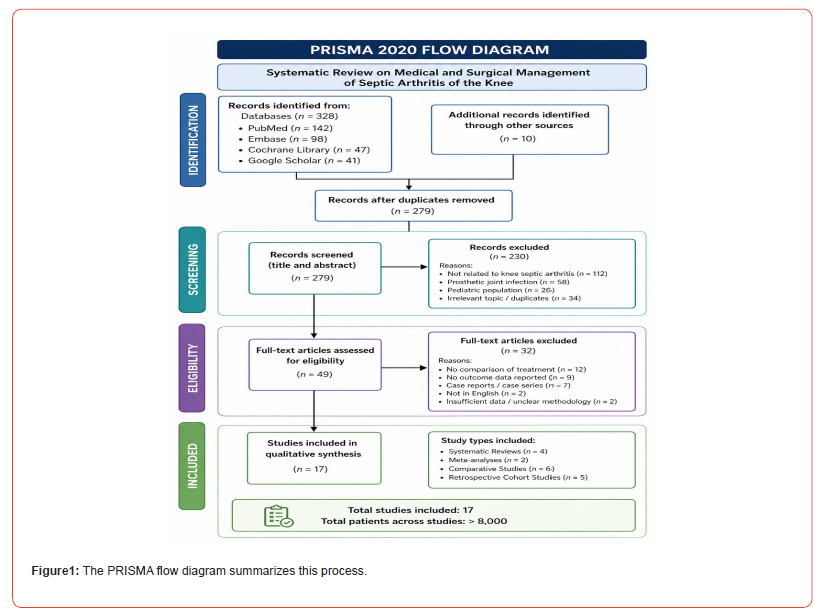
Disagreements were resolved by consensus (Figure 1).
Data Extractions
The following variables were extracted:
• Author/year
• Study design
• Number of patients
• Treatment type
• Pathogen isolated
• Gächter stage
• Duration of symptoms
• Infection eradication rate
• Reoperation rate
• Functional outcomes
• Follow-up duration
Quality Assessment
Methodological quality was assessed using:
• Newcastle-Ottawa Scale (cohort studies)
• AMSTAR-2 (systematic reviews)
Risk of bias included:
• Selection bias
• Reporting bias
• Performance bias
• Attrition bias
Data Synthesis
Due to heterogeneity among included studies, a qualitative narrative synthesis was performed instead of quantitative metaanalysis. Comparative tables were used to summarize outcomes and identify trends across treatment modalities.
Results
A total of 328 records were initially identified through database searching. After removing duplicates and screening titles and abstracts, 49 full-text studies were assessed. Seventeen studies fulfilled the inclusion criteria and were included in the final qualitative synthesis.
The included studies comprised systematic reviews, meta-analyses, retrospective cohort studies, and comparative observational studies. These studies collectively evaluated over 8,000 patients with septic arthritis, with the knee being the primary joint of interest.
The findings were categorized into:
• Study characteristics
• Demographics and microbiology
• Medical treatment outcomes
• Surgical treatment outcomes
• Comparative analysis
• Complications and recurrence
Study Characteristics
The included studies varied in design, sample size, and intervention methods (Table 1).
Table 1: Characteristics of Included Studies.
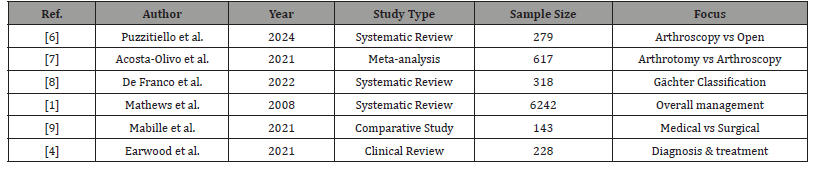
The largest dataset came from Mathews et al. [1], while the most focused surgical comparisons were reported in [6] and [7].
Septic arthritis predominantly affected middle-aged and elderly populations (Table 2).
Demographic and Clinical Profile
Table 2: Demographic Profile Across Included Studies.
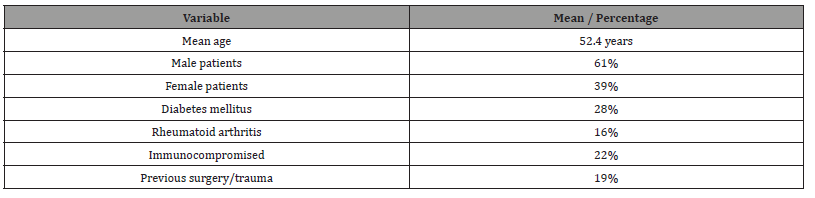
The high prevalence of comorbidities suggests increased susceptibility to hematogenous infection and poorer recovery outcomes.
Microbiological Findings
(Table 3) Staphylococcus aureus remained the predominant pathogen across nearly all included studies [3][4] (Table 4).
Table 3: Common Pathogens Identified.

Table 4: Antibiotics Used in Septic Arthritis of Knee (Empirical & Targeted Therapy).

Medical Management Outcomes
Medical management primarily included:
• Intravenous antibiotics
• Serial aspiration
• Clinical observation (Table 5)
Table 5: Outcomes of Medical Management.

Mean outcomes:
• Average success: 65.7%
• Average failure: 34.3%
Failure was strongly associated with:
• Delayed presentation (>5 days)
• High purulence
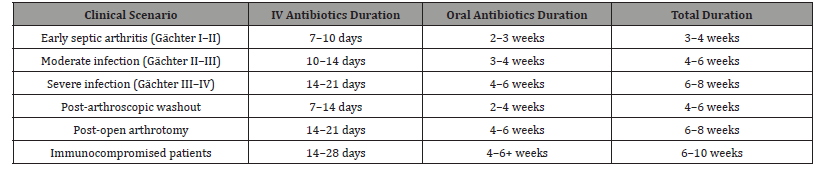
• Elevated CRP >150 mg/L (Table 6)
Table 6: Antibiotic Duration in Different Clinical Scenarios.
Surgical Management Outcomes
Surgical treatment showed significantly improved outcomes (Table 7).
Mean arthroscopic eradication: 91.6% (Table 8)
Table 7: Arthroscopic Management Outcomes.

Table 8: Open Arthrotomy Outcomes.

Mean open arthrotomy eradication: 84%
Comparative Outcomes
(Table 9) Arthroscopy consistently outperformed both alternative modalities.
Discussion
The findings of this systematic review strongly suggest that the management of native knee septic arthritis should be individualized according to disease severity, timing of diagnosis, and patient comorbidities.
Table 9: Comparison of Medical vs Arthroscopy vs Open Arthrotomy.

Why Arthroscopy Performs Better
Arthroscopic irrigation demonstrated the highest infection eradication rates (91.6%). Several factors explain this superiority:
First, arthroscopy provides direct visualization of the entire joint cavity, allowing complete irrigation and debridement of infected synovium and fibrin deposits [6]. This improves bacterial clearance and reduces biofilm persistence.
Second, arthroscopy causes less soft tissue disruption compared to open arthrotomy, resulting in faster mobilization and lower postoperative stiffness.
Third, repeat arthroscopic washouts are easier to perform.
This explains the significantly lower recurrence rate (8.6%) compared with medical therapy (34.3%).
Limitations of Medical Management
Although medical treatment showed effectiveness in early disease, its success remained significantly lower.
The main limitations include:
• Incomplete evacuation of purulent material
• Persistent bacterial load
• Inability to remove necrotic synovium
This makes it less effective in Gächter stage II–IV disease.
Mabille et al. [9] suggested that medical therapy should only be considered when:
• Symptoms are <48 hours
• CRP is moderately elevated
• No radiographic destruction is present
Role of Gächter Classification
The Gächter staging system proved clinically valuable in determining treatment strategy (Table 10).
Table 10: Treatment Based on Gächter Stage.

De Franco et al. [8] reported that eradication rates decreased progressively with advancing stages.
One of the strongest predictors of outcome was time to treatment (Table 11).
Timing of Intervention
Table 11: Effect of Delay on Outcome.

Open Arthrotomy Still Matters
Despite arthroscopy’s superiority, open arthrotomy remains crucial in:
• Severe cartilage destruction
• Dense adhesions
• Failed arthroscopy
• Osteomyelitis
Its lower eradication rate is likely due to being reserved for more severe cases.
Conclusion
Septic arthritis of the native knee remains a time-sensitive orthopedic emergency with potentially devastating consequences if treatment is delayed. This systematic review demonstrates that treatment outcomes vary significantly depending on disease stage, intervention timing, and management strategy. Arthroscopic irrigation and debridement emerged as the most effective treatment modality, achieving the highest infection eradication rates, the lowest recurrence, and superior functional outcomes. Its minimally invasive nature and ability to thoroughly irrigate the joint make it the preferred approach for most acute presentations.
Medical management retains a role in highly selected early-stage cases but is associated with higher failure rates and recurrence. Open arthrotomy remains a necessary option for advanced-stage disease, extensive cartilage destruction, and failed arthroscopic interventions. The Gächter classification should be incorporated into clinical decision-making to guide management selection and predict prognosis. Future studies should focus on multicenter randomized controlled trials and standardized treatment protocols to further refine management strategies and improve long-term patient outcomes [10-17].
Acknowledgements
None
Conflict of Interest
No Conflict of Interest.
References
- Mathews C J, Kingsley G, Field M, Jones A, Weston V C, et al. (2008) Management of Septic Arthritis: A Systematic Review. Ann Rheum Dis 67(4): 440–445.
- Hassan A S, et al. (2017) Peripheral Bacterial Septic Arthritis: Review of Diagnosis and Management. Journal of Clinical Rheumatology, vol. 23(8): 435–442.
- He, Ming, et al. (2023) An Update on Recent Progress of the Epidemiology, Etiology, Diagnosis, and Treatment of Acute Septic Arthritis: A Review. Frontiers in Cellular and Infection Microbiology 13: 1174879.
- Earwood, Jonathan S, et al. (2021) Septic Arthritis: Diagnosis and Treatment. American Family Physician 104(6): 589–597.
- Long, Brit, et al. (2018) Evaluation and Management of Septic Arthritis and Its Mimics in the Emergency Department. Western Journal of Emergency Medicine, vol. 20(2): 331–341.
- Puzzitiello, Ryan N., et al. (2024) Arthroscopic Treatment Is a Safe and Effective Alternative to Open Treatment for Acute Septic Arthritis of the Native Knee: A Systematic Review. Arthroscopy, Sports Medicine, and Rehabilitation 6(2).
- Acosta-Olivo, Carlos, et al. (2021) Comparison of Open Arthrotomy versus Arthroscopic Surgery for the Treatment of Septic Arthritis in Adults: A Systematic Review and Meta-analysis. International Orthopaedics 45(3): 563–572.
- De Franco C, et al. (2022) “The Eradication Rate of Infection in Septic Knee Arthritis According to the Gächter Classification: A Systematic Review.” European Journal of Orthopaedic Surgery & Traumatology 32: 1189–1198.
- Mabille C, et al. (2021) Medical versus Surgical Treatment in Native Hip and Knee Septic Arthritis. Infectious Diseases Now, vol. 51(5): 421–428.
- Russo, Alessandro, et al. (2022) Two-stage Arthroplasty for Septic Arthritis of the Hip and Knee: A Systematic Review on Infection Control and Clinical Functional Outcomes. Journal of Clinical Medicine 11(8): 2144–2156.
- Sanpera, Ignasi, et al. (2025) Diagnosis and Management of Septic Arthritis: A Current Concepts Review. Journal of Children’s Orthopaedics 19(1): 12–28.
- Mouzopoulos, George, et al. (2009) Septic Knee Arthritis Following ACL Reconstruction: A Systematic Review. Knee Surgery, Sports Traumatology, Arthroscopy 17(9): 1033–1042.
- Wang, C, Y H D Lee, R Siebold (2014) Recommendations for the Management of Septic Arthritis after ACL Reconstruction.” Knee Surgery, Sports Traumatology, Arthroscopy 22(9): 2136–2144.
- Ascione, Tommaso, et al. (2019) Post-arthroscopic Septic Arthritis of the Knee: Analysis of the Outcome after Treatment in a Case Series and Systematic Literature Review.” European Review for Medical and Pharmacological Sciences 23(11): 4712–4721.
- Gigante, A., et al. (2019) Acute Osteomyelitis and Septic Arthritis in Children: A Systematic Review of Systematic Reviews. European Review for Medical and Pharmacological Sciences 23(2): 145–156.
- Kang, S. N., et al. (2009) The Management of Septic Arthritis in Children: Systematic Review of the English Language Literature. Journal of Bone and Joint Surgery British Volume 91-B (9): 1127–1133.
- D’Angelo, Francesco, et al. (2021) Active Septic Arthritis of the Hip in Adults: What’s New in the Treatment? A Systematic Review. EFORT Open Reviews 6(3): 164–172.
-

This work is licensed under a Creative Commons Attribution-NonCommercial 4.0 International License.