




 Research Article
Childhood Hand Treadmill Injuries
Received Date: April 24, 2026; Published Date: May 08, 2026
Abstract
Background: : Exercise treadmills have grown in popularity in the past few years. The addition of this type of equipment in the home offers opportunity for injury, particularly in children. We report 05 case of childhood hand treadmill injuries.
Keywords:Treadmill - Pediatric; child; Epidemiology; Treatment; Prevention
Background
The use of home exercise equipment is increasing and treadmills are becoming more popular. This has brought with it an emerging but preventable problem. We present our experience, highlight the importance and promote some public awareness of this type of injury [1]. To our knowledge this has not been reported previously. A treadmill, with a rubberized belt driven by an electromotor, can cause harm to children by hand contact [2]. Usually, curiosity drives children to contact the treadmill with their hands. The lack of selfprotection awareness and slow withdraw reflex make hands the most vulnerable parts in children. Treadmill injuries were initially reported by Qatar researcher Attala et al. [3] in 1991, and were subsequently reported in other developed countries, including the United States, the United Kingdom, South Korea, Australia, china etc...[4]. It seems that this type of injury is taking on a global trend. To the best of our knowledge, the literature had not reported a lot of study about this type of injury. The study aimed to report our experience.
Patients and Methods
Patients
After the internal review board agreement, patients were identified retrospectively through the brun registry of our institution over a period of 12 months. All the children who were admitted during the study period and treated for Hand Treadmill Injuries were included in this series. Parents consent were also obtained.
Data collection
Data collected included age, sex, mechanism of injury, initial clinical assessment, management, and outcome.
Results
Prevalence and Sociodemographic Parameters
Five (05) patients were identified with seven injuries. This represented 6,94% (5/72) of burn injuries during this period.
The Sex ratio was 3/2.
The average age of the patients sustaining a hand treadmill injury was 3 +/- 0,54 years (2,5-4) (Table 1). All of the patients sustained injury from having their hands near the rear of the machine and receiving a friction burn from the moving belt.
Table 1: : Demographic data with the exact location of the injury and treatment for each patient.

Initial Clinical Assessment
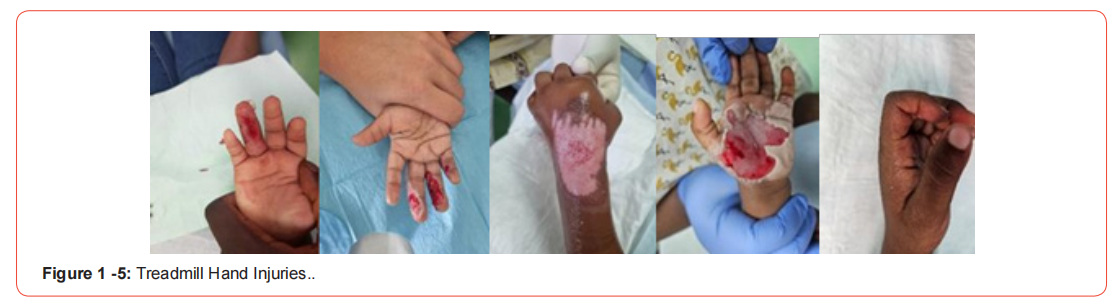
A total of 3 children presented with superficial 2nd degree burn and 2 children with deep 2nd degree burn. The volar surface of the fingers was involved in 3 cases (4,16 %), the palmar surface of the Hand in 01 case (1,39%) and the dorsum side of the wrist in 01 case (1,39 %). Among them two children had been seen ten days and one month after the treadmill injury (Figures 1-5).
Management and Outcome
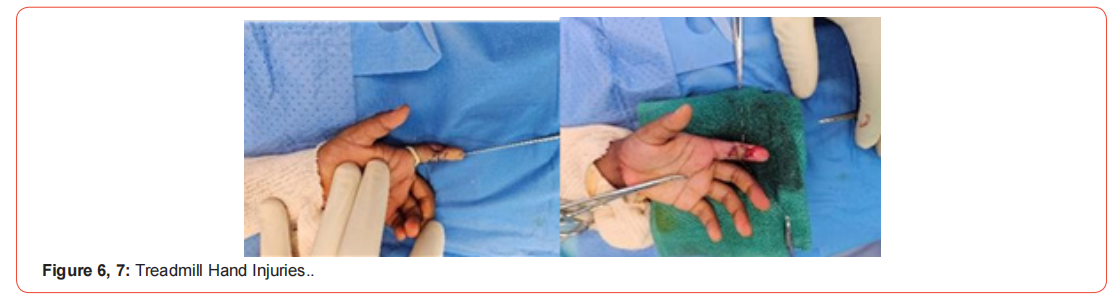
Three patients with superficial 2nd degree burn (4,16 %) were managed with wound care and dressing changes every two days. Two patients sustaining deep 2nd degree burn injuries (2,78%) required operative treatment with “Z “plasty and skin grafting (Figure 6, 7).

The average time of follow-up was 06 months. All patients achieved wound closure without significant complications and all had refound finger mobility (Figures 8, 9).
Discussion
The purpose of this study was to describe our experience of this type of injury. We collected 5 cases in one year which represent 6,94% of all burn injuries in our setting. Prevalence and sociodemographic parameters. Upon first look at the data from this study, it might appear that hand treadmill Injuries in pediatric patients are not a severe or common problem. In reviewing the literature regarding this type of injury, most of the studies are small in scope [5, 8]. However, data from the Consumer Product Safety Commission obtained by another group [5], and that obtained for this study, demonstrate that injuries to children caused by home exercise equipment remain a problem that does not appear to be abating. Considering the recorded data in the US, there have been 1009 hand injuries related to treadmills in a 4-year period, 300 cases of which occurred in toddlers and children younger than 5 years of age [5]. We should mention here that all studies and data related to this kind of injury have been done on very small groups of patients. In our series we had five injuries related to treadmills among all the children coming for burned injury in a year study. Considering the gender, this trauma is more likely to be seen in boys than girls [6]. In our study group the sex ratio was 3/2. It has also been nearly universally found in previous studies that almost all children that sustain these injuries are younger than the age of 5 years. The average age in our series was 3 years. In other studies, it was reported in a range of 2.4-3.9 years [6, 9].
Considering the location of the injuries, most of them had been reported in the upper extremity, especially the hands and fingers [5, 6, 9, 10]. Volar surface of the hand has been the most common site of injury [6, 11]. In our study the most common site of injury was the volar surface of the fingers in 3 cases (4,16 %). However, in two cases the injury location was at the dorsal aspect of the wrist and the volar surface of the hand. It must be taken into account that the earlier the treatment begins, the better the treatment outcome will be. The patients who seek medical help with a delay after the injury have a much worse outcome compared to others. Delaying the initiation of treatment has a direct, linear relation to the increased need for surgery. In case of having such injuries, immediate treatment is necessary [5, 9, 12]. This because first injuries caused by treadmills did not seem serious to parents and because of this delay, a considerable number of patients refer in the chronic phase of the disease with scar contracture. In a study done by Marshall et al [8], 14 patients were studied and 8 of them had come long after their injury, and had developed contraction scars [2]. We had two children who came ten days and one month after injury.
With correct care of the wound and rehabilitation, many of these injuries especially superficial ones can be treated without surgery. Three children of our series were treated by wound care with change dressing immediately after treadmill injury and they had no surgery. In a study done by Camran et al., on 12 patients, half of them had undergone surgical operation [6]. We had in our series 2 children with a delay of treatment who had developed a contraction scar and they required operative treatment to release scar contracture with “Z “plasty completed by skin grafting (Figures). It may be due to delay of treatment. They had static finger splints for three months to prevent the recurrence of contracture. After a followup of 10 month all the children achieved wound closure without significant complications and all had good outcome with good mobility. Several studies have recommended design modifications and warnings for the public to reduce this preventable injury [13, 7, 6]. Wong et al [13] listed public recommendations such as locking the room during treadmill use, positioning the treadmill to face the open door, using of a back wall mirror, avoiding the use of headsets while on the treadmill and avoiding treadmill use in the presence of children. Despite these recommendations, children are still sustaining injuries as detailed above. We can add to proposal that the design modifications include childproof switches or lockout codes, warning labels on the console of the machine, installing guards to shield the belt and sensor-activated mechanisms to stop the belt on soft tissue contact.
Limitations
• Lack of study in the literature • Duration and low sample size of the study, considering the fact that this is our first series. • Complications: Are they only due to delay of treatment?
Conclusion
Home treadmill use is on the rise and more children are at risk of injury. Previous studies have highlighted this and recommended additional safety features but it is still a significant problem. Accidents will continue to happen as long as children have access to the equipment. We believe parents, manufacturers and regulatory authorities must take important steps to prevent this emerging health problem. It is reasonable to conclude that pediatricians and hand surgery practitioners will continue to see these types of injuries for the foreseeable future. We also believe that early referral to a pediatric surgery burned unit results in a better outcome and prevents devastating complications such as hypertrophic scarring and contracture.
Déclaration of Interests
The authors declare that they have no known competing financial interests or personal relationships that could have appeared to influence the work reported in this paper.
Funding
No funding.
Ethical approval
Not applicable.
Consent
The parents of the patients provided written consent.
Guardian/Patients Consent
The parents of the patient provided written consent.
Declaration of Competing Interest
The authors declare that they have no known competing financial interests or personal relationships that could have appeared to influence the work reported in this paper.
Acknowledgement
None.
References
- Lohana P,Hemington-Gorse S, Thomas C, Potokar T, Wilson YT (2012) Paediatric injuries due to home treadmill use: an emerging Ann R Coll Surg Engl 94(2): 121-123.
- MarshallJ, Lourie GM (2003) Pediatric hand friction burns injuries secondary to J Pediatr Orthop 23(3): 407-409.
- AttallaMF, Al-Baker AA, Al-Ekiabi SA (1991) Friction burns of the hand caused by jogging machines: a potential hazard to children. Burns 17(2): 170-171.
- ZhangY, Liu Y, Yuan X, Xiao J, Ding X, et al. (2021) Treadmill Hand Injuries Among Children: A Retrospective Case Series from Hospitalized Patients. Front Pediatr 9: 633091.
- AbbasMI, Bamberger HB, Gebhart RW (2004) Home treadmill injuries in infants and children aged to 5 years: a review of Consumer Product Safety Commission data and an illustrative report of case. J Am Osteopath Assoc 104(9): 372-376.
- CarmanC, Chang B (2001) Treadmill injuries to the upper extremity in pediatric Ann Plast Surg 47(1): 15-19.
- MaguinaP, Palmieri TL, Greenhalgh DG (2004) Treadmills: a preventable source of pediatric friction burn injuries. J Burn Care Rehabil 25(2): 201-204.
- MarshallJ, Lourie GM (2003) Pediatric hand friction burn injuries secondary to J Pediatr Orthop 23(3): 407-409.
- HanT, Han K, Kim J, Lee G, Choi J, et (2005) Pediatric hand injury induced by treadmill. Burns 31(7): 906-909.
- AttallaMF, Al-Baker AA, Al-Ekiabi SA (1991) Friction burns of the hand caused by jogging machines: a potential hazard to children. Burns 17(2): 170-171.
- Rabban JT, Blair JA, Rosen CL, Adler JN, Sheridan RL (1997) Mechanisms of pediatric electrical New implications for product safety and injury prevention. Arch Pediatr Adolesc Med 151(7): 696-700.
- CollierML, Ward RS, Saffle JR, Edelman LS, Morris SE, et al. (2004) Home treadmill friction injuries: a five-year review. J Burn Care Rehabil 25(5): 441-444.
- JonesCS, Freeman J, Penhollow TM (2006) Epidemiology of exercise equipment-related injuries to young children. Pediatr Emerg Care 22(3): 160-163
- WongA, Maze D, La Hei E, Jefferson N, Nicklin S, et al. (2007) Pediatric treadmill injuries: a public health issue. J Pediatr Surg 42(12): 2086-208
-

This work is licensed under a Creative Commons Attribution-NonCommercial 4.0 International License.




