



 Short Communication
Moringa oleifera; young leaves; Nutritional quality; Malnutrition; children
Received Date: March 01, 2024 Published Date: March 28, 2024
Abstract
The malnutrition is responsible of many death of children under 5 years. Thus, investigations must be done to identify leaves with higher nutritive quality which will be include in children diet. The objective of this study was to assess the nutritional quality of young leaves of Moringa oleifera with 3 months old. The samples of young leaves of Moringa oleifera have been appropriated within 2 gardens in Ouagadougou, Burkina Faso. These samples have been analyses for macronutrients and micronutrients parameters. The results showed the dried leaves mean content in proteins was 22.4%. The contents in minerals and trace elements were Calcium (1788.8 mg/100g), Magnesium (289 mg/100 g), Potassium (1956.5 mg/100 g), Phosphor (316 mg/100 g), Iron (12.1 mg/100 g). The young leaves of Moringa oleifera have a high nutritional quality and can help to improve under 5 years’ children nutritional needs.
Keywords:Moringa oleifera; young leaves; Nutritional quality; Malnutrition; Children
Introduction
Malnutrition is a public health problem for under 5 years children. According to Chevalier [1] malnutrition impairs the immune system leading to a high vulnerability to infections. These infections favored other diseases which are responsible of children death. A safe and balanced nutrition will help children to fight diseases. A good nutritional status can reduce infections and extend the life of malnourished children [2]. Then, diets enriched with legumes containing high proteins and micronutrients are necessary for these children [3]. The objective of this study was to
Materials and Methods
Sampling
For the nutritional content determination, the samples of cool leaves have been appropriated on young Moringa oleifera plants which had 3 months old in two gardens. These cool samples have been stored at +4 °C before analysis. A part of the cool leaves has been dried to the laboratory temperature during 14 days and then, reduced in powder with a grinder (mark NIMA, model NO: BL - 888A, Japan). The powder has been sifted by a sifter with the meshes 0.5 millimeter (mm) of diameter and then, kept in plastic sachets to the laboratory temperature (25 °C). The content analyses have been done in triplicate with the cool and dry samples.
Macronutrients content analyses
The samples of cool and dried leaves of Moringa. oleifera have been analysed for the following components: water, proteins, lipids, crude fibers, total sugars and ashes. The Analyses have been done in triplicate. Determination of water content: The content in water has been determined by the AOCS method [4]. A mass, 5 g of samples has been weighed and placed in crucibles. The crucibles have been placed in drying oven to 105 °C until getting a constant mass.
Determination of ashes content
The ashes content have been determined by the AOCS method4. In three crucibles, 2 g of samples has been placed. The samples have been submitted to mineralize in the oven to 550 °C during 3 h. After this time, the crucibles have been withdrawn, cooled to the desiccator during 30 min before being weighed. It has been put back at the oven during one hour and has been weighed after cooling to the desiccator. The operation has been restarted until obtaining a constant weight.
Determination of proteins content
The content in proteins has been determined with Kjeldahl device using AOCS method [4]. The organic nitrogen of the sample (0.2 g) has been transformed in mineral nitrogen (NH4)2SO4 by the oxidizing action of the sulphuric acid concentrated in presence of a catalyst. The content in total proteins has been calculated by multiplication of nitrogen quantity with a conversion factor (6.25).
Determination of crude fibers content
The crude fibers content has been estimated by insoluble formic method [5]. We put 5 g of samples in a vial containing 100 ml of formic acid 80% (V/V). The mixture has been placed in the boiling water during 75 min. After cooling, the product of the digestion has been filtered and the insoluble phase has been recovered in a crucible, dried to 103 °C and weighed (w1). After incineration in an oven, the weight of the ashes has been determined (w2). The crude fibers content has been determined after calculation of the difference of these two weights.
Determination of total sugars content
Total sugars have been estimated according to Tollier and Robin method [6]. A quantity of sample (0.1 g) has been weighed and introduced in three test-tube with 10 ml of NaOH; 0.1 N. The mixture has been placed in the boiling water during 30 min, after cooling the mixture has been decanted in a tube. Then, 0.01 ml of the mixture has been appropriated in a tube and adds 0.99 ml of distilled water, 2 ml of orcinol and 7 ml of H2SO4 60%. The mixture has been homogenized and has been placed again in hot water (80 °C) during 20 min. Then, the tubes have been put to the obscurity after cooling during 45 min. The reading of the optic density has been done to 510 nanometer. A curve of standardization has been achieved using glucose 0.5 mg/ml as reference. The range of concentration in glucose varying between 5 and 50 μg/ml. The curve permitted to determine the concentration in total sugars of samples.
Determination of lipids content
The lipids content has been determined according to the soxlhet method extraction using the hexane like solvent [4]. A quantity of samples (5 g) has been weighed and placed in three extraction cartridges. The cartridges have been plugged with cotton and have been placed in the soxhlet. Cleans and dry extraction balls have been weighed before pouring 250 ml of hexane. The extraction has been done during 5 h. After this time, the solvent has been separated by evaporation in the ROTAVAPOR. The weight of lipids has been gotten by difference between the final weight and the initial weight of balls.
Determination of energizing values
The energizing values of proteins, total sugars and lipids have been determined by Merrill and Watt [7] coefficients adopted by the Food and Agriculture Organization in 1970. The energizing value of samples have been gotten by the following relation: P x 4 Kcal + G x 4 Kcal + L x 9 Kcal = X Kcal/100 g, with P = percentage of proteins, G = percentage of sugars, L = percentage of lipids, X = energizing values.
Micronutrients composition characterization
Determination of Phosphor (P), Potassium (K), Sodium (Na), Magnesium (Mg) and Calcium (Ca)
The content of these minerals in M. oleifera leaves has been determined after the sample mineralization by humid voice according to Houba et al. method [8]. In three tubes, 0.5 g of samples ground to 0.5 mm has been weighed and 5 ml of the extraction solution (sulphuric acid - selenium - salicylic acid: 7.2%) have been added in each tube. A Blanc solution has been prepared with 5 ml of the extraction solution. The samples have been let to rest during 2 h at least. After this time, they have been heated with temperatures varying between 100-340 C. The mixture gotten after heating has been cooled to the ambient temperature during 24 h and then, has been diluted to 2/3 of tubes, agitated, cooling again and completed to 75 ml with the distilled water.
After agitation and decanting, a quantity of the solution has been used for
a) The dosage of the total phosphor with the autosensor (model SKALAR 1000) to 880 nm using the ammonium molybdate as indicator.
b) The dosage of Magnesium and Calcium after dilution in the Lanthane [(La (NO3)3 6H2O)] respectively to 285.2 nm and 422.7 nm with an atomic absorption spectrophotometer (model PERKIN ELMER A100).
c) The dosage of Sodium and Potassium with a flame photometer (model CORNING 400).
d) Ranges of standards solutions have been prepared for the dosage of micronutrients. These ranges are given like follows:
e) Phosphor (P): a solution (300 ppm) of potassium hydrogenophosphate (K2HPO4) permitted to achieve a range of concentration varying between 3 and 15 ppm.
f) Potassium (K) and Sodium (Na): a standard solution of Sodium-potassium (100 ppm) permitted to prepare a range concentration between 0 and 10 ppm.
g) Magnesium (Mg) and Calcium (Ca): standards solutions of Magnesium (1000 ppm) and Calcium (1000 ppm) permitted to prepare concentrations ranges varying between 5 and 30 ppm for the Calcium, 0.5 and 3 ppm for Magnesium.
Zinc (Zn) and Iron (Fe) determination
In three tubes, 0.5 g of samples ground to 0.5 mm has been weighed and 5 ml of the extraction solution: Nitric acid (HNO3; 65%), sulphuric acid (H2SO4; 96%) and perchloric acid (HClO4 70%) have been added in each tube. A Blanc solution has been prepared with 5 ml of the extraction solution. The samples have been let to rest during 2 h at least. After this time, they have been heated with temperatures varying between 75-240 C. The mixture gotten after heating has been cooled to the ambient temperature during 24 h and then, has been diluted to 2/3 of tubes, agitated, cooling again and completed to 75 ml with the distilled water. After agitation and decanting, a quantity of the solution has been used for analyze the Iron (Fe) and Zinc (Zn) in atomic absorption, respectively to 219.9 nm and 248.3 nm. A concentration range of standard solution has been 6 to 36 ppm for the Iron (Fe) and 1 to 6 ppm for the Zinc (Zn).
Statistical analysis
The averages and standards deviations calculation have been done with the software EXCEL 2007. The test of Tukey with the software XLSTAT pro 7.1 has been used to do the comparison between the averages. The test has been found meaningful at the doorstep of 5%.
Results
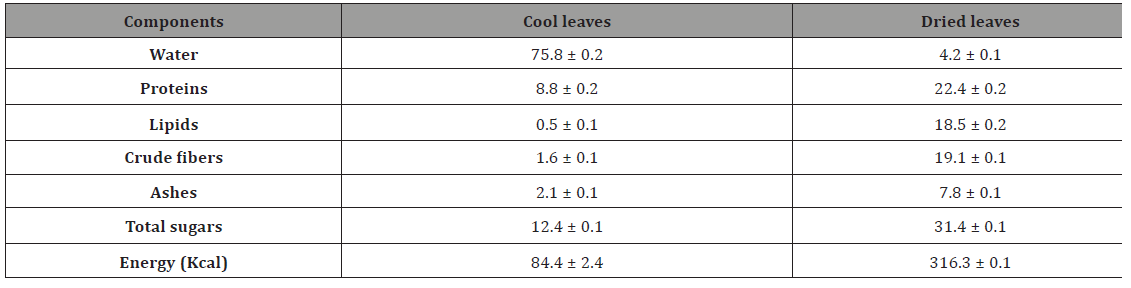
The results showed high contents in water of young leaves of Moringa oleifera. These contents were 75.9 % et 75.6 % respectively for the young cool leaves for the garden 1 and garden 2 (Tables 1 & 2). Content in proteins (8.9 %) and in total sugars (12.5 %) have been found for the young leaves of garden 1. Similar content have been found for the cool leaves of garden 2: water (75.6 %), proteins (8.6 %), total sugar (12.3%). We did not found significant difference between the content in macronutrients of the two garden (p > 0.05). The dried leaves had low content in water. The dried leaves content in water were 4.2 % et 4.1 % respectively for the garden 1 and the garden 2. However, high content in proteins (22.4 %), in lipids (18.5 %) and total sugar (31.4 %) have been found in the dried leaves of the garden 1. Similar content in proteins (22.2 %), in lipids (18.3 %) and total sugar (31.6 %) have been found in the dried leaves of the garden 2. No significant difference has been found between the content in macronutrients of the dried leaves of the two gardens (p > 0,05). The means content in water, proteins and total sugar for all leaves of the two gardens were respectively 75.8 %; 8.8% and12.4 % (Table 3). These contents were higher in the dried leaves: proteins (22.4 %), lipids (18.5 %), total sugar (31.4 %). A high energy value (316.3 Kcal) has been found in the dried leaves.
Table 1: Contents in g/100 g of leaves 1 (means ± standards deviations)

Table 2: Contents in g/100 g of leaves 2 (means ± standards deviations)

Table 3: Means contents in g/100 g of leaves (means ± standards deviations)
For the micronutrients, the results showed that the young cool leaves of the garden 1 had remarkable content in Ca (675.3 mg/100 g), K (600.2 mg/100 g), Mg (143.1 mg/100 g), P (130.1 mg/100 g) and Fe (10.9 mg/100 g) (Table 4). After drying, the leaves content in these micronutrients were 2 time higher compared to the cool leaves. Similar results have been found for the cool and dried leaves (Table 5). The high means content in Ca (1787.5 mg/100 g), K (1955.3 mg/100 g), Mg (298.5 mg/100 g), P (316 mg/100 g), have been found in the all dried leaves of the two gardens (Table 6). Iron and Zinc which are trace elements are also found in the leaves: Fe (12.3 mg/100 g) and Zn (1.3 mg/100 g).
Table 4: Contents in mg/100 g of leaves 1 (means ± standard deviation)

Table 5: Contents in mg/100 g of leaves 2 (means ± standard deviation).

Table 6: Means contents in mg/100 g of leaves (means ± standard deviation)

Discussion
The nutrients content of these young cool leaves of Moringa oleifera with 3 months old were compared to old leaves of Moringa oleifera tree with 17 years old [9]. The young leaves had low content in proteins and lipids compared to the old leaves. However, water and total sugar content of young leaves were higher than the old leaves. These low content in proteins and lipids of cool young leaves are due to high content in water. After drying of the leaves, the nutrients content were higher than those found in cool leaves. Micronutrients content of the young cool leaves where high. These content in micronutrients which are two and four time higher in the dried leaves is explained by the drying process which allow the water evaporation and lead the concentration of the nutrients. Compared to the old leaves from previous study the young leaves of Moringa oleifera are also rich in Ca, Mg, K, P, Na, Fe and Zn. Consumed earlier young leaves of Moringa oleifera present nutritional advantages.
Acknowledgements
We thank Dr Dianou Dayeri for his help to acquire necessary material for conducting this study. We thank Mr Kaboré Dieudonné for his help in the laboratory.
References
- Chevalier P (2005) Malnutrition et infection à VIH/SIDA. J. Alim. Nutr. et Agric 34: 5-15.
- Egal F, Valstar A (1999) HIV/AIDS and nutrition: helping families and communities to cope. Food nutr. Agric. ISSN 1014-806x, n°25 pp. 20-26.
- Yang RY, Tsou SCS, Lee TC, Chang LC, Kuo G, et al. (2006) Moringa a novel plant rich in antioxidant bioavailable iron, and nutrients pp. 224 -239.
- 1990 American Oil Chemists’ Society Official Methods and Recommended Practices Fourth edition.
- Deyimie B, Mutton JL, Simon D (1981) Techniques danalyse et de contrôle dans les industries agro-alimentaires. Vol. 4: analyse des constituants alimentaires.
- Tollier M, Robin JP (1979) Adaptation de la méthode à l’orcinol sulfurique au dosage automatique des glucides neutres totaux : conditions d’application aux extraits d’origine végé Ann. Technol. Agric 28: 1-15.
- Merrill A, Watt BK (1955) Energy value of foods. Basic and derivation. Washington D. C, USA, USDA, Agric. Handbook.
- Houba VW, Van Vark I, Walinga L, Vander Lee JJ (1980) Plant analysis procedure (part 7, chapter 2. 3). Department of Soil Sciences and plant Analysis, Wageningen the Netherlands.
- Yameogo WC, Bengaly MD, Savadogo A, Nikiéma AP, Traoré AS (2011) Determination of chemical composition and nutritional value of Moringa oleifera leaves. Pakistan Journal of Nutrition 10(3): 264-268.
-

This work is licensed under a Creative Commons Attribution-NonCommercial 4.0 International License.




