




 Research Article
Isolation, Derivatization and Bioactive Properties of Phenolics and Flavonoids from Kinnow Peel Zest and Pith
Received Date: March 20, 2025 Published Date:July 29, 2025
Abstract
Southeast Asia is a region that produces high amounts of key food commodities and includes areas of divergent socio-economic status. Food security is a high-priority issue for sustainable global development both quantitatively and qualitatively. In recent decades, adverse effects of unexpected contaminants on crop quality have threatened both food security and human health. Public concern about the adverse environmental and human health impacts of organochlorine contaminants led to strict regulations on their use in developed nations two decades ago. Nevertheless, DDT and several other organochlorine insecticides are still being used for agriculture and public health programs in developing countries in Asia and the South Pacific. Therefore, humans in this region are exposed to greater dietary levels of organochlorines. Heavy metals and metalloids (e.g., Hg, As, Pb, Cd, and Cr) can jeopardize human metabolomics, contributing to morbidity and even mortality. Those during crop production include soil nutrient depletion, water depletion, soil and water contamination, and pest resistance/outbreaks and the emergence of new pests and diseases..
Keywords:Peel, Hesperidin, Naringin, Antioxidant, Antibacterial
Introduction
Citrus is one of the most popular fruit crops containing phytochemicals having the ability to fight with many life-threatening diseases. Citrus fruits are highly consumed worldwide and most often the peel is discarded as waste which contains a wide variety of secondary components with potential bioactive properties such as antioxidant activities in comparison with the other parts of the fruit [1]. The global production of citrus fruit has significantly increased recently and has reached 82 million tons of which orangescommercially the most important citrus fruit accounts for about 50 million tons and 34% of which is used for juice production, yielding about 44% peel as by-product [2]. Therefore, a large amount of peel is produced every year. During winter, a citrus fruit variety grown in north Indian states, mainly in Punjab and Rajasthan namely Kinnow or Tangerine (Citrus reticulata) is processed into juices by the industry and fruit vendors and 30-34% of kinnow peel is obtained as a major processing by-product [3]. Kinnow peel, pulp and seeds account for about 50% of total fresh fruit weight and are obtained as a major waste of kinnow juice processing industry. Kinnow peel itself is divided into two parts, orange colored flavedo (exocarp) and white colored albedo (mesocarp), commonly known as zest and pith, respectively.
Phenolic compounds such as phenolic acids and flavonoids are found to be present in citrus peels [4]. The major groups of polyphenols found in citrus fruits are phenolic acids, flavonoids, tannins (hydrolyzable and condensed), stilbenes and lignans [5] and the major types of flavonoids are flavanones, flavones and flavonols (Calabro et al 2004). Most abundantly, they are found in byproducts mainly in peels (albedo and flavedo), accounting for 4-12% of the dry weight [7]. Polymethoxy flavones and flavanones i.e. hesperidin, narirutin and naringin have been identified in citrus peel as well as in pulp [8]. Great attention is being focused on the extraction and isolation of pure flavonoids from these agricultural wastes for application in diverse fields.
The dominant flavanone glycoside found in mandarins and sweet oranges is hesperidin, whereas in sour oranges, three predominant flavanone glycosides reported are naringin, neohesperidin and neoeriocitrin (Peterson et al 2006). Hesperidin and naringin are found to be present in higher concentrations than other flavanones in Citrus [9]. Hesperidin is an abundant and inexpensive byproduct of citrus cultivation and accounts upto 14% of the fresh weight of fruit in young immature oranges (Rafiq et al 2018). The extraction of these flavanone glycosides from citrus peels has attracted considerable scientific interest to use them as natural antioxidants mainly in food to prevent the rancidity and oxidation of lipids. After isolation, the derivatization of flavonoid compounds found in kinnow for their conversion into more potent antioxidant or antibacterial compounds has not been reported in literature. This investigation is really important as it would open a path for application of natural origin bioactive compounds to replace their synthetic counterparts which is the need of the hour. Natural compounds are safer to use as antioxidants and antibacterials because they cause no side-effects or health ill effects. Therefore, the purpose of present study was to carry out detailed evaluation of zest and pith of kinnow peel separately by using different solvents for the preparation of various solvent extracts, isolation of flavonoids along with the synthesis of their derivatives followed by their antioxidant and antibacterial activities.
Materials And Methods
Kinnow fruits (Citrus nobilis Loureriro × Citrus deliciosa Tenore) collected from local market were washed and peeled carefully to obtain both zest and pith of peel separately. Zest and pith were dried at 45-50℃ for 48 hours and ground to fine powder using warring blender. 2,2-diphenyl-1-picrylhydrazyl (DPPH) and 3,5-di-tert-butyl-4-hydroxytoluene (BHT) were purchased from Sigma-Aldrich [10]. The standard tetracycline used in antibacterial activity was purchased from HiMedia Laboratories Pvt. Ltd. Mumbai, India. All other chemicals and reagents were of analytical reagent grade.
Preparation of extracts and determination of total phenolic and flavonoid contents
The extracts of zest and pith of kinnow peel were prepared by maceration, ultrasonic assisted extraction (UAE) and soxhlet extraction [11]. by using different organic solvents i.e. acetone, ethylacetate, isopropanol, benzene and hexane. The extracts were filtered, evaporated and dried under reduced pressure and stored in dark bottles until use. The yields of extracts obtained were calculated. Total phenolic content of kinnow zest and pith extracts was evaluated using Folin-Ciocalteu assay (Ebrahimzadeh et al 2008a) using gallic acid as a standard. Colorimetric aluminium chloride method was used for flavonoid determination [11] using quercetin as a standard flavonoid.
Isolation of hesperidin
Powdered zest and pith (20g) of kinnow peel were placed in extraction sleeve of soxhlet extractor separately with petroleum ether (150 ml) in round bottomed flask. The reaction mixtures were stirred and heated for 4-5 hours under strong reflux. The petroleum ether extracts were discarded and the residues were re-extracted with methanol unless the solvent leaving the extraction sleeves was colourless. The extracts were concentrated and the residues were crystallized from acetic acid yielding crude solids which were recrystallized in dimethyl sulfoxide (DMSO). Precipitation was done by adding same amount of water slowly with stirring to both the mixtures at room temperature. Precipitates were washed with water and isopropanol and dried in desiccators until constant weight.
Synthesis of acetylated hesperidin
Pyridine: acetic anhydride (1:1, v/v) mixture (6 ml) was added to 0.5g of hesperidin. The solution was kept in dark at room temperature for 72 hours and added dropwise to 120 ml ice-cold water containing 1 ml of concentrated hydrochloric acid under constant stirring. The precipitates were filtered, washed twice with distilled water and dried properly.
Synthesis of hesperitin
A mixture of hesperidin (1g), methanol (28 ml) and concentrated sulfuric acid (1 ml) was stirred and heated at reflux for 8 hours. The resulting homogeneous solution was cooled, concentrated and diluted with ethyl acetate (60 ml). The solution was washed with water and dried with magnesium sulfate. Hesperidin was purified by dissolving the crude product in minimum amount of acetone and the resulting solution was added to a vigorously stirred mixture of water (25 ml) and acetic acid (0.5 ml). In an ice bath, precipitated hesperitin was washed and cooled with water.
Isolation of naringin
100 g of powdered zest and pith were macerated in methanol (1000 ml) separately for 3 days and the slurries were filtered and dried. Distilled water (200 ml) was added to dried methanolic extracts and mixtures were stirred at 70℃ for 30 minutes before transferring them into separatory funnels. Dichloromethane (35 ml) was added to both the mixtures which were swirled and left for 3-4 days at 25℃ to allow crystallization of naringin in aqueous layers of both the mixtures. The naringin crystals were then collected by filtration and air dried.
Synthesis of acetylated naringin
Acetylated naringin was synthesized using same procedure as used for the synthesis of acetylated hesperidin.
Synthesis of naringenin
Naringin (1 g) was boiled with 7% sulfuric acid (20 ml). After heating for 2 hours, the solid was filtered off. The product obtained was crystallized with ethanol.
Synthesis of methylated naringin
A solution of naringin (1 g) in dry acetone (15 ml) was refluxed with dimethyl sulphate (0.3 ml) and anhydrous potassium carbonate (1.5 g) for 20 hours. The potassium salts were then separated by filtration and washed with warm acetone. The acetone filtrate was refluxed with 7% sulfuric acid (10 ml) for 3 hours. The liquid was cooled and extracted with ether. The ethereal extract was dried over calcium chloride and evaporated. A solid product was obtained which was crystallized from ethanol.
DPPH radical-scavenging activity
1,1-diphenyl-2-picryl hydrazyl (DPPH) radical was used for determination of free radical scavenging activity of kinnow zest and pith extracts, isolated flavonoids and synthesized compounds in comparison to 3, 5-di-tert-butyl-4-hydroxytoluene (BHT) (Araujo et al 2013). The working solution of DPPH (6× 10⁻⁵ mol L-1) was prepared. Solutions of different concentrations (0.1ml of each) were vortexed for 30 sec with 3.9ml of DPPH solution and left to react for 30 min, after which the absorbance at 515nm was recorded. A control with no added sample was also analyzed. Scavenging activity was calculated as follows:
DPPH radical-scavenging activity (%) = [(Acontrol-Asample)/ Acontrol] × 100
Where A is the absorbance at 515nm
IC50 values along with antiradical efficiency (AE) of zest and pith extracts, isolated compounds, their aglycone forms and derivatives were calculated.
Antibacterial activity
The effect of different kinnow zest and pith extracts, isolated flavonoids and synthesized compounds on Bacillus aryabhattai (KF 853102) was determined by disc plate method [12,13]. Sterile filter paper discs (HiMedia sterile susceptibility discs) moistened with the test compound solution was placed aseptically on the medium inoculated with bacterial suspension. Sterilized filter paper discs dipped in DMSO served as control. Plates were incubated at 28°C ± 2°C and the diameter of zone of inhibition (mm) were measured after 24 hours. The inhibition of the organism on medium containing the test compound was also compared with the inhibition on the plates containing antibiotic tetracycline as standard.
Results And Discussion
Effects of solvent on yield of extracts from zest and pith of kinnow peel
The overall yield of extracts ranged from 9.80 to 432.0 mg/g dry weight (DW) using different solvents as shown in Table 1. The highest yields were observed with soxhlet extraction in isopropyl alcohol for both zest and pith i.e. 432.0 and 379.0mg/g DW, respectively whereas hexane extracts gave lowest yields i.e. 33.9 and 21.3mg/g DW, respectively. On the basis of polarity, acetone extract is expected to give maximum yield but isopropyl alcohol (IPA) extract yields were found to be more than both acetone and ethyl acetate extract yields in all the three extraction procedures. This may be due to hydrogen bonding between the molecules of IPA and higher content of phenolic compounds giving maximum yield. From above results, it was observed that extracts from zest of kinnow peel showed greater percentage yields as compared to that from pith [14,15].
Table 1: Effect of solvents on yields of extracts from zest and pith of kinnow peel.

Values depicted are mean (±SD) of triplicate values
UAE- Ultrasonic assisted extraction
Total phenolic and flavonoid contents in different extracts of zest and pith of kinnow peel
Total phenolic content (TPC) of extracts of zest and pith of kinnow peel ranged from 2.00 to 40.41mg GAE (Gallic acid equivalent)/g DW (Dry weight) as shown in Table 2. Highest phenolic contents were observed in isopropyl alcohol extracts prepared with soxhlet extraction (40.41 and 37.34mg GAE/g DW for zest and pith of kinnow peel, respectively). Total flavonoid content (TFC) of different extracts of zest and pith of kinnow peel ranged from 0.30 to 6.07mg QE (Quercetin equivalent)/g DW (Dry weight) as shown in Table 3. Isopropyl alcohol extracts showed maximum TFC in zest and pith with values 6.07 and 5.08mg QE/g DW, respectively. The total flavonoid content decreased in the order: isopropylalcohol extract > acetone extract > ethylacetate extract > benzene extract > hexane extract. TFC values for isopro pylalcohol extracts were found to be higher than both acetone and ethylacetate extracts due to hydrogen bonding as explained earlier.
Table 2: Total phenolic content (mg GAE/g Dry weight) in zest and pith of kinnow peel.

GAE-Gallic acid equivalent, UAE- Ultrasonic assisted extraction
Table 3: Total flavonoid content (mg QE/g Dry weight) in zest and pith of kinnow peel.

QE-Quercetin equivalent
Isolation of flavonoids from zest and pith of kinnow peel and their derivatization
Table 4: Physical properties and structural characterization of isolated and synthesized compounds using spectral data.
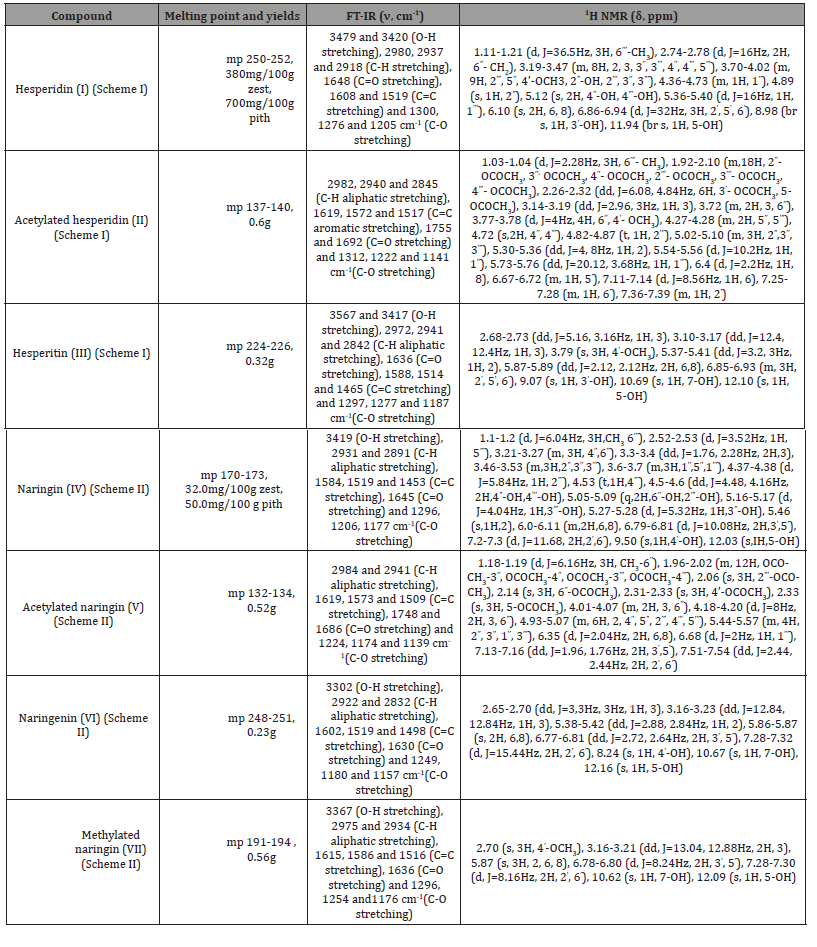
The physical properties and spectral data for the structural characterization of all compounds are presented in Table 4.
DPPH radical scavenging activity
The radical scavenging activity of different extracts was found to be concentration dependent. From different extracts of zest and pith of kinnow peel, maximum scavenging activity was observed for isopropyl alcohol extracts i.e. 67.7 and 61.7%, respectively at 400μg/ml concentration. Hexane extract showed least scavenging activity than all the extracts even at higher concentrations. It showed activity of 20.4% for kinnow zest and 15.1% for kinnow pith at 400μg/ml concentration as shown in Figure.1 and Figure 2. So, decreasing order of antioxidant activity for extracts of zest and pith of kinnow peel was:
BHT > isopropyl alcohol extract > acetone extract > ethyl acetate extract > hexane extract
In case of isolated flavonoids and synthesized compounds, structural features and nature of substitution on rings determined their antioxidant activity. From all the isolated and synthesized compounds, aglycone form of naringin i.e. naringenin (compound VI) showed highest radical scavenging activity of 69.5% at 400μg/ ml concentration followed by aglycone form of hesperdin i.e. hesperitin (compound III) showing activity of 67.3% at 400μg/ ml concentration (Figure 3). All other compounds exhibited lower values than these two compounds where minimum values were observed for acetylated hesperidin i.e. compound II.
It was observed that glycosylation decreased the antioxidant activity whereas hydroxyl groups in ring B and C2-C3 double bond conjugation with a 4-oxo group increased the activity. So, both the aglycone forms i.e. hesperitin and naringenin showed better antioxidant activity as compared to hesperidin and naringin, respectively that contained sugar moieties responsible for reducing antioxidant activities of these compounds. Both the acetylated derivatives showed lesser antioxidant activity than parent compounds because of acetylated groups that replaced the hydroxyl groups and lowered the antioxidant activity. Moreover, methylated naringin showed lower antioxidant activity than naringenin but greater than all other compounds because in its formation, sugar moieties were removed with the replacement of hydrogen of hydroxyl group with methyl group. It was observed that all the extracts and compounds exhibited lower radical scavenging activity than standard BHT. So, overall decreasing order of antioxidant activity for compounds was:
BHT> naringenin > hesperitin > methylated naringin > naringin > hesperidin > acetylated naringin > acetylated hesperidin. IC50 values and antiradical efficiency of zest and pith extracts, isolated and synthesized compounds are shown in Table 5.
Table 5: Scavenging activity of extracts and compounds expressed as IC50 and AE.

IC50 = 50% inhibitory Concentration, AE= Antiradical Efficiency


.png "Click here to view Large Figure 1(Scheme I)")
.png "Click here to view Large Figure 1(Scheme II)")
Antibacterial activity
Different extracts of zest and pith of kinnow peel, isolated compounds, their agylcone forms and derivatives were evaluated for their antibacterial activity by disc diffusion method against Bacillus aryabhattai (KF 853102). From all the extracts prepared, isopropyl alcohol extract of zest showed highest growth inhibition zones at all the concentrations. In case of isopropyl alcohol extract of zest and pith of kinnow peel, the maximum diameters of zones of inhibition against B. aryabhattai were found to be 20.0 and 18.0mm, respectively at 2000μg/disc concentration as shown in Table 6. From isolated and synthesized compounds, the greatest diameter of zone of inhibition was observed for compound VI i.e. 18.0mm at 2000μg/disc concentration Table 7 whereas other compounds showed smaller diameters of zones of inhibition at all the concentrations as compared to compound VI. Moreover, all the extracts and compounds showed smaller diameters of zones of inhibition as compared to standard tetracycline.
Table 1: Glucose and Fructose Content of Some Common Sweeteners.
Table 1: Glucose and Fructose Content of Some Common Sweeteners.
Aglycone forms showed highest inhibitory effects than other tested compounds as these forms lack sugar moieties which were found to be responsible for lowering antibacterial activity. Methylated derivative of naringin showed smaller zones of inhibition as compared to aglycone forms because sugar moieties were removed along with replacement of one hydroxy group with methoxy group leading to the lowering of activity than aglycone forms Acetylated derivatives of both isolated compounds showed lower inhibition zones as compared to hesperidin and naringin because of the acetyl groups which replaced the hydroxyl groups, thus lowering the antibacterial activity of the compounds. Moreover, naringin showed higher zones of inhibition as compared to hesperidin which may be due to additional electron donating -OCH3 group ortho to hydroxyl group present in hesperidin thus lowering its activity.
The results indicated that peel comprising of zest and pith of kinnow possessed significant antioxidant and antibacterial activities as it can be attributed to their high phenolic and flavonoid content. Zest and pith contained valuable flavanone glycosides i.e. hesperidin and naringin which could be converted into their more effective aglycone forms i.e. hesperitin and naringenin, along with their acetylated and methylated derivatives which proved to be potent antioxidant and antibacterial agents. Although the activities of all the extracts, isolated and synthesized compounds were less than that observed for standards, but it was found that natural products being economically beneficial showed safer and promising effects. So, it can be concluded that the byproducts of kinnow i.e. peel comprising of zest and pith can be used as antioxidants and antibacterial agents in pharmaceutical and food industries.
Figure 1:South/Southeast Asian countries (Modified from asiasociety.org).

Table 1: Glucose and Fructose Content of Some Common Sweeteners.
References
- Rahaman MM, Islam KS, Jahan M (2018) Rice Farmers Knowledge of the Risks of Pesticide Use in Bangladesh. J Health Pollut 8(20): 181203.
- Thielecke F, Nugent AP (2018) Contaminants in Grain-A Major Risk for Whole Grain Safety? Nutrients 10(9): 1213.
- Sabir S, Akash MSH, Fiayyaz F, Saleem U, Mehmood MH, et al. (2025) Role of cadmium and arsenic as endocrine disruptors in the metabolism of carbohydrates: Inserting the association into perspectives. Biomed Pharmacother 114: 108802.
- Schafer H (2025) South Asia: A bright spot in darkening economic skies? Wirld Bank Blog (End Poverty in South Asia), South Africa.
- Micha R, Khatibzadeh S, Shi P, Andrews KG, Engell RE, et al. (2015) Global Burden of Diseases Nutrition and Chronic Diseases Expert Group (Nutri CoDE). Global, regional and national consumption of major food groups in 1990 and 2010: a systematic analysis including 266 country-specific nutrition surveys worldwide. BMJ Open 5(9): e008705.
- Brownlee IA, Durukan E, Masset G, Hopkins S, Tee ES (2018) An Overview of Whole Grain Regulations, Recommendations and Research across Southeast Asia. Nutrients 10(6): 752.
- Brar PK, Danyluk MD (2018) Nuts and Grains: Microbiology and Preharvest Contamination Risks. Microbiol Spectr 6(2).
- Thompson LA, Darwish WS (2025) Environmental Chemical Contaminants in Food: Review of a Global Problem. J Toxicol: 2345283.
- Yu T, Sun W (2015) Who Will Feed the Giant? - Chinese Pollution and Grain Crisis. Iran J Public Health 44(10): 1420-1421.
- Tie X, Huang RJ, Dai W, Cao J, Long X, et al. (2016) Effect of heavy haze and aerosol pollution on rice and wheat productions in China. Sci Rep 6:29612.
- Lari SZ, Khan NA, Gandhi KN, Meshram TS, Thacker NP (2014) Comparison of pesticide residues in surface water and ground water of agriculture intensive areas. J Environ Health Sci Eng 12(1): 11.
- Northcoast Horticulture Supply. Pure AG Pest Control Concentrate 8oz.
- Shelef O, Weisberg PJ, Provenza FD (2017) The Value of Native Plants and Local Production in an Era of Global Agriculture. Front Plant Sci 8: 2069.
- Robson MG, DerMarderosian AH (2012) In: Remington: The Science and Practice of Pharmacy. Loyd V Allen Jr (Edt.), 22nd (edn).
- Rahaman MM, Islam KS, Jahan M (2018) Rice Farmers Knowledge of the Risks of Pesticide Use in Bangladesh. J Health Pollut 8(20):181203.
- Food and Agriculture Organization of the UN (FAO). Controlling pests.
- Franklin N Mabe, Kwadwo Talabi, Gideon Danso Abbeam (2017) “Awareness of Health Implications of Agrochemical Use: Effects on Maize Production in Ejura-Sekyedumase Municipality, Ghana,” Advances in Agriculture p: 1-11.
- Roberts JR, Karr CJ (2012) Council on Environmental Health. Pesticide exposure in children. Pediatrics 130(6): e1765-1788.
- (1993) National Research Council (US) Committee on Pesticides in the Diets of Infants and Children. Pesticides in the Diets of Infants and Children. Washington (DC): National Academies Press (US); Estimating Exposures, USA.
- Nicolopoulou Stamati P, Maipas S, Kotampasi C, Stamatis P, Hens L (2016) Chemical Pesticides and Human Health: The Urgent Need for a New Concept in Agriculture. Front Public Health 4: 148.
- (2018) UNISEF-Understanding the Impacts of Pesticides on Children: A discussion paper.
- Centers for Eco genetics & Environmental Health. Fast Facts about Health Risks of Pesticides in Food.
- Li Z, Jennings A (2017) Worldwide Regulations of Standard Values of Pesticides for Human Health Risk Control: A Review. Int J Environ Res Public Health 14(7): E826.
- Waliszewski SM, Carvajal O, Gómez Arroyo S, Amador Muñoz O, Villalobos Pietrini R, et al. (2008) DDT and HCH isomer levels in soils, carrot root and carrot leaf samples. Bull Environ Contam Toxicol 81(4): 343-347.
- Batterman SA, Chernyak SM, Gounden Y, Matooane M, Naidoo RN (2008) Organochlorine pesticides in ambient air in Durban, South Africa. Sci Total Environ 397(1-3): 119-130.
- Mai C, Theobald N, Hühnerfuss H, Lammel G (2016) Persistent organochlorine pesticides and polychlorinated biphenyls in air of the North Sea region and air-sea exchange. Environ Sci Pollut Res Int 23(23): 23648-23661.
- Zhang X, Zhong T, Liu L, Ouyang X (2015) Impact of Soil Heavy Metal Pollution on Food Safety in China. PLoS One 10(8): e0135182.
- Li R, Wu H, Ding J, Fu W, Gan L, et al. (2017) Mercury pollution in vegetables, grains and soils from areas surrounding coal-fired power plants. Sci Rep 7: 46545.
- Retamal Salgado J, Hirzel J, Walter I, Matus I (2017) Bio absorption and Bioaccumulation of Cadmium in the Straw and Grain of Maize (Zea mays L.) in Growing Soils Contaminated with Cadmium in Different Environment. Int J Environ Res Public Health 14(11): E1399.
- Rodríguez J, Mandalunis PM (2018) A Review of Metal Exposure and Its Effects on Bone Health. J Toxicol 4854152.
- Liu Y, Xiao T, Baveye PC, Zhu J, Ning Z, et al. (2015) Potential health risk in areas with high naturally occurring cadmium background in southwestern China. Ecotoxicol Environ Saf 112: 122-131.
- Chang YF, Wen JF, Cai JF, Xiao Ying W, Yang L, et al. (2012) An investigation and pathological analysis of two fatal cases of cadmium poisoning. Forensic Sci Int 220(1-3): e5-8.
- Jaishankar M, Tseten T, Anbalagan N, Mathew BB, Beeregowda KN (2014) Toxicity mechanism and health effects of some heavy metals. Interdiscip Toxicol 7(2): 60-72.
- Jan AT, Azam M, Siddiqui K, Ali A, Choi I, Haq QM (2015) Heavy Metals and Human Health: Mechanistic Insight into Toxicity and Counter Defense System of Antioxidants. Int J Mol Sci 16(12): 29592-29630.
- Hassan FI, Niaz K, Khan F, Maqbool F, Abdollahi M (2017) The relation between rice consumption, arsenic contamination, and prevalence of diabetes in South Asia. EXCLI J 16: 1132-1143.
- Sabir S, Akash MSH, Fiayyaz F, Saleem U, Mehmood MH, et al. (2025) Role of cadmium and arsenic as endocrine disruptors in the metabolism of carbohydrates: Inserting the association into perspectives. Biomed Pharmacother 114: 108802.
- Kumar D, Kalita P (2017) Reducing Postharvest Losses during Storage of Grain Crops to Strengthen Food Security in Developing Countries. Foods 6(1): pii: E8.
- Khaled MS (2018) Food systems at a crossroads in South Asia. The Financial Express, South Africa.
- Sodango TH, Li X, Sha J, Bao Z (2018) Review of the Spatial Distribution, Source and Extent of Heavy Metal Pollution of Soil in China: Impacts and Mitigation Approaches. J Health Pollut 8(17): 53-70.
- Mc Carty KM, Hanh HT, Kim KW (2011) Arsenic geochemistry and human health in South East Asia. Rev Environ Health 26(1): 71-78.
- Pajewska Szmyt M, Sinkiewicz Darol E, Gadzała Kopciuch R (2025) The impact of environmental pollution on the quality of mother's milk. Environ Sci Pollut Res Int 26(8): 7405-7427.
- Rather IA, Koh WY, Paek WK, Lim J (2017) The Sources of Chemical Contaminants in Food and Their Health Implications. Front Pharmacol 8: 830.
- Guo G, Jiang N, Liu F, Bian Y (2018) Storage stability of organophosphorus pesticide residues in peanut and soya bean extracted solutions. R Soc Open Sci 5(7): 180757.
- Bian Y, Liu F, Chen F, Sun P (2018) Storage stability of three organophosphorus pesticides on cucumber samples for analysis. Food Chem 250: 230-235.
- Thapa K, Pant BR (2014) Pesticides in vegetable and food commodities: environment and public health concern. J Nepal Health Res Counc 12(28): 208-210.
- Chekol FA, Melak MF, Belew AK, Zeleke EG (2025) Food handling practice and associated factors among food handlers in public food establishments, Northwest Ethiopia. BMC Res Notes 12(1): 20.
- Tegegne HA, Phyo HWW (2017) Food safety knowledge, attitude and practices of meat handler in abattoir and retail meat shops of Jigjiga Town, Ethiopia. J Prev Med Hyg 58(4): E320-E327.
- Bajwa U, Sandhu KS (2014) Effect of handling and processing on pesticide residues in food- a review. J Food Sci Technol 51(2): 201-220.
- Kaushik G (2015) Effect of processing on mycotoxin content in grains. Crit Rev Food Sci Nutr 55(12): 1672-1683.
- Gray PJ, Conklin SD, Todorov TI, Kasko SM (2016) Cooking rice in excess water reduces both arsenic and enriched vitamins in the cooked grain. Food Addit Contam Part A Chem Anal Control Expo Risk Assess 33(1): 78-85.
-

This work is licensed under a Creative Commons Attribution-NonCommercial 4.0 International License.




