


 Research Article
Exploration and Practice of Civil Engineering Surveying Teaching Based on Multi-Dimensional Assessment System
Received Date:November 19, 2025; Published Date:November 25, 2025
Abstract
This study addresses the gap between traditional civil engineering surveying education and industry requirements by developing and implementing a comprehensive multi-dimensional assessment system. Grounded in Outcome-Based Education (OBE) principles, the reformed curriculum framework integrates modular teaching content, blended learning approaches, and diversified evaluation methods. The assessment system encompasses formative evaluations (including online learning, classroom performance, and experimental operations) and summative assessments (comprehensive practical projects and final examinations), with increased emphasis on process-oriented and practice-based evaluations. Through implementation of flexible scheduling arrangements that effectively integrate theoretical instruction with hands-on training, virtual simulation platforms for equipment operation practice, and project-based learning incorporating real engineering cases, student engagement and practical competency have been significantly enhanced. The multi-dimensional assessment approach provides a more comprehensive and objective evaluation of student learning outcomes across theoretical knowledge, instrumental proficiency, and problem-solving capabilities. Results demonstrate that this reformed teaching model effectively bridges the divide between academic learning and professional practice requirements, offering valuable insights for engineering education reform in similar disciplines.
Keywords:Civil engineering surveying; Multi-dimensional assessment; Outcome-based education; Blended learning; Modular teaching; Engineering education reform
Introduction
Currently, the training objective for engineering management programs is to cultivate technical talents capable of adapting to industry development, mastering practical application abilities, and managing entire project processes in the construction sector. However, in recent years, engineering management graduates frommany universities have been unable to meet the skill requirements of construction enterprise positions, resulting in a disconnect between professional talent cultivation quality and industry demand. The professional teaching system should focus on cultivating students’ engineering practical abilities, transforming teaching models and optimizing teaching content to satisfy professional training objectives.
Civil Engineering Surveying is a fundamental professional course within the engineering technology platform of engineering management programs. The course primarily focuses on teaching content including distance measurement, leveling measurement, angle measurement, construction layout, point positioning, and control surveying. It aims to cultivate and train students to master basic surveying instruments, measurement principles and methods, mapping and construction layout capabilities, while familiarizing them with new technologies, methods, and developments in the engineering surveying field [1]. The various teaching components are both interconnected and independent. Teaching content emphasizes engineering practice and instrument operation, requiring instructional approaches that cannot rely solely on theoretical teaching or pure experimental training [2]. Therefore, exploring an engineering surveying course teaching system that adapts to current developments and applications in the surveying field, as well as enterprise job skill requirements, represents an urgent priority for professional program developers under current circumstances.
Problems
The commonly employed assessment method primarily involves standardized answer examinations. The greatest characteristic of this approach is its foundation on “standards,” converting students’ intelligence and effort levels into grades for differentiation purposes. For students, standardized answer examinations essentially involve copying “standard” knowledge from textbooks or classrooms onto answer sheets - the completer and more precise the replication, the higher the score obtained.
The Civil Engineering Surveying course adopts an assessment method combining regular performance, midterm grades, and final examination scores [3]. Course assessment primarily references learning requirements in the course syllabus, only achieving frequent assessment of important content without satisfying reasonable design for course objective achievement. Processoriented evaluation accounts for insufficient proportion with overly simplified content, lacking practical operation assessment. Assessment content mainly focuses on basic knowledge learned from textbooks, failing to closely integrate theoretical knowledge with engineering practice. Consequently, the current examination method represents “learning without application” - students complete course content but struggle to apply it in practice.
Therefore, consideration must be given to how assessment can better facilitate learning outcome achievement. First, comprehensive instructional design is required to determine which knowledge supports students in achieving which course objectives, and how this knowledge should be assessed - through assignments, classroom quizzes, chapter tests, midterm examinations, or final examinations - all requiring holistic consideration. Second, assessment content and methods require further optimization regarding how assessment can better motivate students to actively participate in course learning, enabling fuller development of student agency. During the teaching process, appropriate approaches should be explored to strengthen students’ primary learning position and enhance effective communication between teachers and students. For this purpose, reform must be conducted throughout the entire course process including instructional design, teaching methods, teaching organization, and teaching evaluation, enabling students to “apply what they learn” and cultivating fundamental problem-solving abilities, thereby establishing a solid foundation for future work or research activities.
Exploration and Practice of Comprehensive Process Assessment Reform
Teaching Reform Framework

Based on OBE (Outcome-Based Education) principles, with the capability requirements of civil engineering industry for application-oriented talents and student development as starting points, the talent cultivation objectives for civil engineering programs are determined, decomposing graduation requirements into course-specific graduation requirement indicators [4,5]. Course objectives for Civil Engineering Surveying are established with output orientation, and a blended online-offline teaching reform framework centered on students is developed. Reforms are implemented in aspects including reconstructing teaching content, integrating teaching resources, informatization teaching methods, comprehensive practical project expansion, and assessment evaluation methods. Course objective achievement is analyzed and feedback provided for continuous course improvement. The details are shown in Figure 1.
Overall Course Assessment Design
Course assessment primarily serves to verify achievement of course learning objectives, thereby supporting graduation requirements for talent cultivation. Therefore, course assessment should first be conducted in conjunction with overall course design. Taking our university’s civil engineering program as an example, combining with talent cultivation needs and course objectives, overall course assessment design is specified as follows:
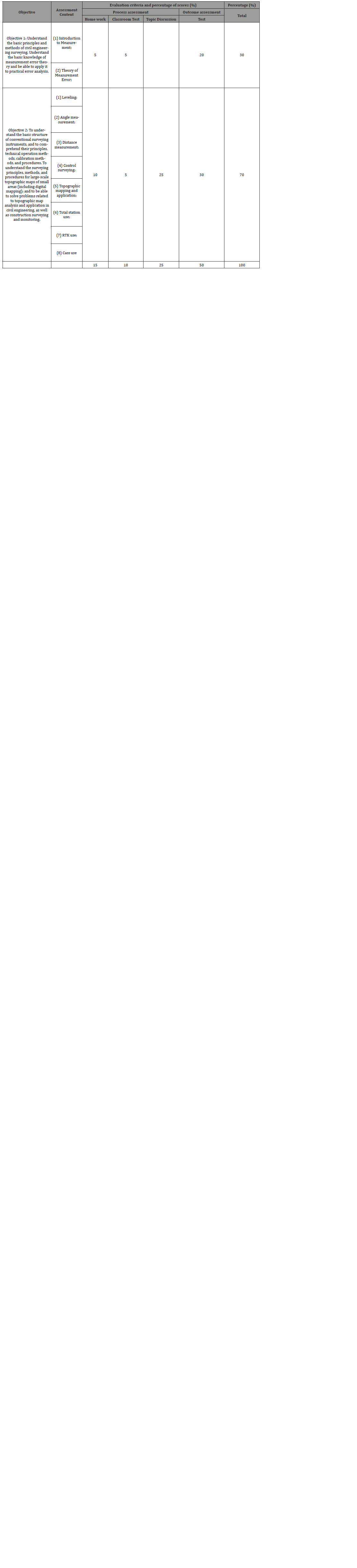
Course Objective 1: Understand basic principles and methods of civil engineering surveying. Understand fundamental knowledge of measurement error theory and apply it to practical error analysis. Corresponding assessment design: Measurement error-related knowledge assessed once in regular assignments plus several other times; topographic map preparation and application abilities assessed during surveying practicum.
Course Objective 2: Recognize basic structure of conventional surveying instruments, understand instrument principles, technical operation methods, inspection and calibration methods and procedures. Understand principles, methods, and procedures for small-area large-scale topographic mapping (including digital mapping); capable of solving topographic map analysis applications and construction surveying and monitoring work in civil engineering. Corresponding assessment design: Basic surveying assessed twice in regular assignments plus several other times; three data collection and processing tasks combined in practical training; topographic mapping and application assessed once in regular assignments (slope line layout scheme design assignment); final assessment of topographic map application (site grading); surveying practicum assessment of practical operation and data processing abilities.
Diversified Assessment Method Reform
The Civil Engineering Surveying course assessment components and corresponding course objectives are presented in Table 1. In regular performance composition, online learning performance includes online video viewing, pre-class preparation, post-class assignments, and online discussions. Classroom performance includes comprehensive evaluation of classroom participation in interactive discussions, enthusiasm in answering questions, and quality of in-class assignment completion. Group presentation grades focus on examining students’ mastery of field survey implementation layout and indoor calculation methods, surveying team unity, cooperation and division of labor abilities, completed through teacher-student mutual evaluation.
Experimental grades transform from previous single operational examination modes of total station centering, leveling, sighting and observation, strengthening comprehensive engineering surveying practical ability assessment. Basic experimental operation examinations are conducted immediately after each experimental class, with corresponding assessment standards formulated based on surveying engineer professional standards and university surveying competition scoring criteria. Experimental operation examinations add virtual simulation training grades, with teachers fully utilizing virtual simulation software to grasp students’ practical training mastery in real-time, dynamically adjusting and implementing improved teaching methods based on surveying assessment platform recorded data. Comprehensive experimental grades add to student on-site defense presentation sessions based on examining students’ comprehensive practical performance and comprehensive experimental report completion quality. Each group member reports individual primary surveying tasks undertaken within the team, with teachers using questioning to examine group members’ understanding of undertaken tasks and mastery of comprehensive surveying projects including topographic mapping and construction layout. Teachers comprehensively provide defense grades based on each student’s defense performance and contribution degree to their group’s practical training [6].
Under OBE principles, a diversified assessment evaluation system is designed based on corresponding course objectives, ensuring scientific and reasonable evaluation of each course objective achievement degree. Through comprehensive, processoriented, multi-level assessment of students, each student’s comprehensive abilities are strengthened and enhanced.
Adjusting Teaching Methods and Approaches to Complement Modular Teaching Content
Adopting a modular teaching system for Civil Engineering Surveying, sub-module teaching content and skill objectives are integrated into teaching tasks, with comprehensive assessment of students’ professional foundational knowledge and skill mastery through sub-module project objective achievement [7]. Actual engineering projects or self-designed project engineering surveying problems are introduced into the course teaching process. Before teaching each module content, students are informed of the teaching objectives, what capabilities must be learned to achieve these objectives, and required practical skills, guiding students to study module content with questions, fully mobilizing students’ enthusiasm, initiative, and autonomy.
Table 1:Course assessment process and objectives.
Compared with students from engineering universities, engineering management students from finance and economics universities relatively lack engineering experience, possess weaker actual engineering perception abilities, and insufficient project practice capabilities. Therefore, in the modular teaching system, flexible and varied teaching approaches must be adopted to complement modular teaching task execution. For example, through animated case simulations of instrument operations, adopting surveying video teaching to understand surveying methods, and perceiving engineering construction layout through actual project cases. According to engineering surveying modular teaching task skill requirements, teachers enrich teaching content through their own engineering experience and actual project surveying processes, making many abstract, complex problems concrete, stimulating students’ learning interest and thirst for knowledge - achievements difficult for traditional PPT teaching methods to accomplish.
Table 2:Teaching Evaluation Based on Closed Traverse Control Survey.

Optimizing Assessment Methods to Make Modular Task Achievement Assessment More Reasonable
Traditional engineering surveying assessment methods essentially belong to typical “examination determines everything” grade evaluation models. In such situations, most students only study for examinations, completely neglecting the essence of learning, disadvantageous for courses with strong practical nature like engineering surveying [8]. To enable students to master engineering surveying skills, combined with the course’s practical and operational characteristics, an assessment approach combining final practicum assessment with modular content process assessment is adopted to examine students’ application abilities for modular teaching content. Through comprehensive, multi-angle evaluation of students’ learning outcomes based on actual project task completion degree, practicum process and report completeness, data analysis and result processing accuracy, actual problem-solving precision, etc.
Modular content process assessment primarily examines students’ mastery of basic surveying theoretical knowledge and instrument operation proficiency, with classroom performance and assignment grades accounting for 40%, and instrument operation and practical grades accounting for 60% [9]. Through comprehensive examination of students’ professional foundational abilities and instrument usage abilities based on measurement method precision, instrument proficiency, and technical scheme completion for single surveying tasks. Final practicum assessment content primarily involves construction surveying for building engineering. Through actual or simulated project construction surveying training, students’ mastery of course content and comprehensive skill qualities are fully demonstrated. Students’ practical application abilities, project task solving abilities, and team comprehensive abilities are assessed based on experimental content, experimental data processing, experimental result analysis, etc.
Flexible Class Hour Arrangements to Effectively Integrate Theoretical and Practical Training
According to unified requirements from the school academic affairs department regarding course teaching hours, theoretical courses generally arrange 2 class hours per session for each class, while experimental courses or open courses can centrally arrange 4 class hours per session. Civil Engineering Surveying is a course combining theoretical knowledge with practical abilities; single theoretical course or experimental course teaching hours struggle to satisfy modular teaching content requirements. To facilitate basic surveying practical task development and appropriately integrate theoretical knowledge with practical training teaching, after completing 2 class hours of theoretical content instruction, 4 class hours of practical training can be adopted, preventing disconnection between theoretical knowledge learning and practical training teaching.
In Civil Engineering Surveying course teaching arrangements, conventional practices are first broken. After application and filing with the college academic affairs department, according to single sub-module teaching content requirements, a combination format of 2 plus 4 class hours is adopted to arrange theoretical teaching content and practical training sessions, forming specific basic surveying module teaching tasks (combining basic surveying theoretical knowledge with surveying instrument practical operations). Through learning stages including problem formation, process discussion, scheme planning, practical operation, and analytical problem-solving, students can well master classroom theoretical knowledge during practical sessions. Through practical instrument operations, experimental task instructor guidance, team cooperation practice, and task work summaries, students can further enhance basic surveying skills, keep pace with teaching progress, and achieve ideal learning outcomes.
Strengthening Course Ideology and Politics for Proper Value Guidance
In Civil Engineering Surveying course teaching, teachers must not only impart basic surveying theory and skills to students but also cultivate students’ innovative consciousness for practical courage and scientifically rigorous research spirit, organically integrating knowledge transmission, ability cultivation, and value formation into classroom teaching. This promotes students firmly establishing ideals, values, and moral concepts, consciously promoting and practicing socialist core values, and fulfilling course ideological and political education functions.
Pre-Class Learning Arrangements
Pre-class: Teachers release course task lists through Chaoxing Learning Platform before class. Students watch closed traverse survey micro-course videos online, complete pre-class preview tests, and participate in online discussions. This section’s online teaching videos are divided into three micro-course videos: closed traverse field observations, coordinate azimuth calculation, and coordinate increment calculation. Each video duration is controlled to 5-10 minutes to accommodate characteristics of fragmented post-class learning. Teachers collect difficulties students encounter during preview through Learning Platform online activity feedback, promptly adjusting and improving teaching content and methods.
Classroom Activity Arrangements
Closed traverse control survey classroom activities are divided into two stages: field measurement and indoor calculation.
(1) Closed traverse field measurement stage: First, each student completes basic tasks including total station setup, data observation, and data output for traverse survey on the virtual simulation teaching platform using knowledge learned during pre-class preview, enabling students to preliminarily master traverse field observation methods. Subsequently, class students proceed to actual sites, freely forming groups of 5-6 people. Teachers assign areas and tasks for control surveying to each group based on the “Wuchang Institute of Technology Smart Campus Construction Geographic Information System Project.” Each group independently designs traverse field measurement schemes and completes point selection, horizontal angle observation, distance observation, etc., enhancing students’ comprehensive traverse field measurement practical abilities. Teachers address problems and difficulties existing in students’ field measurements through explanation and guidance.
(2) Indoor calculation stage: Actual task-driven teaching is adopted, with PBL problem introduction into classroom teaching content. The classroom is divided into several groups for competition, improving students’ enthusiasm and thirst for knowledge regarding course learning. First, teachers pose questions - how to calculate observation errors for groups’ field measurements - thereby introducing concepts of angle closure error and coordinate increment closure error, with students answering questions through group discussions. Second, teachers explain closure error calculation and adjustment methods combined with example problems and assign indoor calculation tasks based on students’ traverse field measurements, with each student independently completing indoor calculation results. Third, groups organize planar traverse field implementation and indoor calculation results, reporting and displaying through smart classroom multi-functional screens. Other students question and discuss reported results, with each group reporting for 8 minutes while teachers provide appropriate guidance and comments during reporting. Finally, teachers and students jointly exchange and discuss, summarizing course error-prone points and difficult point solution methods, including how to correctly select points and measure angles during field measurements to ensure field measurement accuracy, how to avoid confusing signs in angle closure error and coordinate increment closure error calculations during indoor calculations, and how to check coordinate increment correction number calculations.
Post-Class Learning and Evaluation
After classroom activities conclude, “Closed Traverse Control Survey” post-class assignments are released on Chaoxing Learning Platform to further consolidate and strengthen relevant knowledge points. A multi-dimensional evaluation system oriented toward learning output is constructed. This evaluation system increases process-oriented and practical assessment proportions, helping stimulate students’ learning initiative, enabling continuous improvement of teaching methods and content based on evaluation result feedback, effectively improving course teaching quality. The details are shown in Figure 2.
Conclusion
This paper analyzes problems appearing in Civil Engineering Surveying course teaching and proposes a comprehensive process assessment reform scheme for the course. Through establishing support correlation matrices between Civil Engineering Surveying course objectives and graduation requirements, reconstructing teaching content and integrating teaching resources, effective integration between course teaching and industry actual demand for application-oriented talents is ensured. Multi-dimensional course objective achievement evaluation methods are established, promoting continuous course improvement and teaching quality enhancement. Simultaneously, driven by teaching activities including online learning, problem-introduced classroom teaching, result presentations, defenses, experimental testing, and comprehensive practical project expansion, students’ learning initiative is stimulated, effectively enhancing students’ surveying instrument usage abilities. The exploration and practice of Civil Engineering Surveying course assessment evaluation method reform can also provide experiential reference for teaching reforms of other courses..
Acknowledgement
1. Guangdong Province Teaching Quality and Teaching Reform Engineering Project (GDJX2023019);
2. Wuyi University Teaching Quality and Teaching Reform Engineering Project (JX2023010);
3. Wuyi University Teaching Quality and Teaching Reform Engineering Project (KC2023028)
4. Guangdong Provincial Undergraduate Higher Education Teaching Quality and Teaching Reform Project: “Mechanics Curriculum Group Teaching and Research Office” (GDJX2022003)
Conflict of Interest
No conflict of interest.
References
- Li N (2023) Curriculum reform and practice under the background of engineering education professional certification: Taking the engineering surveying course in the building engineering technology professional group as an example. Innovation and Entrepreneurship Theory Research and Practice 6(3): 35-38.
- Guo FB, Liao YP, Huang Y (2022) Integration reform of teaching and examination for "Civil Engineering Surveying" under engineering education certification. Journal of Hubei Open Vocational College 35(19): 128-129, 135.
- Zhang H, Ding HJ, Tang GL (2019) Construction and practice of modular teaching system for civil engineering surveying. Journal of Changchun Normal University 38(6): 172-174.
- Zhang JZ, Xu HL, Song XR, et al. (2023) Reform of parallel teaching mode of engineering surveying theory and practice. Experimental Science and Technology 21(2): 83-87.
- Lin LB, Shen YH, Zhang RJ, et al. (2022) Reform of civil engineering surveying practical teaching oriented by application and innovation. Fujian Building Materials 2: 113-115.
- Sun JP (2023) Teaching design of engineering surveying course based on OBE concept. Heilongjiang Science 14(19): 70-73.
- Meng FJ, Yue SR, Zhang DY (2023) Research and practice of "Engineering Surveying" blended teaching based on Learning Platform. Geomatics and Spatial Geographic Information 46(3): 64-67, 72.
- Sun XW (2022) Engineering surveying practical teaching reform oriented to modern surveying technology. China Housing Facilities 4: 145-147.
- Zhang YF, Ai L (2024) Blended teaching reform practice of civil engineering surveying based on OBE concept. Fujian Building Materials 282(10): 110-114.
-

This work is licensed under a Creative Commons Attribution-NonCommercial 4.0 International License.